


Chalk for Weightlifting: Which Format Grips Best in 2026
If more chalk always meant better grip, why would a heavily coated hand still slide on a bar? The missing detail is the contact surface: how much sweat sits between skin and equipment, what that equipment feels like, and whether the chalk layer helps or gets in the way.
Choosing chalk for weightlifting starts with those conditions, not the whitest palms or the biggest container. A useful purchase also has to fit the gym's rules and the amount of dust the training space can tolerate.
Table of Contents
- Chalk Formats Side by Side for Lifters
- How Magnesium Carbonate Keeps Your Grip Stable
- How Much Chalk Improves Repeated Grip Work
- Gym Rules, Dust and Etiquette
- Applying Liquid Chalk Step by Step
- When Chalk Backfires on Skin and Surfaces
- Choose Your Format and Test It Before Heavy Sets
Chalk Formats Side by Side for Lifters
Chalk for weightlifting is almost always magnesium carbonate, a white mineral used to absorb sweat where the hand contacts the bar. Loose powder, compressed blocks, and liquid chalk deliver that material differently, with practical trade-offs in application, cleanup, and gym acceptance.
Chalk formats compared for weightlifting
| Format | Dust Level | Residue on Bars | Gym Acceptance | Best For |
|---|---|---|---|---|
| Loose powder | High, visible cloud | Visible white film | Often banned | Dry hands in gyms without restrictions |
| Block | Medium, crumbles when rubbed | Chalky marks | Requires explicit permission for dry chalk | Quick touch-ups between sets |
| Liquid | Minimal once dry | Little to none once dry | Allowed in many gyms that ban loose chalk | Sweaty hands, shared or dust-sensitive spaces |
Loose powder offers immediate application without a drying phase. Its open format also makes it easy to take more than the hands need, spreading material onto floors, clothing, bars, and plates. A low purchase price doesn't necessarily mean low consumption if much of the powder ends up outside the gripping area.
Blocks are compressed bricks rubbed across the palms and fingers. They provide direct application, but rubbing and breaking them releases crumbs and powder. As a package-sizing reference, Vulcan Strength's gym-chalk listing describes eight 2-ounce blocks totaling 1 pound.
Compare the handling, not just the container
Liquid chalk suspends magnesium carbonate in a fast-drying carrier. The bottle controls dispensing, while the drying phase requires a little patience before gripping equipment. That makes liquid convenient for shared spaces, but it doesn't automatically make every formula equally effective.
A separate question is whether the lifter needs moisture control or mechanical assistance. NZ Supps' explanation of straps or hooks for strength training helps distinguish those aids from chalk, which doesn't attach the hand to the bar.
Buying rule: Facility permission comes first. Hand sweat and application preference determine the choice among the permitted formats.
How Magnesium Carbonate Keeps Your Grip Stable
A bar held with sweaty hands resembles a wet drinking glass. The fingers may squeeze firmly, yet a thin liquid film can let the surface move before the person intends it to.
Consider a lifter starting a pulling set with comfortable, dry hands. As the set continues, sweat spreads across the palms and finger pads. Moisture collects where the skin presses against the bar, and the bar begins moving within the hand.
The lifter responds by squeezing harder. If the sliding continues, the fingers gradually open even though the back or legs could keep working.
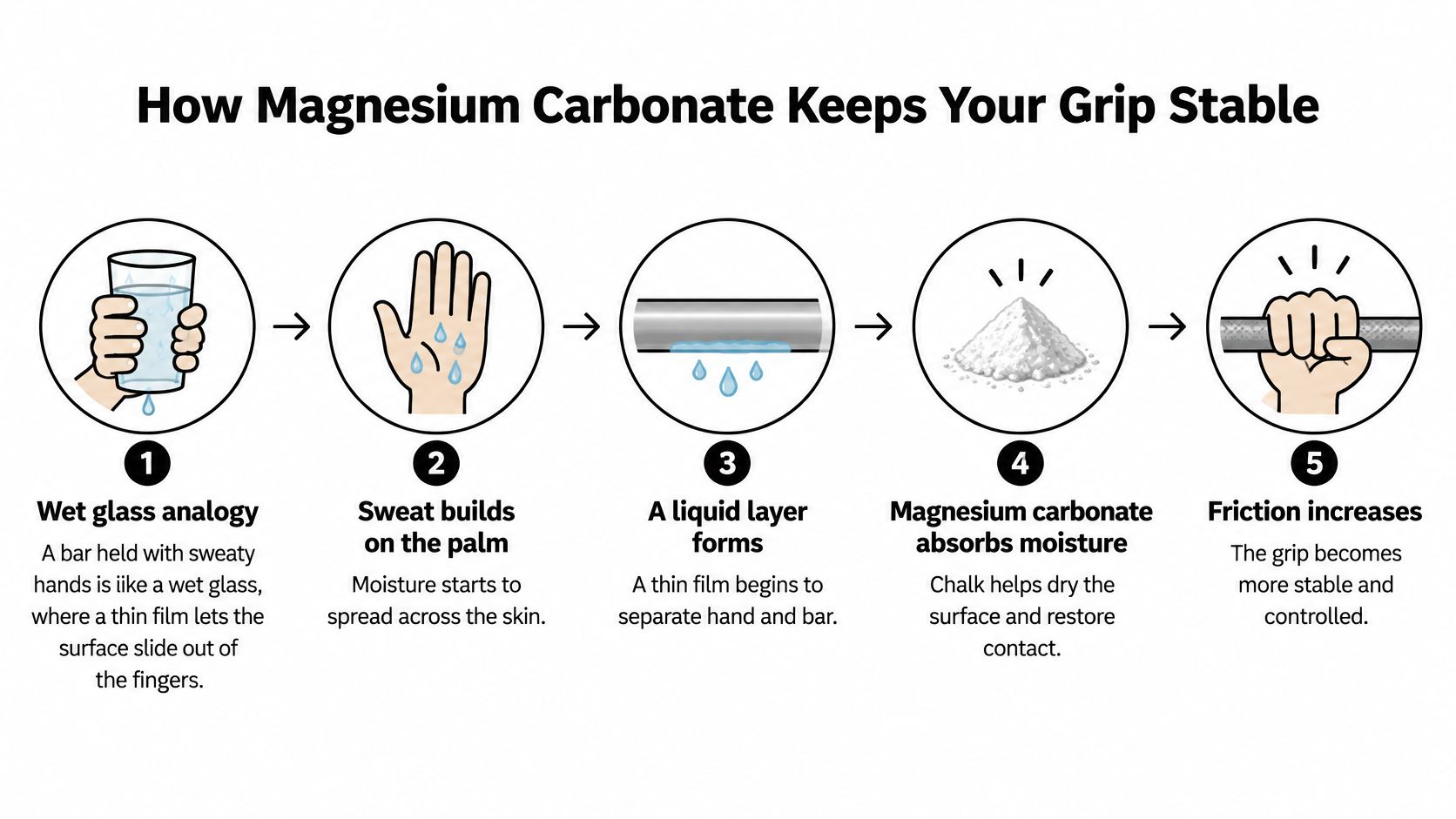
Where chalk interrupts the sequence
Magnesium carbonate absorbs moisture at the contact point, helping the skin maintain a drier interface with the equipment. Rather than letting sweat accumulate unchecked, a suitable layer helps preserve usable contact.
The material is a mineral powder, not an adhesive resin, a distinction explained in Barbell Logic's guide to gym chalk. It conditions the hand-to-bar interface rather than gluing the fingers in place.
That distinction matters during a purchase. A sticky sensation isn't proof that a product has created a better lifting surface, and a thicker coating isn't proof of stronger contact. The useful result is a hand that stays where the lifter places it.
- Moisture management: Chalk addresses sweat at the skin's contact surface.
- Contact management: The condition of both the hand and equipment affects the result.
- Strength limitation: Chalk doesn't add muscle strength or remove fatigue from the fingers.
The explanation of magnesium carbonate in gym chalk provides more context on the material itself. For a lifter choosing a format, the important distinction is between improving contact and increasing the force the hand can produce.
A dry, stable hand may gain little from another application. A damp hand on a suitable surface may benefit because the lifter can use existing holding strength more effectively.
How Much Chalk Improves Repeated Grip Work
The clearest performance evidence concerns repetitions completed before grip failure, not a guaranteed increase in maximal lifting strength. Chalk can help when slipping interrupts a set, but that isn't the same as raising a one-repetition maximum.
In a 2018 peer-reviewed study of repeated grip work, weighted assisted pull-up performance increased from 19.7 to 22.8 average repetitions with an open hand, approximately 15.7%, and from 9.1 to 14.4 with a pinch grip, approximately 58.2%. Both differences were statistically significant.
A separate protocol described in Lyfta's lifting-chalk guide involved male high-school athletes performing clean-grip midthigh pulls at 70% of deadlift one-repetition maximum, averaging 9.1 repetitions without chalk and 11.1 with chalk, a reported improvement of approximately 22.5%.
Reps completed with and without chalk in published trials
| Test | Without Chalk | With Chalk | Change |
|---|---|---|---|
| Weighted assisted pull-ups, open hand, average reps | 19.7 | 22.8 | +15.7% |
| Weighted assisted pull-ups, pinch grip, average reps | 9.1 | 14.4 | +58.2% |
| Clean-grip midthigh pull at 70% deadlift 1RM, male high-school athletes, average reps | 9.1 | 11.1 | +22.5% |
What those results mean beside a lifting platform
The open-hand result is relevant to repeated pulling in which maintaining contact becomes difficult as the set continues. It supports trying chalk when the hands start slipping during pull-ups or extended pulling work.
The pinch-grip result shows that the size of the benefit can change substantially with the gripping task. It doesn't mean a lifter should expect the same improvement in deadlifts, rows, or cleans, because those movements don't reproduce that test.
The midthigh-pull protocol is closer to a barbell setting, but its participants and loading still matter. A finding in male high-school athletes under a controlled protocol isn't a universal prediction for every adult lifter or every workout.
More completed repetitions can reflect fewer repetitions lost to slipping, rather than stronger muscles.
Identify what actually ends the set
A useful comparison starts with the reason the lifter stops. Damp palms, a rotating bar, and fingers opening while the target muscles remain capable suggest that moisture management deserves attention.
By contrast, chalk won't necessarily change a set that ends because the legs or back have reached their limit. It also won't reliably solve holding fatigue when the hands are already dry and stable.
Earlier friction findings weren't positive under every tested condition. Grip type, skin moisture, surface texture, and task demands all affect whether chalk helps.
The guide to weightlifting grip strength helps separate contact problems from holding-capacity problems. The practical expectation is modest and useful: potentially more uninterrupted work during high-volume pulling, not an automatic performance increase across every lift.
Gym Rules, Dust and Etiquette
The facility's written policy determines the permitted format before performance preferences matter. A powder ban isn't automatic permission for a bottle, and rules can distinguish between personal application, apparatus use, and material left on equipment.
PureGym's published gym rules explicitly permit liquid chalk while prohibiting chalk in powder form. That provides a concrete example of why a lifter should ask about the format rather than asking whether chalk is allowed.
Apparatus restrictions can be narrower still. USA Gymnastics' rules prohibit excessive magnesia on the vault table and include location-specific restrictions, so permission to use chalk doesn't mean permission to coat every surface.
Dust concerns extend beyond the floor
A sports-venue air-quality study found chalk-related resuspension associated with indoor PM10 concentrations above 150 micrograms per cubic meter, with chalk-derived carbonate averaging 18% of PM10 mass in the facility. Those are measurements from the studied venue, not a prediction for every weight room.
Visible powder is therefore more than a housekeeping issue. Members with sensitive airways, coaches working long sessions, and cleaning staff all share the same indoor space. Less airborne powder helps with exposure control, but dust-free isn't a medical safety claim.
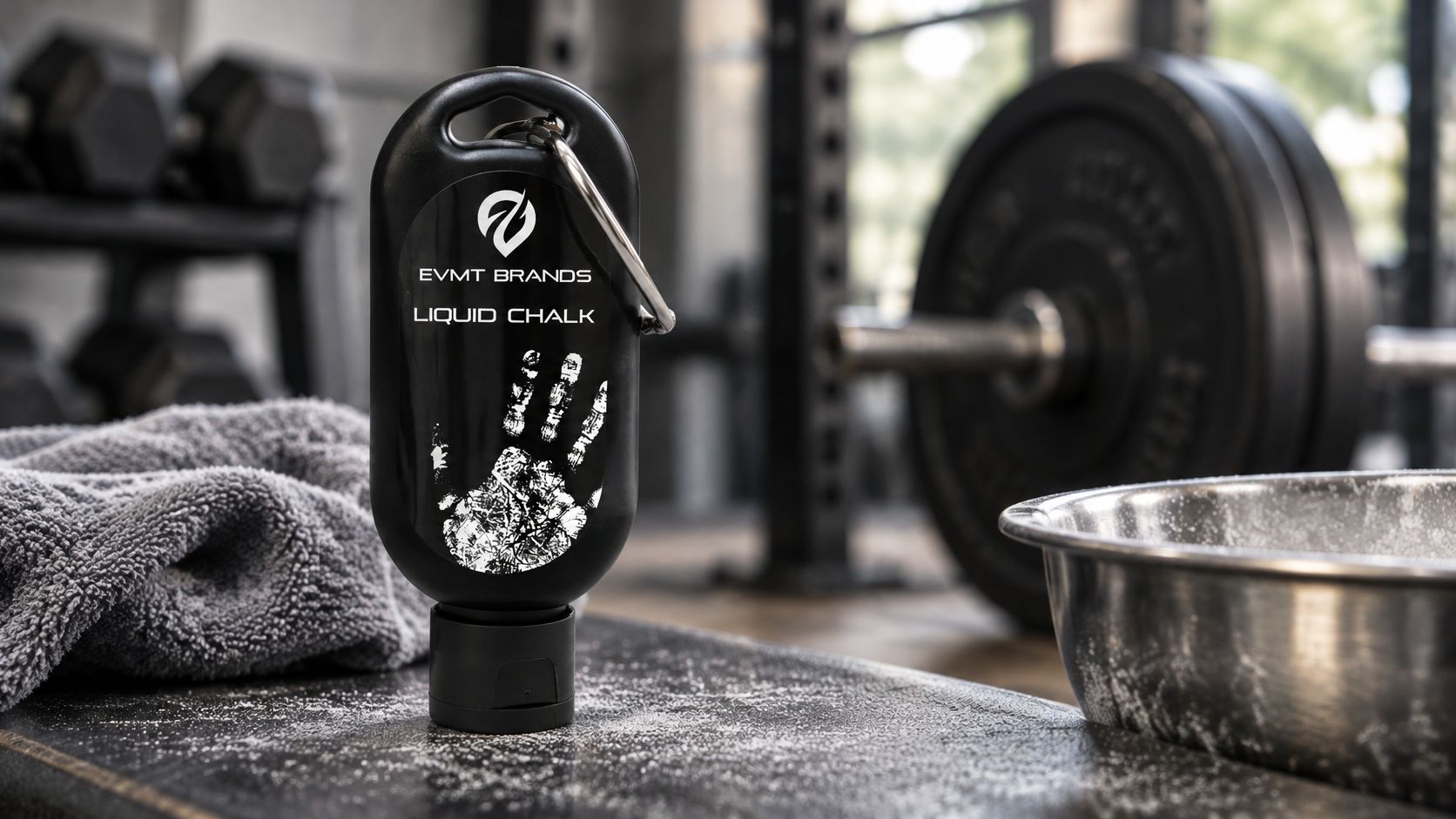
EVMT LIQUID CHALK is a magnesium-carbonate liquid option for weightlifters, CrossFit athletes, and home-gym owners who need moisture control without powder dispersal. It dries in seconds, doesn't create chalk clouds or dust, and doesn't leave white residue on barbells, poles, or apparel once dry.
Many gyms allow liquid while banning loose chalk, but the specific venue or competition policy still applies. Ventilation, sensible application, and regular surface cleaning remain important regardless of format.
Shared-space habits that matter
- Use the approved area: Apply chalk where staff permit it, away from neighboring lifters and open equipment storage.
- Inspect contact surfaces: Wipe shared handles and any transferred material rather than leaving cleanup to the next athlete.
- Keep personal supplies personal: Avoid communal application practices when individual supplies are required.
- Supervise younger athletes: Youth gymnasts, cheer athletes, and dancers should use liquid chalk under adult supervision.
A contained application is useful only when the athlete also respects the room's rules.
Applying Liquid Chalk Step by Step
A successful liquid-chalk application is thin, fully dry, and limited to the areas that grip equipment. The aim isn't to paint the whole hand white.
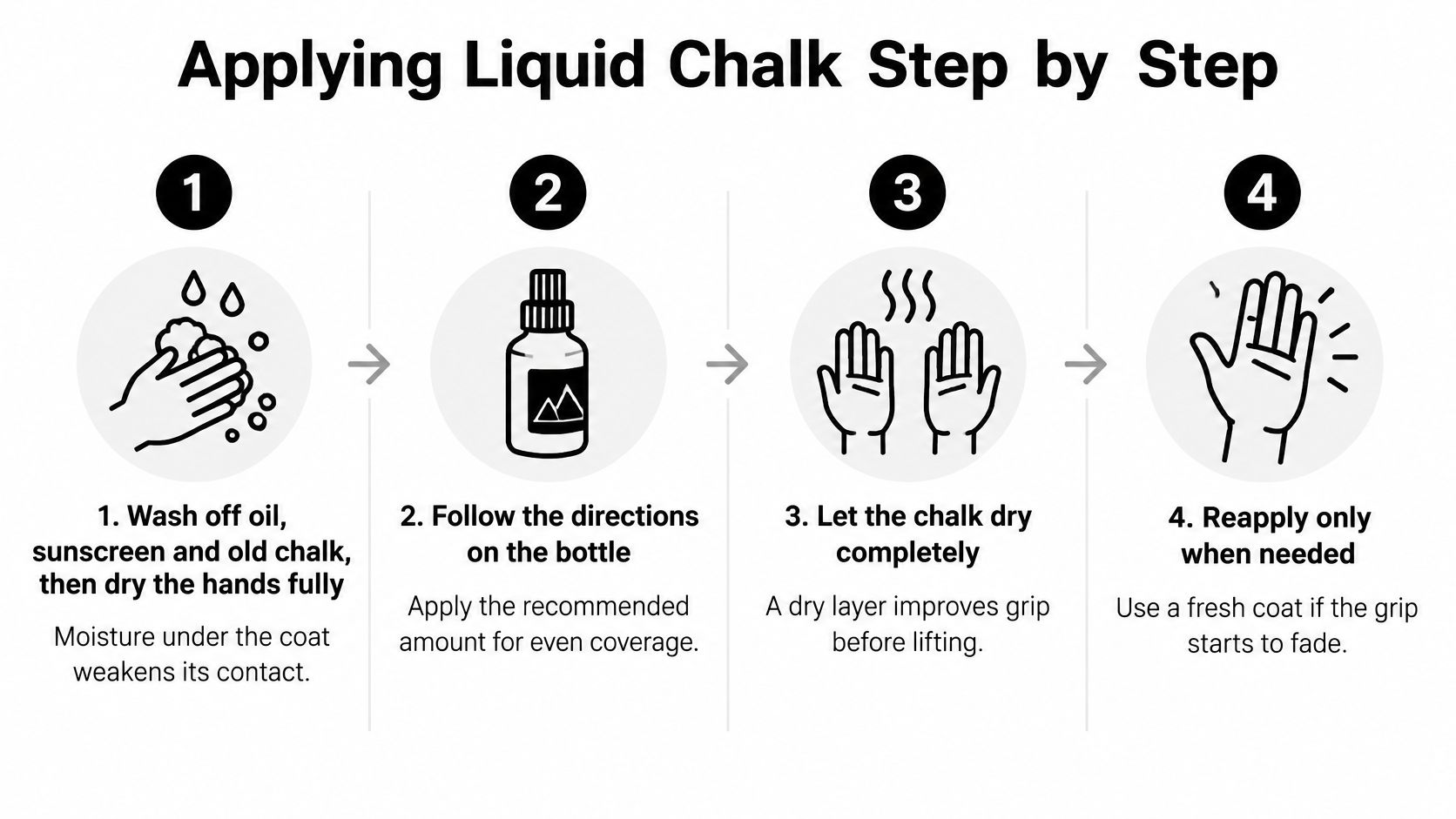
- Clean and dry the hands. Wash off oil, sunscreen, and old chalk, then dry thoroughly. Applying over a wet or greasy surface makes an even, dependable coat harder to achieve.
- Start with a small amount. Follow the bottle's directions and place the product on the palms, fingers, and thumb contact zones. A small starting application is easier to adjust than an overloaded hand.
- Spread a thin, even layer. Rub the product across the gripping surfaces rather than leaving pools in palm creases. Thick pockets take longer to set and can feel tacky.
- Allow complete drying. Fast-drying chalk sets quickly, but appearance and feel matter more than rushing a countdown. Touching equipment while the product remains wet can transfer material instead of establishing a dry contact layer.
- Check contact under light load. Use an empty bar for a gentle grip check before adding substantial weight. The purpose is to detect sliding or an uneven coat, not to prove maximum holding strength.
- Reapply only when needed. Check for dampness or worn contact areas between sets. Automatic application after every set can build unnecessary layers.
- Wash off after training. Soap and water remove the coat from the skin. Dry the hands afterward and avoid scrubbing irritated areas aggressively.
Mistakes that undo a good application
The common problems are too much product, gripping before drying, and coating hands that are still sweaty. When the layer feels uneven, wiping back to a clean surface is often more useful than adding another coat.
Post-session cleanup should focus on what the hands touched. Wipe shared handles and the bar's gripping area with a damp cloth, allow them to dry, and inspect for a white film before another lifter uses them; clean a sleeve only if it was handled. For pole fitness, wipe the actual contact zone rather than spreading moisture over the entire pole.
- Skin check: Stop adding product if the hands feel irritated or uncomfortable.
- Equipment check: Follow the facility's cleaning method for the surface involved.
- Bottle check: Close the cap before returning it to a bag.
Grip products also shouldn't be confused with products intended for muscle discomfort. Athletes comparing those separate needs can explore targeted muscle pain relief through MEDISTIK, while keeping topical products off gripping surfaces and washing hands before chalk application.
When Chalk Backfires on Skin and Surfaces
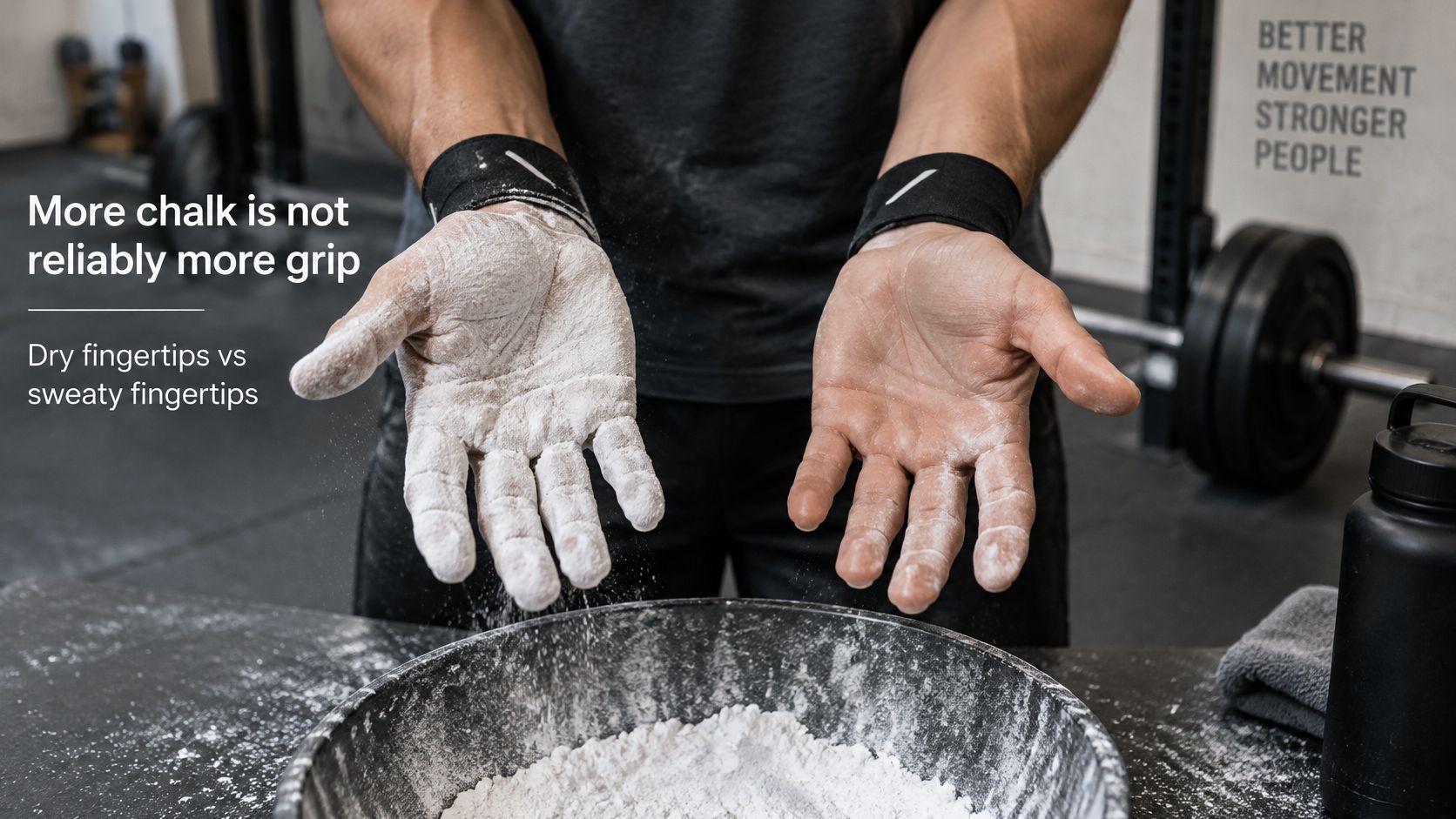
More chalk isn't reliably more grip. An excessive coat can place loose particles between the skin and equipment instead of improving direct contact.
An EVMT discussion of weightlifting-chalk friction findings summarizes a 2024 laboratory study in which chalk generally improved friction more on dry fingertips than on simulated sweaty fingertips, while making friction more consistent across conditions. The same discussion describes finger-to-rock testing in which magnesium carbonate reduced friction under some conditions, potentially because of excessive drying and residue.
Those findings challenge a simple assumption: that chalk works identically on every surface. They don't establish that dry hands on every steel bar receive the largest benefit, because fingertip tests and lifting tasks aren't interchangeable.
Match the adjustment to the problem
| Contact condition | Sensible adjustment |
|---|---|
| Dry hands with secure contact | Avoid adding chalk simply out of habit |
| Heavily sweaty hands | Wipe and dry first, then apply sparingly |
| Unfamiliar knurling or coated handles | Assess contact with a light test set |
| Thick, loose, or patchy buildup | Remove excess before applying a fresh thin coat |
| Tender or cracked skin | Pause application and assess skin condition |
Surface microtexture matters. Bare steel, pronounced knurling, rubber-coated handles, and climbing holds don't present identical contact conditions, so a product that feels effective on one may feel different on another.
A heavily sweating lifter may be tempted to cover visible moisture with more chalk. Drying the hands first provides a cleaner starting point and makes it easier to judge whether the remaining problem is sweat, buildup, or holding fatigue.
The useful amount is the amount that preserves stable contact, not the amount that makes the hands look fully coated.
Protect the skin as well as the grip
If skin becomes dry, cracked, or irritated, reduce application frequency and quantity rather than repeatedly covering the discomfort. Avoid applying over broken skin, and seek medical advice for persistent symptoms.
The instructions for removing liquid chalk can help with routine cleanup. Gentle removal is preferable to aggressive scraping, especially when skin already feels sore.
Choose Your Format and Test It Before Heavy Sets
The best purchase is the chalk that addresses an identifiable contact problem in the place the athlete trains. A permitted, comfortable product that applies predictably is more useful than an ambitious grip claim.
A lifter can narrow the decision with a short checklist:
- Confirm written permission first. Check whether the facility accepts liquid chalk, blocks, loose powder, or no chalk at all. Competition venues may have separate requirements.
- Review recent hand conditions. Note whether slipping starts with visible sweat, after repeated pulls, or only when the fingers become fatigued.
- Identify the surface. Record whether the problem occurs on a knurled bar, a smooth handle, or coated equipment rather than assuming every implement behaves alike.
- Choose a practical quantity. A single bottle suits a personal training bag, while multi-packs can suit regular use or a shared home gym.
- Test before demanding work. Assess application with an empty bar, then continue through normal warm-ups rather than first trying a new product on a heavy attempt.
Choose coverage and size deliberately
For liquid-chalk buyers, an extra-thick weightlifting formulation suits powerlifting, Olympic lifts, and bodybuilding when controlled coverage is the priority. Thickness still calls for careful spreading, not a heavy coat.
Compact 50 ml bottles fit travel and gym bags, while 250 ml bottles suit gym use and higher-volume routines. Classic, Weightlifting, and Rock Climbing formulations serve different application preferences, but a formula name doesn't remove the need to evaluate the actual hand-to-equipment contact.
Athletes who also climb needn't abandon their powder chalk. A liquid base applied to dry hands, allowed to set completely, and followed by powder creates a layered approach described in EVMT's liquid-chalk primer guidance. The aim is longer-lasting coverage and less frequent re-chalking, particularly during extended routes or humid sessions, not a promised duration.
For weightlifting, the final decision remains straightforward: choose the allowed format, assess it during a light session, and add product only when contact needs attention.
Evermost LLC offers liquid chalk in single bottles and multi-packs for athletes managing sweaty hands without loose-powder mess. Visit Evermost LLC to choose a suitable bottle and formulation, then test a thin, fully dried application during warm-ups before heavy lifting.