


Weight Lifting Grip Strength That Holds Under Heavy Pulls
You pull a heavy deadlift from the floor, and the first part feels powerful. Your legs drive, your back stays organized, and the bar rises cleanly. Then your hands start to open. The load hasn't suddenly become heavier, but the bar's contact with your skin has changed, and your strength can no longer reach the steel.
That moment is where weight lifting grip strength becomes its own performance quality. Grip isn't just a matter of having large forearms or squeezing a gripper as hard as possible. It controls friction, thumb engagement, hand position, and the transfer of force between your body and the bar.
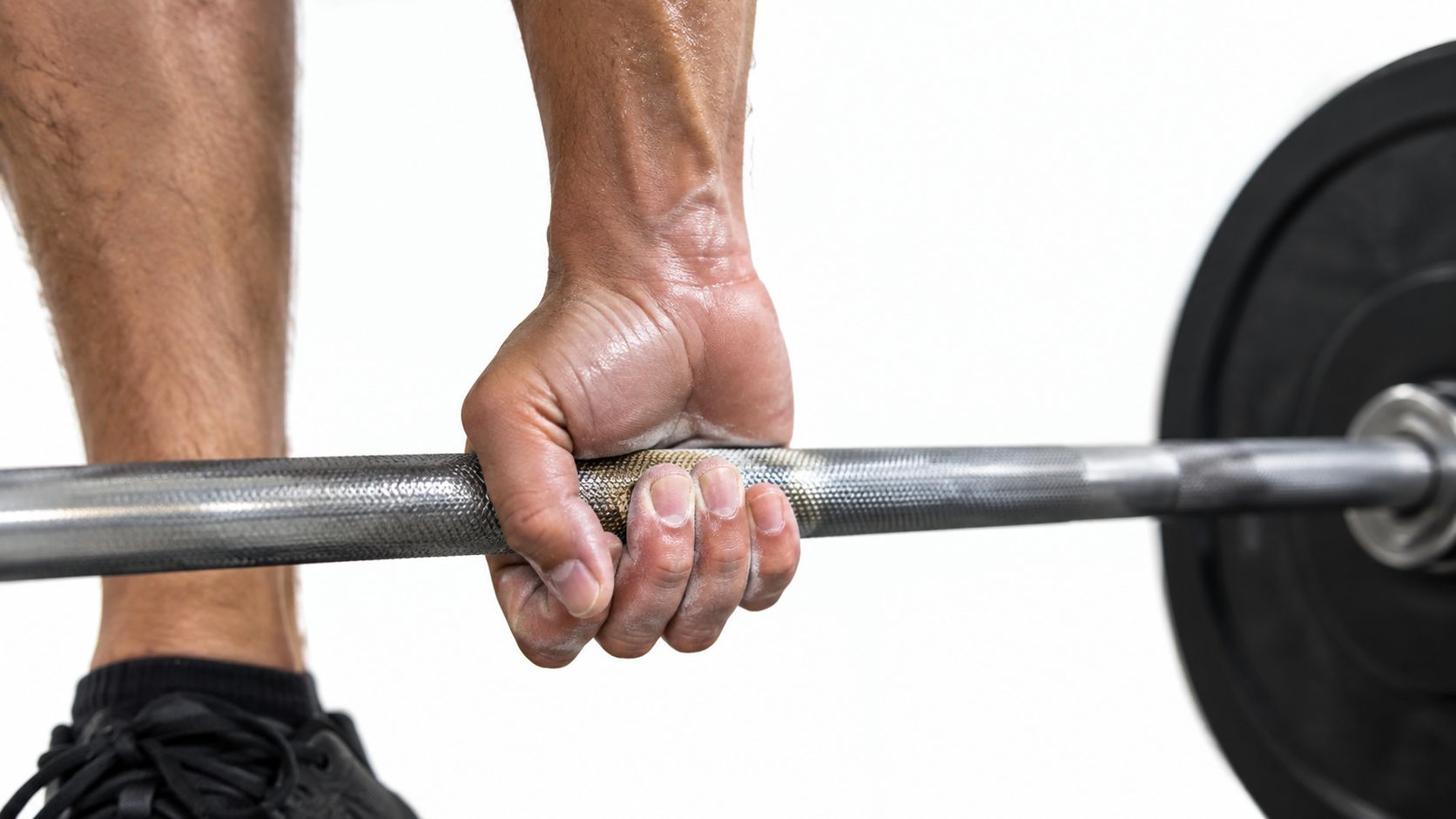
A powerlifter may lose a deadlift because support grip cannot hold the bar at lockout. An Olympic lifter may need a secure hook grip while moving quickly through a clean. A bodybuilder may use straps to keep back training productive after the hands are fatigued. A home gym owner may need a repeatable way to manage sweaty hands without covering the room in chalk dust.
The practical answer starts with identifying the exact grip demand. Then you can test the right quality, train the weak link, and use chalk or straps without confusing immediate performance support with long-term adaptation.
Introduction Why Grip Fails Before Strength Does
The bar usually doesn't slip because your entire body has run out of strength at the same instant. More often, your hand loses its relationship with the bar first. Sweat reduces friction, the fingers extend slightly, the bar rolls, and the forearms must work harder to maintain the same hold.
That small change matters most during heavy pulls and repeated sets. Once the hand begins to open, your nervous system has to protect the grip instead of allowing the hips, lats, and upper back to express their available force. The lift can fail even though the prime movers still have capacity.
Practical rule: Treat grip failure as a contact and force-transfer problem before treating it as a forearm-size problem.
The research on strength-sport athletes supports this more precise view. A study of 34 male weightlifting, powerlifting, and strongman athletes found that handgrip dynamometer, pinch grip, and revolving thick-bar grip results were related but not interchangeable (strength-sport grip assessment study). A lifter can perform well on one test and still struggle with another because each test exposes a different hand position and loading demand.
That explains why generic squeezing sometimes fails to improve a deadlift. A deadlift asks your hand to hold a particular bar diameter under a particular load, often while the bar tries to roll and fatigue accumulates. A pinch block, hand gripper, or thick handle may build useful capacity, but it won't automatically reproduce every feature of a conventional barbell pull.
This guide treats grip as a task-specific skill. You'll see how grip changes across powerlifting, Olympic weightlifting, and bodybuilding, how to choose a useful test, and how to match training to crush, support, pinch, hook, or open-hand demands.
You'll also learn how magnesium carbonate chalk changes friction, where straps fit, and how a competition-standard preparation routine can protect bar speed without pretending that equipment builds the underlying quality by itself.
What Weight Lifting Grip Strength Really Means
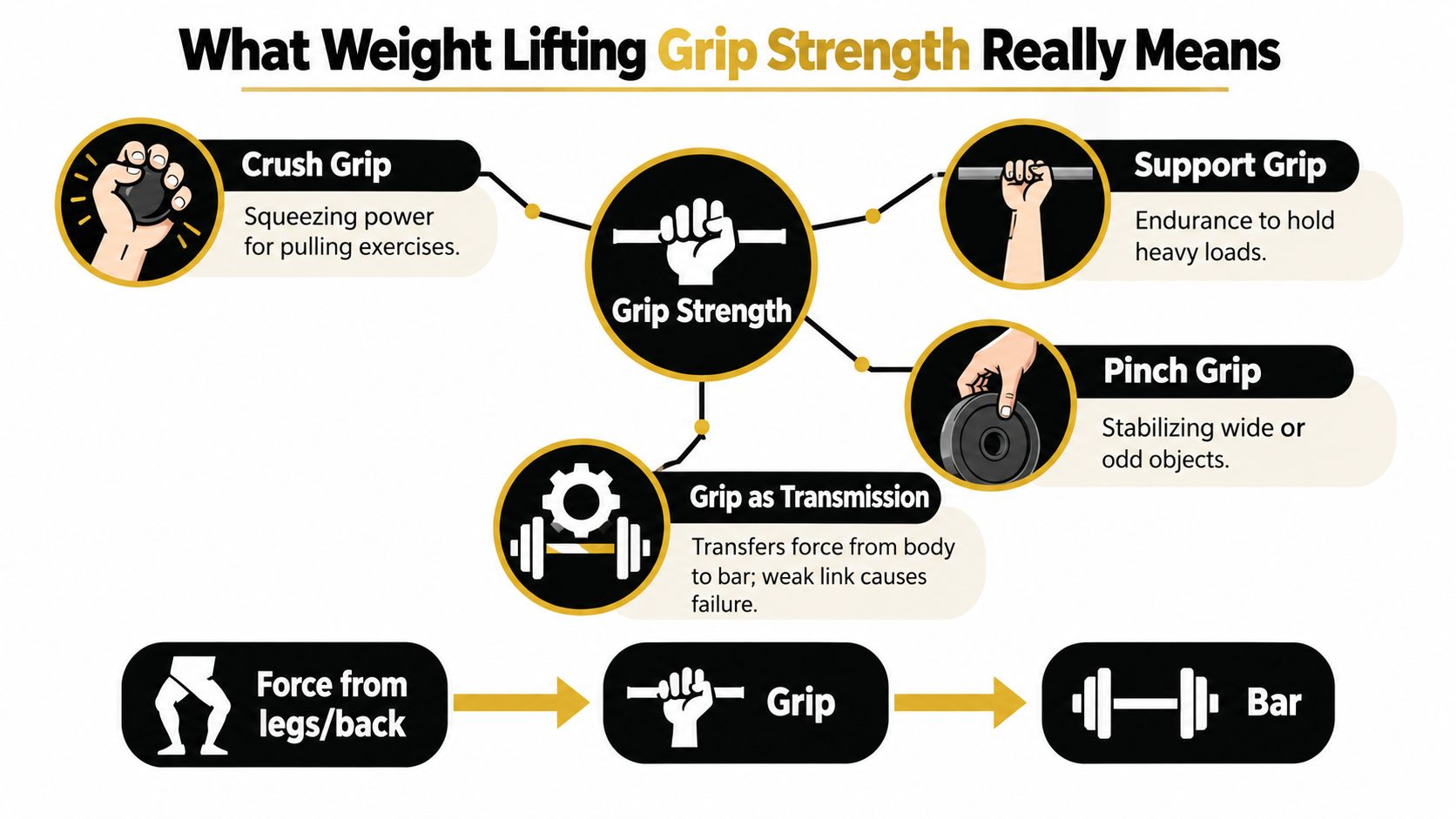
Weight lifting grip strength is your ability to create and maintain useful force through the hand while controlling an implement. That definition includes more than closing the fingers. It also includes the thumb, wrist position, contact area, friction, endurance, and the way the bar tries to move inside the hand.
A useful analogy is a vehicle's transmission. Your legs, hips, back, and shoulders provide the engine. The bar is the wheel receiving that output. Your grip is the transmission between them. If the connection slips, a powerful engine can't move the wheel effectively.
Key concept: Grip strength is not one universal score. It is the hand's ability to transfer force under a specific combination of geometry, friction, thumb use, and fatigue.
Crush grip
Crush grip describes the force used to close the fingers into the palm. It matters when you squeeze a handle, secure a dumbbell, or reinforce a barbell hold. Hand grippers can expose this quality, but a gripper doesn't fully represent the rolling and sustained demands of a deadlift.
Crush strength is useful for making initial contact feel secure. It isn't identical to support strength, which determines how long you can retain a heavy object without allowing the fingers to extend.
Support grip
Support grip is the ability to hold an object for time. Deadlift lockouts, farmer's carries, bar hangs, and repeated pulling sets all place a major emphasis on this quality. The hand may not be closing forcefully in a series of dramatic squeezes. Instead, it must maintain a stable shape while the load pulls downward.
Support grip often fails gradually. The fingers lengthen, the wrist position changes, and the bar begins to migrate toward the fingertips. Training must therefore include holds and loaded carries that resemble the duration and implement used in the target lift.
Pinch and open-hand demands
Pinch grip uses the thumb against the fingers to stabilize an object that can't be fully wrapped. Plate pinches and wide objects expose this demand. Open-hand work increases the challenge further because a thick handle or awkward implement reduces how completely the fingers can close.
A lifter with strong crushing power may still struggle to control a wide or smooth object. The athlete hasn't become generally weak. The hand is being asked to create force through a different shape.
The same principle applies to thumb engagement. A conventional double-overhand deadlift, a mixed grip, and a hook grip don't distribute force through the hand in the same way. Your program should reflect the grip you need to use, not just the grip that produces the most impressive standalone test score.
How Grip Demands Change Across Lifting Disciplines
A powerlifter finishing a deadlift, an Olympic lifter catching a clean, and a bodybuilder completing a pulldown all hold a bar. The friction, hand position, speed, and time under tension make their grip problems different. Forearm size alone does not predict who will keep the bar. Chalk, bar diameter, and grip type can change the result before hand strength changes.
Powerlifting
The deadlift creates a high-load, mostly static support task. The bar must stay connected from the start through the knee and into lockout. The fingers resist the bar's tendency to roll while the legs, hips, and back produce force.
A lifter can have enough posterior-chain strength to complete the pull yet lose the bar near lockout. The useful remedy may be double-overhand holds, timed deadlift lockouts, or thicker-handle work that exposes a retention weakness. These drills train the hand to transfer force into the bar rather than just squeeze harder.
Mixed grip can improve security, but it changes shoulder and hand positions and may create an asymmetrical setup. Hook grip offers another option. Its thumb pressure and discomfort require gradual practice, especially before heavy attempts. The bar diameter also matters. A thicker bar gives the fingers less room to close, so the same lifter may fail sooner without any change in pulling strength.
Olympic weightlifting
The clean and snatch require a faster connection between hand and bar. During an explosive pull, the athlete must keep contact, manage rotation, and move around the bar without letting it drift away.
The hook grip changes how the thumb and fingers lock together. It reduces dependence on pure finger-closing force, while still demanding enough thumb tolerance and hand control to remain stable during fast repetitions. Hook-grip pulls from the knee can reinforce this position while keeping the bar path and speed relevant to the lift.
Olympic lifting also depends on reliable friction. Sweat can change the bar's feel at the moment precise contact matters most. The International Weightlifting Federation's technical and competition rules define chalk as magnesium carbonate and require chalk and rosin to be available near the competition platform (IWF Technical and Competition Rules). Chalk is therefore part of normal competition preparation, not an improvised fix.
Bodybuilding
Bodybuilding often combines moderate or heavy loading with longer sets and repeated pulling. Rows, pulldowns, Romanian deadlifts, shrugs, and high-repetition dumbbell work may fatigue the hands before the target muscle receives the intended stimulus.
Straps can keep the lats or upper back working after grip becomes the limiting factor. Use them when the session is designed to train those muscles. Keep some unsupported work when the goal includes building support capacity. Bar diameter, handle texture, and accumulated fatigue all affect where that limit appears.
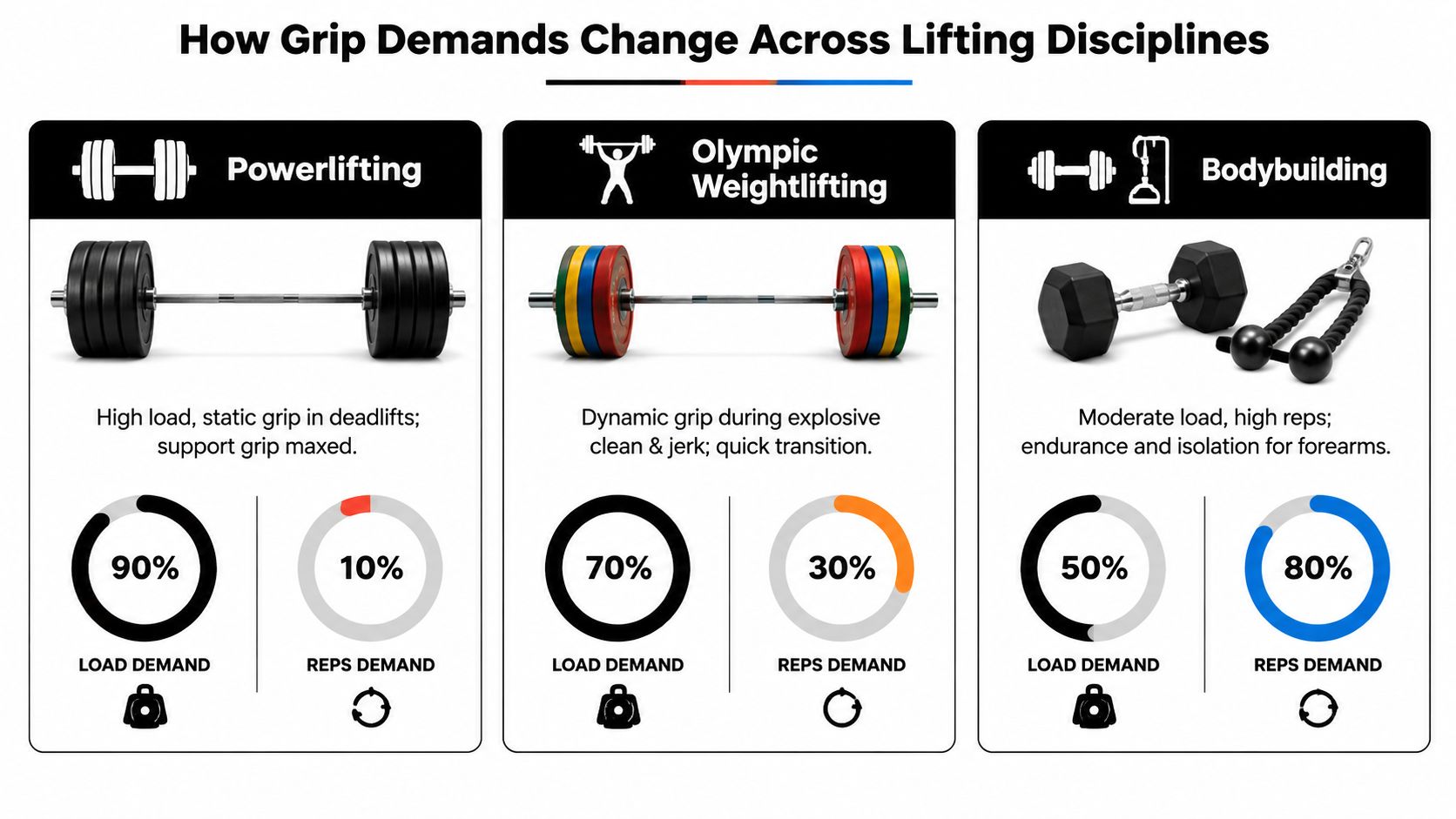
Program the grip task to match the discipline: powerlifters can use double-overhand holds, Olympic lifters can practice hook-grip pulls, and bodybuilders can reserve straps for later back work when grip would otherwise end the set.
How Grip Strength Is Tested and What Scores Actually Tell You
A failed deadlift does not always mean weak hands. The bar may be too smooth, the handle too thick, the thumb unable to keep contact, or fatigue may have reduced friction before the back and hips reached their limit. A useful test recreates the task closely enough to identify which link in that chain failed.
Three common tests
| Test Type | What It Measures | Best Use Case |
|---|---|---|
| Handgrip dynamometer | Short-duration crush force through a standardized handle | Tracking a general squeeze benchmark |
| Pinch grip test | Thumb and finger force against a flat or narrow object | Diagnosing plate, block, or wide-object control |
| Thick-bar hold | Support and open-hand capacity around a larger diameter | Finding a bar-retention weakness |
A dynamometer is practical for repeatable baseline testing. Keep the handle setting, body position, hand, and effort instructions consistent. Record each hand separately, then compare the result with your own earlier tests. A single score cannot account for bar diameter, chalk, grip type, or the length of a working set. For benchmark numbers by body weight and training age, see this guide to grip strength standards.
A pinch test answers a narrower question. It shows whether the thumb can press against the fingers when an object cannot be fully wrapped. That makes it useful for plate-loaded carries, blocks, wide handles, and similar tasks. A low pinch result points to limited thumb-driven control, not automatically poor support on a barbell.
A thick-bar hold changes the hand's shape. As the handle widens, the fingers have less room to close around it, so friction and contact must carry more of the load. This test often reveals why a lifter can squeeze a dynamometer strongly yet lose a large dumbbell or axle-style handle.
Match the score to the lifting decision
Absolute force helps describe how much total load the hand can retain. Relative force can help compare athletes with different body sizes, but neither measure replaces observation of the lift. Compare a deadlift hold time or unsupported working-set performance with your own previous block, rather than ranking it against a heavier training partner's dynamometer score.
Use the test that resembles the failure. A score is a diagnostic tool, not a substitute for lift-specific observation.
For a deadlift problem, film the hand and bar during the failed portion. Note whether the fingers open, the thumb loses pressure, or the bar rolls as fatigue rises. Pair that observation with a support or thick-bar test. Use a dynamometer for a general baseline and a pinch test for wide-object control. The useful benchmark is the one that changes the next programming decision.
Evidence Based Ways to Build Stronger More Reliable Grip
A deadlift can fail because the hand cannot keep the bar in place, even when the back and legs still have force available. Match the implement and hand position to that failure. Endless squeezing may add fatigue without teaching the hand to transfer force through the bar used in training.
Start with implement choice
Thick-bar work increases the distance between the fingers and palm. The hand closes less completely, so contact and friction must preserve the hold through a less secure shape. A thesis on thick-bar resistance training reported improvements in grip strength and upper-body functional strength, with the experimental group gaining more than twice as much dominant-hand grip strength as the control group, along with significant nondominant-hand improvements (thick-bar resistance training thesis).
Use a thick handle for controlled accessories rather than automatically changing every heavy competition lift. Farmer's carries, rows, holds, and dumbbell work can expose open-hand demands while allowing the main lift's technique to remain stable. Bar diameter changes the friction problem, so forearm size alone does not predict performance.
Match the drill to the grip
- Crush work: Use a gripper or controlled handle squeeze when the hand lacks closing force.
- Support work: Choose dead hangs, farmer's carries, or timed barbell holds when the fingers open during sustained loading.
- Pinch work: Use plate pinches or a pinch block when thumb contact fails on flat or wide objects.
- Hook-grip practice: Add the position to lighter Olympic-lifting warm-ups and pulls so the thumb learns the technique before maximal attempts.
Keep the work specific and modest enough to protect the main lifts. A lifter who performs exhaustive holds before deadlifts may rehearse fatigue rather than build usable capacity. Place demanding grip work after primary lifts, or use a separate day when heavy pulling requires fresh hands.
Progress tension without chasing exhaustion
For support grip, add load, extend the hold, or choose an implement that is harder to retain. Change one variable at a time. For pinch grip, improve hold quality before adding load. For thick-bar work, treat diameter as a real progression because it changes hand closure and friction, not merely the appearance of the exercise.
Training frequency should reflect the grip demands already present in deadlifts, cleans, rows, carries, climbing, and other pulling work. Start with a manageable dose, watch whether hand fatigue reduces performance, then adjust the next session. The useful prescription is the one that improves force transfer without weakening the lifts it is meant to support.
Gym owners should also connect equipment choices to member education. They can optimize acquisition hooks in onboarding content so new members understand why thick-bar and pinch tools belong in the program, rather than treating them as random accessories.
A short demonstration can help athletes see the difference between squeezing harder and positioning the hand better:
Managing Grip in Training and Competition With Chalk Straps and Smart Programming
Chalk, straps, and grip training solve different problems. Chalk improves the hand's contact with the bar. Straps reduce the need for the hands to retain the bar during selected exercises. Grip training develops the hand's capacity. Treating these tools as interchangeable creates poor programming decisions.
Chalk manages friction
Magnesium carbonate chalk can reduce slippage and help preserve force output during repeated grip-demanding tasks. In recreational climbers performing weight-assisted pull-ups, chalk increased open-handed repetitions from 19.7 ± 4.39 to 22.8 ± 4.53, and pinch-grip repetitions from 9.1 ± 4.83 to 14.4 ± 4.47 (chalk and repeated grip-demanding tasks). In a clean-grip mid-thigh pull study, chalk increased repetitions at 70% deadlift 1RM from 9.1 ± 3.1 to 11.1 ± 5.1, a 22.5% improvement, supporting its use when friction limits repeated pulling work.
For commercial gyms and home spaces where loose powder creates cleanup problems, Evermost LLC's EVMT Liquid Chalk is one liquid option. It dries quickly, absorbs moisture, and is positioned as a dust-reducing grip aid for lifting and other grip-intensive sessions. Apply it before the hands become heavily sweaty, allow it to dry, and reapply only when the contact surface needs it.
You can find a lift-focused explanation of application and use in this guide to liquid chalk for weightlifting.
Straps manage overload
Straps can help a lifter keep training a target movement when grip fatigue would otherwise end the set. They make sense for selected rows, shrugs, or high-volume pulls when the back is the priority. They don't replace direct grip work on deadlift attempts, carries, or other lifts where the competition grip matters.
A 2026 review found that straps can increase maximal strength and perceived grip, while effects on pulling and back exercises were inconsistent. The review also found no apparent increase in muscle recruitment and no scientific evidence yet for chronic training benefits from regular strap use (2026 review of lifting straps). The sensible interpretation is limited and strategic use, not permanent dependence and not blanket avoidance.
A practical week might keep primary competition lifts strap-free when grip is part of the event, use chalk to control moisture, and reserve straps for accessory volume after the specific grip demand has been addressed. That sequence protects training quality without pretending that straps strengthen the hands just because they allow heavier work.
Putting Grip Strength to Work for Heavier Cleaner Lifts
A reliable grip plan starts with the failure you can observe. During a deadlift, fingers may open, the bar may roll, the thumb may lose position, or sweat may reduce friction. Each problem points to a different training choice.
Match the test to the task. A support hold examines sustained retention, a pinch test challenges thumb control, and a dynamometer provides a general crush-strength benchmark. These measures help locate a weakness, but a higher dynamometer score does not guarantee better performance on every barbell lift.
Then change the variable that limits the lift. Chalk improves the hand-to-bar contact surface. A thicker implement increases open-hand demand. Hook-grip practice prepares the thumb and hand position used in Olympic lifting. Straps let the target muscles continue working after grip-specific work is finished, while keeping competition-relevant attempts dependent on the required grip.
Track one meaningful metric through the training block and keep its setup consistent. For deadlift-focused programming, use these deadlift grip-strength recommendations, then add one suitable drill rather than stacking every grip exercise into the week.
A simple next-session process works well: observe the failure, prepare the contact surface, perform the main work with the required grip, then add one hold, pinch, or thick-handle exercise. Re-test the chosen metric every 4 to 6 weeks and adjust one training variable at a time.
Evermost LLC offers liquid chalk for athletes and gyms seeking fast-drying, sweat-resistant hand contact without loose powder. Visit Evermost LLC to review grip solutions for deadlifts, Olympic lifting, bodybuilding, climbing, and other high-demand training.