


Rock Climbing Chalk Ball: When It Wins Over Liquid Chalk
The usual advice is to buy a chalk ball for less dust. That confuses spill control with airborne exposure. A rock climbing chalk ball keeps powder contained and makes application easier to control, but it isn't a dust-free grip aid.
The better choice starts with the problem: sweaty fingertips, powder scattered across mats, a venue's chalk restriction, or repeated re-chalking on a long route. A ball can solve the housekeeping problem. Liquid chalk can provide a clean starting layer, with familiar powder added afterward wherever the venue permits it.
Table of Contents
- What a Chalk Ball Is and How It Holds Chalk
- Chalk Ball, Loose, Block and Liquid Chalk Compared
- How to Use a Chalk Ball, Step by Step
- When Chalk Helps Grip and When It Backfires
- Where a Chalk Ball Fits
- Gym Chalk Rules and Competition Use
- Liquid Chalk as a Base Layer Under Powder
- Choose Your Chalk Format for Your Next Session
What a Chalk Ball Is and How It Holds Chalk
A rock climbing chalk ball is a porous fabric container filled with powdered magnesium carbonate. Its mesh or cloth shell holds the powder while allowing a small amount to pass onto the hands.
Think of a tea infuser: it holds the leaves and releases a measured amount instead of pouring out the whole tin. The porous fabric limits how quickly particles escape, so a climber squeezes or taps the ball to replenish the fingertip layer rather than plunging a hand into loose powder.
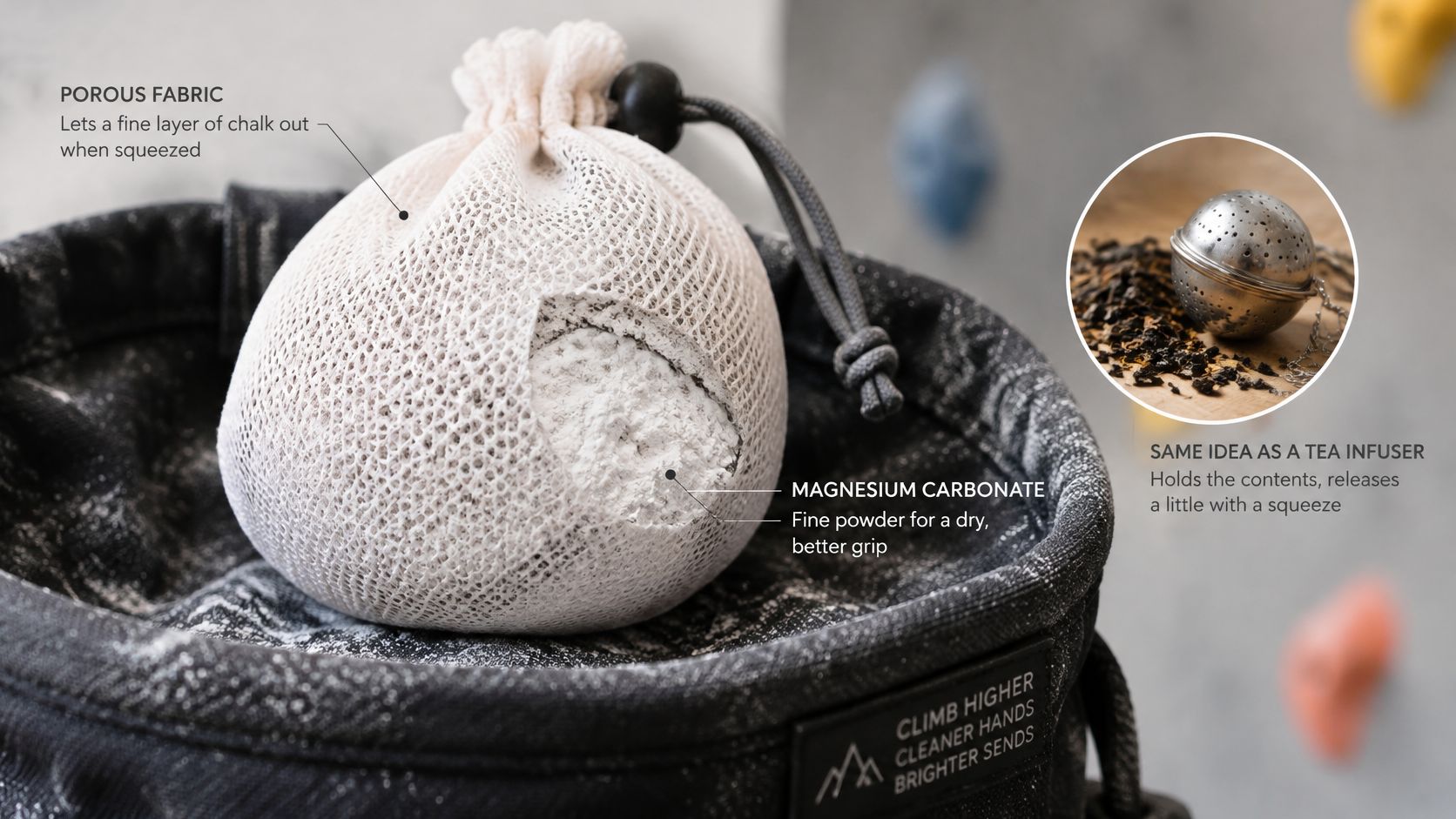
What the shell changes
Magnesium carbonate entered climbing in 1954, when John Gill introduced gymnastics chalk at Stone Mountain, Georgia, according to Climbing's account of climbing chalk. The same account describes a 2012 airborne-particle study in which chalk balls didn't significantly reduce airborne concentrations compared with regular block chalk.
The clearest advantage is containment. When a container tips over, loose powder can pour out; a closed fabric ball keeps its contents together. That makes a ball useful around shared mats and busy indoor climbing areas without making it an air-quality intervention.
Practical rule: Contained powder is still powder. A fabric shell controls dispensing, not everything that happens after chalk reaches the hands.
Before buying, a climber should check:
- Shell construction: Identify whether the ball uses mesh or cloth and whether its closure stays secure during squeezing.
- Contents: Confirm that the fill is powdered magnesium carbonate only, rather than assuming every grip product contains the same ingredients.
Chalk Ball, Loose, Block and Liquid Chalk Compared
A rock climbing chalk ball cuts spills, but it doesn't reliably cut airborne dust compared with loose or block chalk. The distinction matters when a gym's concern is shared air rather than powder on the floor.
The Climbing Wall Association's dust-mitigation review distinguishes spill prevention from airborne-particle control and reports that ethanol-based liquid chalk produced particle concentrations comparable to a complete chalk ban in the cited study. That finding isn't a direct measurement of any particular liquid-chalk brand.
Chalk formats compared on dust, spills and gym acceptance
| Format | Airborne dust | Spill control | Gym acceptance | Best use |
|---|---|---|---|---|
| Loose powder chalk | Readily dispersed during handling and movement | Weak when an open container tips | Often restricted | Outdoor climbing and competition where permitted |
| Block chalk | Crumbles; airborne concentrations can resemble those from a chalk ball | Moderate while intact | The written policy determines acceptance | Shared chalk stations where permitted |
| Rock climbing chalk ball | Not significantly lower than block chalk in the cited comparison | Strong because the shell contains powder | Often permitted under ball-specific rules | Indoor sessions prioritizing spill control |
| Liquid chalk | No powder cloud during application; the cited ethanol-based formulation performed similarly to a chalk ban | Applied directly to skin; the bottle still needs closing | Accepted in many gyms that ban loose chalk | Powder-restricted gyms and a starting layer for longer routes |
Choose by the actual constraint
For someone who prefers the feel and dosing freedom of powder, a closer look at loose climbing chalk helps separate that preference from a venue requirement. A ball changes delivery, not the material touching the skin.
The practical decision order is venue rule first, spill control second, airborne exposure third. Where respiratory sensitivity is a concern, a cleaner floor shouldn't be treated as proof of cleaner breathing air, and no chalk format substitutes for the facility's ventilation and dust-management measures.
How to Use a Chalk Ball, Step by Step
A chalk ball works best as a dosing tool, not something to squeeze continuously between attempts. The target is a light, even coating that addresses surface moisture without leaving loose grains between skin and hold.
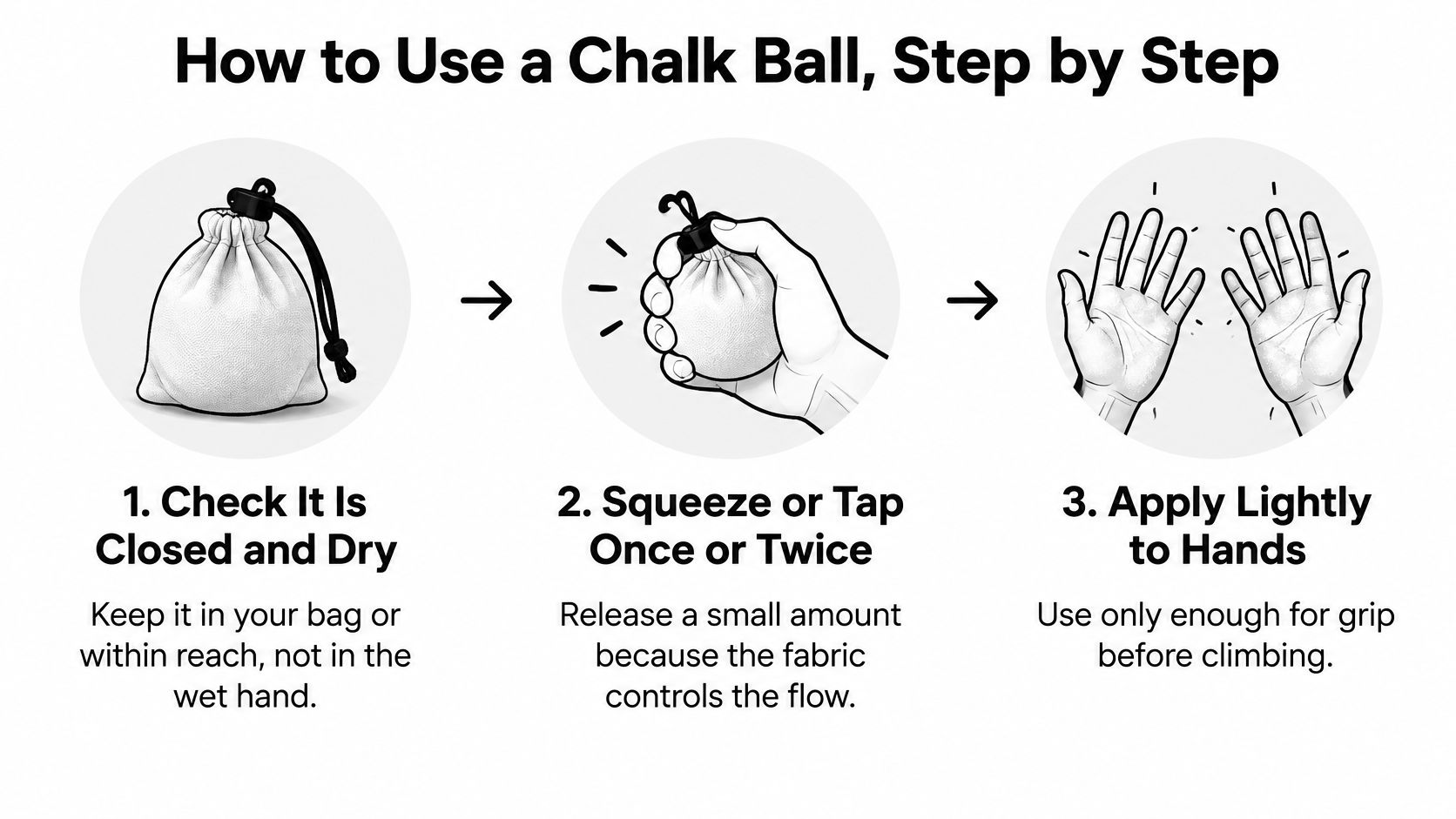
- Check the closure and dryness. The ball should be closed, dry and stored within reach rather than held in a wet palm. A loose closure can defeat the containment benefit before climbing begins.
- Squeeze or tap gently. A brief squeeze or a couple of light taps should release enough powder to assess coverage. Heavy squeezing is the common mistake, since it pushes out chalk faster than the hands need it.
- Spread a thin film. Rub the fingertips and palms lightly, concentrating on the skin that contacts holds. A dense white coating isn't the target; loose powder can form a granular interface rather than useful contact.
- Allow the coating to settle. Pause briefly while surface moisture is absorbed, then inspect the fingertips. Immediately grabbing a hold with visibly loose powder transfers the excess instead of improving the application.
- Reapply deliberately. Before a demanding move, another brief squeeze may be enough if sweat has returned. Repeating the whole application automatically can build a layer without solving a moisture problem.
- Remove excess before pulling on. Wipe loose chalk from fingertips and brush permitted holds with an appropriate climbing brush. Scrubbing aggressively or brushing vegetation beside the hold creates a different problem, especially outdoors.
- Secure and clean up. Keep a refillable ball's closure fastened between attempts and wash hands with soap and water at session end. Any chalk transferred to shared bars, poles or other equipment should be removed before leaving.
Judge the finish, not the whiteness
Laboratory work archived by the University of Leeds research repository found that chalk's friction response changed with fingertip moisture and surface roughness. That supports adjusting the dose to conditions rather than chasing a uniform white appearance.
A useful coating feels settled and controlled, not loose and grainy. Chalk isn't a tackifier, so sticky fingertips aren't the standard for success.
Good application leaves no shedding powder on the hands and only a light dusting on the hold. If another squeeze doesn't improve contact, the next action should be inspection and cleanup, not more chalk.
When Chalk Helps Grip and When It Backfires
More chalk doesn't always mean more grip. Chalk can improve usable contact when sweat is the limiting factor without increasing measured friction in every test.
Ecoportal's coverage of climbing-chalk testing describes 19 experienced recreational climbers hanging approximately 14 seconds longer with gymnastic chalk, while measured friction between fingers and plastic holds didn't change measurably. That isn't evidence that every chalked hold becomes more frictional, and it shouldn't be counted as a separate benefit from the underlying hang-time result.
The Northern Arizona University publication record on magnesium-carbonate chalk also summarizes recreational-climber testing in which 100% magnesium carbonate increased repetitions during open-handed and pinch-grip weight-assisted pull-ups, with p = 0.006 and p = 0.007, respectively. Those results support chalk for repeated gripping, not unlimited application.
Diagnose the slip before adding powder
On rock, drying can make skin less pliable. Excess particles can also create a grainy layer between the fingertips and the surface, so a climber may feel less secure despite having visibly chalked hands.
Chalk symptoms, causes and fixes
| Symptom | Likely cause | Fix |
|---|---|---|
| Fingers slip on smooth plastic despite chalk | A thick, grainy layer lets particles move between skin and hold | Brush off excess, then apply a thin film and let it settle |
| Grip feels slick after several attempts | Chalk has accumulated on holds and fingertips | Brush the hold and wipe fingers before the next attempt |
| Skin feels dry and pulls on holds | Over-dry skin has lost pliability, and heavy chalk adds no useful drying | Apply less, skip unnecessary applications and allow skin to recover |
| Chalk gives less grip on a damp hold | Moisture on skin or the hold limits useful contact | Dry fingertips and the hold where appropriate, then apply a light film |
Textured rock, smooth plastic and slopers don't present the same contact surface. On a sloper, adding powder won't compensate for a polished, damp or heavily coated contact patch; the climber needs to assess the surface rather than assume the ball is empty.
Damp conditions also need a distinction between sweaty skin and wet rock. Chalk can address hand moisture, but it doesn't make unsuitable outdoor conditions safe or override local guidance about climbing on wet rock.
The decision test is simple: if fingertips are slipping because they're wet, a small application may help. If the skin is already dry or the contact layer feels grainy, less chalk is the better experiment.
Where a Chalk Ball Fits
A shared indoor gym is the clearest setting for a chalk ball's containment benefit. Climbers can use familiar powdered chalk without leaving an open supply ready to scatter across the mats.
That doesn't settle the air-quality question. Climber movement and traffic can keep deposited dust circulating, and a gym may restrict powder formats even when another facility permits them.
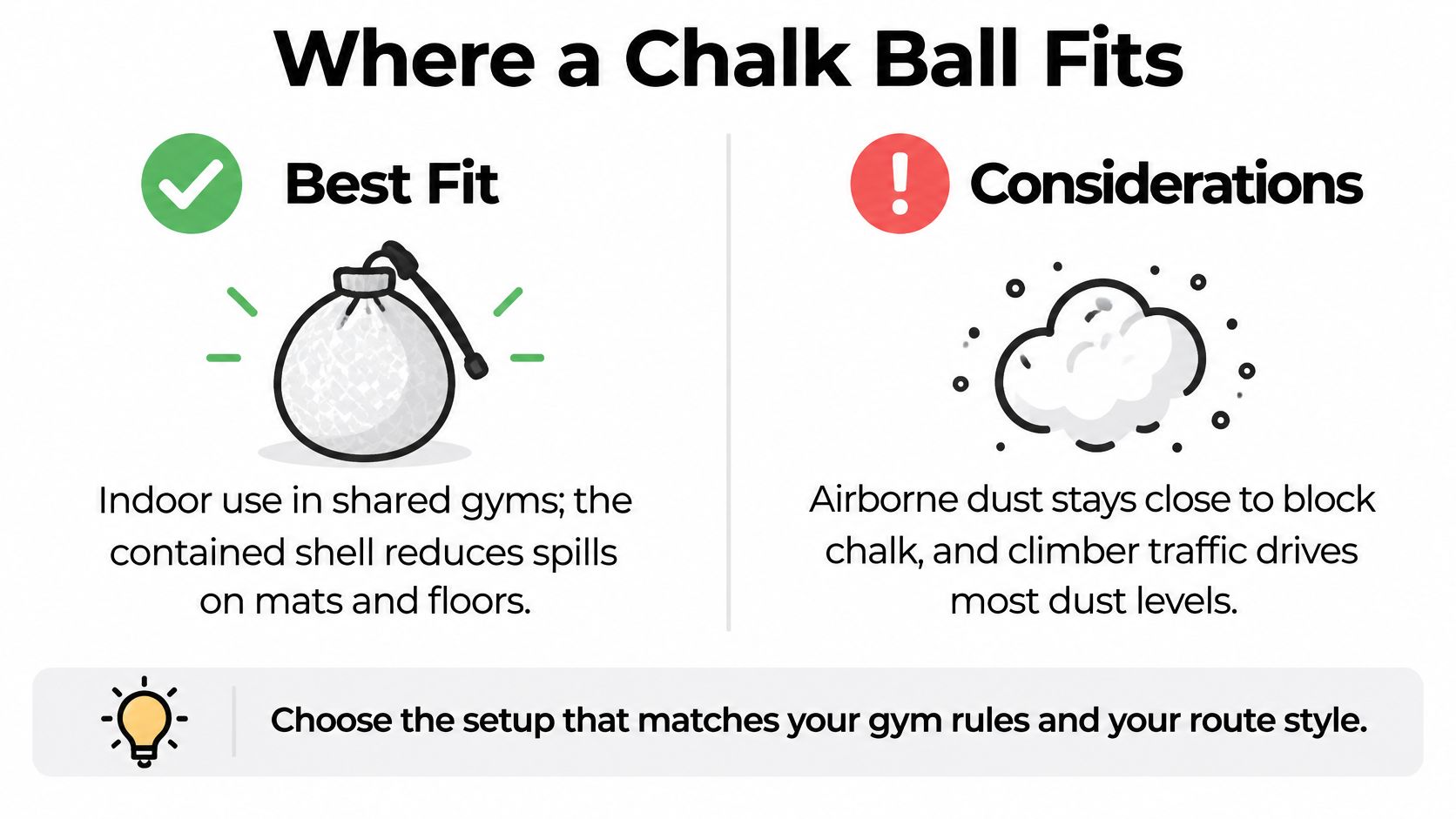
Indoor pros and cons
- Pro, controlled access: The shell makes a modest application easier than reaching into free powder.
- Pro, easier housekeeping: A closed ball contains the supply during an accidental knock.
- Con, shared-air limits: Fabric doesn't make the applied powder disappear.
- Con, policy restrictions: Permission for hand chalk doesn't necessarily include every powder format.
Indoor verdict: A ball suits a powder-friendly gym where containment is the main concern. A climbing chalk pouch setup should support controlled access rather than encourage repeated, unnecessary application.
Outdoor pros and cons
National Geographic's reporting on a 2020 peer-reviewed study describes higher chalk concentrations along climbed routes and laboratory effects on germination and survival in four fern species and four moss species. It also reports that chemical traces could alter surface pH after visible chalk was removed.
- Pro, measured dispensing: The ball helps a climber avoid pouring excess powder onto the ground.
- Pro, contained storage: Keeping the supply enclosed reduces accidental releases around the base of a climb.
- Con, residue remains: The contents still reach rock surfaces and can accumulate.
- Con, sensitive surroundings: Brushing and application need care around mosses, ferns and other vegetation.
Those findings don't establish that every chalk application causes ecological harm. They do give climbers a reason to use restraint rather than treating a contained format as environmentally neutral.
Outdoor verdict: Apply the least chalk that works, follow local access rules, brush responsibly and practise Leave No Trace. Visible cleanup is worthwhile, but it isn't proof that every chemical trace has gone.
Gym Chalk Rules and Competition Use
A chalk ball controls how powder leaves the container, but it does not guarantee that a gym permits it. Dartmouth's climbing gym policy is one example: it bans loose chalk while allowing chalk balls, chalk socks and liquid chalk. The policy also states that chalk socks and liquid chalk are provided free.
Check the rules for the specific facility. A sign that says “no chalk” may cover every format, while a written policy may distinguish among them.
Competition rules and venue rules are separate
The USA Climbing 2025–2026 competition rulebook permits commercially available dry or liquid climbing chalk on the hands. It prohibits substances containing agents that add tack or otherwise alter a hold's condition. Conventional magnesium-carbonate liquid chalk fits the rulebook's permitted chalk category.
The host venue sets its own housekeeping rules for spaces such as warm-up areas and public zones. Check both sets of rules before packing chalk.
- Get the written policy. Ask the front desk or event organizer which rules apply to the climbing area and surrounding spaces.
- Confirm each format. Ask specifically about loose powder, block chalk, chalk balls and liquid chalk.
- Pack an allowed option. If the venue allows liquid chalk but restricts powder, choose a format that complies with its policy.
Temporary climbing events need clear rules too. Organizers considering branding options for portable climbing walls should set a chalk policy as part of event planning, particularly when the climbing activity shares space with other visitors.
Before competing: Read the current competition rules and the host venue's policy. Check what each allows.
Liquid Chalk as a Base Layer Under Powder
A thin liquid coat under powder can help chalk adhere for longer on tough routes. Climbers who prefer powder can keep its familiar feel at the surface, using a chalk ball for controlled touch-ups where powder is permitted.
Apply the layers in order:
- Wash and dry your hands fully. Remove old chalk buildup and surface moisture.
- Apply a thin, even coat. EVMT Rock Climbing Liquid Chalk can be used as a primer beneath regular loose chalk.
- Let it dry completely. The surface should be dry before you touch holds or add powder.
- Add a light powder layer where allowed. Use loose chalk or dispense it through a ball.
- Refresh when contact changes. Reapply powder when sweat or wear affects your grip.
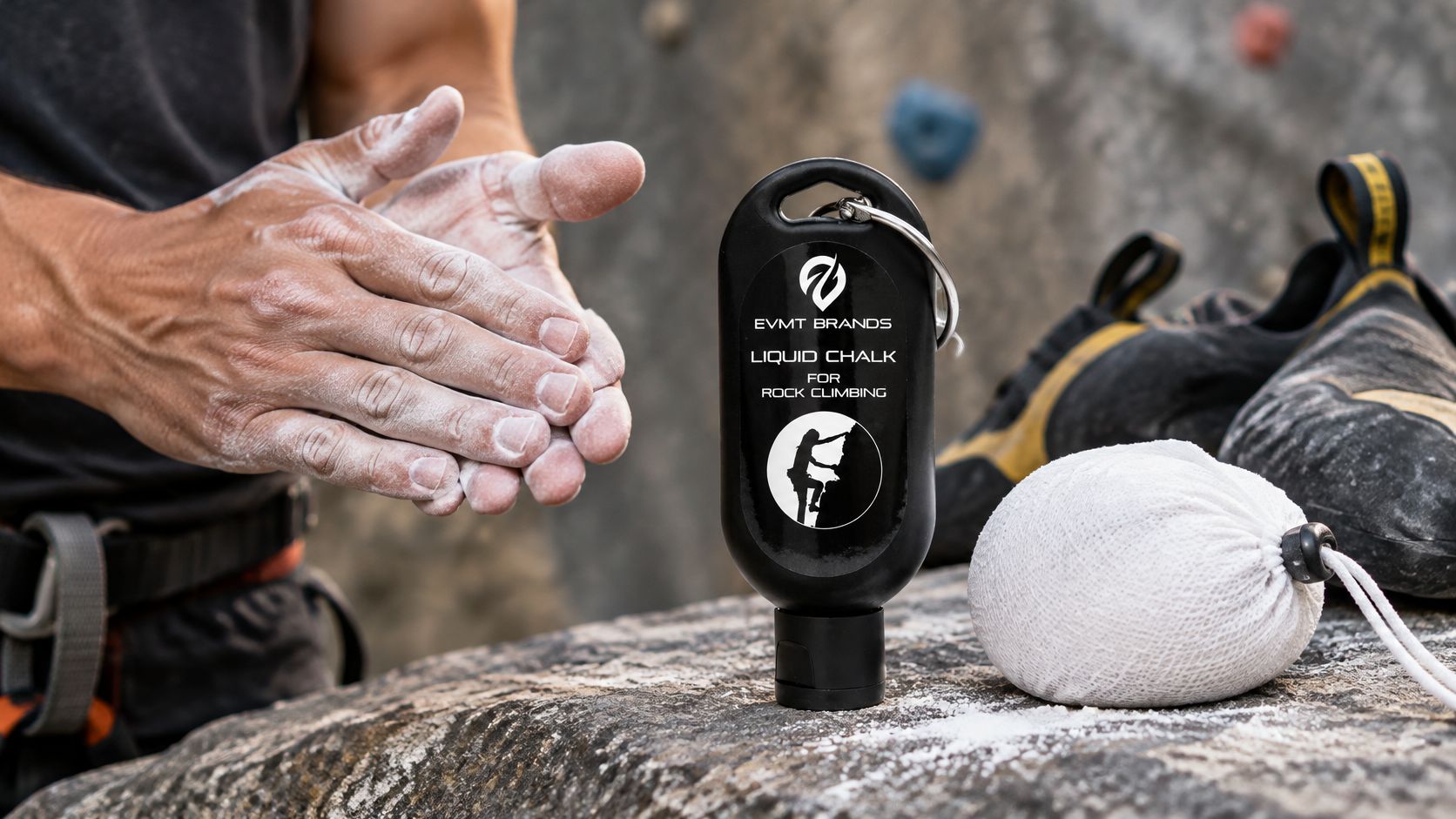
What layering can reasonably deliver
The primer helps powder adhere and can extend the time before a touch-up is needed on a tough route. Sweat has another applied layer to work through, while the powder provides a familiar surface feel.
Liquid chalk applies without a powder cloud. Powder added on top can still transfer, though, so the layered approach does not remove the need to clean up loose chalk.
The climbing-chalk study summarized by EVMT involved 19 climbers. Their failure-limited hang time increased significantly from 49.3 ± 25.2 seconds without chalk to 62.9 ± 36.7 seconds with chalk. The study supports chalk for sustained gripping. It does not test liquid chalk under powder.
A primer may be useful on long sport routes, multi-pitch climbs or in humid gyms, where frequent chalking is inconvenient. The guide to applying liquid climbing chalk explains the basic application; judge the layered approach by how long the coat lasts and how often you need to touch up.
Where powder is banned, use only the permitted liquid format and let it dry before climbing.
Choose Your Chalk Format for Your Next Session
Choose chalk by the problem you need to solve. A chalk ball controls loose chalk and helps limit spills, but it does not eliminate airborne dust. Liquid chalk avoids a free-powder cloud, while a powder-restricted gym may allow liquid chalk and prohibit loose chalk. Check the venue's rules before choosing.
Match the format to the session
- Shared indoor gym that permits powder: A chalk ball makes it easier to control how much loose chalk you dispense and helps reduce mess on the floor. It still releases dust.
- Long routes or humid sessions: Use a fully dried liquid coat, then add a light powder layer only if the venue permits it.
- Loose-powder ban: Use an accepted liquid format without a powder top-up.
- Powder-friendly climbing area: Loose chalk remains an option if you prefer its familiar application. Apply only as needed.
- Outdoor climbing: Limit the amount you apply and clean up visible residue responsibly.
- Other sweaty-hand sports: Weightlifters, powerlifters, CrossFit athletes, gymnasts, cheer athletes and pole fitness athletes should check venue rules before choosing a format.
- Dust-sensitive home gym: Liquid chalk avoids dispensing loose powder into the room.
For a short bouldering session, careful dosing may be enough. Longer climbs may warrant a primer, but a thicker coat is not automatically better.
Check the venue's written chalk policy, select an allowed format and start with a thin coat. Judge it by how well you hold the grips and how often you need to reapply.
Evermost LLC offers EVMT Liquid Chalk in 50 ml portable bottles and 250 ml high-volume sizes. Climbers can use it as a primer beneath regular powder where that format is permitted. Visit Evermost LLC to choose a size and try a thin coat before your next climbing session.