


Liquid Weight Lifting Chalk: The Ultimate Grip Guide
The bar leaves the floor cleanly, knees lock on schedule, and then the fingers begin to open. No pain, no torn callus, just a warm film of sweat turning a secure hold into a slow slide. That's the failure liquid weight lifting chalk is built to address. It doesn't create strength, and it doesn't replace grip training. It manages moisture at the one interface that decides whether existing strength reaches the bar.
Table of Contents
- The Set Before the Set Why Grip Quietly Caps Your Strength
- What Liquid Weight Lifting Chalk Actually Is
- What the Friction Research Actually Says
- Liquid vs Powder vs Chalk Ball vs Gloves
- How to Apply Liquid Chalk the Right Way
- Sweat, Skin, and Hyperhidrosis A Real Trade-Off
- Gym Rules Venues and Competition Use
- Buying Checklist What to Look for in a Liquid Chalk
The Set Before the Set Why Grip Quietly Caps Your Strength
A heavy deadlift rarely fails all at once. The lifter sets the lats, pulls slack out, drives through the floor, and gets the bar past the knees. Then the bar drifts toward the fingertips, the pinky loses contact, and lockout becomes a negotiation instead of a finish. The hips and back still have work left. The hands don't.
High-rep cleans expose the same limiter differently. Early reps stay crisp because the palms are dry and the hook grip sits deep. By the final reps, sweat fills the palm, the bar shifts during the turnover, and bar speed dies because the lifter is managing slippage instead of pulling. A sensible deadlift progression plan builds positional strength, but no progression survives a hand that keeps opening under load.
The Moisture Problem Knurling Cannot Solve Alone
Knurling helps through mechanical interlock, biting into skin so the hand and steel move together. Sweat undermines that interlock by lubricating the contact points. Once moisture wins, the lifter squeezes harder, fatigues the forearms earlier, and still loses position.
- Deadlift singles: slippage shows up late, near lockout, when shear force peaks.
- Clean and snatch work: slippage shows up across reps, degrading timing before it causes a miss.
- Bench press: slippage is subtler, with the bar settling unevenly in damp palms.
Practical rule: if the bar moves inside the hand before the target muscles fail, grip is a moisture problem first and a strength problem second.
Liquid chalk fits that specific failure mode. A thin, dry film between skin and steel keeps contact consistent from the first work set to the last, so the limiter returns to the muscles the lift is supposed to train. That's the whole job, and it's enough.
What Liquid Weight Lifting Chalk Actually Is
Liquid chalk isn't a new grip technology. It's a delivery format for magnesium carbonate, the same drying compound gymnasts, weightlifters, and climbers have used for decades. The modern climbing history traces to 1954, when gymnast John Gill introduced gymnastics chalk to bouldering, as detailed in the history of gym chalk and magnesium carbonate use. More than 70 years of cross-sport use sits behind the ingredient. Only the packaging changed.
Liquid weight lifting chalk works like roll-on deodorant. The liquid part spreads the active material evenly, then gets out of the way. The solid that remains does the actual work.
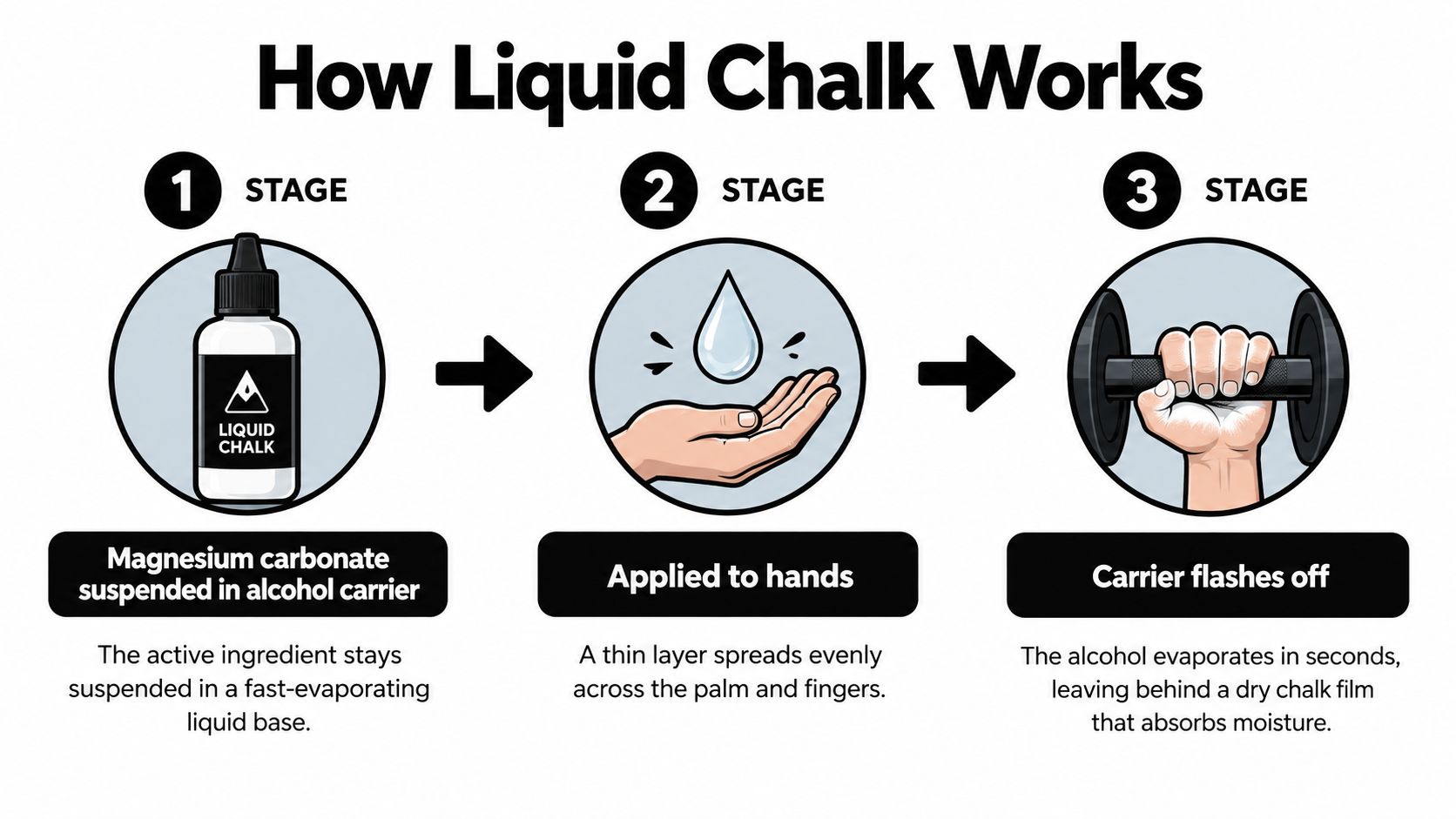
The Carrier and the Film
The formula has two phases. The volatile carrier, typically alcohol-based, suspends fine magnesium carbonate particles and spreads them into every crease of the palm and fingers. Within seconds the carrier evaporates. What's left is a thin particulate film bonded to the skin rather than a cloud of loose powder.
That film absorbs surface moisture as it forms. Because it goes on wet, coverage is more uniform than patting a block against the palm, where high spots get chalk and the webbing between fingers gets missed.
Why the Format Matters
A block or bucket delivers the same mineral through dust. A bottle delivers it through a sealed, metered coat. For liquid weight lifting chalk, that difference is commercial as much as chemical. There's no airborne plume, minimal transfer to bars and clothing, and no open container spilling across a gym bag.
The trade-off is control. Powder can be reapplied in a second between attempts. Liquid demands a short drying window before gripping. Lifters who understand that exchange, cleanliness and consistency for a few seconds of patience, tend to get the most from it.
What the Friction Research Actually Says
The lazy claim says more chalk equals more grip. The research says something narrower and more useful. Chalk performance is condition-dependent, shaped by skin moisture, surface texture, applied force, and how much chalk is present.
A 2024 laboratory study measured static friction across sandstone, granite, dark limestone, and light limestone under normal forces of 5, 10, and 15 newtons, comparing dry and wet fingertips with and without chalk, as reported in the 2024 tribology study of fingertip friction and chalk. Chalk generally helped dry fingertips more than sweaty ones and made friction more consistent across most conditions. Consistency, not a guaranteed boost, is the defensible selling point.
When Chalk Underperforms
A 2001 experiment with 15 participants found magnesium carbonate could decrease friction on a flattened surface, partly because excess particles create a granular layer between skin and surface. A 2018 study of repeated open-handed and pinch-grip pull-ups reported crushed chalk produced higher peak friction than liquid chalk or a dry hand on clean climbing holds, as described in the 2018 comparison of crushed and liquid magnesium carbonate. Liquid and loose formats don't perform identically, and pretending otherwise sets buyers up for disappointment.
Performance data points the same direction. A controlled study of 12 male high-school athletes found magnesium carbonate raised clean-grip mid-thigh-pull repetitions at 70% deadlift 1RM from 9.1 ± 3.1 to 11.1 ± 5.1, a 22.5% increase with a medium effect size of 0.6, per the study of magnesium carbonate and mid-thigh-pull repetitions. That measures repeated pulling with general magnesium carbonate, not maximal strength with liquid chalk specifically.
Chalk improves the hand and implement interface. It doesn't alter muscle strength or mechanically lock the hand to the bar.
For lifters, the reading is straightforward. Judge liquid weight lifting chalk as a moisture and consistency aid, test dosage during warm-ups, and pair it with a fast-drying liquid chalk formula that fully sets before the grip closes. Over-application can create the very loose layer the product is meant to prevent.
Liquid vs Powder vs Chalk Ball vs Gloves
These are four tools, not four religions. Each one wins somewhere, and serious lifters often own two of them. The mistake is choosing by habit instead of by venue, lift, and mess tolerance.
Loose powder remains the reference for long, hot sessions in a home gym with a chalk bucket beside the platform. It's cheap, instant, and easy to layer thick. It's also the format commercial facilities ban, and it coats everything within reach. A chalk ball keeps the familiar powder feel while constraining dust inside a fabric pouch, which suits lifters who want lower mess without changing grip style.
Choosing the Right Chalk Format for Your Training
| Format | Best for | Mess level | Skin sensitivity |
|---|---|---|---|
| Liquid chalk | Commercial gyms, travel, deadlifts, cleans | Very low | Moderate, alcohol can dry skin |
| Loose powder | Home gyms, long sessions, hot rooms | High | Low to moderate |
| Chalk ball | Shared spaces, moderate dust control | Low | Low to moderate |
| Grip gloves | High-volume work, palm padding | None | Low, but traps sweat |
Gloves belong in a different conversation. They pad the palm and protect skin during volume work, but they add thickness between hand and bar, which effectively widens the grip diameter and can reduce bar feel. They also trap sweat inside rather than absorbing it. For maximal pulling, most lifters prefer direct contact with knurling plus chalk, treating gloves as a skin-protection option rather than a grip maximizer, a distinction covered in this guide to choosing a hand grip aid.
The default recommendation is simple. Liquid weight lifting chalk for commercial gyms, travel, and lifters who want one less variable between sets. Powder where dust is welcome and sessions run long. A chalk ball as the middle path. Gloves when padding matters more than bar feel.
How to Apply Liquid Chalk the Right Way
Application is where most lifters waste the product. They squeeze out too much, grip too early, and conclude liquid chalk doesn't work. The correct sequence is short and unforgiving about order.
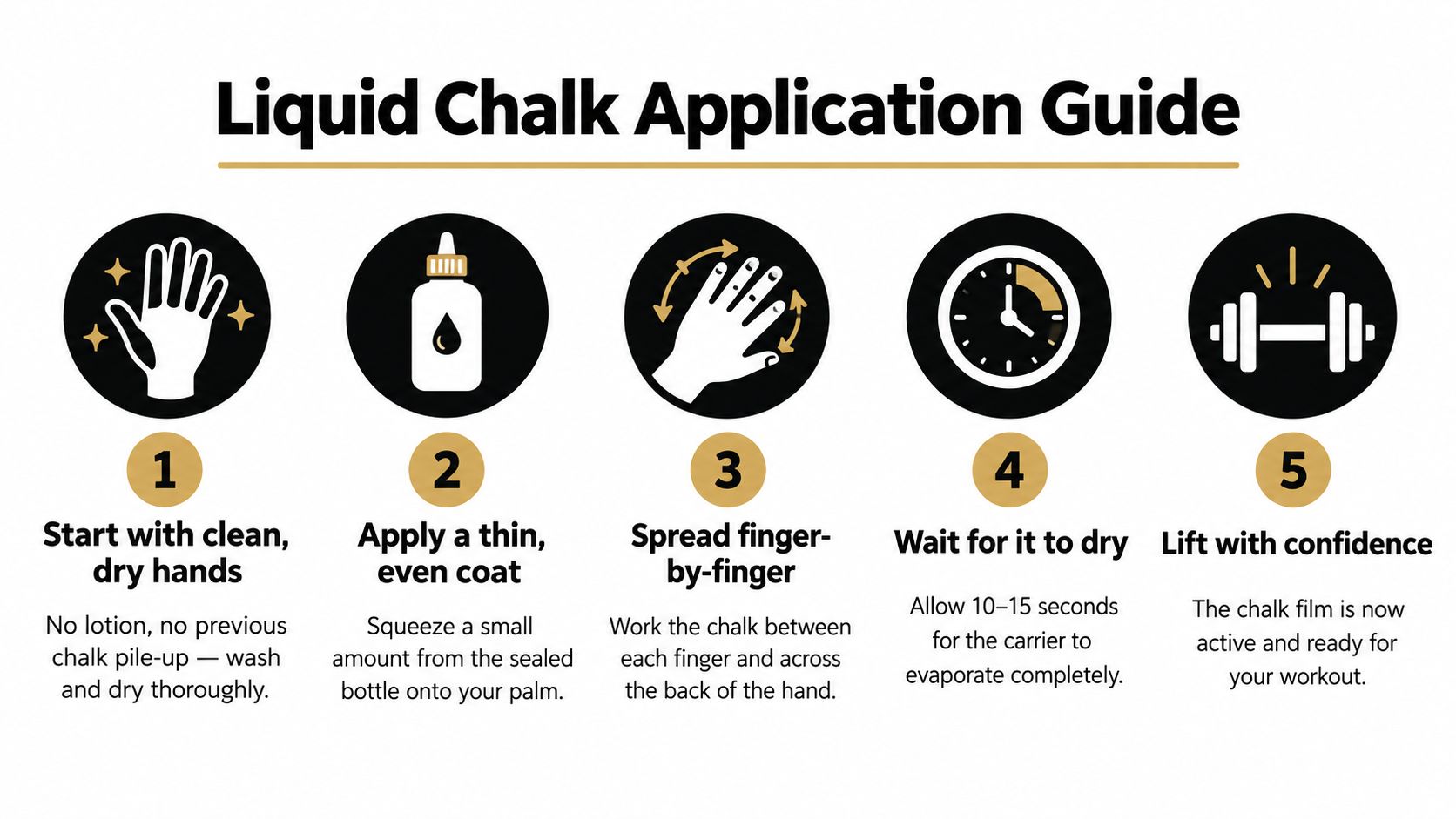
The Five-Step Sequence
- Start clean and dry: wash off lotion and old chalk, then dry hands completely.
- Dose small: a pea-to-dime amount covers both hands for most lifters.
- Spread with intent: work it across palms, between fingers, and over the thumb for hook grip work.
- Wait for the flash-off: keep hands open until the carrier fully evaporates and the film looks matte.
- Grip and lift: close the hand only once the film is fully dry.
Coverage should match the lift. Deadlifts and rows need finger-by-finger coverage because the bar hangs from the fingers. Bench and overhead pressing need full-palm coverage because the bar sits in the heel of the hand. Cleans need both, plus the thumb.
The Three Errors That Ruin It
Gripping while the coat is still wet smears the film onto the bar instead of bonding it to skin. Over-applying builds loose residue that can roll between skin and steel. Skipping hand prep traps sweat and lotion under the film, so the coat fails from underneath.
Dose test: if visible flakes fall when the hands are rubbed together, the last coat was too thick.
Reapply selectively between heavy sets, not automatically before every set. Warm-ups are the time to find the right amount for that day's skin, bar, and humidity. Top sets are not.
Sweat, Skin, and Hyperhidrosis A Real Trade-Off
Maximum dryness isn't automatically optimal. Skin is the equipment every grip aid depends on, and liquid weight lifting chalk asks something of it. The alcohol carrier that makes the film dry fast also strips natural oils, a concern noted in this comparison of liquid chalk and regular chalk skin effects. With frequent training or cold weather, that can contribute to dryness, cracking, or stinging.
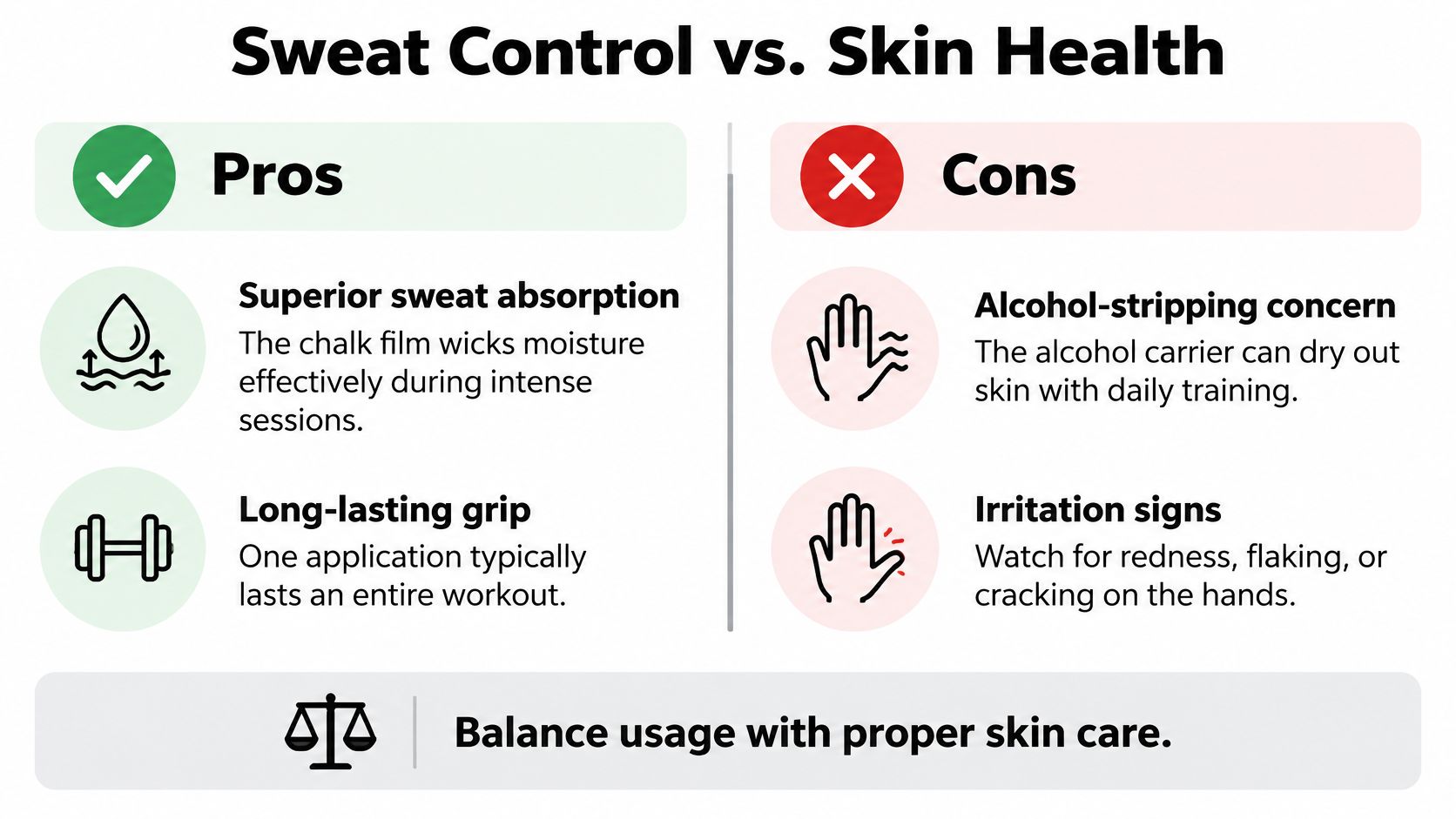
Normal Dryness Versus Warning Signs
Temporary tightness after a session is common and usually resolves with washing and moisturizer. Persistent redness, fissures, burning, or worsening dermatitis is a different signal. Those signs mean the current frequency or formula is costing more skin than the grip is worth.
- Normal skin, frequent training: dial back application to top sets and moisturize after washing residue off.
- Sensitive or eczema-prone skin: patch-test new products, never apply to broken skin, and let the coat dry fully.
- Cracked calluses: skip damaged areas and reduce total drying exposure, including layered loose chalk.
- Hyperhidrosis: treat the sweating itself with a clinician rather than escalating chalk indefinitely, alongside the strategies in this guide to sweaty hands during weightlifting.
Excessive dryness promotes cracking and painful tears, which cost training days and reduce consistency far more than one slipped set. The goal is selective use, enough film to control sweat during the sets that matter, and enough recovery care between sessions to keep the barrier intact. Athletes who layer liquid chalk under loose chalk should count both toward total exposure.
Gym Rules Venues and Competition Use
Most powder bans aren't anti-lifting. Loose chalk becomes airborne, settles into HVAC systems and equipment, and generates member complaints. A USA Climbing medical document noted loose chalk can irritate the respiratory tract and increase behaviors such as eye rubbing and mask touching, while encouraging alcohol-based liquid chalk and minimizing chalk dust in competition venues, according to the USA Climbing medical return-to-sport guidance.
Liquid chalk slips inside most of those rules because the carrier evaporates on the hands instead of dispersing through the room. There's no plume, minimal residue on bars, and nothing for the next member to inhale. For home-gym owners, the same logic protects floors, electronics, and lungs.
What Competition Rules Actually Permit
USA Climbing's 2025-2026 rulebook explicitly permits competitors to use "commercially available dry or liquid climbing chalk" on their hands during attempts, per the USA Climbing 2025-2026 competition rulebook. Container rules matter too. Liquids must be stored in sealable, leak-proof containers, and a small container of commercially available liquid chalk is an allowed item, as stated in the USA Climbing rulebook provisions on liquid containers.
Venue permission is never automatic. Current event rules and front-desk policy override any product label.
Climbers get one extra option lifters don't need. Liquid chalk works as a base layer under powder, applied to dry hands before the session and allowed to dry fully, so sweat must work through two layers and re-chalking happens less often on long routes. For lifters, the bottle alone is usually the whole system.
Buying Checklist What to Look for in a Liquid Chalk
Four criteria separate a good bottle from a sticky disappointment. Everything else is packaging.
- Magnesium carbonate base: the established drying solid, clearly listed.
- Fast-drying carrier: full flash-off in seconds, with no tacky residue.
- Low transfer: no dust cloud and minimal residue left on bars, poles, or apparel.
- Sealed, portable bottle: leak-resistant storage that satisfies venue container rules.
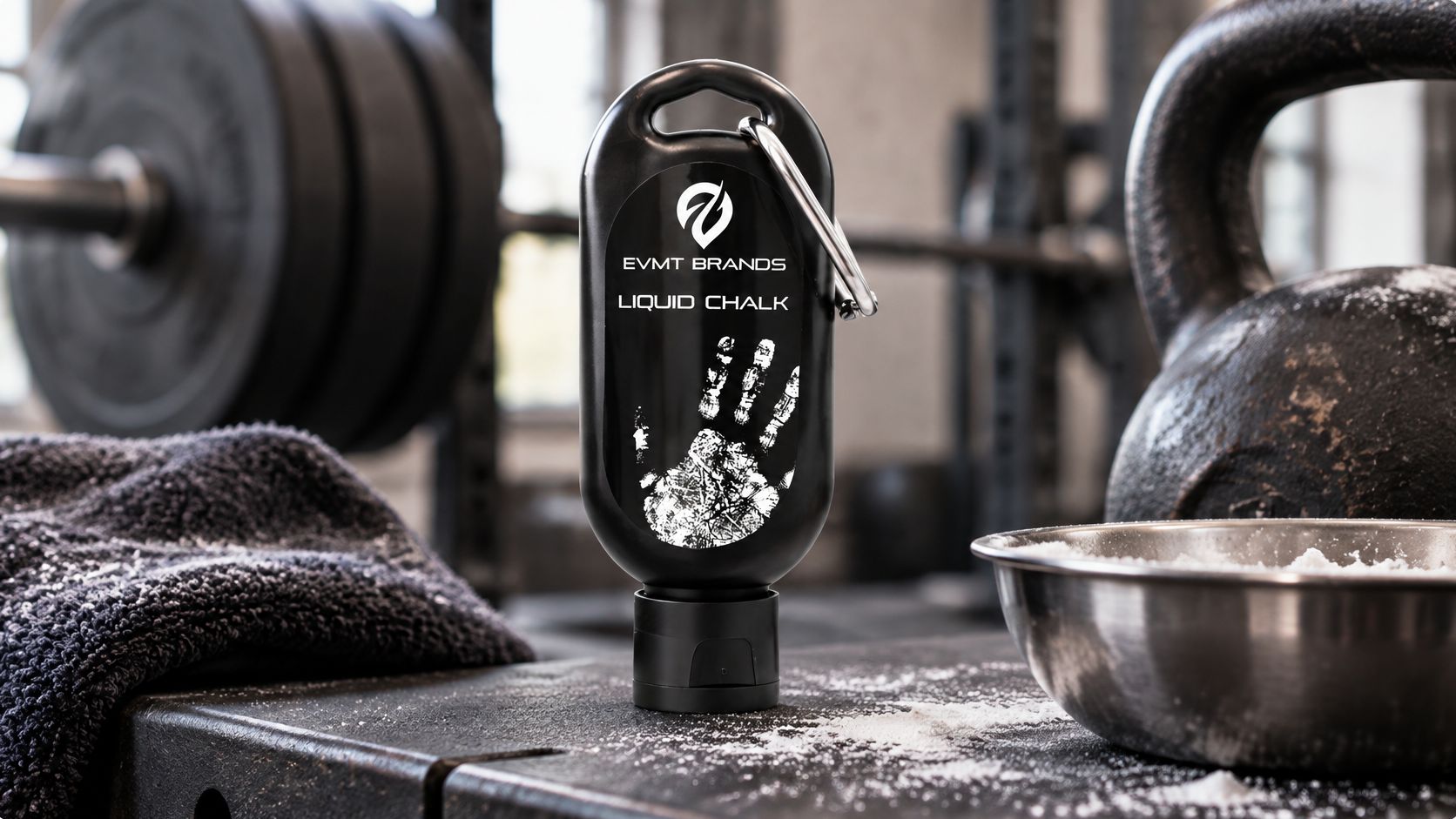
EVMT LIQUID CHALK meets that checklist with a magnesium-carbonate liquid chalk offered in single bottles and multi-packs, including 50 ml portable and 250 ml high-volume sizes, with subscription savings, free U.S. shipping over $20, and 30-day returns for a low-risk trial. Select portable bottles include a carabiner ring for gym-bag carry.
Judge any bottle the same way during warm-ups. Thin coat, full dry, honest top set. Liquid weight lifting chalk earns its place when the bar stops moving inside the hand and the lifter stops thinking about grip at all.
Lifters ready to retire the dust cloud can find fast-drying, magnesium-carbonate liquid chalk in portable and high-volume bottles from Evermost LLC, built for deadlifts, cleans, climbing sessions, and gyms that ban powder. Grab a bottle, test the dose during warm-ups, and let the next top set fail for a better reason than sweat.