


Hyperhidrosis Hands: Causes, Treatments and Grip Fixes
A heavy set starts well, then the bar begins to roll. The legs and back still have strength, but wet palms lose friction and the lift ends early. That mismatch confuses many athletes with hyperhidrosis hands, because the problem isn't weakness. It's moisture at the skin and object interface. Medical treatment can reduce sweating over time, while a grip aid manages surface moisture during a session. Those two jobs are different, and combining them usually works better than choosing one.
Table of Contents
- What Palmar Hyperhidrosis Is and How to Recognize It
- Diagnosis and When to See a Doctor
- Medical Treatments for Palm Sweating Compared
- Liquid Chalk, Powder Chalk and Chalk Balls Compared
- Grip Strategy for Lifting, Climbing and Gymnastics
- How to Layer Liquid and Powder Chalk Step by Step
- Gym Rules, Residue and Cleaning Up After Liquid Chalk
- Confirm Your Grip Plan Before Your Next Session
What Palmar Hyperhidrosis Is and How to Recognize It
By the third set, a lifter's palms are already wet. The room isn't hot, warm-up sets felt normal, and a towel buys only seconds before the bar slides again. That pattern points away from ordinary exercise sweat and toward palmar hyperhidrosis, focal, excessive sweating of the palms.
The condition usually affects both palms in a roughly symmetric pattern and often starts in childhood or adolescence. It can appear at rest, in cool rooms, or before training begins. Readers comparing everyday coping options with clinical care can find broader background in resources on managing excessive sweating, but recognition starts with the pattern, not the product shelf.
How common palm involvement is
The International Hyperhidrosis Society epidemiology summary reports that a large U.S. epidemiological survey published in 2016 estimated hyperhidrosis affected 4.8% of the population, equivalent to approximately 15.3 million people, with the highest prevalence among adults aged 18 to 39 at 8.8%. In a survey of 1,985 people with hyperhidrosis, palmar involvement was reported by 65% of participants.
Those palm, underarm, and sole percentages overlap because many people sweat in several regions. Hand involvement is therefore common, not rare.
| Feature | Normal palm sweat | Primary palmar hyperhidrosis | Secondary sweating |
|---|---|---|---|
| Trigger | Heat, exercise or stress | Often none; can occur in cool rooms and at rest | May follow medication or illness |
| Distribution | Varies across the body | Both palms, roughly symmetric | May be one-sided, patchy or whole-body |
| Onset | Any age | Often childhood or adolescence | Often adult onset or sudden change |
| During sleep | Stops | Stops | Can continue |
Self-check for this week: Does sweating happen at rest or in cool rooms, does it affect both palms, and does it stop during sleep?
Three yes answers suggest a focal pattern worth discussing with a clinician. A no answer doesn't rule anything out, but it changes which questions matter most at an appointment.
Diagnosis and When to See a Doctor
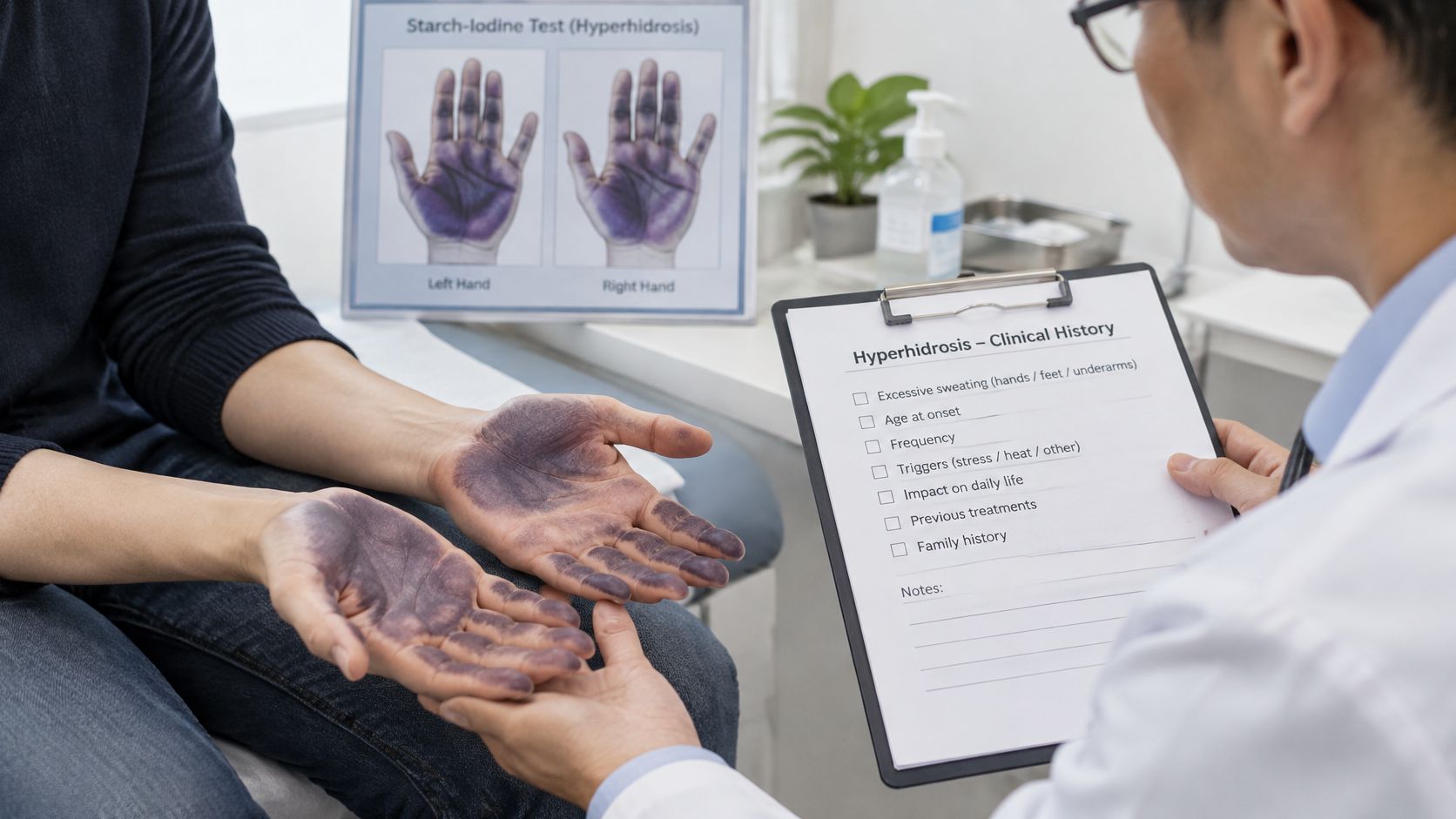
A clinician can often diagnose palm hyperhidrosis by asking when the sweating began, whether it affects both hands, and whether it continues during sleep. This history helps distinguish a persistent focal pattern from sweating that may have another cause.
A clinical examination can add detail. A review of primary focal hyperhidrosis describes starch-iodine mapping to show where sweating occurs. Gravimetric or evaporimetric measurements can quantify sweat output and track change over time, much like taking a baseline measurement before judging whether a treatment has helped.
Ruling out secondary causes
The clinical review describes primary palmar hyperhidrosis as excessive sweating from eccrine glands, linked to heightened sympathetic signaling. That can leave the palms wet even when the room is cool and the body does not need to shed heat. Grip aids may improve friction during a session, but they do not diagnose or treat the cause of sweating.
Medications and conditions such as endocrine disease, infection, neurologic disease, or hypoglycemia can also cause sweating. Sudden onset in adulthood or sweating across the body calls for medical assessment rather than relying on a grip product alone.
Red flags that change the path
Arrange prompt medical assessment if sweating comes with any of these changes, especially if several occur together:
- New, sudden, or generalized sweating: A marked change from a stable pattern needs an explanation.
- Sweating during sleep: This differs from the usual primary focal pattern.
- Onset after a medication change: Tell the prescriber when the sweating began and when the medication changed.
- Fever or unexplained weight loss: These symptoms warrant assessment beyond the skin.
- Cracked, white, softened, foul-smelling, or infected-looking skin: Have damaged or waterlogged skin assessed before applying a grip product.
Do not stop or change a prescribed medication without speaking to the prescriber. Its timing may matter, but changing it without guidance can create other risks.
What to bring to the appointment
A brief record can make the visit more useful than a general description such as “my hands sweat a lot.” Note:
- Onset: The age or date when palm sweating first became noticeable.
- A one-week log: When palms get wet, including at rest, work, training, and sleep.
- Medication list: Current medicines, start dates, and recent dose changes.
- Training impact: The specific moments when moisture affects grip, such as a pull, long route, or routine transition.
Persistent palm sweating that limits training, work, or fine motor tasks is a reason to book a planned appointment. Red flags call for prompt assessment. A grip aid can address moisture and friction during activity, while a clinician can assess the sweating itself and discuss medical options.
Medical Treatments for Palm Sweating Compared
Choose treatment by trade-off: how much it reduces sweating, how it fits your schedule, and what side effects you can tolerate. A clinician can help match the option to your symptoms and health history.
| Treatment | How it is used | Reported effect | Main trade-off |
|---|---|---|---|
| Prescription aluminum chloride (topical) | Applied to dry palms at bedtime and washed off after 6 to 8 hours | In an evaporimetry study described in the International Hyperhidrosis Society's guidance for palmar hyperhidrosis, 20% aluminum chloride reduced palmar water loss by 17% after one week and 30% after four weeks | Irritation is possible; palmar disease may require concentrations up to 30% |
| Tap-water iontophoresis | Repeated device sessions using tap water | The same guidance reports an 81% reduction in sweating in a study using an appropriate device correctly | Sessions take time, and maintenance is needed |
| Botulinum toxin A | Clinician injections into the palms | In a randomized comparison of 60 patients, botulinum toxin A improved symptoms in 80% of initial-treatment cases, compared with 47% for iontophoresis plus aluminum chloride | Relief averaged about four months, compared with one month for the other treatment; repeat treatment may be needed |
| Oral anticholinergics | Prescribed tablets | May reduce sweating in severe or multifocal cases | Side effects can limit continued use |
| Surgical sympathectomy | Surgical procedure | Can produce a strong reduction in palm sweating | Compensatory sweating elsewhere may offset the benefit |
Topical and device-based options
Prescription aluminum chloride is applied to completely dry palms at bedtime, left on for approximately 6 to 8 hours, then washed off. The International Hyperhidrosis Society guidance notes that palmar treatment may require concentrations as high as 30%. In the evaporimetry study described in the table, 20% aluminum chloride reduced palmar water loss by 17% after one week and 30% after four weeks.
Tap-water iontophoresis uses a device to deliver a mild electrical current through water while the hands are placed in the treatment trays. The International Hyperhidrosis Society guidance reports an 81% reduction in sweating in a study using an appropriate device correctly. The trade-off is routine: treatment involves repeated sessions and ongoing maintenance.
Injections, tablets, and surgery
In the randomized comparison of 60 patients, botulinum toxin A improved symptoms in 80% of initial-treatment cases, versus 47% with iontophoresis plus aluminum chloride. Average relief lasted about four months, compared with one month for the combination treatment. For more information before discussing the option with a clinician, read about neurotoxin injections for excessive sweating.
Oral anticholinergics may suit severe or widespread sweating, though side effects can make long-term use difficult. Surgery can reduce palm sweating substantially, but compensatory sweating elsewhere may diminish the overall benefit.
Medical treatment addresses sweating over time; a grip aid addresses moisture and friction during a session. They serve different purposes, so athletes can discuss medical care with a clinician and still plan how to manage grip while training.
Liquid Chalk, Powder Chalk and Chalk Balls Compared
A lifter in a powder-friendly gym can reapply loose chalk between sets. In a venue that restricts airborne dust, a liquid formula or chalk ball may fit the rules better. Choose the format by sport and venue.
| Format | Dust | Residue on bars and poles | Venue acceptance | Best use |
|---|---|---|---|---|
| Liquid chalk | No dust once dry | Minimal residue once dry | Accepted where powder is banned | Longer sessions, a base layer under powder, home gyms |
| Powder chalk | Dust can spread across the room | Visible chalk marks | Often restricted by gyms | Short bouldering problems where loose chalk is allowed |
| Chalk balls | Mesh contains much of the powder | Light marks, less spread than loose powder | Permitted by some venues that ban loose chalk | A middle option where balls are allowed |
Loose powder is familiar and effective where permitted. Its main trade-off is airborne dust, which can settle on equipment and spread beyond the lifting platform or climbing wall.
A chalk ball releases powder through its mesh while limiting how much spreads at once. It may provide less coverage than loose powder, but some venues allow balls where they prohibit loose chalk.
Liquid chalk goes on wet, then dries into a grip film. It produces no dust and leaves minimal residue on bars or poles once dry. EVMT Liquid Chalk is sweat-resistant and fast-drying, reduces hand moisture, and washes off with soap and water.
For climbers, liquid chalk can form a base layer, with powder added on top when needed and allowed. Liquid chalk suits dust-restricted gyms, home gyms, and longer sessions; loose powder remains useful for quick reapplication on short bouldering problems where venue rules permit it. Chalk balls offer another option when loose powder is restricted but balls are accepted.
Grip Strategy for Lifting, Climbing and Gymnastics
A bar starts to roll during a heavy pull. On a climbing route, fingertips lose purchase halfway through a sequence. In gymnastics, a damp palm can turn a secure hold into a distraction. Match the grip setup to where and when slipping occurs. For broader advice on hand strength, see Flourish-Everyday's guide to grip strength. Strength work and grip aids serve different purposes.
| Sport | Usual slip point | Grip setup | Role of liquid chalk |
|---|---|---|---|
| Weightlifting and powerlifting | Bar rolls or slides on pulls and heavy sets | Powder for bar contact; liquid base for longer sets | Base coat under powder to support grip through more reps |
| Bouldering | Hands slip on short, hard moves in warm gyms | Powder between attempts | Thin base under powder for hard moves |
| Long sport and multi-pitch climbing | Hands re-sweat over long routes and in humid gyms | Liquid base with powder on top | Can reduce trips to the chalk bag |
| Gymnastics and cheer | Hands slide on bars, rings, or during routine transitions | Powder where allowed; liquid chalk before routines | Provides a dry grip film before the routine |
| Pole fitness | Palms or skin slide on the pole when sweating | Liquid coat on palms before the routine | Provides a grip film; wipe the pole after training |
Lifting and climbing setups
For lifting, apply chalk before the heavy set. A liquid base under powder can help the grip last through more reps, while powder provides the familiar contact layer on the bar. Athletes comparing session options can read about hand grip aids.
Climbers can keep powder in their setup and use liquid chalk as a base layer. With EVMT Liquid Chalk, let the coat dry fully before adding powder. That approach can be useful on long sport routes, multi-pitch climbs, and in humid gyms, where re-chalking may interrupt a sequence. On short boulder problems, stepping off to re-chalk may be simpler.
Gymnastics, cheer, and pole
Gymnasts and cheer athletes need their hands ready before a routine, since there may be no chance to dry them mid-performance. A dry liquid-chalk film can help prepare hands before they touch bars or rings. Pole athletes can apply a palm coat before a routine, then wipe the pole after training so the next athlete has a clean surface.
How to Layer Liquid and Powder Chalk Step by Step
Layering fails for simple reasons. Hands start damp, too much liquid goes on, or powder hits a wet coat and clumps. The sequence below prevents those errors. Athletes dealing specifically with liquid chalk for sweaty hands benefit most from patience at the drying step.
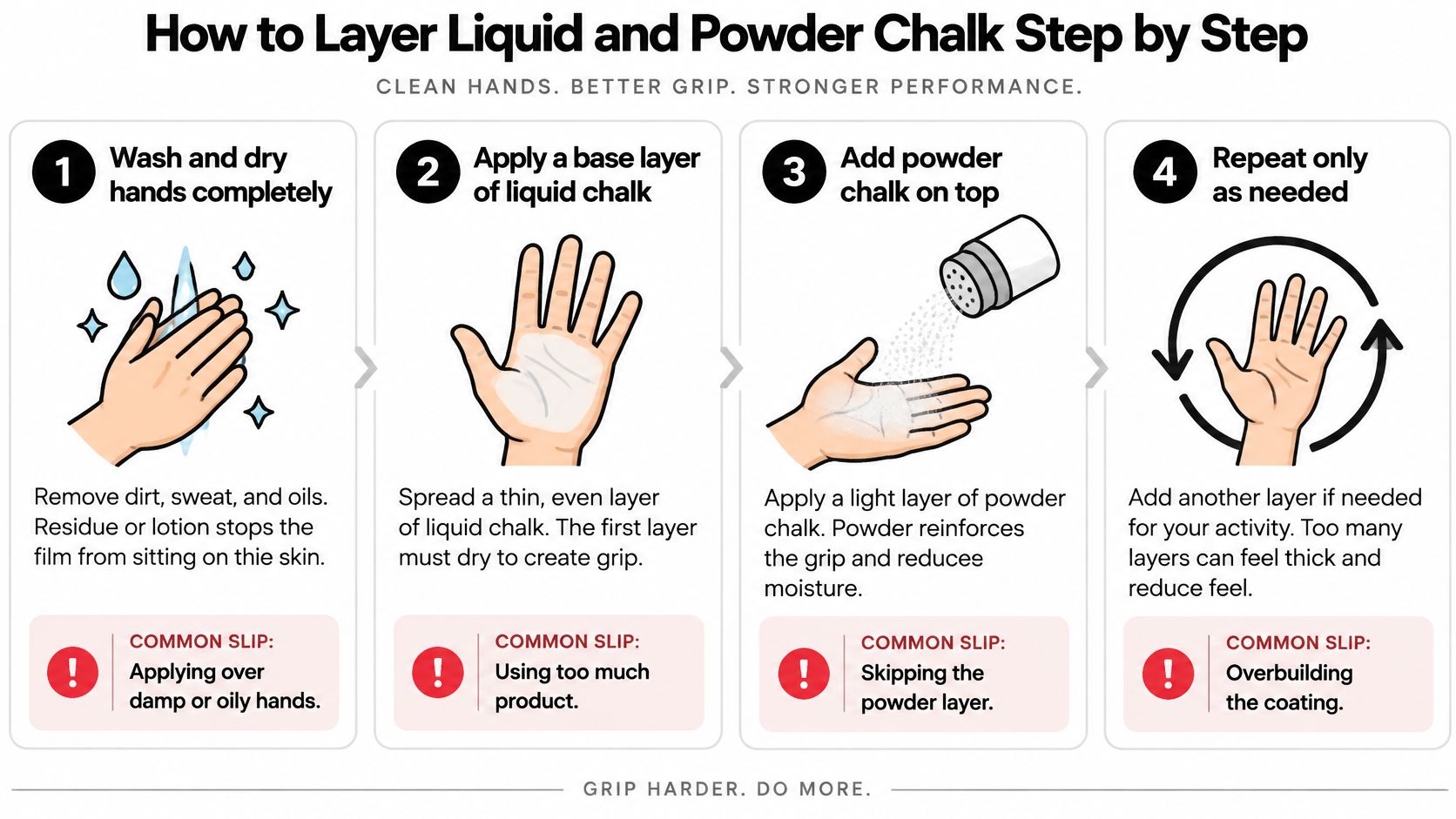
- Wash and dry hands completely. Soap removes lotion and residue that stop the film from sitting on skin. A base layer only works from a clean, dry start.
- Squeeze a dime-sized amount into one palm. More product doesn't mean more grip. Excess liquid cakes as it dries and can flake when fingers close.
- Rub hands together until fully coated. Cover fingertips and the spaces between fingers, where sweat collects first. Missed patches become the first slip points.
- Let the coat dry fully. Hands should look matte and feel dry, not tacky. Powder applied too early clumps and loses grip.
- Dust powder chalk on top as usual. The powder layer spreads evenly over a dry base. Balling or streaking signals that the liquid needed more time.
- Re-chalk mid-session only when needed. The base holds through more moves, so trips to the bag drop. Repeated full applications build thickness and reduce feel.
- Wash hands with soap and water afterward. Removal clears the coat and lets skin be checked for cracks or irritation. Damaged skin shouldn't be coated again until it recovers.
What good looks like: Hands feel dry, the film doesn't flake when grip closes, and powder spreads evenly instead of balling up.
Thickness is the most common mistake after rushing. A thin, complete coat gives friction without dulling contact on small holds, bars, or poles. Athletes who need more should add powder first, not a second wet layer.
Gym Rules, Residue and Cleaning Up After Liquid Chalk
Venue rules can decide the purchase before grip enters the discussion. The Dartmouth climbing gym facility page states that loose chalk is not allowed to maintain healthy air quality and minimize dust, while chalk balls, chalk socks, or liquid chalk are permitted instead. That single policy shows why "no chalk" doesn't always mean no chalk in any form.
Policies still differ by facility and room. A climbing wall, lifting platform, gymnastics hall, and pole studio may each apply separate rules inside one building. Posted rules come first, then staff clarification.
Questions worth asking staff
- Bars and platforms: Is liquid chalk allowed on barbells, pull-up bars, and lifting platforms?
- Apparatus and poles: Does the policy cover rings, gymnastics bars, and poles, or only climbing walls?
- Cleaning expectations: Should equipment be wiped after every set, every session, or only when marks appear?
- Powder on top: Does a liquid base with powder over it count as banned loose chalk?
Home-gym owners face a simpler version of the same choice. Liquid chalk avoids airborne dust around electronics, flooring, and shared living space. Guidance on how to remove liquid chalk covers hand and equipment cleanup in more detail.
Liquid chalk dries to a thin film with minimal transfer, but minimal isn't an excuse to skip cleanup. Bars and poles should be wiped with a damp cloth after sessions, following the gym's cleaning routine. Bottles belong away from shared equipment, and hands should be washed before leaving.
Unclear rules belong at the front desk. Asking before a bulk purchase costs minutes. Guessing wrong can cost a session.
Confirm Your Grip Plan Before Your Next Session
Before your next workout, decide what you'll test and what you'll track. A short plan makes it easier to tell whether a grip adjustment helped.
- Check the sweating pattern. Long-standing sweating limited to the palms can be handled through routine care. New, sudden, widespread, or sleep-time sweating warrants medical assessment.
- Match the setup to the sport. Identify where grip fails, such as on a rolling bar, a humid climbing route, or during a routine transition.
- Confirm venue policy. Check rules for liquid chalk, powder, and cleanup before buying or applying a product.
- Test one setup for a full session. Record where slipping occurs, when you reapply chalk, and how your skin looks afterward.
- Change one variable at a time. Adjust the amount, drying time, or reapplication interval separately so you can tell which change helped.
For an on-session grip layer, EVMT Liquid Chalk reduces hand moisture and improves grip. To apply it, squeeze a dime-sized amount into your palm, rub your hands together until they are fully coated, then let the formula dry. It is sweat-resistant and washes off with soap and water.
Use grip products during training alongside any medical care you receive for palm sweating. Track the result, then make one adjustment at a time.
Athletes can choose EVMT Liquid Chalk for grip-intensive training, including lifting, climbing, gymnastics, dance, and sports. The Classic formula dries quickly, reduces hand sweat, and improves grip. EVMT is available in 50 ml portable and 250 ml high-volume bottles. Visit Evermost LLC to choose a size for your training.