


Liquid Chalk for Sweaty Hands: Grip That Lasts Longer
The bar is loaded, the route looks manageable, and then your palms turn slick. A deadlift starts well before the handle rotates in your hand, or a promising climbing move ends because your fingertips slide from a hold that felt secure seconds earlier. Liquid chalk for sweaty hands targets that failure point by drying the skin surface and leaving a grip-supporting film where loose chalk often gets overwhelmed.
The right choice still depends on sweat level, skin tolerance, venue rules, and the activity. EVMT Liquid Chalk gives lifters, climbers, gymnasts, cheer athletes, pole athletes, and home-gym owners a magnesium-carbonate formula that dries in seconds without airborne dust. For climbers, it works best as a base layer under powder chalk, not as a wholesale replacement.
Table of Contents
- Why Grips Fail When Hands Get Sweaty
- How Liquid Chalk Works for Sweaty Hands
- Liquid Chalk vs Powder Chalk for Sweat
- Choosing the Right Liquid Chalk Formula
- Proper Application Techniques for Maximum Grip
- The Climbing Base Layer Strategy
- Skin Safety and Managing Sweat Responsibly
- Making the Switch to Liquid Chalk
Why Grips Fail When Hands Get Sweaty
A slick palm changes the contact between skin and equipment. During a heavy pull, the sweat film acts like a lubricant between the hand and the bar. On a climbing hold, the same moisture can turn a precise fingertip placement into a slow slide, forcing the athlete to abandon the attempt before strength or technique becomes the limiting factor.
That failure is especially frustrating because the athlete often responds with more loose chalk. Powder can help absorb surface moisture, but heavy sweat may saturate or displace it quickly. The result is a familiar cycle: chalk, grip, slip, re-chalk, and lose focus.
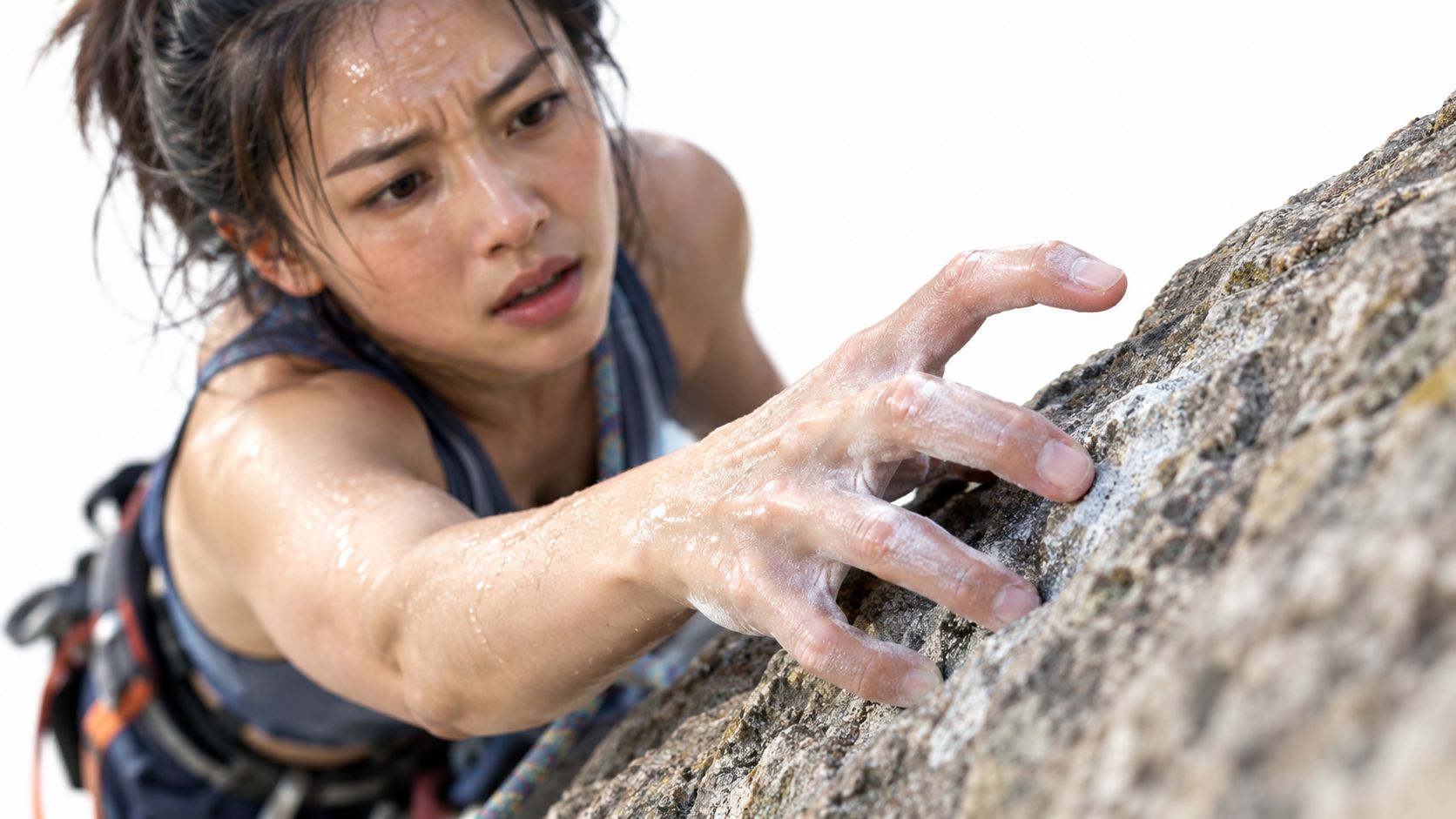
The problem is surface moisture
Grip aids don't stop sweat production. They manage the moisture already sitting on the skin and create a more consistent contact surface. That distinction matters for athletes whose hands re-wet within minutes, because a thick layer of powder won't necessarily stay where it was applied.
Palmar hyperhidrosis is estimated to affect about 3% of the population, while one U.S. estimate places hyperhidrosis overall at 4.8%, or about 15.3 million people. People with palmar hyperhidrosis may sweat at roughly 4 to 5 times the rate of the general population, according to the available guidance on liquid chalk for sweaty hands. For those athletes, a fast-drying film can make more sense than repeatedly adding loose powder.
Practical rule: If sweat returns before the next set, route, or apparatus sequence begins, the athlete needs a base layer that stays attached to the skin, not just more powder on top.
Liquid chalk addresses that need by combining a drying carrier with deposited magnesium carbonate. It doesn't turn a medical sweating condition into a nonissue, but it can make grip management more predictable in lifting, climbing, gymnastics, pole fitness, and other grip-dependent work.
How Liquid Chalk Works for Sweaty Hands
Liquid chalk is generally a magnesium-carbonate-and-alcohol blend applied directly to the hands. The alcohol carrier evaporates in seconds, leaving a thin magnesium carbonate film. That film absorbs surface moisture and helps remove the lubricating sweat layer that makes skin slide against a bar or hold, as described in this technical explanation of how liquid chalk works.
The mechanism is easier to understand as a two-stage process. First, the alcohol spreads the chalk evenly across the skin and then disappears. Second, the remaining magnesium carbonate acts like a field of microscopic moisture absorbers, drawing sweat away from the contact surface before it can become a slick layer.
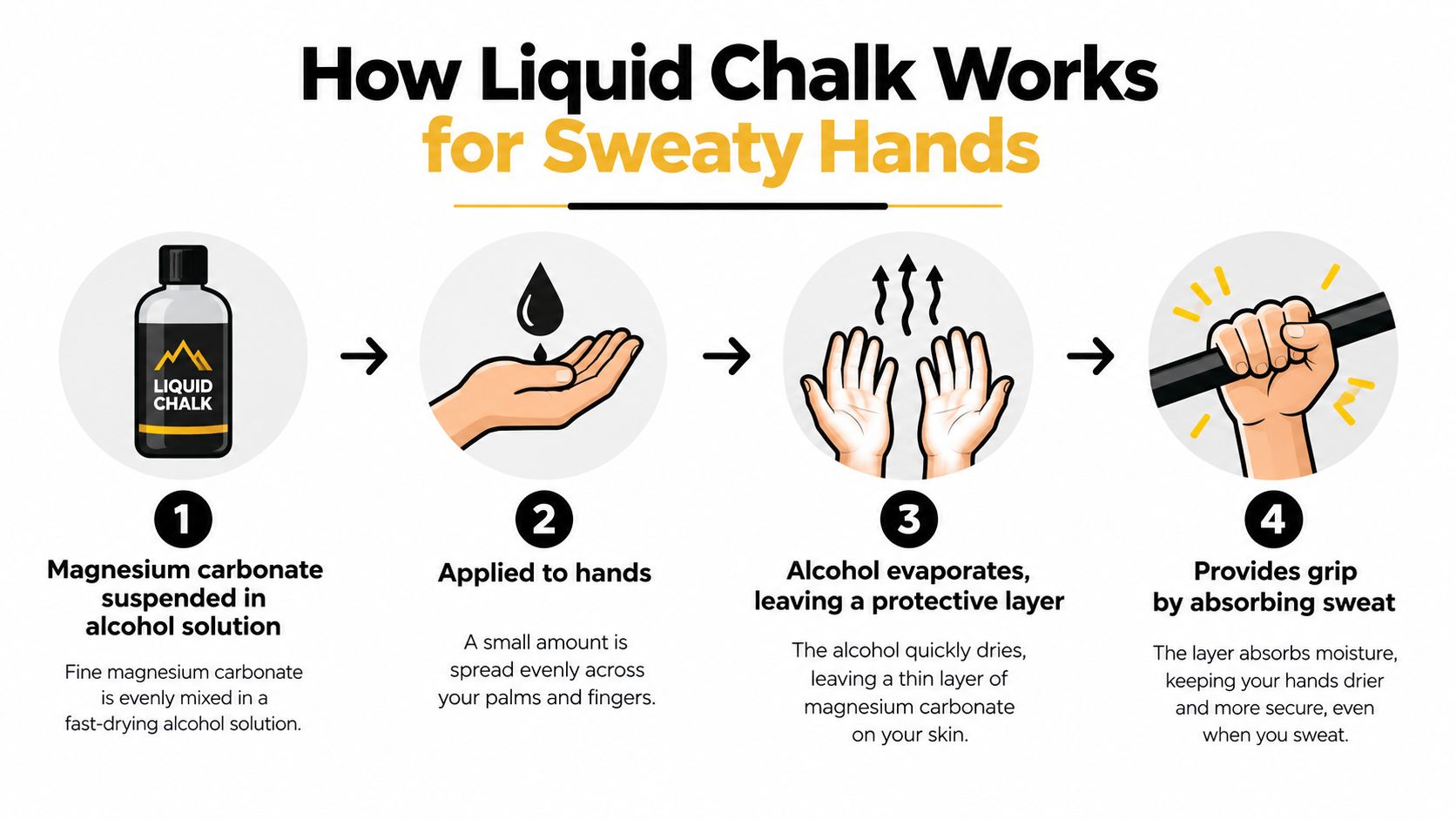
Why the film matters
Loose chalk sits on the skin as a powder. Liquid chalk begins as a spreadable solution, so it can form a more even first coat over the palm, fingers, and contact areas. That doesn't mean it will last indefinitely, especially for pronounced hyperhidrosis, but it gives the athlete a stable starting surface.
The practical sequence is simple:
- Dry the hands completely. Moisture left underneath the product weakens the initial coat.
- Apply a thin layer. Cover the areas that contact the bar, hold, pole, or apparatus.
- Rub it in evenly. Uneven patches can flake or feel rough under pressure.
- Let it dry fully. Contact should begin only after the alcohol has evaporated and the film feels dry.
EVMT Liquid Chalk follows this liquid-to-dry format for weightlifting, gymnastics, rock climbing, and other sports. Athletes evaluating a formula can also review the brand's explanation of its drying formula before deciding how it fits their routine.
The key limitation is dosage. A thin film supports grip. A thick, cracked layer can become its own slippery interface, particularly when sweat builds underneath it.
Liquid Chalk vs Powder Chalk for Sweat
Powder chalk remains useful, especially when an athlete needs a quick top-up between attempts. It spreads immediately and gives familiar tactile feedback, but loose particles can become airborne, settle on equipment, and create cleanup problems. Heavy sweat can also overwhelm a powder-only application before the session's demanding work is finished.
Liquid chalk behaves differently. It dries on the hands rather than dispersing into the air, which is why many commercial gyms permit it even when they ban loose chalk. The gym-use explanation for liquid chalk notes that it creates no dust clouds and leaves only faint, wipeable residue on contact surfaces.
| Factor | Liquid chalk | Powder chalk |
|---|---|---|
| Initial application | Even film after drying | Immediate powder coating |
| Airborne dust | Minimal compared with loose chalk | More likely to disperse |
| Sweat management | Forms a drying base layer | Absorbs moisture at the surface |
| Mid-session use | Useful for a controlled reapplication | Fast for small top-ups |
| Venue compatibility | Often accepted where powder is restricted | Frequently restricted by facility rules |
Gym policies still control the final decision. Bans commonly respond to dust filtration, residue on shared bars and pads, cleaning demands, and complaints from other members. Some gyms also restrict liquid chalk when its dried film remains visible on handles or poles, so athletes should check the facility's current rule before buying.
For readers comparing formats in a climbing context, the guide to loose climbing chalk helps clarify why powder still has a role. The strongest setup often isn't liquid versus powder. It's liquid for the initial coat and powder for selective refreshes.
Independent grip testing summarized in a technical comparison found that dry magnesium carbonate increased pinch-grip duration by 177.7%, while liquid chalk increased it by 108.8%. The result supports a practical conclusion: liquid chalk can improve grip substantially, but powder may outperform it in some high-friction benchmark tests, so the best format depends on the task and environment.
Choosing the Right Liquid Chalk Formula
A liquid chalk decision starts with the athlete's problem, not the label. Someone lifting in a tightly managed commercial gym has different priorities from a climber with sensitive skin or a pole athlete who needs a clean, controlled application. The formula should dry reliably, provide an even coat, and remain comfortable enough for repeated sessions.
Match the formula to the hand
Sensitive skin deserves attention before grip performance becomes the only criterion. Alcohol-based products can feel sharp on cuts, flappers, or already-irritated skin. Athletes with eczema-prone hands should test a small area first and stop if burning, persistent redness, cracking, or worsening irritation develops.
Drying speed matters during busy training. A formula that sets quickly supports short rest periods and rapid transitions between attempts. Sweat resistance matters for a different reason. A product can feel excellent during application yet fail if it forms a flaky layer or becomes slick after too much is applied.
| Factor | Why it matters | EVMT advantage |
|---|---|---|
| Skin comfort | Frequent users need to manage dryness and irritation | EVMT Liquid Chalk is positioned for skin-friendly use |
| Drying behavior | Fast setting keeps transitions practical | It dries in seconds |
| Grip format | A liquid coat creates an even starting layer | Magnesium carbonate deposits directly on the hands |
| Venue rules | Dust restrictions can determine what athletes may use | It makes no dust and is designed for gym use |
| Activity fit | Different contact patterns require different coverage | Variants include Classic, Weightlifting, and Rock Climbing |
EVMT Liquid Chalk has 11 variants across three option categories, with availability data listed for all 11 variants in the catalog snapshot. That gives buyers room to select a format aligned with their activity without treating every hand or venue the same.
Avoid the false promise of a complete fix
For genuine hyperhidrosis, liquid chalk should be treated as a grip aid, not a medical treatment. Independent climbing guidance says chalk alone is often insufficient for pronounced hand hyperhidrosis, and liquid chalk is better understood as a first-line base layer. If hands repeatedly become soaked despite careful application, a clinician can discuss antiperspirants or other hyperhidrosis treatments.
The useful buying test is straightforward: choose a formula that dries evenly, doesn't force excessive reapplication, and remains compatible with the gym or venue. A product that performs well but violates facility rules isn't a practical solution.
Proper Application Techniques for Maximum Grip
Application determines whether liquid chalk supports grip or turns into a brittle coating. The athlete should begin with clean, fully dry hands. Any water, lotion, or visible sweat left on the skin can dilute the first layer and reduce how evenly the product sets.
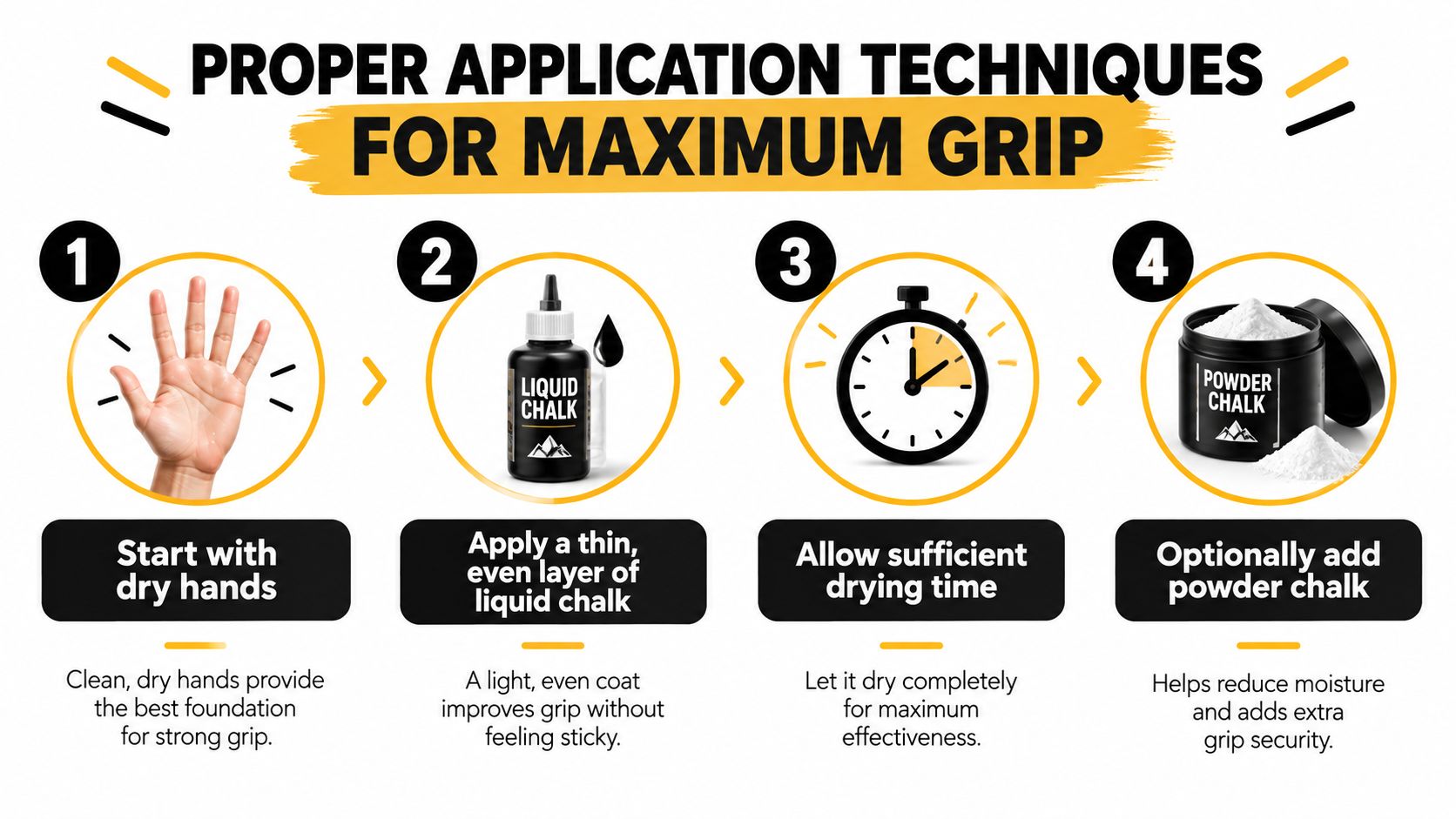
Build a thin coat
A small amount spread across the palms, fingers, and other contact areas is usually more useful than a heavy application. The product should be rubbed until the hands feel dry and evenly covered, not left with wet patches or thick white ridges.
A reliable application sequence looks like this:
- Wash and dry the hands. Remove oils, sweat, and previous product.
- Apply a thin, even coat. Cover contact areas without creating a crust.
- Wait until fully dry. A climbing guide recommends allowing 20 to 30 seconds before touching holds, particularly when using liquid chalk as a base layer. (Climbing chalk application guidance)
- Add powder only when useful. Climbers can apply a light layer over the dry base, while lifters may prefer the liquid coat alone.
- Reapply selectively. Touch up when friction drops instead of repeatedly coating the hands out of anxiety.
Application check: If the layer flakes under pressure, the problem is usually excess product, incomplete rubbing, or skin that wasn't dry enough at the start.
For long sessions, a portable bottle with a carabiner ring can keep access simple during rest periods. That convenience should support smaller touch-ups, not encourage repeated heavy re-coating. After training, hands should be washed thoroughly so dried product doesn't remain trapped in skin folds.
The Climbing Base Layer Strategy
Climbers who already use powder chalk don't need to abandon it. The more useful setup is liquid first, powder second. A coat of EVMT Liquid Chalk on dry hands creates the initial film, and powder chalk can then be applied on top once the liquid layer has dried completely.
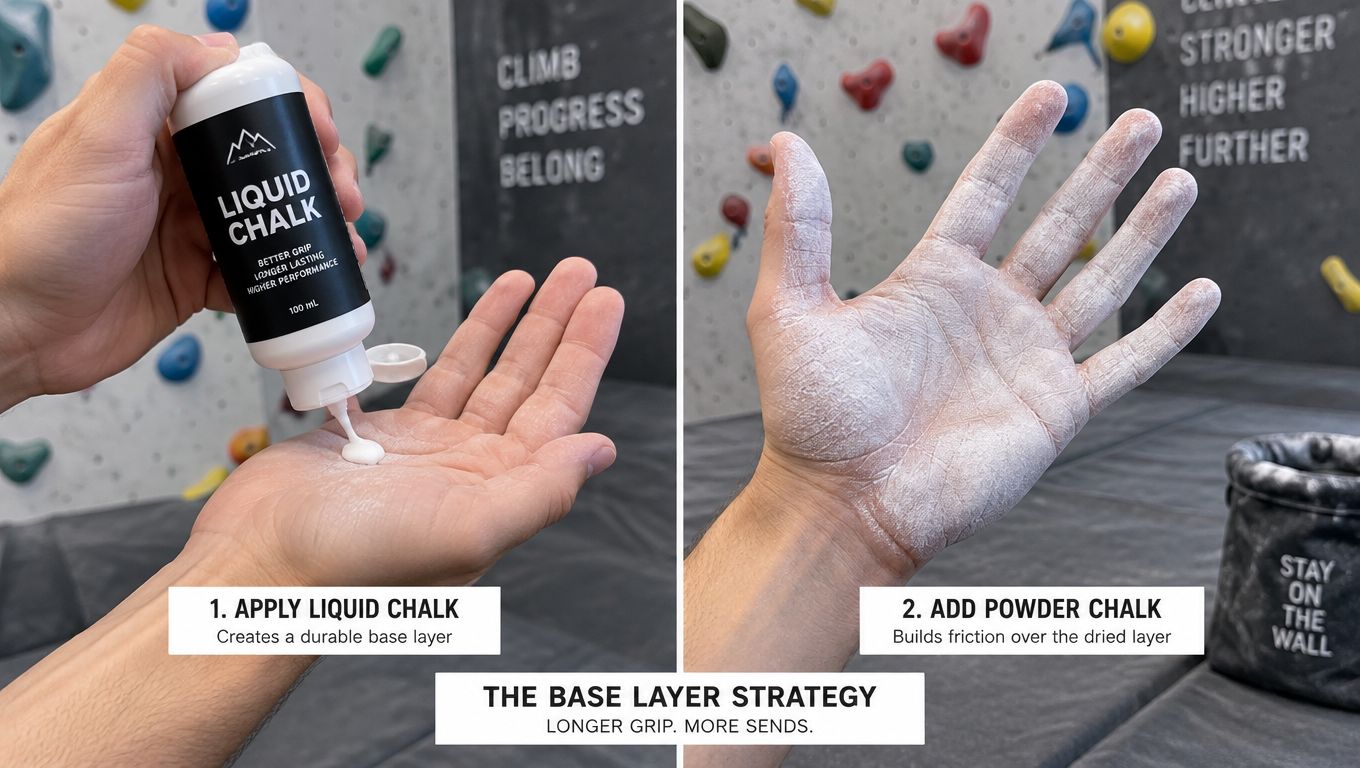
The two layers serve different purposes. Liquid chalk bonds directly to the skin and establishes the moisture-absorbing base. Loose chalk then provides the familiar feel and fast refresh option between attempts. The coat can last through more moves before re-chalking, while sweat has to work through two layers instead of one.
That approach is most useful on long sport routes, multi-pitch climbing, humid gyms, and extended sessions. It has less practical value on a short boulder problem where the athlete can re-chalk quickly between attempts and contact time is brief.
Use powder as a controlled top-up
The mistake is treating the base layer as permission to cake the hands. Climbers should brush excess residue from the skin when needed, then add only enough powder to restore the contact feel. If the hands feel greasy despite looking heavily chalked, more product may be making the interface worse.
A good routine is:
- Apply liquid chalk before the session.
- Wait until the film is fully dry.
- Add powder chalk on top.
- Use light powder refreshes when friction drops.
- Reassess the layer instead of panic-chalking every move.
This preserves the climber's existing powder-chalk habit while giving sweaty hands a more durable foundation.
Skin Safety and Managing Sweat Responsibly
A dry hand isn't automatically a healthy hand. Frequent exposure to drying formulas, repeated washing, friction, and reapplication can leave the skin tight, flaky, or irritated. Athletes who train daily need to treat skin condition as part of grip management, because cracked or damaged skin can end a session regardless of how effective the chalk feels.
Liquid chalk may be especially useful for people with sweaty hands, but it doesn't eliminate the need for sensible limits. Too much product can create a flaky layer that fails under pressure, while excessive reapplication can worsen dryness.
Build recovery into the routine
After training, wash the hands to remove chalk and residue. Once the skin is clean and dry, apply a moisturizer suited to the athlete's skin. The goal isn't to leave a greasy film before the next session. It's to restore comfort after training, then start the next workout with clean, dry hands.
Athletes should watch for warning signs:
- Persistent burning or redness: Stop using the formula until the skin settles.
- Cracks or open areas: Avoid applying alcohol-based product directly to damaged skin.
- Increasing flaking: Reduce product volume and reassess frequency.
- Sweat that remains unmanageable: Seek medical guidance rather than adding thicker chalk layers.
The discussion of whether chalk is non-toxic can help athletes think about exposure and cleanup, but it shouldn't replace attention to personal skin response. “Skin-friendly” isn't a guarantee that every formula suits every user.
Know when chalk isn't enough
Severe sweating can exceed what a grip aid can manage. When palms repeatedly become wet within minutes, liquid chalk may improve the starting grip but still fail during longer work. That's the point to consider a clinician's advice about medical options, rather than treating every failure as an application mistake.
The practical standard is simple. If the product supports grip without causing skin damage, it has a place in the routine. If performance requires constant reapplication or the skin deteriorates, the athlete needs a broader sweat-management plan.
Making the Switch to Liquid Chalk
The transition doesn't require a complete change in training habits. The athlete can test liquid chalk during a normal session, beginning with dry hands and a thin coat. The result should be judged by practical signals, such as fewer unexpected slips, less frantic re-chalking, cleaner equipment, and compliance with the venue's policy.
Choose the setup that fits the session
Weightlifters, powerlifters, CrossFit athletes, gymnasts, cheer athletes, pole fitness athletes, and climbers can use the same basic principle while adjusting the amount and timing. A lifter may use liquid chalk before bar work, a pole athlete may prioritize controlled coverage with minimal residue, and a climber may layer powder over the dry base.
For home gyms, no-dust application can be decisive. Commercial gyms may allow liquid chalk where loose chalk is banned, but athletes still need to confirm local rules because some facilities restrict any visible film. Climbers should preserve powder chalk for quick top-ups rather than treating the liquid layer as a reason to discard a familiar tool.
EVMT offers single bottles and multi-packs of its liquid chalk, with portable and higher-volume options represented in its catalog. Buyers should choose based on session frequency, travel needs, skin response, and whether the product will be used alone or as a climbing primer.
Decision rule: Start with the smallest practical change, measure how your hands behave during real work, and keep the method that improves consistency without damaging the skin.
Liquid chalk won't stop sweat glands from working, and it won't override a gym's policy. Used correctly, though, it gives sweaty-handed athletes a cleaner, faster-drying starting layer for grip-intensive training and a reliable foundation for the liquid-plus-powder climbing method.
Evermost LLC offers EVMT Liquid Chalk for lifting, climbing, gymnastics, cheer, pole fitness, and other grip-intensive training where sweat or dust creates problems. Visit Evermost LLC to choose a single bottle or multi-pack and build a cleaner grip routine around the rules of the athlete's gym or venue.