


Grip Enhancer Explained: Why Liquid Chalk Holds Longer
The bar starts slipping before the set is finished. Or a climber reaches for powder again while the next hold is still within reach. The hands feel sweaty, so adding more chalk seems obvious, but a thicker coating doesn't always produce a better grip.
A grip enhancer should solve the slipping problem without creating another one: airborne powder, paste on holds, irritated skin, or a conflict with venue rules. The useful question isn't how dry the hands can become. It's whether the right amount of product helps an athlete maintain reliable contact for the task.
Table of Contents
- Choosing Liquid, Powder, Chalk Ball or Grip Gloves
- How a Grip Enhancer Works on Sweaty Hands
- When Liquid Chalk Helps and How to Test It
- How to Apply Liquid Chalk for Lifting and Pole Work
- Layering Liquid Chalk Under Powder for Climbing
- Gyms That Ban Chalk and What They Allow
- Skin Reactions and Who Should Patch-Test First
- Choose Your Grip Aid Before Your Next Session
Choosing Liquid, Powder, Chalk Ball or Grip Gloves
The right format comes down to where an athlete trains, how much dust is acceptable, and what causes the slipping. A grip enhancer helps reduce unwanted movement at the hand's contact surface, but chalk and gloves approach that problem differently.
Liquid chalk delivers magnesium carbonate in a fast-drying carrier. Powder applies directly, while a chalk ball contains powder without eliminating its transfer to hands and equipment. Gloves introduce a material between the skin and surface rather than applying a moisture-absorbing coating.
Grip enhancer formats compared on buying criteria
| Format | Dust | Drying or contact time | Residue on bars and poles | Best for |
|---|---|---|---|---|
| Liquid chalk | No airborne cloud during application | Dries in seconds | Thin film, minimal transfer when fully dry | Lifting, pole work, gyms that permit liquid but ban powder |
| Loose powder chalk | High, airborne | Immediate on contact | Visible powder can accumulate | Outdoor climbing, gyms that allow loose chalk |
| Chalk ball, sock or bomb | Lower, contained powder | Immediate on contact | Some powder transfer | Gyms that allow contained powder only |
| Grip gloves | No chalk dust | Ready once fitted | No chalk residue, material transfer isn't established | Users who avoid applying products to skin |
Venue acceptance remains a separate buying check. A liquid format isn't automatically permitted everywhere, and a chalk ball isn't equivalent to permission to use loose powder.
Quick picks for common training settings
- Commercial-gym lifters: A liquid coating suits athletes who need sweat management without spreading loose powder around a shared weight room.
- Climbers with existing powder: Liquid chalk makes sense as a base layer, not necessarily as a replacement for the powder already used during climbing.
- Dust-sensitive home gyms: Liquid avoids the application cloud that makes loose powder difficult around household furnishings and shared spaces.
A broader hand grip aid comparison can help separate moisture management from other reasons for choosing a hand-contact aid. Gloves shouldn't be assumed to reproduce chalk's feel, drying action, or contact with small holds.
Buying rule: When loose chalk is banned, confirm permission for liquid chalk or contained powder before choosing a format.
The cleanest purchase is the format that fits both the athlete's problem and the venue's actual policy.
How a Grip Enhancer Works on Sweaty Hands
Sweat can create a thin, slippery film between skin and equipment. Magnesium carbonate works like tiny sponges, taking up moisture at that interface and leaving a drier contact surface.
The analogy has limits. Skin isn't a rigid block, and a bar, rock face, or pole isn't a perfectly uniform surface. Grip comes from the interaction among moisture, skin flexibility, surface texture, pressure, and whatever material sits between them.
Chalk's sporting history predates modern liquid formulations. Gymnasts used magnesium carbonate long before climbers adopted it, and the same moisture-management principle later spread across activities including weightlifting and wrestling.
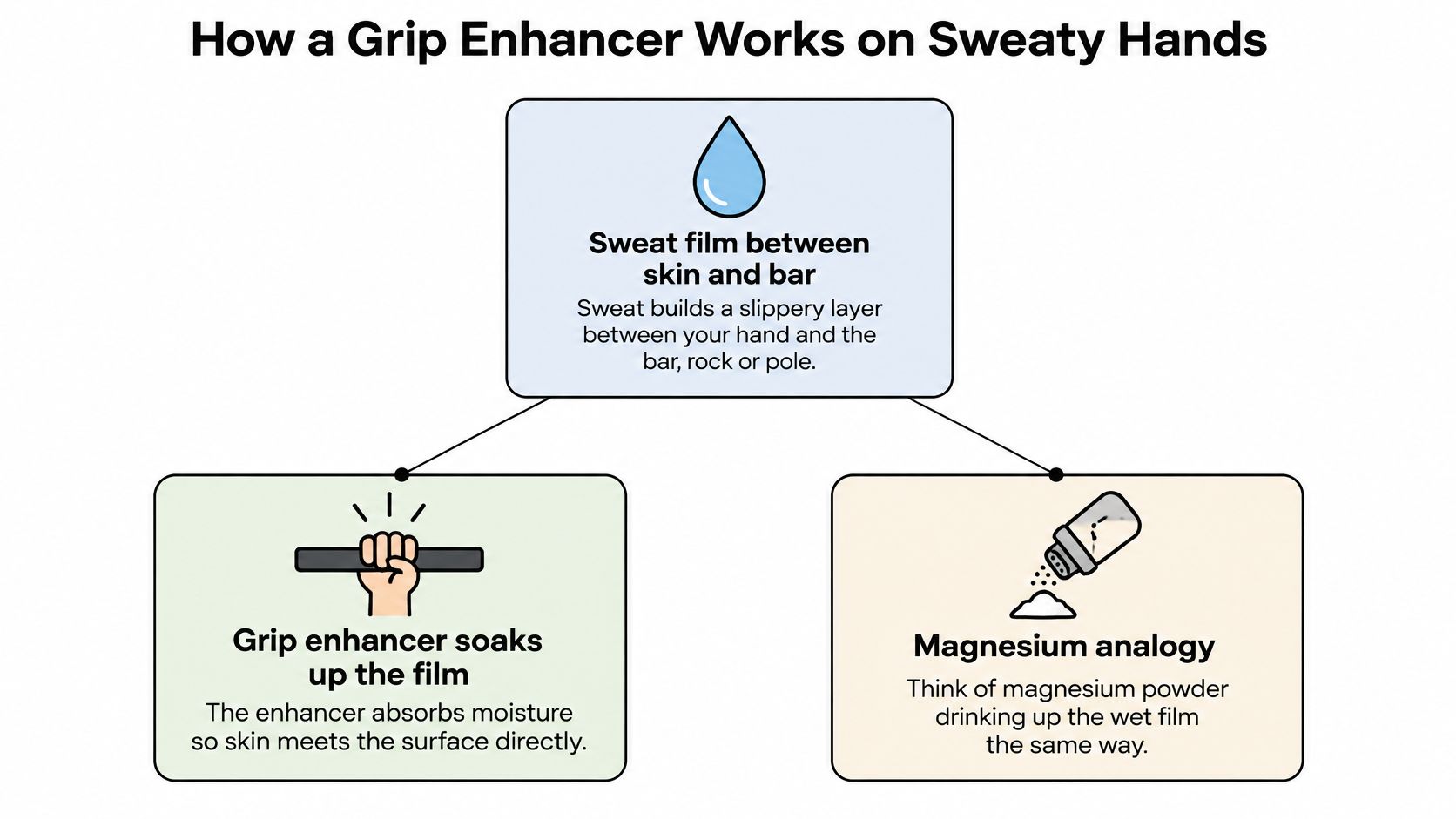
The mineral does the work after the carrier dries
The Barbell Logic lifting-chalk guide identifies magnesium carbonate as the conventional chalk material. It explains that liquid chalk uses a liquid carrier, commonly alcohol, which evaporates and leaves the mineral on the hands. At the contact interface, that mineral can fill small gaps and increase the area where skin meets the surface. The effect depends on how much product remains and how wet the hand becomes.
That is why a thick coat can feel reassuring but still fail. Filling gaps can help contact under one set of conditions, while excess material can interfere with contact under another. The same logic explains why two athletes with similar-looking sweaty palms can get different results from the same product.
The practical distinction is the source of failure:
- Moisture-related slipping: A suitable chalk coating may help maintain contact as sweat develops.
- Insufficient holding strength: The fingers still need to produce the force; chalk manages moisture at the surface.
- Poor or contaminated contact: Adding chalk isn't a substitute for checking the surface and establishing secure contact.
A powerlifter with damp palms and a gymnast struggling to maintain a hold may both reach for chalk, but their limiting factors needn't be identical. Sweat management is the job; maximum dryness isn't the goal.
When Liquid Chalk Helps and How to Test It
More chalk doesn't automatically mean more grip. Even a hand that feels noticeably drier may not produce a better result on the surface being used.
A University of Leeds finger-friction assessment compared powdered chalk, liquid chalk, rosin, and Venice turpentine. Liquid chalk performed similarly to an untreated finger on dry steel; the investigators suggested that too little product might have been applied to establish an effective moisture barrier. As water was added, friction declined for both liquid chalk and untreated fingers, while powder performed well when applied after the finger was wet.
A separate controlled finger-pad friction study found that chalk generally had a more positive effect on dry fingertips, with reduced benefit under simulated sweaty conditions and results influenced by surface roughness. These findings challenge the assumption that a chalk product can overcome any amount of sweat.
Judge the task, not just the sensation
In a study of 19 experienced recreational climbers, chalk didn't significantly change measured friction or muscular activity, yet mean hang duration increased from 49.3 seconds without chalk to 62.9 seconds with chalk. Longer usable holding time and a higher laboratory friction measurement aren't necessarily the same outcome.
A practical comparison should control the conditions that can hide or exaggerate a benefit:
- Surface: Use the same bar, pole, or hold, with the same cleaning condition.
- Moisture: Compare attempts at similar points in the warm-up and under similar sweat conditions.
- Application: Use a thin, even coating and let it dry completely.
- Task: Record a safe timed hold, repeatable set, or successful repetitions rather than relying only on feel.
- Fatigue: Allow comparable recovery and reverse the testing order during another session.
Testing shouldn't involve maximum-risk lifts, unsupported pole skills, or hanging until an uncontrolled fall. A manageable task gives a cleaner comparison.
A useful grip enhancer helps the athlete complete the task more reliably. A chalkier-looking hand isn't evidence by itself.
Liquid chalk is a sensible candidate when sweaty hands interfere with contact, particularly during sustained efforts or on textured surfaces. Smooth steel, already-dry skin, and strength-limited attempts may show little improvement.
How to Apply Liquid Chalk for Lifting and Pole Work
Application mistakes can make a suitable product feel ineffective. The common problems are damp starting skin, uneven coverage, and touching equipment before the carrier has evaporated.
- Wash away old buildup and dry thoroughly. Clean hands let a fresh coating spread evenly. Water left between the fingers or across the palms defeats the clean, dry starting point.
- Spread a small amount across the contact areas. Cover the palm and finger surfaces that meet the equipment, using only enough for a thin film. A pea-sized starting dab is more useful than pouring a puddle into the hand.
- Rub evenly and allow complete drying. The coating should finish drying before the athlete loads a bar or grips a pole. Touching equipment while it's wet can move product away from the intended contact areas.
- Check the finish. A dry, even coating shouldn't feel pooled or pasty. Remove excess rather than trying to bury it beneath another layer.
- Reapply when moisture breaks through. Renew the affected contact areas between efforts instead of following a fixed timer. A heavier opening coat isn't a substitute for checking the hands during the session.
- Wash after training. Soap and water remove the remaining coating from the hands. Equipment should be cleaned using the venue's approved method, especially where pole finishes require specific care.
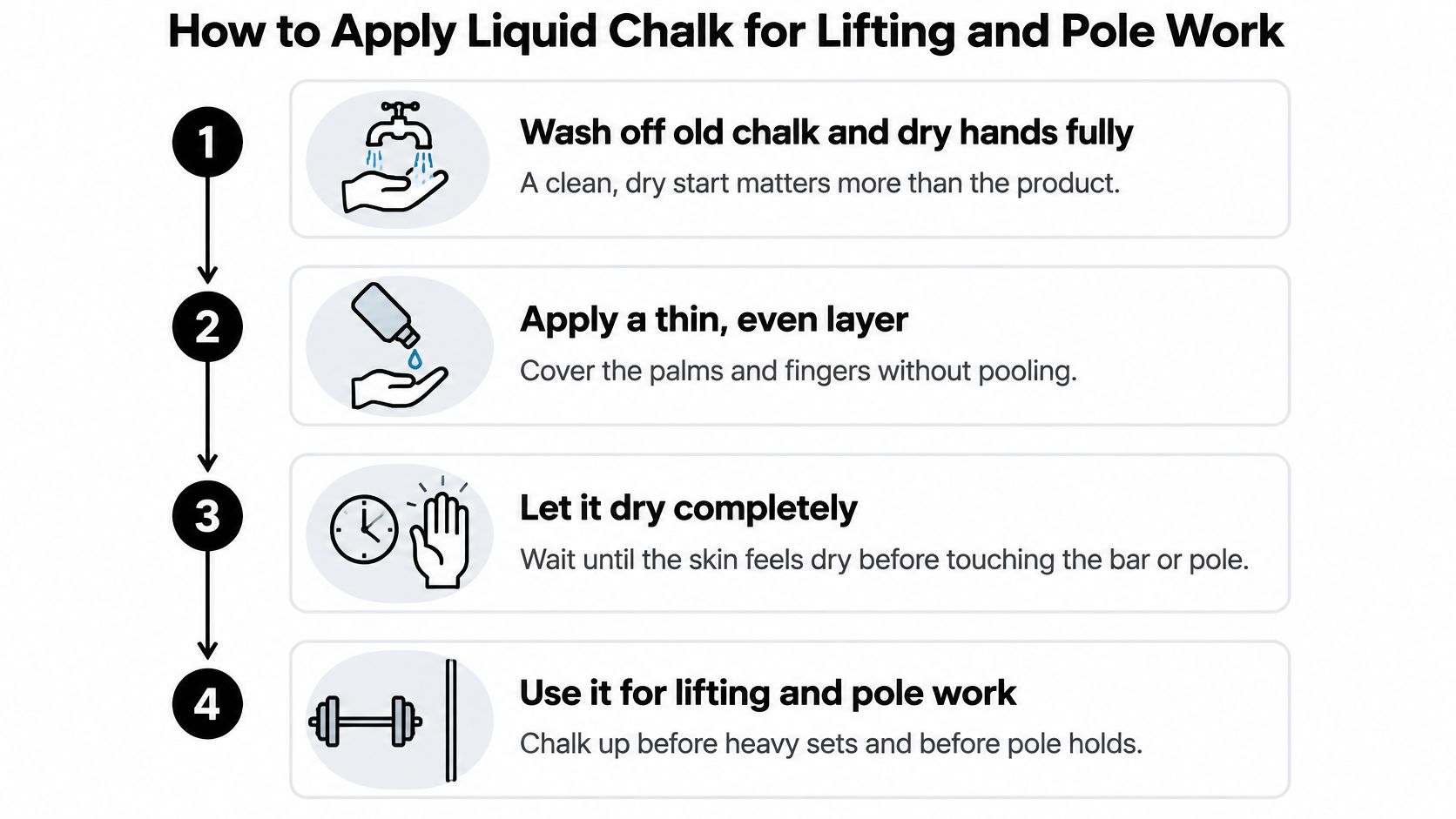
Match the correction to the failure
For a deadlift where damp palms allow the bar to roll near lockout, even coverage and complete drying are the relevant checks. If the hand opens because the load exceeds holding strength, another coat won't solve that limit.
For pole work, a wet or excessive application can undermine the intended contact. The athlete should remove pooled product and assess a fully dried coating during a controlled, low-risk movement before attempting a demanding routine.
A gymnast whose palms become sweaty between routines needs a fresh, controlled application between efforts. A CrossFit athlete losing contact during repeated pull-ups should assess sweat breakthrough between sets rather than starting with a thick coating.
Athletes also need to separate grip-product use from broader lifting preparation. Peak Performance's resource on strength training for beginners offers context for the training side, which chalk doesn't replace.
Thin coat. Complete drying. Reapplication when needed. Those habits matter more than making the hands visibly white.
Layering Liquid Chalk Under Powder for Climbing
A climber three bolts up a humid sport route reaches for the chalk bag, finds the powder has turned slick on already damp skin, and loses rhythm. Layering liquid chalk under powder addresses that sweat-management problem: a liquid base creates a grip layer, and a light powder top-up keeps the surface dry between chalking opportunities.
Where a liquid base layer helps climbers most
| Climbing setting | How much the base layer helps | Why |
|---|---|---|
| Short boulder problems | Least opportunity for benefit | Few moves leave less time for sweat to build |
| Long sport routes | Most useful when repeated re-chalking interrupts climbing | A lasting coat can cover more moves before renewal |
| Multi-pitch climbs | Most useful when coating durability matters between opportunities to chalk | Less frequent mid-route re-chalking can be helpful |
| Humid gyms | Most useful when sweat quickly compromises powder alone | Moisture must pass through both coatings |
The table is a set of use cases, not a ranking. Dry hands on a short boulder may notice little difference; a sweaty-handed climber on a sustained route has more reason to test the method. Liquid chalk cannot add holding strength when the muscles or tendons are the limit. Sweat must pass through both layers, so the method buys time before powder alone turns slick. The aim is a longer-lasting coat with less frequent re-chalking; it does not promise stronger fingers.
The climbing-specific order is Liquid first, then Powder last. Apply the base to clean, dry contact areas, follow the same drying and handling care as for a lifting application, and add powder only if the venue permits it. The base should sit thin and even, like a primer coat rather than a paste. Heavy product pressed together can ball up and transfer to holds, so restraint matters more than visible whiteness.
A successful layered session means fewer re-chalk stops on the same route.
Test the method across comparable sessions: a long sport route in a humid gym, a multi-pitch day where coating durability matters, or two similar sessions with and without a primer. Count re-chalking stops rather than assuming the layered approach must help every climb.
Gyms That Ban Chalk and What They Allow
Cove Bouldering's January 2024 policy prohibited loose chalk while allowing powder inside a purpose-built chalk ball, sock, or bomb, as well as liquid chalk. The policy also advised a pea-sized liquid application, warning that excess can form paste on holds.
That distinction matters at purchase time. A ban on one format isn't necessarily a ban on magnesium carbonate itself.
Chalk formats against a real venue policy
| Chalk format | Cove Bouldering rule (Jan 2024) | What it means for the athlete |
|---|---|---|
| Loose powder chalk | Banned entirely | Leave loose powder outside this gym |
| Powder in a chalk ball, sock or bomb | Allowed | Keep powder contained rather than emptying it loose |
| Liquid chalk | Allowed | Use the policy's small application to avoid paste on holds |
Loose powder can disperse through the room and settle on equipment. Contained formats give venues a way to manage that mess without necessarily excluding chalk altogether.
Check the wording before buying
- Read the posted policy: Look for distinctions among loose powder, contained powder, and liquid.
- Confirm liquid permission: A general chalk ban may be broader than a loose-powder restriction.
- Ask about containment: Establish whether a chalk ball must remain enclosed and how it may be used.
- Check shared containers: Permission for personal contained powder doesn't establish permission for open communal buckets.
A gym chalk guide can help identify the format questions worth asking, but the venue's own rules remain decisive. Competition organizers may also set requirements separate from the training facility.
Permission doesn't mean unlimited application. A venue can allow liquid chalk while still expecting clean holds, controlled quantities, and prompt cleanup.
Two assumptions cause avoidable problems: treating a loose-chalk ban as a liquid-chalk ban, and applying a climbing gym's policy to a commercial weight room. Confirm the actual rule before committing to a multi-pack.
Skin Reactions and Who Should Patch-Test First
Skin irritation deserves attention without treating every dry palm as an allergy. A dermatology case report described recurrent facial swelling associated with liquid chalk exposure and positive patch tests to colophony and abitol, resin-related substances found in some friction-enhancing products. Possible transfer from contaminated gym equipment to the face was also identified.
That report doesn't establish that every liquid chalk contains those ingredients. It does show why the complete formulation matters, including additives rather than magnesium carbonate alone.
Irritation and allergy need different responses
Alcohol-containing products can sting damaged or cracked skin. That sensation doesn't establish an allergy, but persistent burning is a reason to stop rather than keep applying.
Delayed itching, an eczema-like rash, or swelling can indicate a different reaction. Symptoms alone can't reliably identify the ingredient responsible; clinician-directed patch testing is different from a small home tolerance check.
- Check ingredients: Review resins, fragrance, and other additives, particularly after a previous reaction.
- Protect damaged skin: Avoid applying product to open cracks or active irritation.
- Test cautiously: On intact skin, a small-area trial over several days may reveal intolerance, but it can't rule out allergy. People with eczema or previous reactions should seek clinical advice before deliberate re-exposure.
- Limit transfer: Wash hands before touching the face, and avoid sharing bottles where practical.
- Respond to warning signs: Stop use and obtain medical advice for a spreading rash or facial swelling. Lip, tongue, or throat swelling, or breathing difficulty, requires urgent medical attention.
A discussion of whether chalk is non-toxic should remain separate from whether a particular person tolerates a particular formula. Non-toxic doesn't mean non-irritating or allergy-proof.
Low airborne dust also doesn't establish compatibility with sensitive skin. Skin-friendly claims should rest on the tested formulation, not on the absence of a powder cloud.
Choose Your Grip Aid Before Your Next Session
Start with the source of the slip. Sweat on a bar or pole calls for a moisture manager such as liquid chalk. On a long climb, repeated re-chalking may call for a liquid primer under powder. A loose-powder restriction calls for an approved liquid or contained format. Previous skin reactions call for ingredient review and a small-area tolerance check before full-session use.
Grip is a sweat-management problem, not a dryness contest. Chalk works like a thin towel between skin and equipment, absorbing moisture so contact stays predictable. The benefit depends on correct application and identifying the underlying source of slipping. If the issue is poor technique, a cracked bar, or skin already irritated, grip aid will not solve it by itself.
Run a controlled comparison: the same manageable task, similar conditions, and an observable result such as hold time or reliable repetitions. Use a thin coating, let it dry fully, and note whether the grip feels steady through the set. That gives you a practical answer faster than switching products at random.
EVMT Liquid Chalk is a magnesium-carbonate option for lifting, climbing, and gymnastics. It dries in seconds without a dust cloud, reduces hand sweat, washes off with soap and water, and can serve as a primer beneath powder. The business states that its formula is backed by research to improve grip and help prevent blisters and slips.
Evermost LLC offers liquid chalk in 50 ml portable bottles and 250 ml high-volume sizes. Choose the bottle size that fits an approved venue and training routine, then judge a thin, fully dried coating during the next controlled session.