


Gym Chalk Verdict: Liquid Wins Where Powder Is Banned
A heavy pull reaches the knees, the legs still have drive, then the bar starts to roll through damp fingers. That failure isn't a strength problem. It's a contact problem, and gym chalk exists to remove the moisture that causes it. Format still matters, because dust, residue, and venue rules separate a useful coat from a product left in a locker.
Table of Contents
- Gym Chalk Formats Compared at a Glance
- Why Chalk Works on Sweaty Hands
- Whether Chalk Really Makes Your Grip Last Longer
- How to Apply Liquid Chalk Step by Step
- Fixing Residue, Slippery Bars and Dry Skin
- Matching Chalk Setup to Your Sport and Gym
- Liquid Base Layer Under Powder for Climbing
- Checking Venue Rules Before You Buy
Gym Chalk Formats Compared at a Glance
The same grip failure has three different prices: a powder cloud that gets a lifter stopped in a commercial gym, dust nobody minds on an outdoor platform, and a climbing route where a thin base under loose chalk decides whether fingers stay on a small edge. Start with the room. EVMT Liquid Chalk fits spaces that ban loose chalk, loose powder fits chalk-friendly floors and open air, and block or ball sit between them when spill matters more than policy.
Gym chalk comes in four formats. They differ mainly on dust, residue on bars and poles, and where venues allow them. Grip ingredients are similar. Delivery decides whether staff tolerate the product.
| Format | Dust | Residue on bars and poles | Typical gym policy | Best use |
|---|---|---|---|---|
| Liquid chalk (EVMT Liquid Chalk) | Almost none | Little to none once dry | Often allowed where loose chalk is banned | Lifting, CrossFit, gymnastics, pole and climbing base layer |
| Loose powder chalk | High; settles on floors, mirrors and consoles | Visible white film | Often restricted to lifting platforms or banned | Open-air climbing and heavy pulls where allowed |
| Chalk block | Moderate; dust released when rubbed | Rubs onto bars and holds | Front desk approval needed before use | Quick hand top-up during climbing |
| Chalk ball | Low; puffs out when tapped | Light; depends on how firmly it is pressed | Front desk approval needed before use | Climbers who want a loose-chalk feel with less spill |
Reading the Table Honestly
Liquid chalk fits commercial gyms, shared studios, and home setups where floors, mirrors, and consoles must stay clean. It goes on wet, dries on the hands, and leaves little for other members to breathe or staff to sweep. Reapplication takes longer than dipping into a bucket, so it suits sessions where one coat should carry through work sets rather than constant top-ups.
Loose powder remains the budget choice for outdoor climbing and chalk-friendly platforms. Cost per session is low and reapplication is instant. The trade-off is mess. Powder travels onto clothing, mats, and machine screens within minutes.
Blocks and balls reduce spillage without removing dust. A block rubs a concentrated layer onto skin and equipment. A ball meters powder through mesh, so the coat is thinner and cleaner, though it still puffs when squeezed hard.
Practical rule: Choose by the room first, required grip duration second, and residue tolerance third. The best-feeling chalk is useless if staff stop the set.
I treat climbers' liquid-plus-powder setup as a separate decision, not a loophole. A liquid base under loose chalk helps adherence on tough routes only where powder itself is allowed; if the venue bans dust, liquid alone is the compliant option.
Why Chalk Works on Sweaty Hands
A dry towel grips a wet glass better than a damp towel does. Gym chalk works the same way: it leaves a dry mineral film on the palm, so skin meets knurling, hold texture, or pole instead of sliding on water.
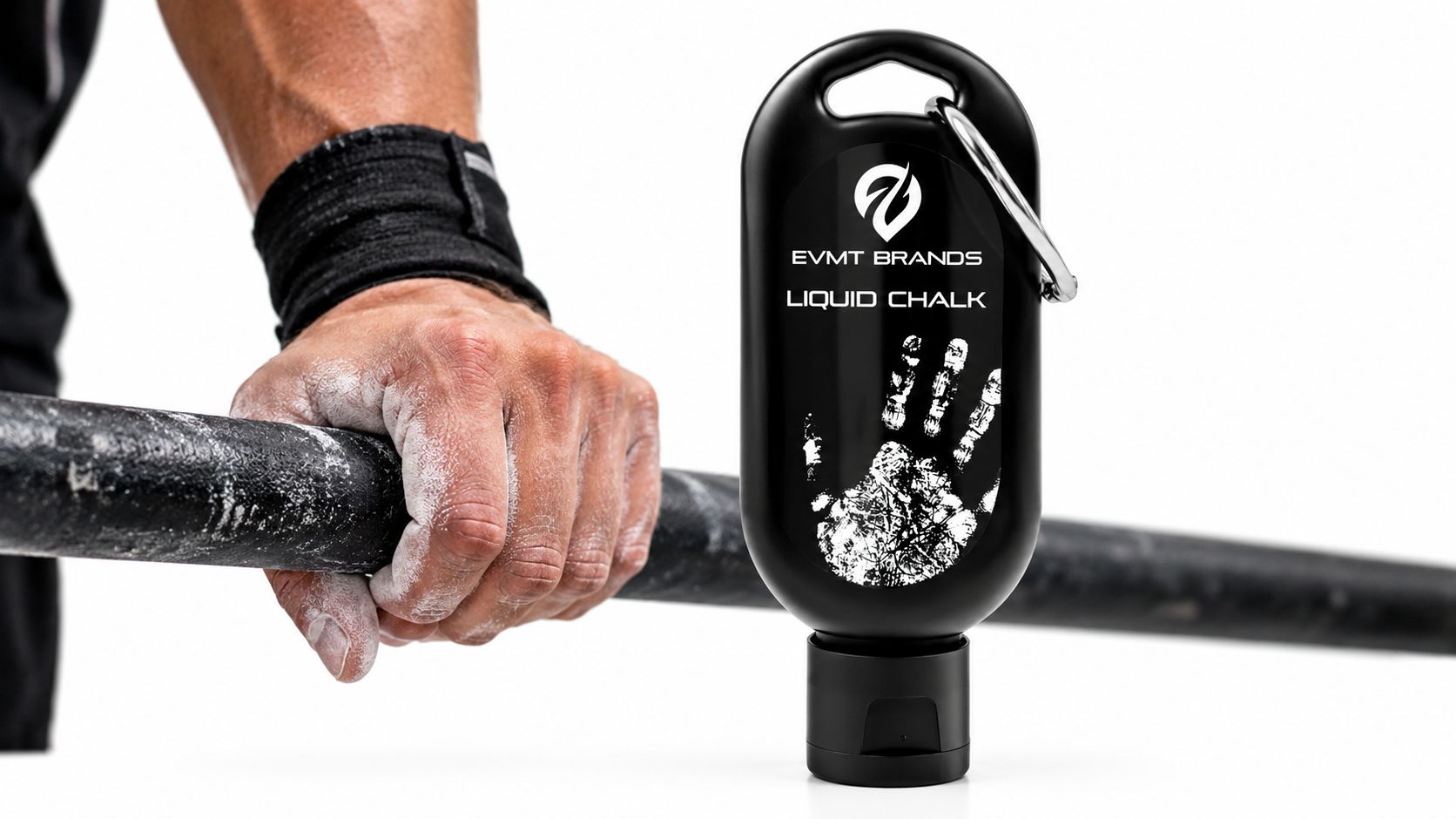
The active material is magnesium carbonate (MgCO₃), described in the 2021 National Geographic rock climbing document as a drying compound that reduces hand moisture and can increase friction between skin and equipment or rock. Magnesium carbonate pulls water off the surface, so the skin touches steel. For material background, use the guide to gym chalk and magnesium carbonate.
Where Sweat Breaks Contact
Sweat creates a thin water film between palm and bar. The bar rolls toward the fingertips even when forearm strength is fine. The lifter squeezes harder, the skin shears, and calluses tear.
The same failure shows up in different grips:
- Deadlifts and pull-ups: Water lets the bar rotate inside the hand.
- Pole work: Moisture fills the contact patch, so spins and holds slide.
- Small climbing edges: Damp skin loses the few crystals carrying the load first.
The useful contrast is dryness versus tack: chalk earns its keep by keeping the contact surface dry.
That is why format choice follows the room. Loose powder dries fast but leaves dust; liquid suits spaces that restrict loose chalk because it leaves far less residue; a climber's liquid base under powder is a separate decision for long routes, not a stickiness trick.
Whether Chalk Really Makes Your Grip Last Longer
Rep one feels welded to the bar. By rep six, the same bar creeps toward the fingertips. That gap between the first pull and the last is where chalk earns its place: it extends how long grip stays usable, even when peak friction stays the same.
In the Northern Arizona University research record on magnesium carbonate chalk, 19 experienced recreational climbers averaged 49.3 ± 25.2 seconds on a hang without chalk and 62.9 ± 36.7 seconds with chalk, a statistically significant difference at P = .046. Coefficient of friction, geometric entropy, hand-to-foot vertical-force ratio, and average muscular activity showed no statistically significant differences. The study measured longer hangs, not higher friction.
What the Result Means
Chalk kept contact usable longer by managing sweat, cutting perceived slippage, and holding conditions steady from move to move. Endurance improved because hands stayed workable.
That distinction matters in the weight room. Judging chalk by the first pull flatters it. The last rep of the last set shows what it does.
A Test Any Athlete Can Run
Track the same session across a week with and without chalk:
- Hang time: Time a dead hang or top hold under the same conditions.
- Failed reps: Count sets ended by slipping rather than target-muscle fatigue.
- Bar control: Note whether the bar migrates toward the fingertips mid-set.
- Reapplication point: Record when sweat breaks through and grip fades.
Keep load, rest, and exercise order steady. One heroic session proves little. A repeated pattern proves plenty.
Judge chalk by endurance, failed-rep rate, and consistency, not friction alone.
Limits deserve plain language. The study tested magnesium carbonate chalk in general, not liquid chalk specifically. The case for a liquid base layer lasting through more moves comes from layering logic: climbers apply liquid chalk as a primer under powder so the top coat adheres better and grip holds longer on tough routes. In gyms that ban loose chalk, a sweat-resistant liquid formula is the format that fits the rules. Excess buildup can still dull tactile feedback and leave abrasive residue, so renewal belongs at the moment sweat breaks through, not on a fixed schedule.
How to Apply Liquid Chalk Step by Step
Liquid chalk applied to damp palms goes tacky within a set. Moisture sealed under the film softens the coat, transfers it to the bar, and leaves it flaking once real load arrives. Technique decides more here than the product does.
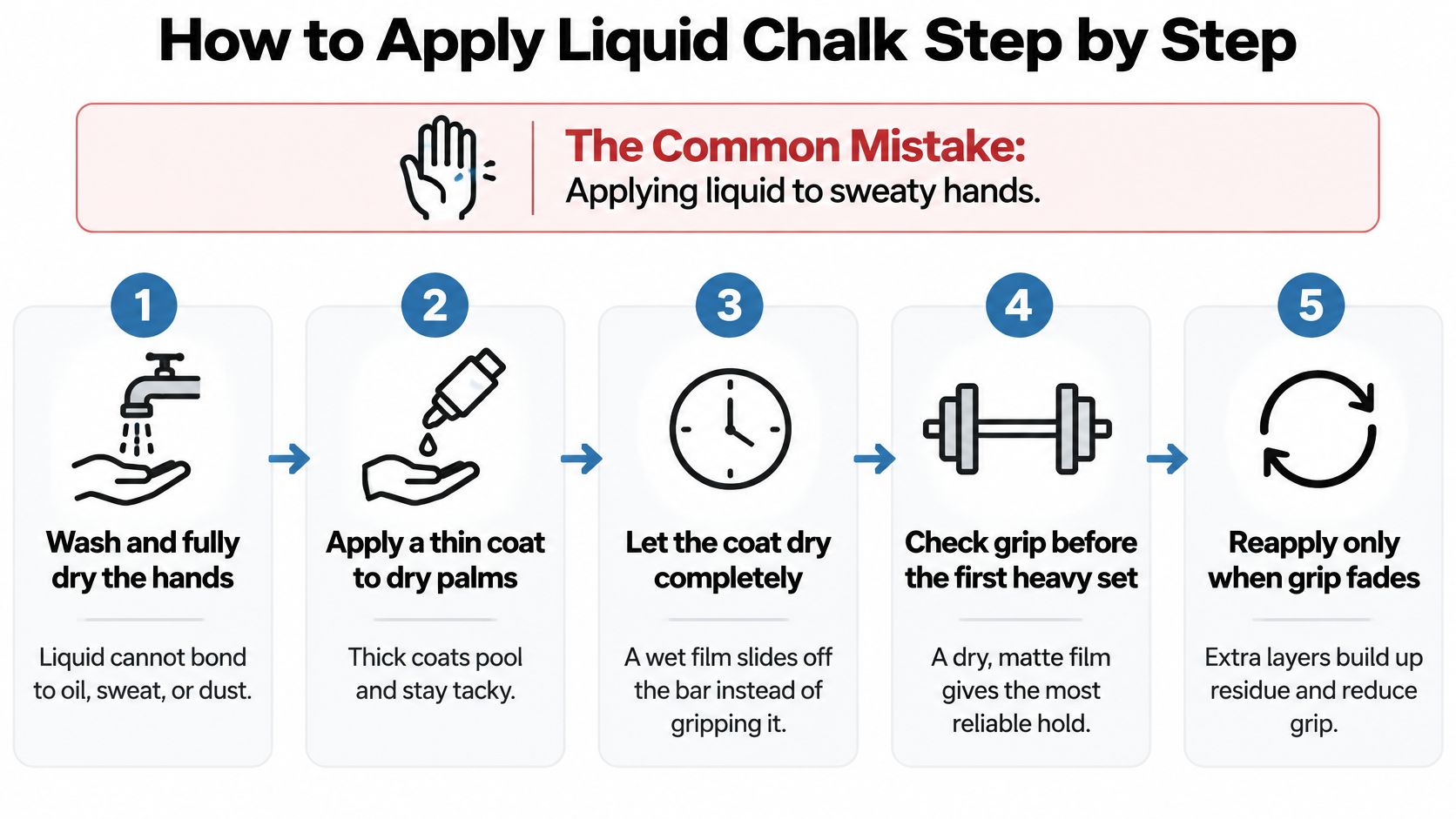
The Routine
- Wash and fully dry the hands. Liquid cannot fix moisture, oil, or old chalk already sitting on skin.
- Shake the bottle and dispense a small amount. A thin film dries evenly, while a heavy pool stays tacky.
- Spread one even layer over palm and fingers. Coverage should reach every contact point, including finger pads and thumb.
- Let the coat dry fully until matte. Grip comes from dry residue, and a wet coating has none.
- Grip the bar or pole only after drying. Early contact transfers the coat to equipment instead of keeping it on skin.
- Reapply only when sweat breaks through. Add one thin layer to clean, dry skin rather than stacking over a wet film.
EVMT's Weightlifting Liquid Chalk has an extra-thick consistency for maximum coverage and prevents bar slippage and callus tears, so restraint with quantity matters even more. A little spreads further than expected.
The thin-coat rule doubles as the venue rule. Most gyms allow EVMT Liquid Chalk because it creates almost zero mess compared to loose chalk, and that holds only when the film dries before it touches anything.
Why Dry Hands Win
Magnesium carbonate absorbs surface moisture and fills the microscopic gaps between skin and steel. That mechanism only works when the film starts dry. Water trapped underneath stays there under a heavy pull and turns the coat into a slick layer, while loose particles sitting on top of a wet film can roll like a granular slip layer under load.
A correct coat is easy to read. The finish goes matte, the palms feel dry to the touch, and the bar stays where you set it on the first pull without extra squeeze. Hands that still feel tacky after a minute of air time got too much product or started damp; wipe the coat off, dry the skin, and go again with less.
Fixing Residue, Slippery Bars and Dry Skin
Most chalk problems trace back to three causes. The coat went on wet, the amount was too large, or frequent use over-dried the skin. Diagnosis beats adding more product.
The residue rule is clear. Liquid chalk does not leave white residue on barbells, poles, or apparel once it dries. Visible white film usually means the coat was heavy or still wet at contact. EVMT Liquid Chalk reduces hand sweat and is easy to wash off with soap and water, so cleanup is a fix after mistakes, not a complicated routine.
| Symptom | Likely cause | Fix |
|---|---|---|
| White film on bar or pole after training | Coat was too thick or not fully dry | Wipe the surface with soap and water, then use less product next session |
| Grip slips partway through a set | Sweat broke through a thin or wet coat | Let the coat dry fully, then add one thin layer on clean skin |
| Hands feel tacky or sticky | Wet coat applied, or product built up in layers | Wash hands with soap and water, dry them, and reapply a single thin coat |
| Chalk flakes or rubs off quickly under load | Film too thin for the load, or moisture under the film | Dry hands fully and apply a slightly fuller single coat, never a layer over wet film |
| Residue on clothing or grips | Excess product transferred during contact | Wipe excess from hands before gripping and wash apparel after training |
| Dry, cracked skin after heavy use | Frequent application over long periods | Apply less often and moisturize away from training |
Cleaning Skin and Equipment
Soap and water handle skin. The separate instructions for removing liquid chalk cover stubborn buildup. Pole studios may ask for an alcohol wipe on the pole between users, which returns the surface to neutral for the next athlete.
Bars need a wipe, not a deep clean, when a wet coat transfers. Clothing usually releases residue in a normal wash once excess product stops transferring.
Visible white residue is feedback about timing and quantity, not proof that more chalk is needed.
Skin deserves the same restraint. Moisturizer belongs after training, never right before lifting, since lotion under chalk recreates the slip problem. If the same fix hasn't worked after a few sessions, changing the amount or formula beats repeating the habit and blaming grip strength.
Matching Chalk Setup to Your Sport and Gym
A deadlift stalls when hands slip, so lifters think about chalk first. A pole studio asks a different question: what leaves the surface neutral for the next athlete. The right setup comes down to three things: what the venue permits, how long the grip has to last, and how much residue the space tolerates.
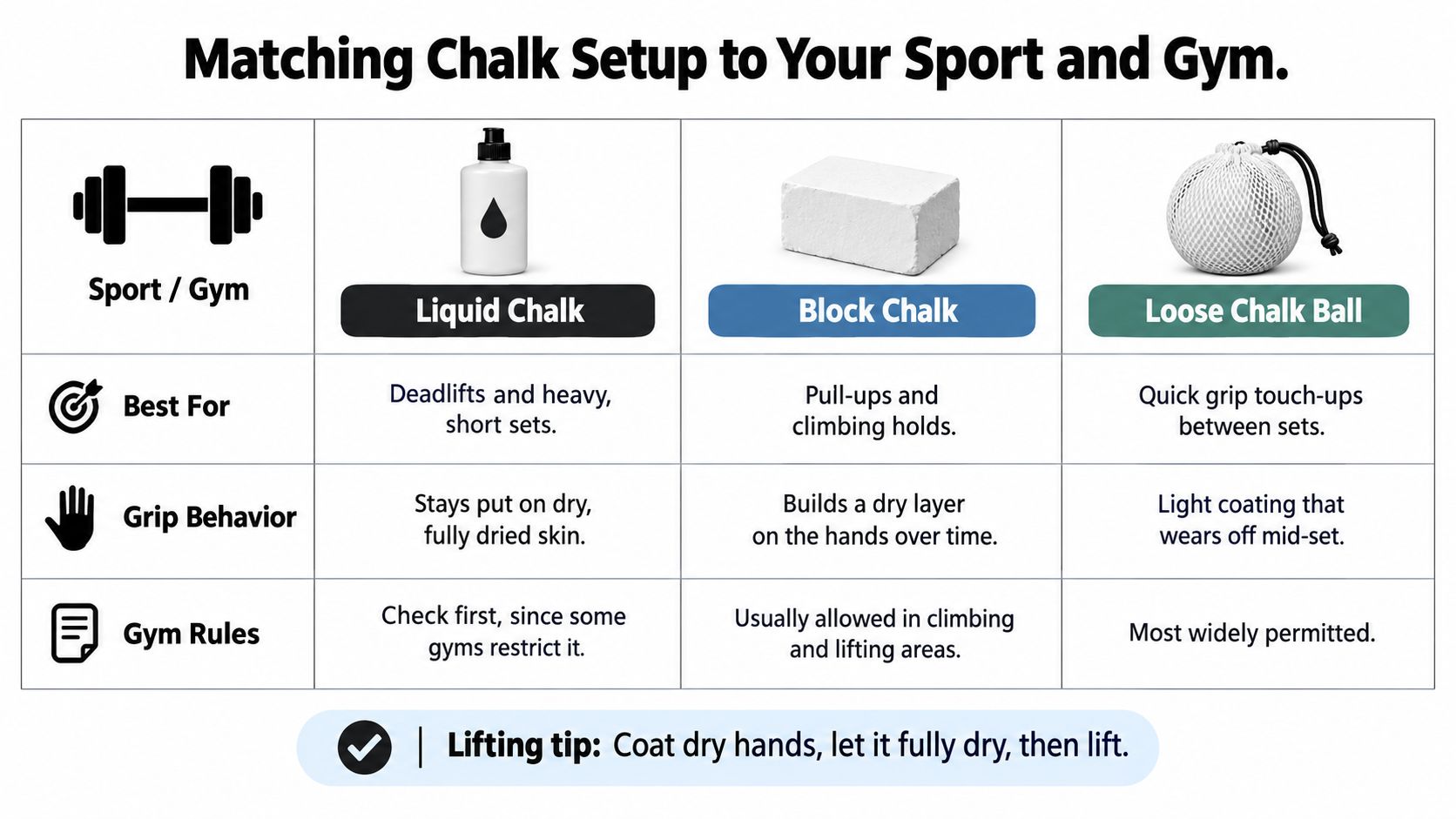
| Situation | Liquid chalk role | Powder on top | Why it fits |
|---|---|---|---|
| Heavy deadlifts and Olympic lifts | Liquid on dry hands, fully dried | Only if the venue allows powder | A dry film resists bar slippage in short, heavy sets |
| CrossFit and mixed high-rep workouts | Liquid on dry hands | Not usually needed | One coat carries across many movements in a shared gym |
| Gymnastics, cheer and dance | Liquid on dry hands | Only where the venue permits | Dries clean on shared floors |
| Pole fitness | Applied to hands before the set | Usually not | Dries fast with no powder cloud; confirm studio rules and clean the pole after use |
| Humid gyms and sweaty sessions | Liquid on dry hands | Optional | Film is set before the first pull, so sweat meets dry residue |
| Home gym where dust is not allowed | Main chalk | Not used | No dust cloud to clean from floors and equipment |
| Competition arena | Liquid if the organiser permits it | Not where powder is banned | Check the organiser's rule before packing |
EVMT Liquid Chalk comes in three types for these calls: Classic for gym, CrossFit, gymnastics, dance and sports; Weightlifting, with an extra-thick consistency for powerlifting, Olympic lifts and bodybuilding; and Rock Climbing, made for indoor and outdoor climbing on small holds and crimps.
Two rows deserve a second look. A powerlifter at a chalk-friendly gym gains little from liquid alone when powder is allowed; the thick Weightlifting coat earns its keep where loose chalk is banned, because it prevents bar slippage and callus tears without raising a dust cloud. A parent buying for a youth gymnast decides differently again: liquid chalk is safe and frequently used by youth gymnasts, cheer athletes and dancers under adult supervision, and it leaves no white residue on barbells, poles or apparel once dry.
Climbers sit outside this table. They keep the powder bag and treat liquid chalk as a primer underneath for better adherence and longer grip on tough routes, which is a layering decision rather than a format swap.
Grip is also only one training variable. A lifter logging barbell sessions alongside protein intake can use nutrition tracking for muscle gain to keep the eating side as structured as the lifting side.
Liquid Base Layer Under Powder for Climbing
Climbers already own powder chalk and aren't looking to replace it. Liquid chalk earns its place as a base layer, not a substitute. The powder bag stays. The liquid goes underneath.
The Two-Layer Method
- Start with clean, dry hands. Old chalk and sweat weaken the base.
- Apply a thin coat of EVMT Liquid Chalk. Cover palms, fingers, and fingertips evenly.
- Let it dry fully until matte. Powder over a wet film clumps and slides.
- Add powder chalk on top as normal. Regular chalking habits stay unchanged.
Sweat then has to work through two layers instead of one. The coat lasts through more moves before re-chalking, which means fewer trips to the bag mid-route and fewer one-handed shakes on marginal rests.
Where It Helps and Where It Doesn't
- Long sport routes: Fewer re-chalks matter when rests are poor.
- Multi-pitch climbs: A durable base reduces fuss at belays and on sustained pitches.
- Humid gyms: Two layers slow sweat breakthrough during crowded sessions.
- Short boulder problems: Gains are small because re-chalking between attempts is already quick.
Rock type, moisture, and surface texture change how chalk behaves, and dry fingertips respond better than sweaty skin. Friction also becomes more consistent across most conditions, but no surface reacts identically. Testing the base layer on the actual rock or hold material being climbed beats trusting a general claim.
The promise is fewer re-chalks and a longer-lasting coat, not a measured number of extra minutes.
Discipline matters. A thick liquid layer under heavy powder creates buildup that dulls feel on small holds. Thin, dry, then powder. That order protects tactile feedback while extending the working life of each application.
Checking Venue Rules Before You Buy
Venue policy decides most purchases. Many gyms ban loose chalk but allow liquid chalk, so format choice starts at the front desk rather than the checkout page. The practical split is residue and control: powder can drift onto floors, mirrors, consoles and shared equipment, which is why some facilities confine it to a platform zone or ban it outright. Liquid chalk leaves little airborne dust and minimal residue once dry, so it is usually the easier format to clear with staff.
Rules still vary by room. A commercial gym may allow liquid anywhere but keep loose chalk at lifting platforms. A pole studio may permit liquid chalk, restrict resin products, and expect the pole to be cleaned between users. A CrossFit box may care less about dust than about keeping bars and rigs clean between classes; athletes can review liquid chalk choices for CrossFit before asking the owner.
Two Rule Patterns Worth Knowing
Competition rules can be stricter than daily gym rules. Organisers may provide no chalk, limit powder in the arena, or specify which formats athletes may bring, so the event notice matters more than a general gym policy.
Youth and studio settings add supervision and cleanup expectations. EVMT sells Classic Liquid Chalk, Weightlifting Liquid Chalk, and Rock Climbing Liquid Chalk; its liquid chalk is used by youth gymnasts, cheer athletes and dancers under adult supervision. For climbers, the base-layer choice only matters after permission: where powder is banned, liquid alone is the option; where powder is legal outdoors, liquid can serve as a primer under loose chalk.
Before Packing a Bottle
- Ask the venue or organiser whether liquid and powder are allowed, and where.
- Confirm the sport-specific policy, since gymnastics arenas and pole studios differ from lifting gyms.
- Start with a 50 ml bottle, then move to a 250 ml size if the routine fits training.
Applied to dry hands and allowed to dry fully, liquid avoids airborne powder, subject to each venue's own rules.
Evermost LLC offers EVMT Liquid Chalk in Classic, Weightlifting and Rock Climbing formulas for lifters, climbers, gymnasts, pole athletes and home-gym owners who need grip without powder dust. Athletes can choose between 50 ml portable bottles and 250 ml high-volume sizes, match the format to venue rules, and order directly from Evermost LLC.