


Rock Climbing Chalk: Liquid Base Layer Lasts Longer
The next hold looks manageable, but the climber's fingertips already feel slick. Another handful of rock climbing chalk seems like the obvious fix, until the same slip returns a few moves later. The useful choice isn't more powder. It's the right chalk for the moisture, the length of the climb, and the venue's rules.
Table of Contents
- Why Grip Fails Halfway Through a Session
- Pick Your Rock Climbing Chalk by Setting
- How Chalk Actually Keeps Your Hands Gripping
- How to Layer Liquid and Powder Chalk Step by Step
- Dust, Residue and Venue Rules That Shape Your Choice
- Liquid Chalk for Lifting, Pole and Gymnastics
Why Grip Fails Halfway Through a Session
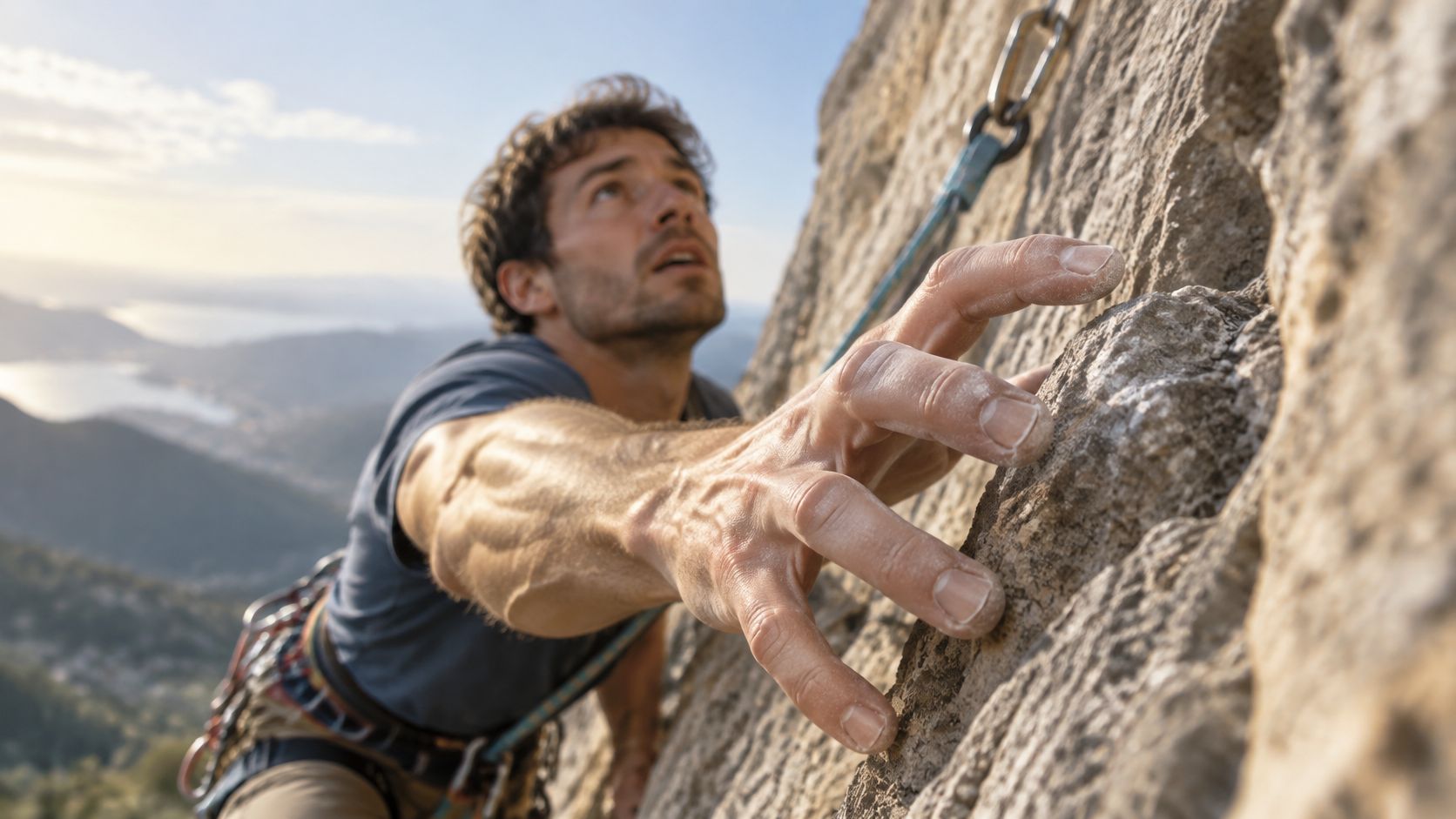
At the third clip on a sport route, a climber's fingers start to open. The immediate explanation is weak forearms, yet the fingertips may be sliding before the muscles have reached their limit. A sweat film can make a familiar hold feel unexpectedly insecure.
Think of holding a wet glass instead of a dry one. The hand hasn't suddenly become weaker, but keeping the glass steady requires more effort and constant adjustment. Climbing can create the same mismatch between available strength and usable contact.
Separate Slipping From Fatigue
In a 2018 study of nine recreationally active climbers, magnesium-carbonate chalk increased open-handed pull-up performance to 22.8 ± 4.53 repetitions, compared with 19.7 ± 4.39 without chalk, according to the study available through Europe PMC. That's a difference of about three repetitions in that particular test, not a promise of equivalent improvement on a route.
The practical distinction matters. Chalk can help a climber use existing grip capacity more effectively, but it can't remove muscular fatigue, repair damaged skin, or make an unsuitable hold secure.
Diagnostic check: A hand that slides and a hand that can no longer hold tension don't necessarily need the same fix.
Check When the Slip Starts
- After sustained sweating: Moisture management and selective reapplication deserve attention.
- On the first hard move: Excess chalk, polished contact surfaces, skin condition, or the demands of the move may matter more.
- Despite dry, stable contact: More chalk probably isn't the missing ingredient.
A useful self-check compares slipping after several minutes of sweating with slipping immediately on a difficult move. The first points toward keeping the hand's contact surface consistent. The second calls for checking contact quality before adding another coating.
Pick Your Rock Climbing Chalk by Setting
A humid gym and a dry sport crag can demand different chalk even when you are climbing both days. Moisture on the skin, how much dust the room will tolerate, and the venue's written rule pick the format. Sport name alone does not. Liquid under powder is the base-layer option for long sport routes and humid gyms: a dried coat first, then familiar loose chalk on top.
Rock climbing chalk types compared
| Type | Form | Dust | Residue | Best for |
|---|---|---|---|---|
| Block chalk | Solid block rubbed onto hands | Moderate, falls from the block | Chalky marks on holds | Quick touch-ups at the wall |
| Loose powder | Fine magnesium carbonate in a bag | High, airborne | Heavy on holds, bars and floors | Long sessions where dust is allowed |
| Chalk ball | Powder inside a mesh ball | Lower than loose powder | Light, mostly on hands | Gyms that restrict loose powder |
| Liquid chalk | Magnesium carbonate in liquid form, dries in seconds | Near zero | Minimal on dry hands | Gyms that ban loose chalk, lifting and boulder warm-ups |
| Liquid under powder | Liquid base coat, then loose powder on top | Low with controlled application, powder still on top | Less than loose powder alone with restrained application | Long sport routes, multi-pitch and humid gyms |
A heavy scoop of powder over a liquid coat still throws dust and marks holds. Treat the rows as restrained application patterns. Quantity changes the result as much as the container does.
Match the Format to the Venue
Setting decides the format before brand or bottle size does.
- Loose powder restricted, not banned: A chalk ball meters powder if the gym's rule allows mesh. This explanation of rock climbing chalk balls separates contained powder from a powder-free coat.
- Loose chalk banned: Liquid is the format that matches a ban, and only when the gym says liquid is allowed. Mesh does not automatically clear a powder ban.
- Dust-sensitive lifting bay or home setup: Liquid stays on the hands instead of leaving an open bag of airborne powder.
- Long sport, multi-pitch, or a humid gym: Put liquid down as a primer, then loose powder. The base coat is an addition, not a replacement for powder you already trust on small holds.
- Short boulder attempts with dry hands: Block chalk or a light powder touch-up is often enough. Reaching for a second layer between problems that end in seconds adds little.
On a sustained pitch, stopping to re-chalk breaks the sequence. The primer keeps a usable coat through more moves, so you reapply less often. On a one-move boulder, that extra step rarely pays.
Choose Coverage for the Setting You Actually Train In
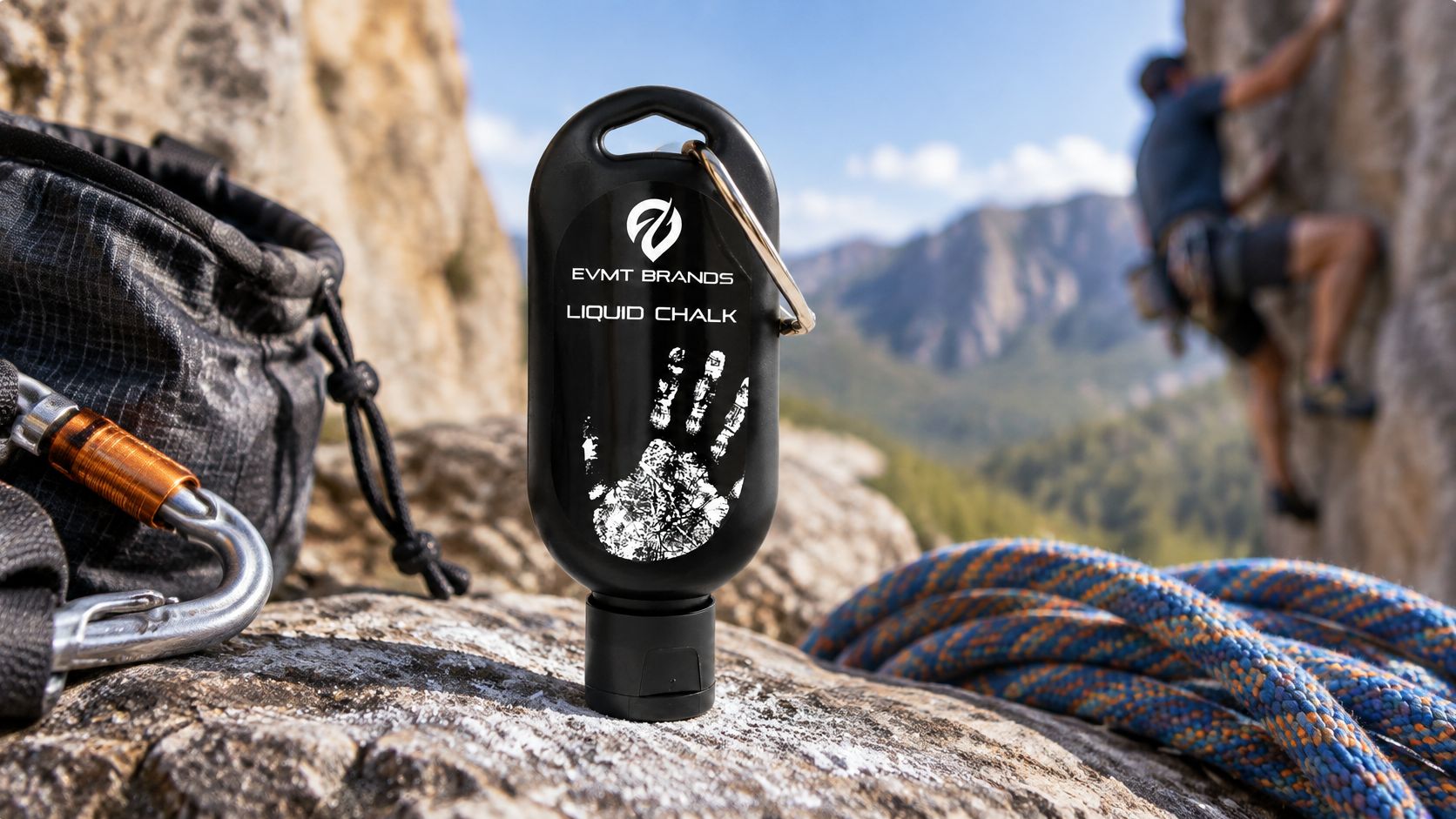
EVMT LIQUID CHALK comes in 50 ml portable bottles and 250 ml high-volume sizes, in Classic, Weightlifting, and Rock Climbing. The climbing formula is for indoor and outdoor use, supports control on small holds and crimps, and works as the powder primer. The weightlifting formula is extra-thick for powerlifting, Olympic lifts, and bodybuilding, with coverage aimed at bar slippage and callus tears. Classic is the general option for gym, CrossFit, gymnastics, dance, and sports.
I would start with the 50 ml bottle if you are only testing a base layer on humid sessions. Move to 250 ml once that primer is part of how you climb long routes, not because a larger bottle means a thicker coat.
Hand coating is only one piece of an outdoor day. For a desert climbing trip, SANS Meal Bar's real-food fuel for desert adventures sits next to decisions about heat, water, and which chalk format the approach and the crag will allow.
How Chalk Actually Keeps Your Hands Gripping
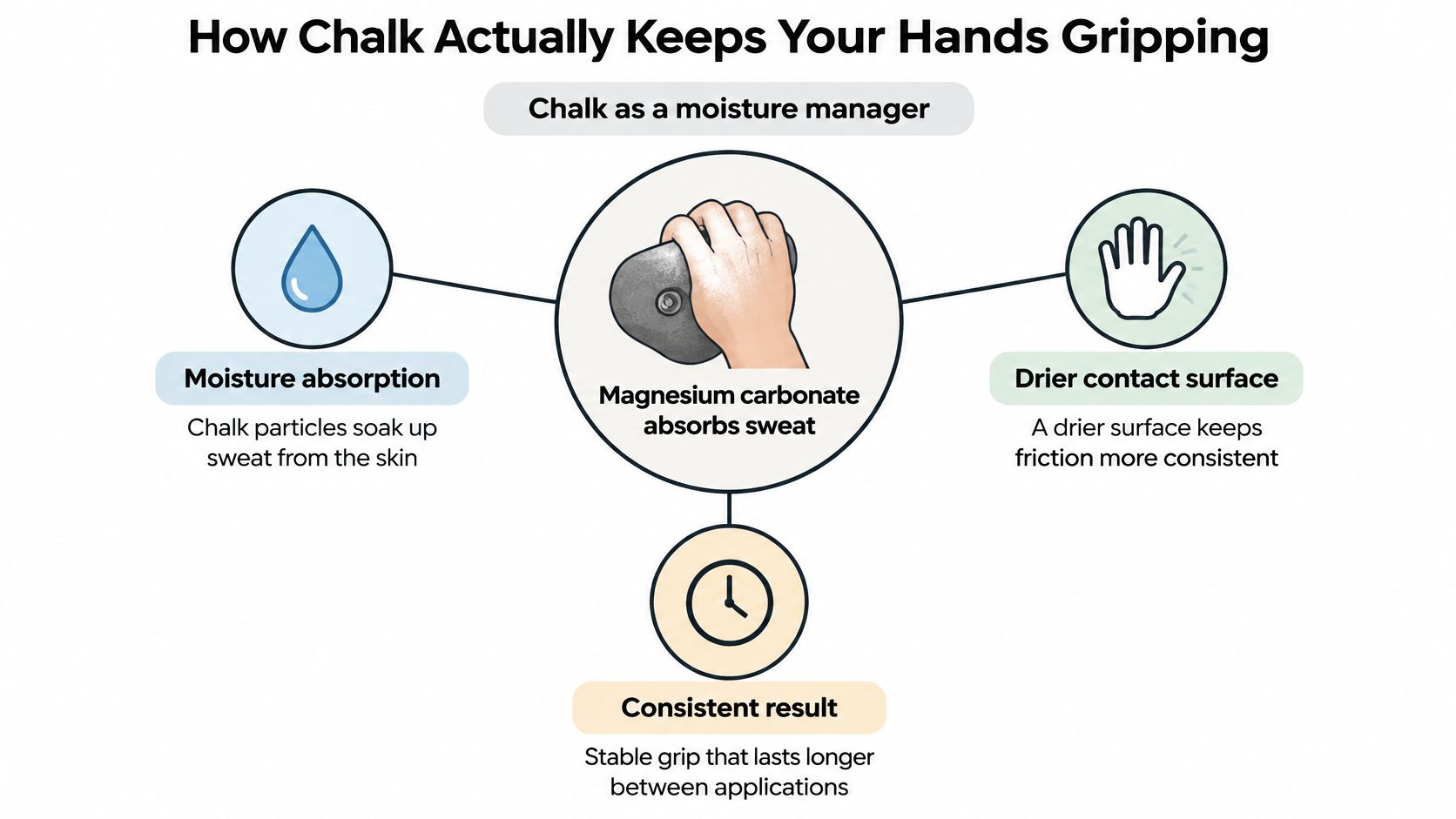
Magnesium carbonate is a moisture-management aid. Its particles take up moisture from the skin, helping prevent a wet contact surface from becoming the weak point in the grip. That doesn't mean the driest possible hand always produces the strongest contact.
Fingertip moisture, rock roughness, and the way skin meets the hold all affect the result. A rough edge and a polished sloper don't interact with a chalked fingertip in the same way. Neither does comfortable, slightly hydrated skin behave exactly like skin that has become excessively dry.
Friction Is a Contact Problem
A 2024 laboratory study measured static friction at normal grip forces of 5, 10, and 15 N across multiple rock surfaces and found that chalk generally improved friction on dry fingertips and made results more consistent, while its benefit weakened under simulated sweaty conditions, according to the study held by White Rose Research Online.
That finding argues against treating chalk as a universal friction booster. Chalk helps manage the interface between skin and rock, but it doesn't override the properties of either surface. A hand that keeps sweating can outpace what a coating can manage.
Chalk is a moisture-management aid, not a guaranteed friction boost.
For readers comparing ingredients rather than textures, this explanation of what rock climbing chalk is made of clarifies the distinction between the chalk itself and the form used to deliver it.
Why More Can Become Less
Excess powder can sit between skin and rock as a granular layer, reducing direct contact. On a smooth or polished hold, loose particles may become contaminants rather than useful drying material. Adding another handful without removing the buildup can make the contact less predictable.
The opposite problem is incomplete drying. If the hand remains wet beneath the coating, chalk hasn't solved the slippery interface just because the fingers look white.
- Aim for an even film: The fingertips should be coated, not buried.
- Remove loose particles: Brush permitted holds with an appropriate climbing brush and clear excess from the fingertips.
- Respond to moisture: Reapply when the hand starts becoming slick, rather than following a fixed schedule.
- Respect skin condition: Stop treating further drying as the answer when skin feels cracked, sore, or glassy.
The useful finish is controlled contact, not maximum whiteness.
How to Layer Liquid and Powder Chalk Step by Step
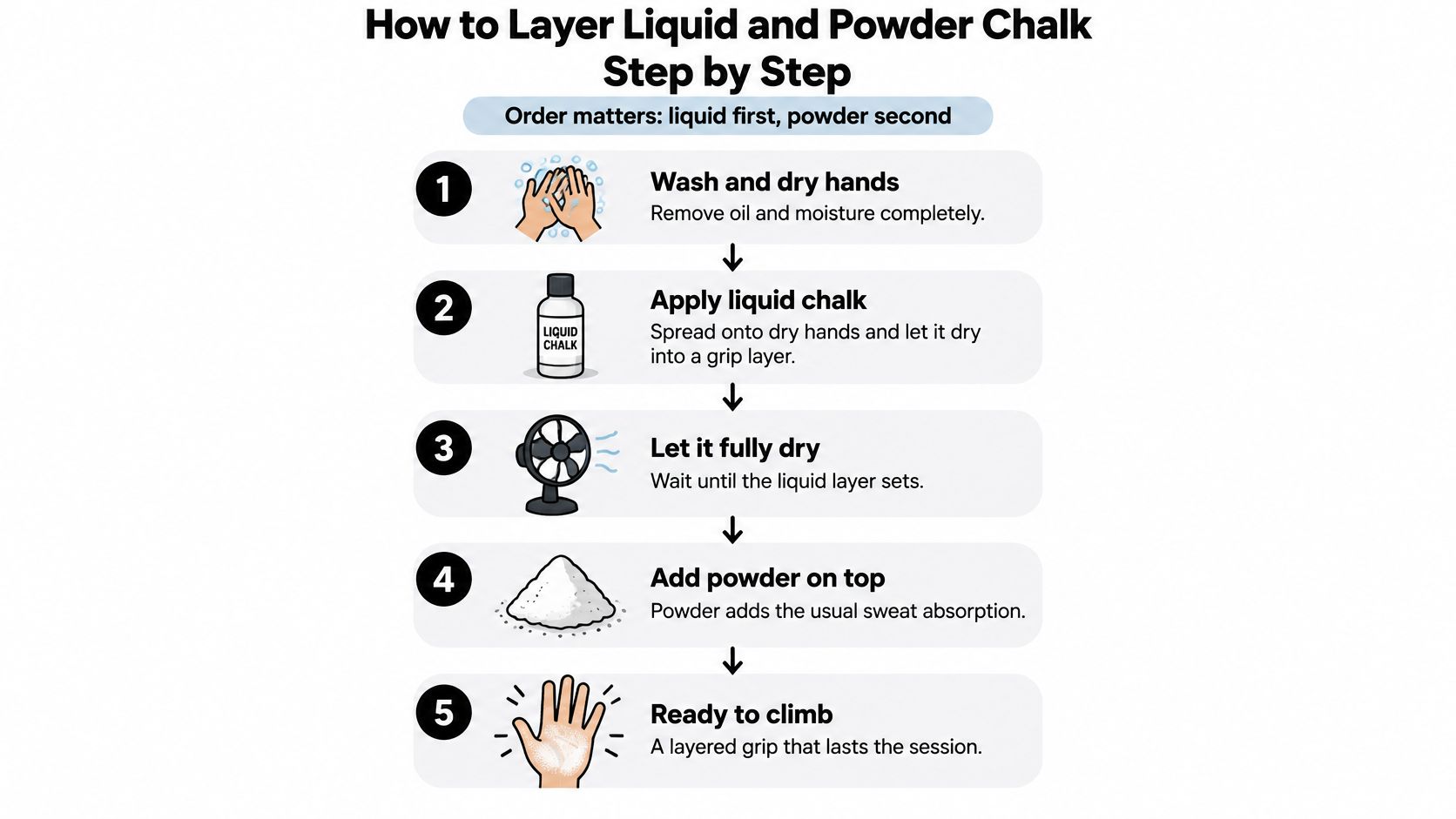
Liquid first, powder second is the workable order. The liquid application dries against clean skin, while the familiar powder coating sits over that base. Reversing the sequence mixes liquid into loose powder instead of establishing a clean foundation.
A magnesium-carbonate primer can improve powder adherence and keep the coating useful longer on demanding routes. The honest target is fewer trips to the chalk bag, not zero trips. Sweaty hands, sustained climbing, and repeated contact will still wear down the finish.
Build the Coat Before Leaving the Ground
- Wash and fully dry the hands. Soap and water remove skin oil and old chalk, then a clean towel and time in the air finish the drying. The common mistake is applying liquid while the palms or finger creases are still damp, which prevents an even coating.
- Spread a thin liquid coat over the contact areas. Work it across the finger pads, fingertips, and palm rather than leaving a thick blob in the center. Too much liquid can produce a heavy coating that flakes instead of staying evenly attached.
- Allow the coat to dry completely. Fast-drying liquid chalk sets in seconds, but the condition of the hands matters more than rushing to a count. Touching holds while the coating is wet interrupts the finish and transfers material before it has set.
- Add powder sparingly. A light dip into loose chalk, or contact with a chalk ball, supplies the top layer; gentle rubbing sheds the surplus without a theatrical clap. The usual mistake is building a mound over the fingertips until the coating itself gets in the way.
- Climb and refresh powder at suitable rests. Keep the liquid application for the ground or an appropriate secure stopping point, rather than trying to handle a bottle mid-route. Powder remains the convenient top-up when moisture starts returning.
- Wash off the coating between sessions and start fresh. Soap, water, and careful drying prepare the skin for the next application. Repeatedly coating old, worn patches creates an uneven starting surface rather than restoring the original layer.
Judge the Finish, Not the Amount
The finished hand should feel dry and securely coated, with powder staying on top rather than sliding across a wet surface. A slightly tacky hand feel shouldn't be confused with adding an adhesive. The product belongs on the hands, not painted onto holds.
The USA Climbing competition rulebook allows commercially available dry or liquid climbing chalk while prohibiting substances such as resin and rosin that alter the climbing surface. A conventional magnesium-carbonate primer is a hand-moisture aid, not permission to modify a hold.
Application test: An even coat that stays put is more useful than a thick coat that sheds.
If the coating flakes immediately, the next attempt should start with less liquid on cleaner, fully dry hands. If powder gathers in damp streaks, the base wasn't ready. If the finish works initially but fades later, a selective powder refresh is more sensible than rebuilding the entire coating.
Local restrictions still determine whether this routine is appropriate. Where powder isn't permitted, the top layer must be omitted rather than added over an approved liquid base.
Dust, Residue and Venue Rules That Shape Your Choice
A climber hits a humid bouldering gym with a chalk ball in one pocket and a small liquid bottle in the other. The bag of powder stays in the car. The posted rule bans loose chalk and still allows a liquid coat. Dust in the air, marks on shared holds, and the written policy decide the format.
Dust-free doesn't mean residue-free. Liquid chalk dries on the skin and generally transfers less material than loose powder. A dried coat can still leave a film on a hold or a shared volume. Putting chalk on cleanly and looking at the surface afterward are separate jobs.
Loose powder escapes during handling, settles on equipment and floors, and can remain suspended in the air. Gyms ban that cloud and still allow liquid chalk so the room, and the people training beside you, stay usable.
Competition Permission Has Boundaries
The USA Climbing competition rulebook names liquid chalk as an allowed exception to restrictions on liquids in the field of play and permits a small container of commercially available liquid chalk with essential attempt equipment.
A compact bottle has a defined place in that competition setting. That permission covers USA Climbing competition, not every independent gym or event. Confirm the venue before you buy and again before you arrive, because warm-up areas and competition areas often run different procedures. Ask whether loose chalk is banned, whether a mesh chalk ball counts as loose chalk, and whether liquid is allowed in the training area. For an event, check that the rules name the product type and any limit on how you carry it. Mesh reduces how far powder travels. The fill is still powder.
Outdoors, local access guidance and conservation rules replace the gym sign. A boulder with no white streak can still hold chalk. A peer-reviewed study in Ecology and Evolution found chalk at 65% of sampling points without visible residue on climbed boulders in Ticino, Switzerland, and recorded species-variable negative effects on fern and moss spores in laboratory tests.
Treat that finding as a reason for a thinner coat, a careful line around vegetation, and compliance with the restriction for that crag. The tests are species-specific and tied to sampled boulders in one region, so they describe a real residue problem without claiming the same damage at every cliff.
I recommend carrying only the form the venue has already allowed. Liquid is the lower-dust option when airborne powder and mess on shared equipment are what the policy is written to stop. On a long sport route or in a humid gym that still permits powder, a dried liquid coat under a light powder top matches the moisture and the dust rule together. If the venue stops at liquid, leave the powder packed.
Liquid Chalk for Lifting, Pole and Gymnastics
Sweaty hands show up on a barbell, a pole, and a gymnastics apparatus the same way they show up on a hold. A history of rock climbing credits gymnast and boulderer John Gill with bringing gymnastic chalk into bouldering in the 1950s. That shared history explains the material. It does not make one coat right for every surface.
A powerlifter whose hand starts to slip near lockout needs coverage that stays on the palm through the pull. A dry liquid coat gives contained coverage before the attempt. Powder goes on only where the platform allows it. A liquid base does not make a powder top layer stay put in the air, so dust still has to be managed if powder is used.
Pole work is stricter about the shared surface. Loose powder left on the pole is undesirable, so a fully dried liquid application is the more practical option when the studio permits it. I would wait until that coat is dry before the first contact on a shared pole. This guide to liquid chalk for pole dancing covers that setting without treating every pole grip product as interchangeable.
In a facility that bans loose powder, a gymnast or cheer athlete can use an approved liquid coat for a contained application. Youth athletes should use it under adult supervision, with attention to skin comfort and full drying before they touch the apparatus.
A home gym beside furniture or household storage often leaves liquid as the only workable format, because it keeps loose powder out of the room.
A CrossFit athlete moving between stations usually wants a controlled coat more than a climber who chalks between short attempts. A dancer may run into a studio rule before personal preference matters. The sport printed on a bottle does not replace checking how wet the hands get, whether dust is allowed, and what that room permits.
A coat that lasts one athlete's workout is not a duration guarantee for the next person. The useful test is whether contact stays reliable without heavy reapplication or a clash with the venue.
Evermost LLC offers liquid chalk in 50 ml and 250 ml sizes for controlled application across climbing and other grip-intensive activities. Visit Evermost LLC to choose a liquid base for regular climbing powder, or a powder-free option where venue rules require it.