


Gymnastics Chalk Explained: Powder, Liquid and What to Buy
Your kid walks up to the bar, claps their hands, and a white cloud hangs in the air. Grip feels better for one swing, then the rail looks filmed over, and the coach glances at the floor. That is the chalk problem, not a missing superpower. Gymnastics chalk can dry sweat so the hand stays in contact. It cannot promise more friction on every surface, and the format you pick changes dust, residue, and whether the gym lets you use it at all.
Table of Contents
- What Gymnastics Chalk Is and How It Works
- Powder, Liquid and Chalk Balls Compared
- Dust, Health Evidence and Gym Chalk Rules
- How to Apply Liquid Chalk Step by Step
- Layering Liquid Chalk Under Powder for Climbing and Poles
- Skin Health, Blisters and Safe Use
- Competition Rules and Pre-Meet Checklist
- Pick Your Chalk and Confirm the Venue Rule
What Gymnastics Chalk Is and How It Works
Gymnastics chalk is mostly magnesium carbonate, often sold as basic magnesium carbonate or magnesium carbonate hydroxide. Its main job is moisture management. It pulls perspiration off the interface between skin and apparatus, so sweat stops acting like a slippery film during swings, supports, and holds.
The particles work like tiny sponges. They soak up sweat before that moisture reaches the bar.
Say a gymnast is midway through a release series. Palms heat up, a thin layer of sweat forms, and the next catch starts to slide. A light coat of chalk absorbs that film so the hand meets the rail consistently. The same thing happens when someone is progressing toward strict pull-ups and dips on a home bar: wet hands slide, dry contact holds.
Whether chalk adds friction depends on the conditions. Results change with the surface, how wet the skin is, the movement, and how much product you apply. On some dry, polished surfaces, a heavy powder layer can even leave the hand sliding more than it would on bare skin.
The working rule
Use a thin, even layer on clean, dry hands. Heavier coverage does not automatically mean a better hold.
- Too much powder: it can sit as a gritty intermediate layer between skin and rail.
- Over-drying: skin gets less compliant, and contact can get worse on some surfaces.
- Right amount: enough to manage sweat, thin enough that nothing cakes.
Practical rule: Chalk is a condition-specific friction-control aid. Match the amount to the surface and the sweat level in front of you.
Magnesium carbonate started in gymnastics and strength work, then spread into rock climbing and other sports where athletes needed the same dry contact. Format still shapes the outcome, since powder and liquid leave different amounts of dust and residue on equipment, and some venues allow one while banning the other.
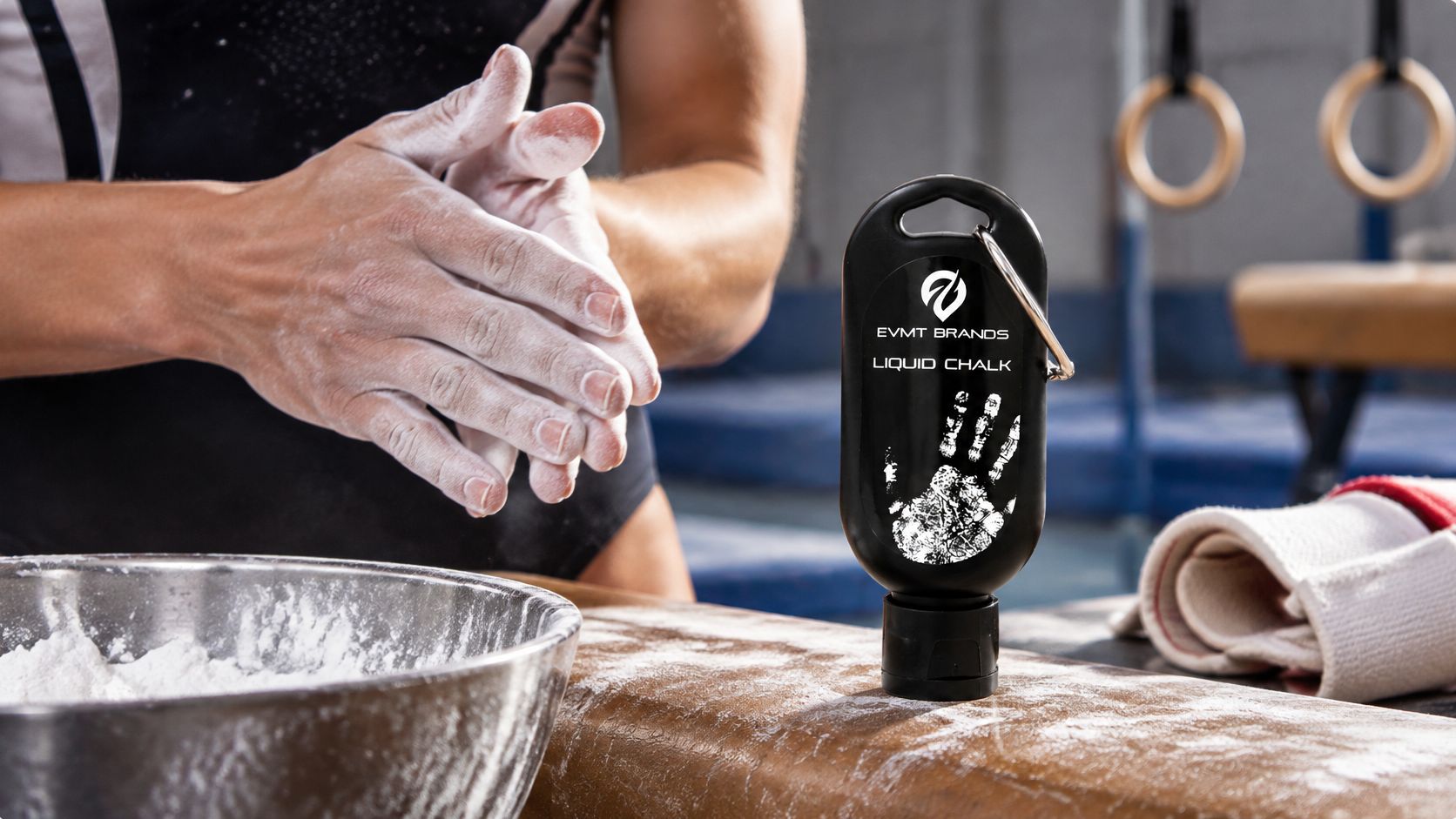
Powder, Liquid and Chalk Balls Compared
The format sets the dust level, the residue, and the rule you have to follow. Choosing between them works like choosing shoes for a floor: the right pair depends on the surface as much as the fit.
| Format | Dust in the air | Residue on bars and poles | Drying time | Typical gym policy |
|---|---|---|---|---|
| Loose powder (block or bucket) | High, settles on equipment | Visible white film | Immediate on skin | Often banned in commercial gyms |
| Liquid chalk | Minimal, no dust cloud | Little to none once dry | Seconds once applied | Often allowed where powder is banned; confirm the venue rule |
| Chalk balls | Lower than open powder | Light smear on contact points | Immediate on contact | Check the venue rule |
Loose powder, from a block or an open bucket, grips as soon as it hits dry skin. It also throws dust that settles on floors, mats, and rails, and it leaves a visible white film on bars and poles. Many commercial gyms ban it for that reason.
Liquid chalk spreads as a thin film and dries in seconds, so there is no cloud and little to nothing left on bars and poles once it sets. Most gyms allow it because it creates almost zero mess compared with loose chalk, which makes it a practical choice where powder is banned. Policies still differ by venue, so confirm the written rule before you buy a bottle. The step-by-step section covers the full application routine.
Chalk balls sit between those two. The powder stays inside a mesh pouch, which cuts loose dust compared with an open bucket, and that is why some athletes carry a gym chalk ball into a shared space. A ball can still leave a light smear where it meets skin or equipment, and rules vary, so you check that venue too.
Pick the format for the room in front of you. Powder when the gym allows it and you want the classic feel. Liquid when dust, residue, or the house rule is the limit.
No format is universally better. A training gym with a chalk tray and a boutique gym with a no-powder sign are different problems, and the same gymnast may use powder at one and liquid at the other.
Dust, Health Evidence and Gym Chalk Rules
Chalk dust is easy to see and hard to measure. A single clap sends a visible puff into the air, but the particles that matter for breathing are smaller than the ones you can watch drifting down onto the mat.
Researchers at a collegiate women's gymnastics facility measured total and respirable magnesium-carbonate particles during two three-hour practices, with attention on the air around the uneven bars. Concentrations came in at a minimal percentage of OSHA comparison limits, yet the team still recommended cutting airborne chalk to limit possible respiratory and skin irritation, according to the University of Wisconsin–Madison record of that facility study. Read that result two ways at once: the room stayed far under a legal line, and the people running it still wanted less chalk in the air. Long-term effects remain unsettled.
What the climbing numbers do and don't prove
A separate look at indoor climbing facilities, a different sport with the same dusty hands, measured particulate levels above WHO guideline values, and a portion of surveyed climbers reported respiratory or irritation symptoms during or after sessions. Treat that as a reason to care about ventilation in any room where chalk is used. It falls short of proving that gymnastics chalk harms gymnasts.
A "dust-free" label describes the bottle, not the room. A clean film still sits in shared air, so the checks are ventilation, a cleaning routine, and a modest amount on the hands. Judge any format change by the particles it removes from the air. If coughing, a rash, or eye irritation keeps showing up in the same room, bring it to a clinician instead of reaching for more product. Questions about ingredients sit next to a clear note on whether chalk is non-toxic, read alongside the venue rule.
Named gym policies
Most gyms allow liquid chalk because it creates almost zero mess compared to loose chalk, and the policies below draw their lines in that spirit. LSU University Recreation prohibits loose powder chalk in every facility area but permits liquid chalk, and the University of California, Santa Barbara restricts chalk and other grip products outside Olympic platforms while allowing a small amount of liquid chalk for Olympic lifts. A powder ban still leaves the liquid question open, so read the exact line in the policy before you buy.
How to Apply Liquid Chalk Step by Step
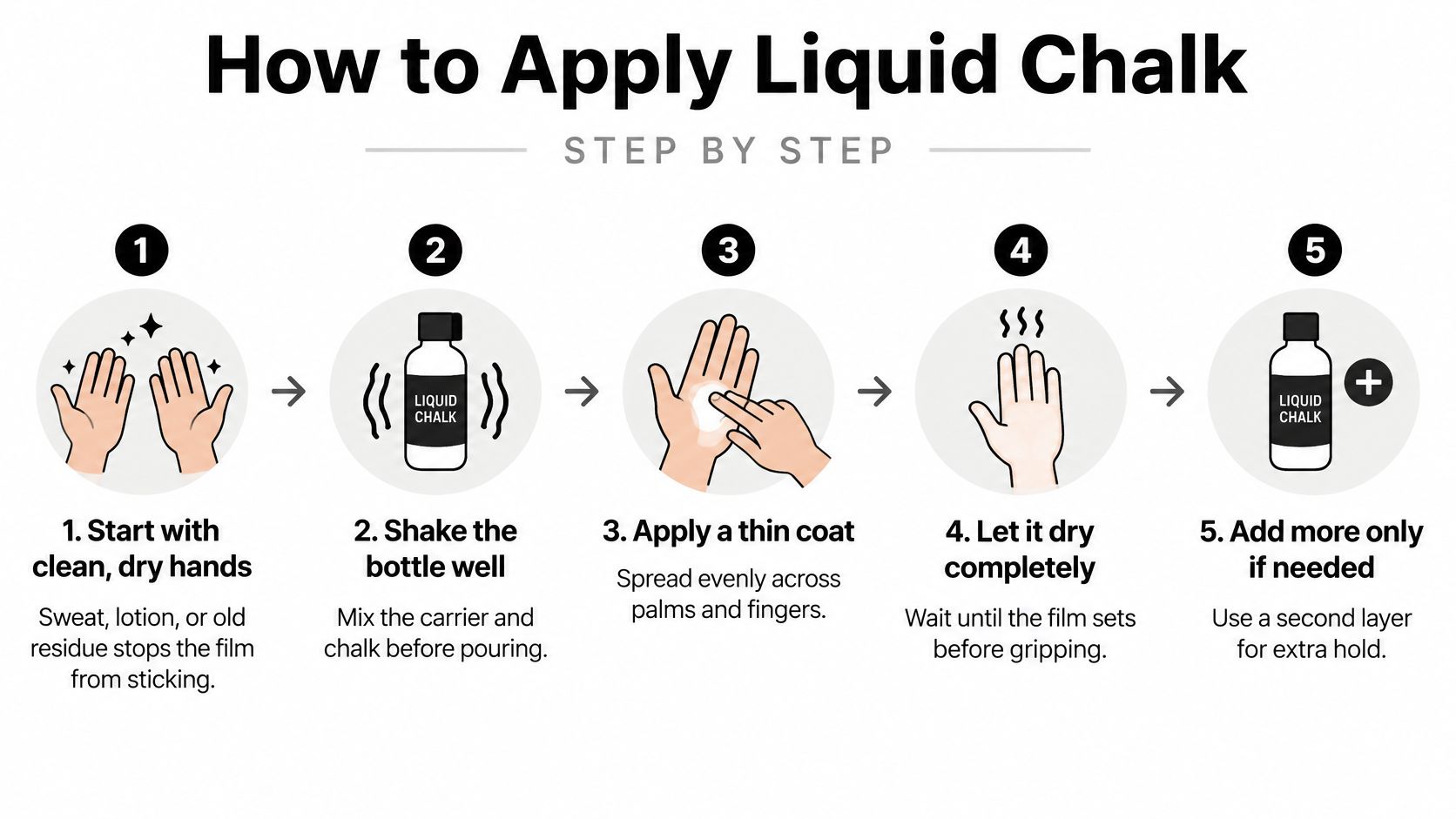
A parent can coach this in one minute. Each step has a reason.
- Start with clean, dry hands. Sweat, lotion, or old residue stops the film from sticking. Wipe palms, finger pads, and thumbs, then let them air-dry.
- Shake the bottle well. The carrier and the chalk separate in the bottle. A short shake mixes them so the coat is even instead of watery in one spot and thick in another.
- Squeeze a small amount into the palm. A dime-sized pool is enough to coat without puddling. If it runs toward the wrist, you used too much.
- Rub until every contact point is covered. Palms, fingertips, and thumb pads all meet the bar. A bare patch is where the slip starts. For a pole or a narrow rail, favor the pads that touch.
- Let the film dry before any contact. It should look dry and stop feeling tacky. That takes seconds. Touching a bar, rail, or pole while it is wet transfers residue onto the equipment.
- Add powder only where the venue allows it. If the gym permits loose chalk, powder goes on after the liquid film is fully dry. If it does not, stop at the dry film.
Slips that undo the coat
Too much product stays tacky and grabs lint. Wet hands weaken adhesion, so the film pills off on the first swing. Skipping the dry time smears the carrier onto the rail, which is the mess people hoped to avoid.
Wash it off with soap and water after the session so it does not build up on skin or on grips. Then run a quick test: hold a light bar or rail for a few seconds. If the contact feels secure and the rail stays clean, you are ready for the working set. If it feels slick, your hands were probably still damp when you applied it.
Layering Liquid Chalk Under Powder for Climbing and Poles
Climbers who already own a chalk bag are not looking for a replacement. They want the bag to last longer between dips.
The fix is a base coat. Put a thin layer of liquid chalk on clean, dry hands and let it dry completely. Then add loose powder the way you already do, provided the gym or crag allows powder. The dried liquid coat works like a primer under the powder: sweat has to work through two layers instead of one, so the grip holds through more moves before you re-chalk.
The payoff grows with the length of the effort. On a long route or a humid session, fewer trips to the bag add up. On short boulder problems, where you re-chalk every minute anyway, a base layer changes little.
That last point matters, because the supporting evidence is easy to overstate. A climbing chalk review covers a friction study that measured static friction on sandstone, granite, dark limestone, and light limestone with dry and simulated-sweaty fingertips at 5, 10, and 15 newtons. Across most of those conditions, chalk on dry fingertips produced a more positive and consistent friction effect than chalk on sweaty fingertips. The study tested chalk on skin, though, not a liquid coat under powder. Using a dried liquid base is a practical extension of that dry-skin result: start with a dry surface, then let the powder do its work on top. The benefits are a longer-lasting coat and less frequent re-chalking. No stopwatch claim belongs on top of that.
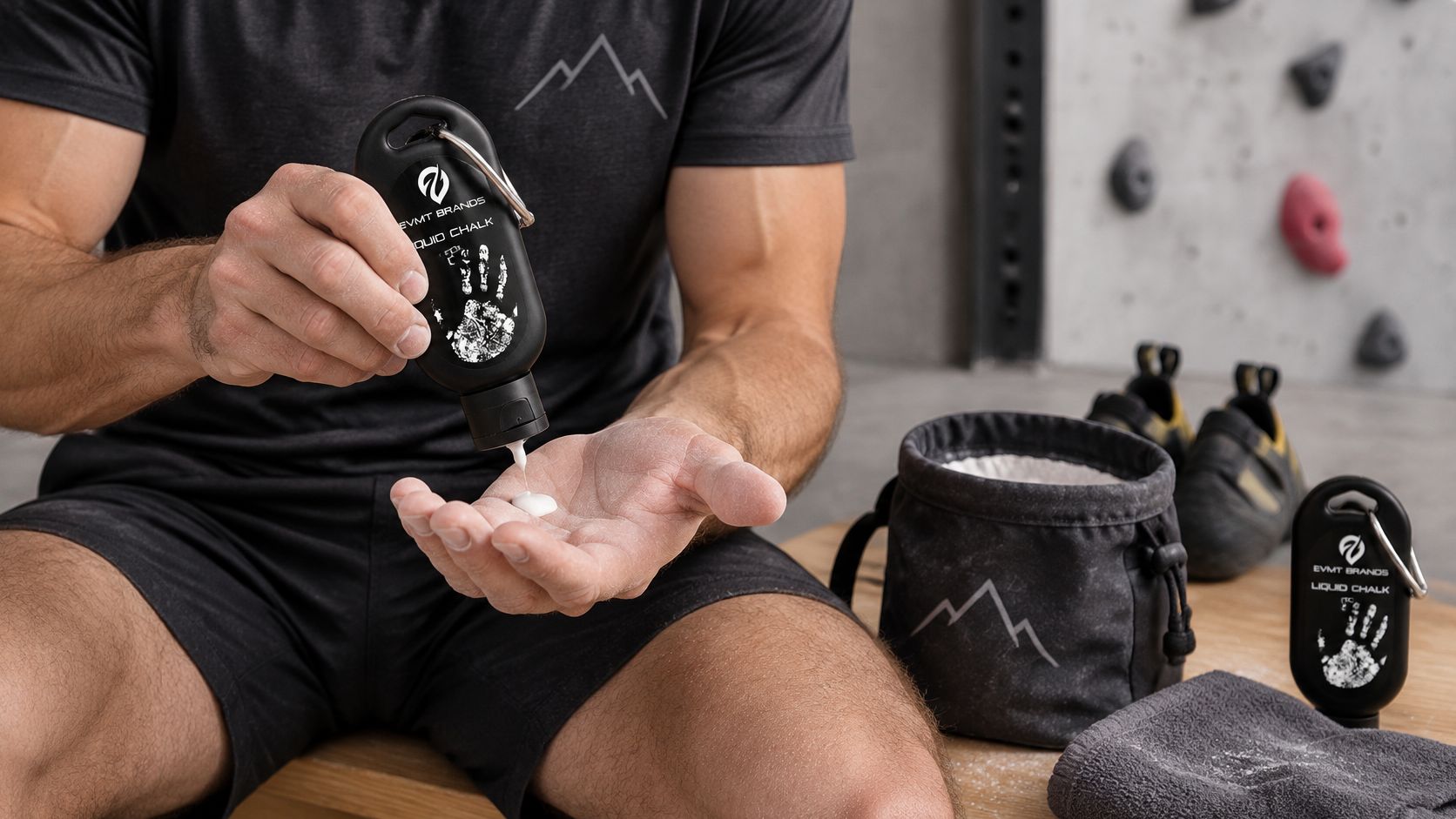
The same logic on a pole
Pole athletes have to separate grip from house rules. On the grip side, liquid chalk leaves a thin film on the skin that manages sweat, as pole grip guidance describes it. Use a small amount on the finger pads or the palm areas that touch the pole, spread it evenly, and wait until the wet carrier has fully evaporated before contact.
On the house-rule side, the studio or competition organizer has the final say. A powder ban does not approve every liquid product, and you still follow that studio's cleaning steps so nothing transfers to the next athlete.
Skin Health, Blisters and Safe Use
Chalk articles often skip the trade-off between a drier grip and skin that still has to last the week.
A 2018 study in Gazzetta Medica Italiana tested 106 University of Prishtina physical-education students, 72 males and 34 females, with mean ages of 20.18 and 21.18 years. Researchers measured left- and right-hand grip with a hand dynamometer on clean hands and on hands treated with powdered magnesium carbonate. Pressure-force results were better for both hands and both sexes with chalk. That is a grip result. It is not a skin-safety result, so it should not be read as proof about blisters or injury.
Treat skin as its own check. Chalk can support contact while still asking something of the palms, especially when sessions stack up. Skin that is already losing water will feel that dryness sooner. A plain explanation of why skin loses moisture helps a parent see why piling on more chalk is the wrong fix for sore hands.
Habits that keep palms usable
- Thin layer only: Enough to manage sweat. Extra product does not heal a hot spot.
- Rest between heavy days: Back-to-back bar sessions on the same raw skin is how small irritation grows.
- Wash after training: Soap and water, then dry. Leftover chalk plus sweat sits on the skin overnight.
- Don't chalk over irritation: More product will not cover a tear. Stop and look at the hand.
For youth gymnasts, cheer athletes, and dancers, liquid chalk should be used under adult supervision. On sensitive skin, do a patch test on a small area before it becomes a daily habit. If a rip is already open, look at gymnastics hand rips and pause the apparatus work until the skin closes.
Get medical advice for blisters that don't heal, rashes that spread or hurt, cracked or bleeding skin, and irritation that is still there after the session ends.
Competition Rules and Pre-Meet Checklist
A judge walks to the uneven bars between rotations and asks who left chalk on the rail. That small scene is what meet rules are really about. At practice, a coach can test a thin coat, watch the rail, and wipe it down. At a sanctioned meet, the handbook decides what may touch the equipment, who cleans it, and what happens if residue is still there when the next athlete starts.
The questions that matter are practical ones. Is this grip product allowed at this meet? Can the athlete apply it to hands, grips, or rails? Who removes marks, and when? Could leftover residue change the apparatus for the next turn?
What to confirm before warm-up
- Permitted substances. Ask the meet director or read the current handbook. Don't guess from last season's email.
- Where application is allowed. Confirm each surface separately, since hands, grips, and rails carry their own rules.
- Residue and cleanup. Pack a small towel. Plan to remove whatever your athlete leaves behind.
- Who removes markings. Name the person before the rotation starts, not during it.
Controlled application is part of performance prep. A thin coat your athlete can explain and clean up serves them better than a sticky rail that draws a judge's attention. If the handbook says nothing about a product, ask the meet director before warm-up rather than assuming it is fine.
Pick Your Chalk and Confirm the Venue Rule
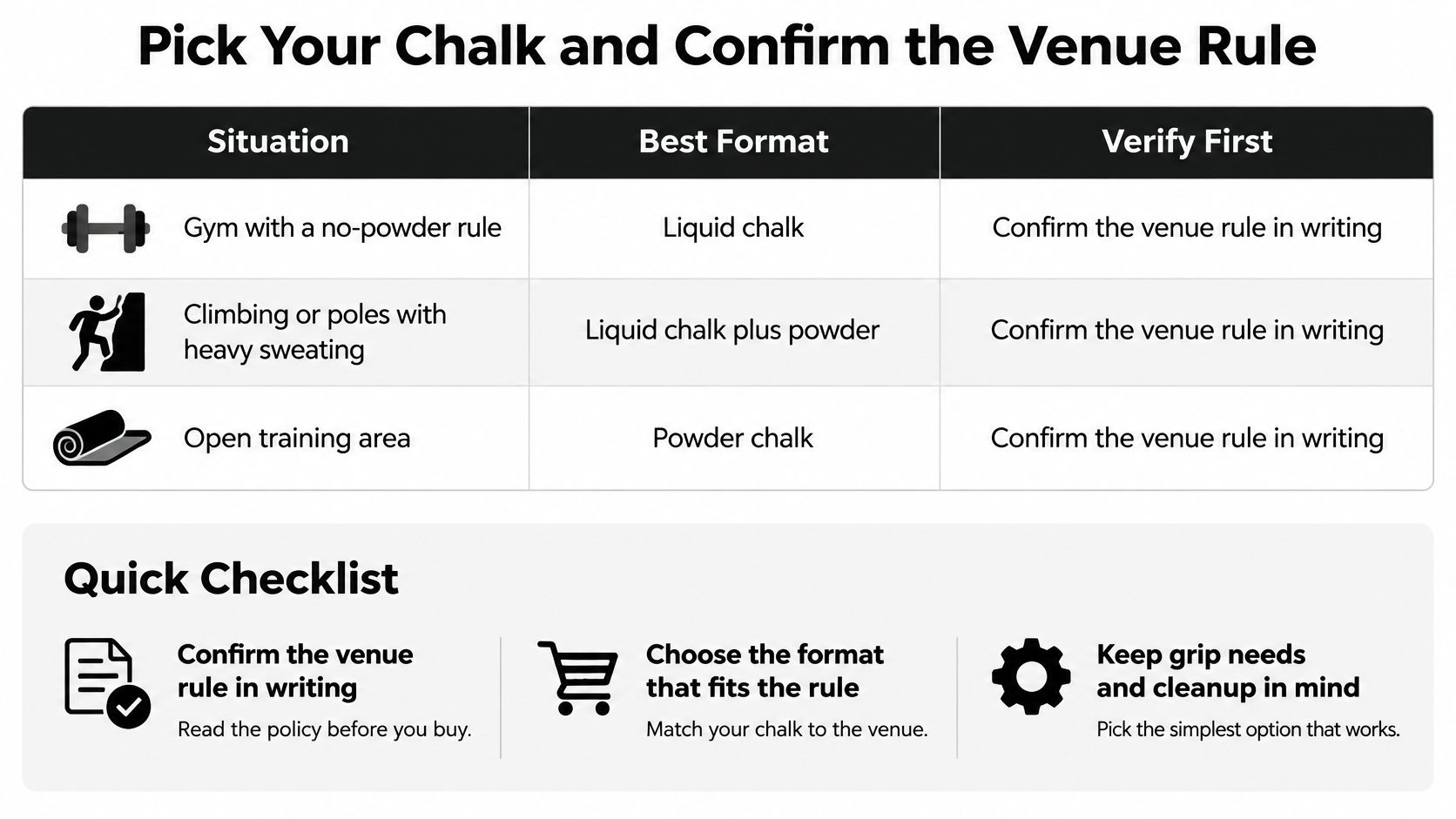
A chalk choice only works if the venue allows it. The format changes more than feel. It changes dust, residue, and whether the gym allows it at all. Check the room's rule before you compare formulas. A liquid bottle that passes a gym front desk can still fail a meet handbook.
The table keeps that order. Treat the suggested format as a starting point after the rule is clear.
| Setting | Suggested format once allowed | Confirm before use |
|---|---|---|
| Commercial gym that bans loose chalk | Liquid chalk | Written policy that names liquid chalk, not a verbal maybe |
| Home gym where dust is a problem | Liquid chalk | Cleaning routine and ventilation |
| Gymnastics training gym that allows powder | Powder or liquid by athlete preference | Separate rules for bars, rails, and mats |
| Competition gymnastics | Only what the meet allows | Current handbook and apparatus rules |
| Long climbing routes or humid gyms | Liquid base, then powder where permitted | Whether the venue allows both products and who cleans holds |
| Pole fitness studio | Thin liquid coat after full drying | Studio approval and cleaning procedure |
On uneven bars, USA Gymnastics apparatus requirements state that only chalk and water may be placed on the rails. Chalk markings on landing mats are allowed only as visual cues and must be removed after the athlete finishes the event. That is why the competition row does not name a format. The meet handbook does, and a parent still reads the handbook for that federation and that weekend.
A short venue and buying check
- Confirm the venue rule in writing. A front-desk shrug is not a policy.
- Choose the format that rule allows. Many gyms ban loose chalk but allow liquid chalk.
- Match the formula to the sport. Evermost LLC sells three liquid chalk types: Classic Liquid Chalk, Weightlifting Liquid Chalk, and Rock Climbing Liquid Chalk. Classic Liquid Chalk is the fit for gym, CrossFit, gymnastics, dance, and sports. It reduces hand sweat, improves grip right away, and washes off with soap and water.
- Test a 50 ml bottle on grip and on washing before you rely on it at a meet.
- Keep a note for each facility. A gym, studio, and meet can each use a different rule, and memory at the door is a poor substitute for a written policy.
EVMT LIQUID CHALK is the liquid option for weightlifting, gymnastics, rock climbing, and sports, sold in 50 ml and 250 ml sizes. Check the product page for the current formula and size before you order. A powder ban still does not approve every liquid formula.
A bottle cannot answer a handbook question. The athlete or parent has to, before warm-up starts.
Evermost LLC makes fast-drying liquid chalk for athletes who need grip without a dust cloud on bars, poles, or gym floors. If your gym, studio, or meet allows a liquid formula, visit Evermost LLC to match Classic, Weightlifting, or Rock Climbing chalk to the way you train.