


Chalk Bag Boulder vs Liquid Chalk: Which Grip Wins?
Three problems into a session, the fingertips go slick and the reflex is to reach for the bag again. That reflex is usually the wrong move. More powder on a sweaty fingertip pad often makes contact worse, and in a gym that bans loose chalk it isn't even an option.
Bouldering is where this plays out most often. A 2024 survey of climbers collected 5,489 usable responses and found indoor bouldering ranked as the most popular activity, ahead of indoor roped climbing, outdoor bouldering, sport climbing and traditional climbing. 34% of climbers bouldered indoors at least twice a week and another 27% once a week. That's a lot of repeated dips into a bag over a two-hour session.
The short version: the bag controls how much chalk reaches your skin. The format controls how much reaches the air, the holds and the floor. Those are two different problems, and most climbers only solve the first.
Treat the bag as a dosing tool and the bottle as a moisture barrier underneath it, and the whole chalk bag boulder question gets simpler.
Table of Contents
- Liquid, Powder and Chalk Ball Compared at a Glance
- How Chalk Bag Powder Handles Sweat on Boulder Problems
- How to Layer Liquid Chalk Under Powder
- Where Gyms and Competitions Allow Liquid Chalk
- Dust, Residue and Cleanup After Each Session
- Choose Liquid, Powder or Both for Your Next Session
Liquid, Powder and Chalk Ball Compared at a Glance
Two things settle most of the decision: what the venue permits, and how long the hands need to hold before you can step back to the bag. Application speed, dust, residue and acceptance are the variables that change a session, and a bottle of EVMT Liquid Chalk scores differently on every one of them than a loose bag does.
| Format | How it is applied | Dust | Residue | Gym acceptance | Best for |
|---|---|---|---|---|---|
| Chalk bag powder | Dipped from a bag and rubbed into fingertips | High, airborne | Visible on holds and mats | Restricted in some venues | Short problems and quick top-ups |
| Chalk ball | Pressed into hands from a ball | Moderate, loose powder still sheds | Light but builds on holds | Set by each venue | Controlled dosing for light use |
| Liquid chalk | Applied from a bottle and dries in seconds | Minimal, no dust cloud | Minimal once dry | Often allowed where loose chalk is banned | Long sessions, humid gyms and a base layer under powder |
The practical split is straightforward. Powder is still the fastest top-up on a short boulder problem: one dip, one rub, go. Liquid earns its place across a longer session, in a humid gym, or under a layer of powder when the hands need to hold through more moves between visits to the bag. Run them as a sequence, not a choice: the bottle lays down the base coat at the start of the session, and the bag handles the mid-problem touch-up on top of it.
The scale of the audience explains why format matters now. The number of U.S. climbing gyms nearly doubled from 310 at the end of 2013 to 591 by the end of 2021, a 90.6% increase, according to a study published by Springer. More gyms means more venue rules, more shared air, and more climbers whose first hundred sessions happen indoors.
If the only thing in the pack is a bag of loose powder, you are one facility policy away from a session with no grip aid at all.
Starting rule: if your gym restricts powder, start with liquid and don't argue with the front desk. If powder is allowed and your hands stay dry, keep your current setup and test a liquid base layer once before changing anything.
A chalk ball sits between the two formats and doses a little more tightly than a loose bag, though it still sheds powder. The chalk balls for climbing guide covers where that middle option fits and where it doesn't.
How Chalk Bag Powder Handles Sweat on Boulder Problems
Magnesium carbonate absorbs fingertip moisture. A chalk bag manages moisture; it does not reliably add friction, and the effect depends on skin condition and hold texture.
What the friction measurements show
A 2024 laboratory study on chalk and fingertip friction measured static friction at normal fingertip forces of 5, 10 and 15 N and found that chalk generally had a more positive effect on dry fingertips than under simulated sweaty conditions. It also made friction more consistent across most test conditions.
Consistency is worth more than peak grip on a boulder problem. The crux usually lands on a hold you've already touched twice with damp skin, and a predictable contact beats a sticky one that fades halfway through the move.
The granular interface problem
Over-application is what bites here. A thick, loose coating creates a granular interface between skin and hold, and that reduces contact quality, particularly on smooth or heavily chalked indoor holds. The powder turns into loose particles rolling under the fingertips instead of staying on the skin where it can absorb sweat.
The dosing rule that follows is simple:
- Dip once, rub thoroughly. Work a thin layer into the fingertip pads until the skin looks matte and the loose dust is gone.
- Skip the pre-crux top-up. Brushing the hold and wiping excess off the fingers is technically sounder than adding powder the skin can't absorb.
- Re-chalk on dry skin only. Powder pressed onto a damp hand cakes into a paste that sheds off on the first hold.
When chalk fights back
The counter-evidence matters. Controlled work on chalk and climbing friction reports friction gains of roughly 18.7% on limestone and 21.6% on sandstone in the tested conditions, which is a real effect. The same body of work found chalk could reduce friction when the rock or hold was already dry, partly because magnesium carbonate stiffens the skin and leaves loose particles between the contacting surfaces.
So the decision rules differ by condition:
- Clean, dry, textured hold: use a light uniform film, then stop.
- Sweaty hands: wipe first, let the skin dry, then re-chalk. Powder over wetness just cakes.
- Caked hold: brush it before adding anything. Indoors, repeated buildup changes the contact interface and makes a visually dry hold less predictable than it looks.
Practical rule: judge by the fingertips. If the skin looks white and dusty, there's more chalk on your hand than the hold can use.
The bag's design either supports dosing or undermines it. A wide opening gets the hand in fast, a secure closure keeps old chalk and brush debris out, and a fleece lining or elastic rim spreads powder evenly instead of dumping a handful. A stable waist belt matters as much: a bag that swings forces a twist mid-problem, and that twist costs more than a re-chalk.
How to Layer Liquid Chalk Under Powder
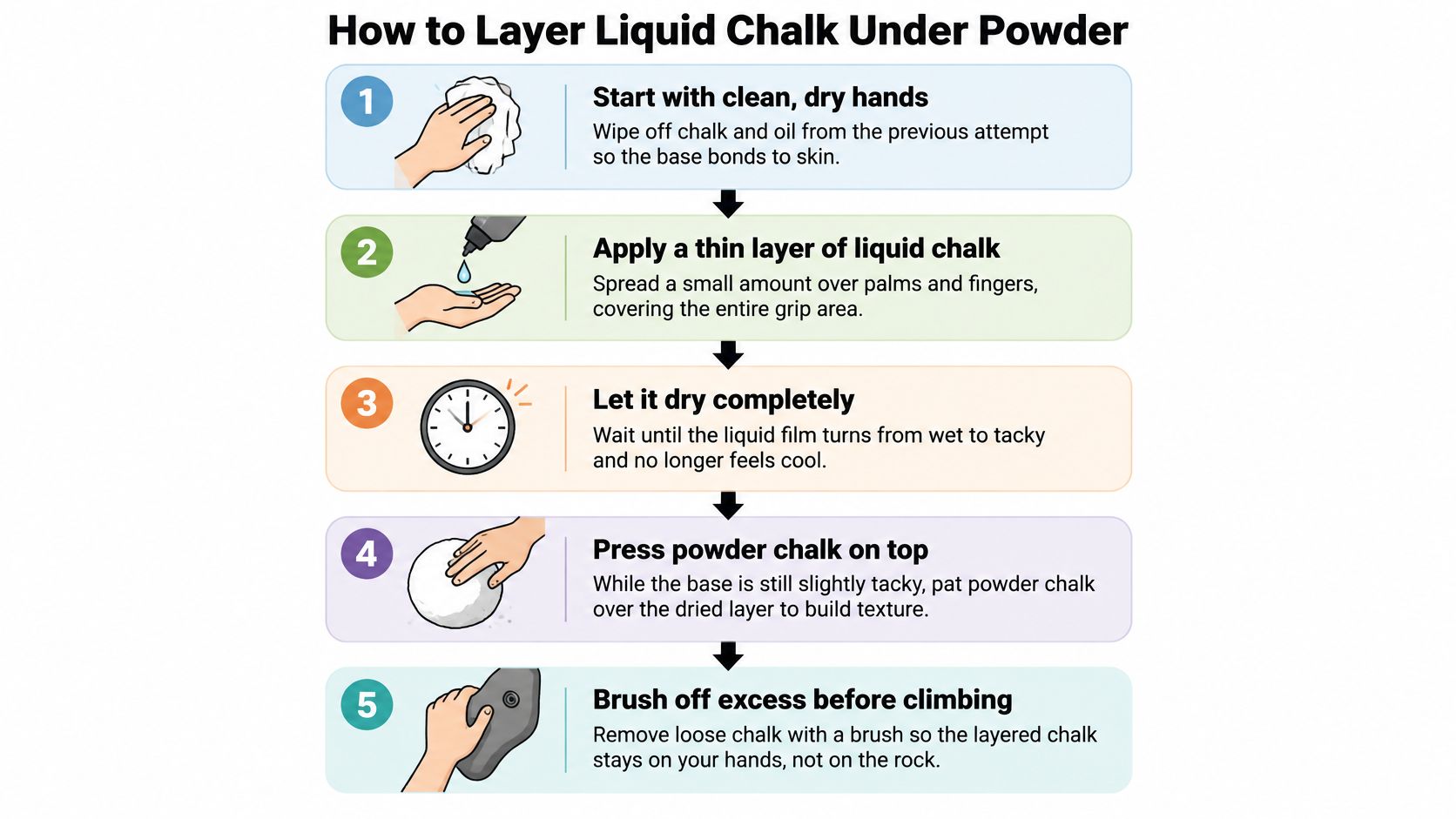
Treat the bag as a dosing tool: the liquid coat manages sweat at the skin, and the powder only refreshes the surface. The sequence is quick once familiar, and each step prevents a specific failure.
- Start with clean, dry hands. Wipe off old chalk and oil. A liquid base bonds to clean skin; old powder and sweat keep the film from setting evenly.
- Apply a small amount of EVMT Liquid Chalk to the fingertip pads, the palm contact area and the thumb. Rub until an even film forms. The palm and thumb matter because slopers and pinches load there as much as the tips.
- Let the coat dry completely. Wait for the shine to turn matte. Pressing powder onto wet liquid smears the base and leaves a tacky film that collects dust.
- Dip lightly and add a thin powder layer over the dry coat. Climbers can use EVMT Liquid Chalk as a primer under regular loose chalk for better adherence and longer grip on tough routes.
- Climb, and re-chalk only when grip starts to fade. Wiping and re-chalking after every move defeats the purpose of a base layer.
- Wash hands with soap and water afterwards. Residue left in skin creases tends to leave hands tight after a long week.
Why the order works
The liquid layer gives sweat a sealed base to cross before it reaches the powder surface. The coat holds through more moves before the powder needs replacing, so the bag becomes a metered top-up: a light dip restores feel without burying the base. Fewer trips to the bag mid-problem is the practical outcome, and it's the only benefit worth promising.
The honest limit: boulder problems are short. On a single short crux, a base layer changes very little. It earns its value across repeated attempts, longer circuits and humid gyms, where hands stay damp between tries and the bag gets opened again and again.
Dosing note: start with a small amount of liquid chalk and reapply only when needed. EVMT recommends exactly that, and it's the difference between a base layer and a sticky film that collects half the wall's powder.
If the hands feel slick after the powder layer, use less liquid next time; extra powder only cakes over a tacky film. Over-application is the most common layering error, and it's an easy one to correct in a single session.
Where Gyms and Competitions Allow Liquid Chalk
Venues restrict loose powder because of the dust. It settles on holds, mats and equipment, drifts into ventilation, and cleaning it costs staff hours. The question worth checking is narrower than "is chalk allowed": each policy names the formats it permits.
| Setting | Powder chalk | Liquid chalk | Condition |
|---|---|---|---|
| USA Climbing competition | Permitted | Permitted | Dry or liquid chalk named in the 2025-2026 rulebook |
| International competition | Not named in the rule text | Permitted | Small container, sealable and leak-proof; excess removed before starting |
| Tokyo Dome City bouldering | Not permitted | Required alternative | Facility-management reason |
| Typical commercial gym | Often banned | Often allowed | Policy set by each venue, so check before arriving |
The venue-level distinction
Tokyo Dome City's bouldering facility states that powdered chalk is not permitted for facility-management reasons and instructs visitors who need a non-slip surface to use liquid chalk instead, according to its visitor rules. One venue's chalk policy is really two decisions: whether the substance is allowed, and which format is allowed.
What the competition rules actually say
The USA Climbing rulebook for 2025-2026 permits competitors to use a chalk bag and commercially available dry or liquid chalk on their hands, while separately prohibiting unapproved performance-enhancing agents such as resin or rosin. Naming liquid chalk directly means it isn't an improvised substitute. It's a listed option.
At international level, the climbing rules for 2026-2027 require liquids brought onto the field of play to be kept in sealable, leak-proof containers and specifically permit a small container of commercially available liquid chalk. Climbers may also use potable water or a non-greasing hydrating agent to clean their hands before an attempt, provided excess liquid is removed before starting.
That rule treats the bottle the way a chalk bag treats powder: a closed container that puts grip product on the hands and nowhere else. On the field of play, a spilled bottle creates the same problem as a burst chalk ball, so the container matters as much as the contents. A waist-mounted bag and a sealed bottle end up doing the same job in different formats, as the climbing chalk pouch guide sets out.
Before you climb: check the posted policy, ask the front desk whether liquid is accepted, carry it in a sealed bottle, and remove excess before you pull on.
Many gyms ban loose chalk but allow liquid chalk, which is why a bottle clears a restriction a bag can fail. The venue always decides, though, and a venue that allows chalk can still limit it to one format.
Dust, Residue and Cleanup After Each Session
A boulder that looks clean can still be carrying chalk. In a study of climbed gneiss boulders reported in research on chalk and climbing environments, researchers found high chalk levels at 65% of sampling points where no chalk was visibly present, and laboratory experiments in the same work found that increased chalk concentrations reduced germination and survival of several rock-dwelling fern and moss species. Brushing the white marks away doesn't undo that. A cleaned surface can still carry a deposit, so the working standard outdoors is leaving no impact at all.
Effects varied by species, and the study did not establish the exact scale of harm in natural climbing areas. Uncertainty about scale is a reason to reduce what you leave behind.
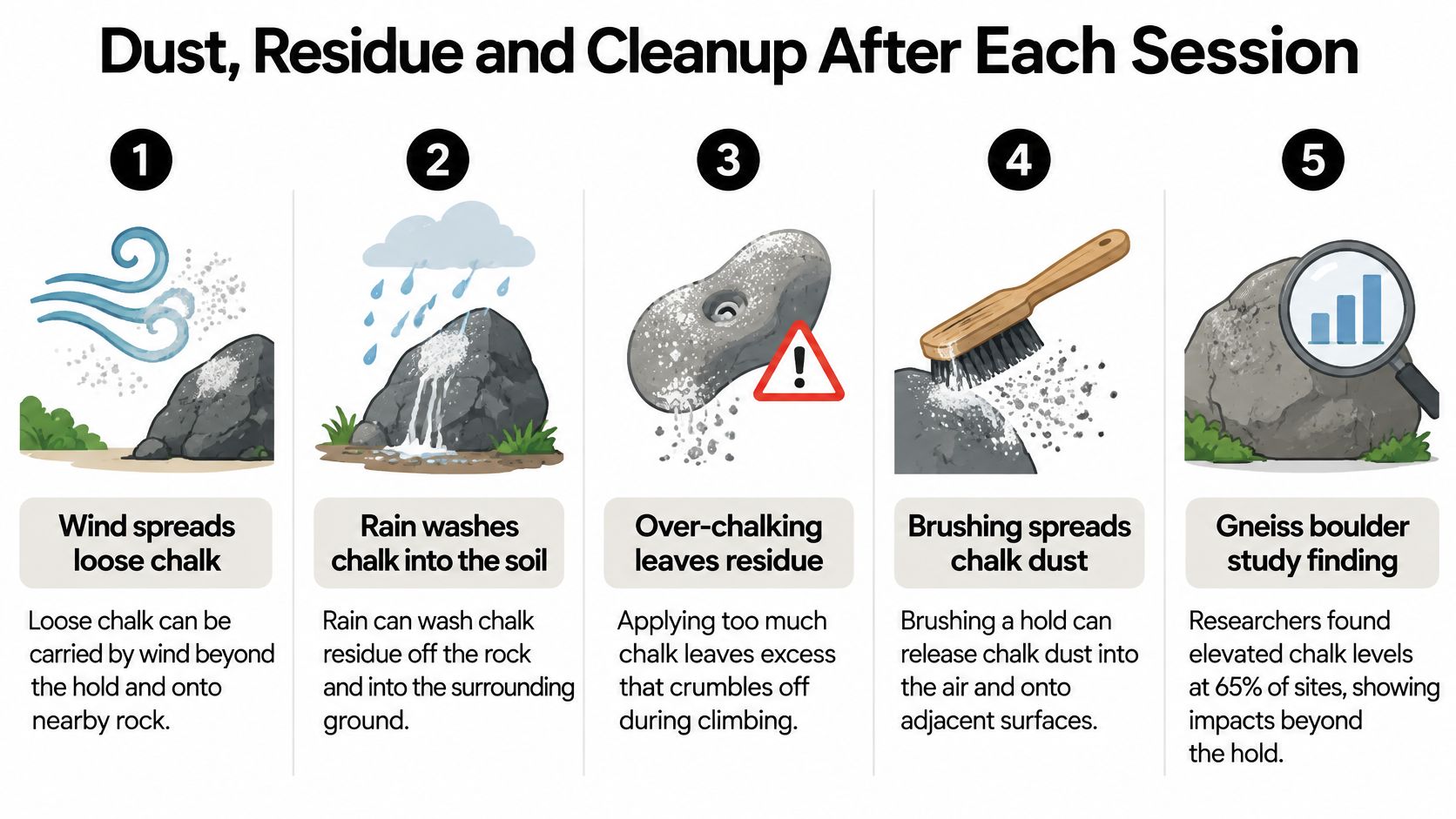
Where loose chalk travels:
- Wind lifts powder off the hold and deposits it on adjacent rock and soil.
- Rain washes residue off the boulder and into the ground around the base.
- Over-chalking leaves excess that crumbles away as you climb.
- Brushing releases dust into the air and onto nearby surfaces.
The contrarian point: chemically dispersed chalk stays dispersed. A brushed boulder is tidier, and the chalk is still on it.
A cleanup routine for the next session
- Carry less than you think you need. The bag is a dosing tool, and every dip you skip outdoors is residue that never reaches the rock.
- Brush so dust falls away from the base. It shouldn't land where the next climber sits and pads.
- Follow local rules on chalk color and bans. Colored chalk requirements exist for a reason, and some areas prohibit chalk outright.
- Wash your hands after the session. Soap and water remove residue that would otherwise dry the skin, and the guide to removing liquid chalk covers the sequence properly.
I treat a liquid layer as the easier format to keep contained, because it dries on the skin and washes off afterwards. Loose powder leaves through wind, rain and brushing. No chalk format is environmentally neutral, and the realistic goal is dispersal control.
Choose Liquid, Powder or Both for Your Next Session
A chalk bag is a dosing tool: it controls how much chalk reaches your hands and when you take it. The format you pair it with depends on the room, your skin and the length of the session. Four situations cover most of the decision:
- Dry hands, short problems, powder allowed: keep the bag, use a thin layer, skip the layering step entirely.
- Humid gym, sweaty hands, longer sessions: put a liquid base under the powder and test it against your usual routine before trusting it on a project.
- Gym that bans loose chalk: liquid only, carried in a sealed bottle, applied before the attempt and left to dry. Most gyms that refuse loose chalk still allow liquid.
- Sensitive or cracking skin: start with the smallest amount, moisturise between sessions, and stop when irritation or fissures appear. Chalk's job is keeping hands dry during a session, so persistent sweating needs a different fix.
Independent coverage of climbing's boom has noted that the evidence on chalk and performance is mixed rather than settled, with some work finding no additional grip benefit and other work finding an improvement. That uncertainty has a practical consequence: no climber should assume more chalk equals more friction. Test on the holds you climb, and separate moisture management from the confidence boost, because both are real and only one shows up on a friction plate.
Run a one-session test
Pick two problems of similar difficulty. Chalk the first with a liquid base under powder, the second with powder alone, and count how many times the bag gets opened on each. For a bigger sample, run the base layer on half the problems in a normal session and compare the re-chalk count against your usual number. Note whether the fingertips felt slick at the crux and whether the skin was dry or tight afterwards. That count is more useful than any general claim, because it is measured on your hands, your gym and your humidity.
Matching the formula to the wall
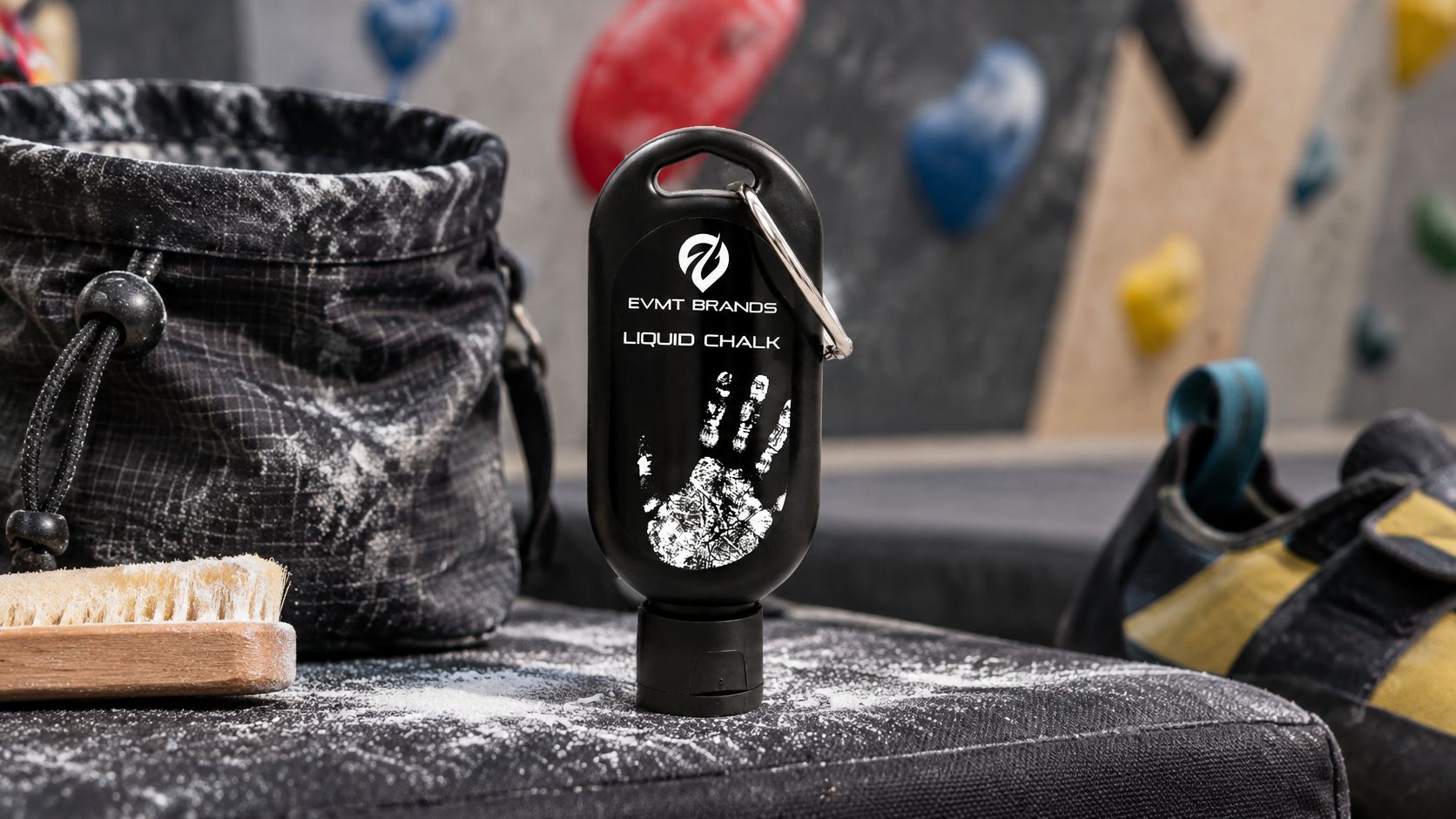
EVMT's Rock Climbing Liquid Chalk is made for indoor and outdoor climbing, enhances control on small holds and crimps, and can be used as a primer before powder chalk, which is exactly the role the test above puts it in. The range also includes Classic and Weightlifting formulas, and bottles come in 1, 2, 4 and 8 packs, so a first test does not require committing to a case. Start with a small amount, reapply only when needed, and a single bottle covers the base layer for several sessions.
EVMT Liquid Chalk dries in seconds, produces no dust cloud and leaves minimal residue on holds, mats and equipment once dry, which is why it works in gyms that refuse powder. For a boulderer whose hands give out halfway through a session, or whose gym has posted a no-powder policy, a portable bottle covers the base layer before every attempt and washes off with soap and water afterwards. Visit Evermost LLC to choose a formula and bottle size, then run it under your own powder chalk for a week.