


Best Chalk for Gymnastics: Liquid, Powder or Block?
The popular advice to use more chalk whenever grip feels uncertain is incomplete. The best chalk for gymnastics depends on the apparatus, the gym's dust rules, and how often the athlete can reapply it. Powder is a practical choice for long, sweaty uneven-bar work where re-chalking is possible. A liquid formula fits powder-restricted gyms, cheer training, and home spaces where airborne dust is unwelcome.
Magnesium carbonate has evidence behind its grip purpose, but that evidence doesn't prove every format works equally well on every surface. The useful goal is a thin, consistent layer that manages sweat without creating excess buildup, skin irritation, or slipping.
Table of Contents
- Best Chalk for Gymnastics at a Glance
- Six Criteria That Decide Gymnastics Chalk
- Liquid, Powder and Block Compared Side by Side
- Which Chalk Fits Each Apparatus and Setting
- How to Apply Liquid Chalk for Gymnastics
- When Chalk Stops Helping or Starts Hurting
- Choose Your Chalk Before the Next Session
Best Chalk for Gymnastics at a Glance
For powder-restricted gyms, cheer practice, and home training, the named pick is EVMT Liquid Chalk. For long, sweaty uneven-bar sets, choose loose powder when the facility allows it and athletes can reapply between skills. For brief touch-ups, choose a chalk block. These picks reflect different training conditions, not proof that one format improves grip across every apparatus.
| Setting or need | Named pick |
|---|---|
| Powder-restricted gym, cheer, or home gym | EVMT Liquid Chalk |
| Long, high-sweat uneven-bar sets | Loose magnesium-carbonate powder |
| Brief touch-up during practice | Chalk block |
The choice depends first on where the athlete trains and which apparatus is involved. A powder restriction makes liquid chalk the practical fit, while sustained uneven-bar work can call for powder if reapplication is allowed. A block is the focused pick for a small touch-up, rather than a substitute for choosing a format suited to the whole session.
EVMT Liquid Chalk is sold in single bottles and multi-packs, and its product description says it is suitable for gyms that ban powder chalk. That description does not override facility rules: athletes should confirm which chalk formats are permitted before training. The named pick is useful only if the gym allows it.
This summary is a starting point, not a universal ranking. Athletes still need to match the format to the session and judge whether its application and feel work for their hands and equipment.
Six Criteria That Decide Gymnastics Chalk
Grip should be tested on the apparatus and in the routine, not judged by how chalk feels in a container. These six checks help identify whether a format suits a gymnast's hands, equipment and training conditions.
- Does it cover the contact area evenly? Apply a small amount to the hand and, if used, the leather grip. Inspect the surface for bare patches or thick clumps. A thin, even layer is the target.
- Does the facility control airborne chalk? Powder can become airborne around frequently used apparatus. In a 2022 analysis, researchers sampled chalk during two three-hour practices and measured total and respirable magnesium-carbonate dust. They found levels below OSHA permissible exposure limits for magnesite and recommended reducing airborne chalk to limit potential respiratory and skin irritation (the collegiate airborne-chalk analysis). Ask the facility how it manages chalk dust, then follow its rules for permitted formats.
- Does liquid chalk dry before contact? Apply it and wait until the hand feels dry rather than wet or slick before gripping. This is a practical test for whether the application is ready for the apparatus.
- What remains on the equipment? Wipe the bar with a damp cloth after use, then check for a white film. Inspect leather grips for chalk buildup as well. Repeated residue can make cleaning and equipment care part of the format's cost.
- Can you reapply at the right moment? Test the routine's transitions during practice. If grip needs refreshing between skills, choose a format that fits the available pause; a liquid application needs to dry before gripping again.
- Is the supply managed hygienically? FIG medical guidance recommends individually issued or separately maintained chalk supplies to reduce cross-contamination. Check how chalk is stored and issued, especially for competition, and use a personal supply when required (FIG medical guidance on competition hygiene).
For a closer look at the material, see what gymnastics chalk is made of. Record the results of these checks in practice:
- Coverage: Is the layer even on hands and grips?
- Dust: Does the application comply with facility rules?
- Drying: Is the hand dry before contact?
- Residue: Is chalk left on the apparatus or leather?
- Refresh: Can you reapply at a suitable pause?
- Hygiene: Is the supply personal or separately maintained?
Liquid, Powder and Block Compared Side by Side
Chalk improves friction, but the research does not identify one format as best for every gymnastics setting. A University of Wisconsin analysis reports that cited research found an approximately 19%–21.5% increase in friction coefficient with chalk compared with no chalk (the University of Wisconsin analysis of chalk and friction). For athletes, the practical implication is to choose a format that supplies enough grip without creating dust, buildup, or delays during practice.
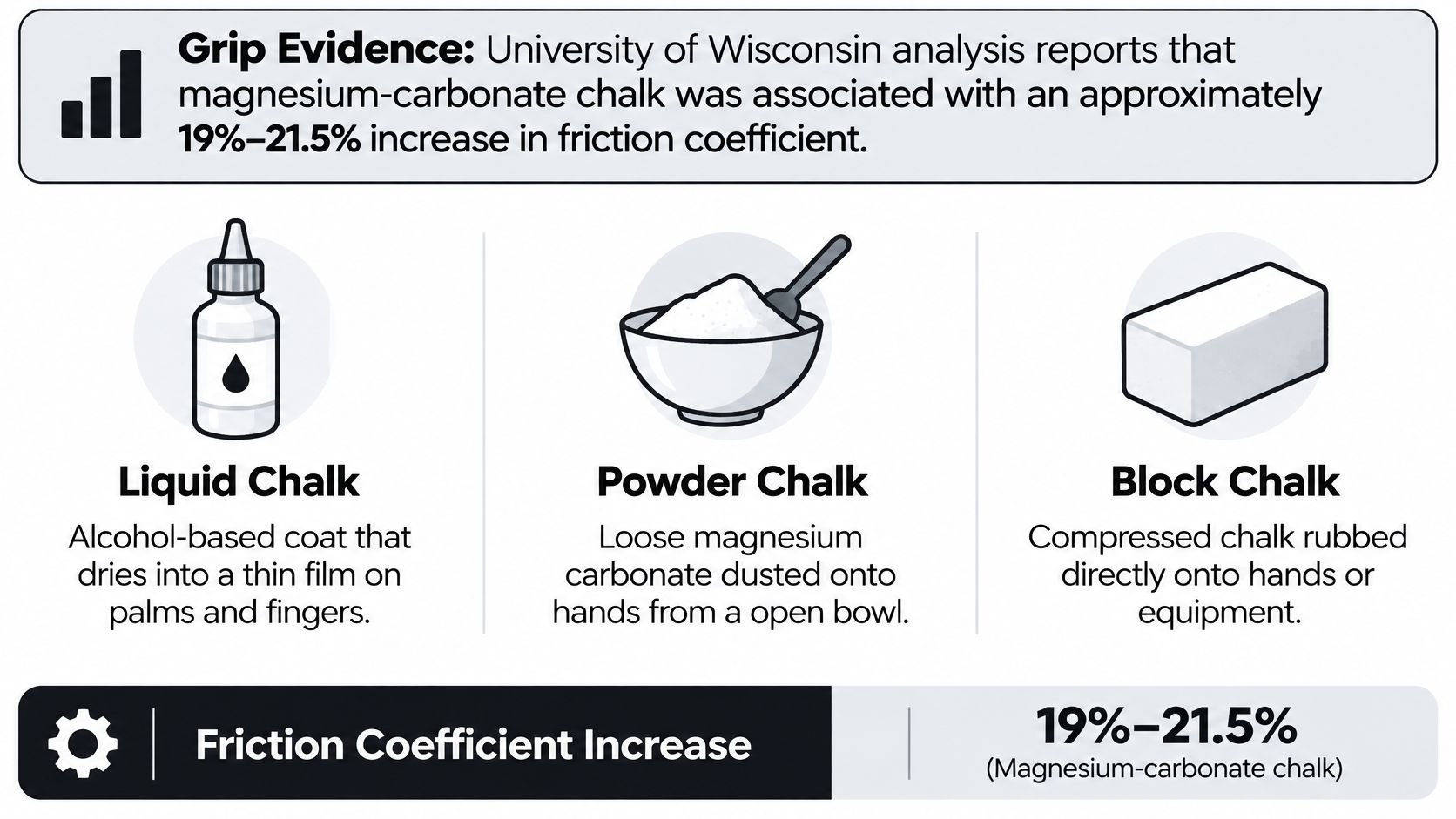
How each format puts chalk on the hand
Loose powder is the practical pick for long uneven-bar sets when the facility permits it. Athletes can refresh their hands between routines as sweat builds. The same repeated applications can add airborne dust and residue, so more frequent use has a cleanup cost.
A block transfers chalk through direct rubbing, while a chalk ball releases powder through its fabric covering. Both suit quick touch-ups, particularly when the athlete needs a small amount rather than a complete coating. They are less convenient when hands need full, even coverage.
Liquid chalk spreads magnesium carbonate across the skin, then dries as its carrier evaporates. It is the clear pick where powder is banned, and it also suits cheer and home practice when reducing airborne powder matters. The cost is time: athletes need to let a fresh coat dry before gripping. EVMT Liquid Chalk is a magnesium-carbonate formula described as drying in seconds, producing no dust cloud, and leaving minimal residue.
A setting-specific choice follows from these differences: use powder for extended bar work where refreshes matter, liquid in dust-restricted spaces, and a block for quick touch-ups. The research supports chalk's friction benefit; it does not show that applying a thicker layer improves grip. Apply only enough to create a dry contact surface, then judge the result by control and residue on the apparatus.
The formats therefore solve different problems rather than forming a single ranking. Gym policy and the athlete's need to refresh during practice should decide which trade-off matters most.
Which Chalk Fits Each Apparatus and Setting
The most useful choice is the one that satisfies both the apparatus requirements and the facility's rules. The table gives a starting point; the governing federation and gym policy decide what is allowed.
| Situation | Recommended chalk | Reason |
|---|---|---|
| Uneven bars, no dust restriction | Powder, with optional liquid base | Mid-routine refresh and high-sweat control |
| Uneven bars, powder banned | Liquid chalk on hands | Minimal dust and residue, allowed where powder is not |
| Balance beam | Light liquid or block | Little grip need, avoid heavy buildup |
| Rings and high bar | Liquid base under light powder | Even coverage plus quick top-ups |
| Vault and floor | Block or light liquid | Low sweat load, avoid mess |
| Cheer and tumbling, shared gym | Liquid chalk | Dust-free, clean on mats and apparel |
| Home gym | Liquid chalk | No dust in the house |
| Competition with shared bucket | Personal supply | Hygiene guidance favors individually issued chalk |
| Landing mats and markings | Chalk markings only | Must be removed after the event |
USA Gymnastics apparatus requirements specify that no substance besides chalk and water may be placed on the uneven-bar rails. The same document permits chalk markings on landing mats as visual cues, but requires those markings to be removed after the athlete finishes the event (USA Gymnastics apparatus requirements). These rules distinguish hand-applied chalk from products intended to coat an apparatus.
A liquid chalk should be applied to the athlete's hands, not the rails, mats, or other equipment. The facility's own policy controls even when a format is permitted under a federation rule. Athletes weighing the difference between tumbling and gymnastics training can also compare tumbling and gymnastics for context on how their training setting may differ.
For competitions, a personal supply is more defensible than relying on a shared bucket under FIG hygiene guidance. Athletes should confirm the rules for their federation and event before competing, especially if the venue has stricter limits than the general apparatus requirements.
How to Apply Liquid Chalk for Gymnastics
A liquid layer only helps if it dries before the athlete grips. The goal is a thin, even coating on the hands, with no wet film and no application to the apparatus.
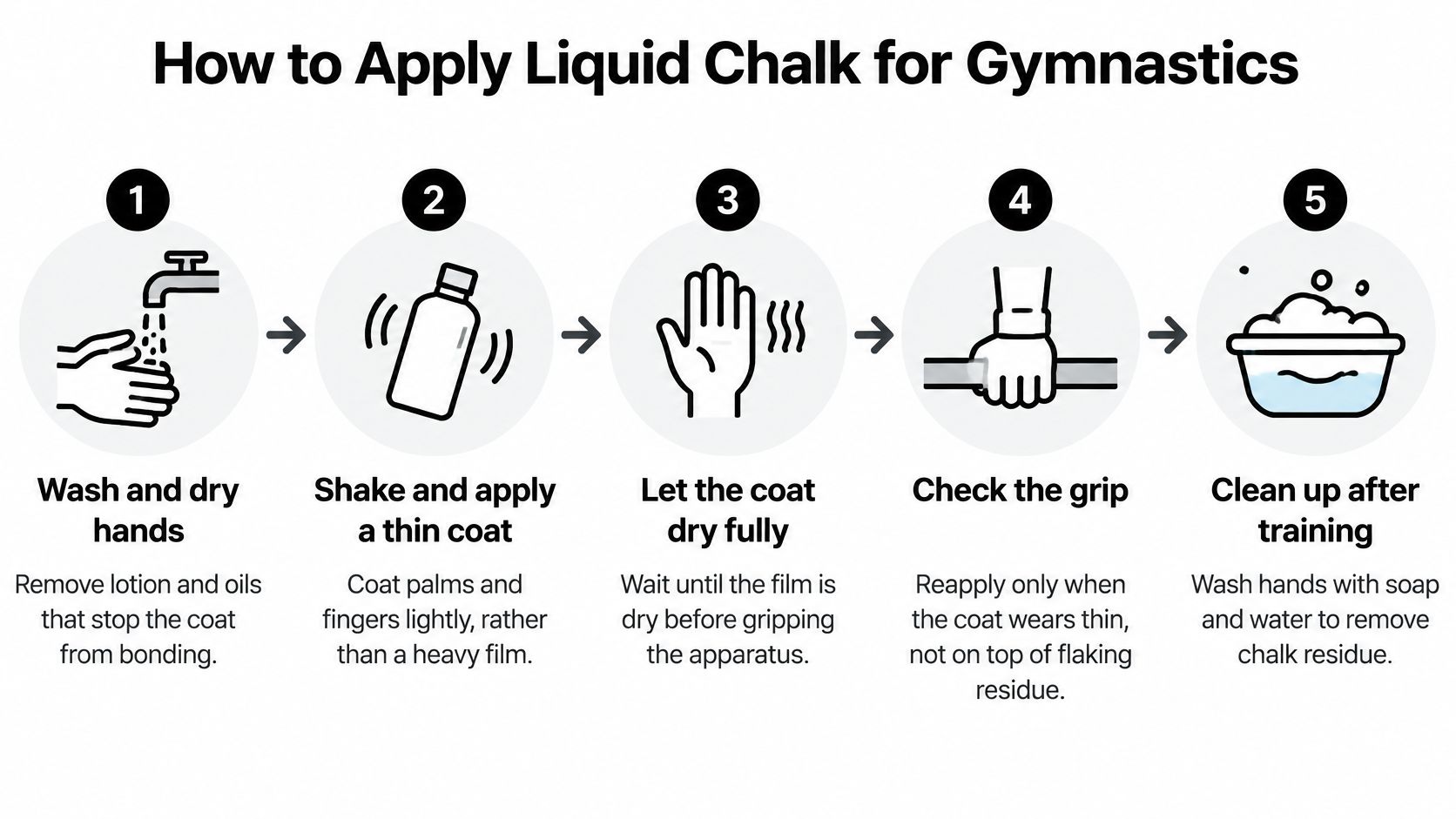
- Wash and dry hands. Remove lotion and oils that may keep the coating from bonding evenly. Starting with clean, dry skin also makes it easier to notice whether a later layer feels slick or patchy.
- Shake the bottle and apply a thin coat. Spread a light amount over the palms and fingers rather than building a heavy film. Thin coverage avoids unnecessary buildup and makes it easier to judge whether more is needed.
- Let the coat dry fully. The product may dry in seconds, but the hand still needs to feel dry before gripping. A wet film can slip instead of providing stable contact.
- Add a light powder top-up only if needed. If the routine calls for more grip and the facility permits powder, apply it over the dried liquid layer. Keep the application light so the combination doesn't cake on the hands or grips.
- Check between sets. Notice whether the coating has worn thin or whether only certain areas need attention. Re-coat those areas rather than repeatedly covering the entire hand.
- Wash hands after training. Use warm water and soap to remove the film and avoid stacking fresh layers over old chalk. That also gives the athlete a chance to check for dryness or irritation.
- Wipe the bars or rails after practice. Use a damp cloth and look for a white film or grip buildup. Keeping residue low makes the next session easier to assess.
A successful application feels dry and even, holds through the set, and doesn't feel wet or tacky. More application isn't automatically a better result; athletes can learn more about using liquid gymnastics chalk by checking the product guidance before training.
When Chalk Stops Helping or Starts Hurting
Chalk can improve grip on one surface and reduce it on another. The 2018 magnesium-carbonate grip study found better hand-grip dynamometer results with chalk than without it. That result supports chalk's potential to improve grip, but a dynamometer test cannot establish how a particular coating will perform on every gymnastics apparatus.
The effect depends on the apparatus material, hand temperature, sweat level, grip type, and whether the athlete is swinging, bearing weight, or sliding. A coating that feels secure on a wooden bar may behave differently on polished metal or a composite surface. Test the grip on the apparatus used in training, since adding more chalk may not improve contact.
Leather handguards also need a measured amount. Too little chalk may let the grip slide; too much can increase friction and heat, raising the chance of blisters. Aim for a thin, even contact layer that supports grip without building up on the handguard or skin.
The study also documented raised rashes, water blisters, blood blisters, and painful palm injuries associated with repeated gymnastics activity and chalk use. These findings show that skin problems can accompany training, but they do not establish that chalk alone caused each injury.
Practical test: Apply a thin coat, complete one set on the actual apparatus, and note whether the hand slides, heats, or feels tacky.
| Symptom | Likely chalk-related cause | Fix |
|---|---|---|
| Raised rash or redness on palms | Repeated friction over thick or caked chalk | Use a thin, even coat, wash after the session, and allow rest |
| Water blisters | Moisture trapped under heavy layers and friction | Use fewer layers, let the coat dry fully, and apply less |
| Blood blisters or painful palm injury | Over-drying or heavy friction during high-load work | Reduce session volume, check grip fit, and seek professional advice if painful |
| Skin cracking or tearing | Over-drying from repeated heavy application | Switch to a thinner coat and reduce stacked applications |
| Slipping despite chalk | Too little chalk or a film that has worn off | Reapply a thin coat after drying and test it on the actual apparatus |
For painful, spreading, or persistent blisters, seek advice from a medical professional. Hand irritation and tearing also call for a review of application habits. Gymnastics hand-rip guidance can help readers consider skin care alongside chalk use.
Choose Your Chalk Before the Next Session
The setting narrows the choice, but a short on-apparatus trial should decide it. If powder is prohibited, liquid chalk is the practical format, provided the facility allows it. Liquid also suits cheer and home sessions where loose powder is a concern. For long, sweaty uneven-bar sets, choose powder when permitted, since it can be refreshed during training. A block is the quick-touch-up pick when a small amount is needed between turns.
Test any liquid format for two sessions on the athlete's apparatus. Track slippage, residue, and skin response, then compare those observations with the six criteria above. EVMT Liquid Chalk is one liquid option mentioned earlier, not a substitute for checking how a formula performs in the athlete's own setting.
Confirm the gym's chalk policy before bringing a product in. The final choice should satisfy the rules and work on the surface without creating avoidable cleanup or skin irritation.
Evermost LLC offers EVMT Liquid Chalk in single bottles and multi-packs. Its liquid format may suit gymnastics sessions where powder rules or cleanup needs influence the choice. For product details, visit Evermost LLC.