


Powerlifting Grip Training That Actually Works
You're on the platform for your opener deadlift. The bar leaves the floor cleanly, your back and legs stay tight, and then the knurling starts sliding through your palm around mid-shin. The strength is there, but the connection isn't. That miss feels avoidable because it is, at least in part. Grip is a trainable lifting quality, not a test of character you either pass or fail on meet day.
Effective powerlifting grip training should improve bar security, hand positioning, forearm endurance, and your ability to express strength without turning every session into a forearm demolition workout. It should also account for the squat and bench press, where the hands control the bar path and help create a stable platform. Chalk, hook grip practice, thick handles, carries, and straps all have a place, but only when they serve the current training goal.
Why Grip Matters in All Three Powerlifts
A deadlift miss makes the role of grip obvious. If your fingers open at lockout or the bar rolls away during the pull, your posterior chain can't finish the lift even if your hips and back are capable of moving the weight. Grip failure can cost kilos that your larger muscle groups were prepared to lift.
That same hand-to-bar connection matters in the squat and bench press, although it shows up differently.
Deadlift connection
For the deadlift, grip has to resist bar rotation while you maintain lat tension and a consistent bar path. Double overhand work exposes raw holding strength, while mixed and hook grips give you ways to secure heavier attempts. The choice changes the demands on your thumb, fingers, wrists, shoulders, and trunk, so it should be trained deliberately rather than improvised when the bar gets heavy.
A useful deadlift setup starts before the plates move. Close the hand hard around the bar, pull slack out of the system, keep the bar close, and commit to the position before lift-off. If your grip is only partly engaged, the rest of your setup can't compensate.
Squat rack control
A secure squat grip lets you place the bar where you want it, usually across the rear delts in a low-bar position or across the upper back in a high-bar position. When the hands hold the bar firmly and the elbows stay organized, the bar can settle without forcing the wrists to carry unnecessary extension.
That control also helps you maintain upper-back tension and a braced thoracic position under load. The hands don't lift the squat directly, but they help create the shelf that keeps the bar stable. A loose rack grip often appears as shifting elbows, bent wrists, or a bar that moves during the descent.
Bench press stability
On the bench, a tight grip helps set the upper body before the unrack. Squeeze the bar, keep the wrists stacked over the forearms, and use the hands to support scapular positioning against the bench. If the wrist collapses backward, the bar can drift and the force from the chest, shoulders, and triceps becomes less efficient.
The wider your grip, the more carefully you need to manage wrist and forearm alignment. A narrower, firm hold usually gives you a clearer feeling of the bar sitting over the base of the palm. That doesn't mean every lifter should use the same width. It means the grip should reinforce your chosen technique rather than fight it.
Practical rule: Train the hand position you need to reproduce under pressure, then add accessory work that strengthens the weak link without disrupting your main lifts.
A well-built barbell training for results approach treats contact points as part of technique. Grip belongs in that category. It deserves planned exposure, clear cues, and progression across all three powerlifts, not a few exhausted wrist curls after deadlifts.
Grip Styles and Thumb Placement Explained
Competitive lifters usually rely on three deadlift grips: double overhand, mixed, and hook. Each changes how the bar wants to rotate and where the hand has to create pressure. The right choice depends on whether you're developing grip, practicing competition technique, or trying to complete a demanding top set.
Double overhand
Place both palms toward your body, wrap the thumbs, and keep the wrists straight. Don't use a figure-four position or let the fingers loosen as the bar rises. Double overhand is the most useful starting grip because it exposes the actual capacity of the fingers and thumb.
It generally holds well through warm-ups and moderate work, often up to roughly 70% of 1RM, but that load guidance is a practical training range rather than a guarantee. As the bar gets heavier and begins rotating out of the fingers, the grip can unravel before the legs or back reach their limit.
Mixed grip
With a mixed grip, one palm faces you and the other faces away. Set the supinated hand under your dominant side so the bar rolls toward your body rather than away from it. Keep the arms long and avoid actively curling the underhand side.
The trade-off is asymmetry. The alternating hand position can encourage trunk and shoulder rotation, especially when the same hand is always supinated. Many lifters offset their stance or alternate the underhand side in training to reduce that repeated pattern. Mixed grip is practical for heavy competition pulls, but it shouldn't be the only grip you practice.
Hook grip
Set the thumb first. Wrap it around the bar, then close the fingers over the thumb and squeeze before lift-off. A high thumb position gives the index finger more material to lock against, while a low thumb can let the index finger slip and weaken the wrap.
Hook grip keeps both palms facing down and demands gradual adaptation. In a power clean study, all subjects lifted a greater 1RM with hook grip than with closed grip, with the difference reported as statistically significant at P < .001. The hook grip also improved several power and technical measures at most submaximal intensities, while the athletes' perceived advantages were less consistent at maximal loads. PubMed's power clean study supports practicing the grip before maximal attempts, not introducing it only on meet day.
| Grip Style | Setup Cue | Typical Load Range | Main Trade-Off |
|---|---|---|---|
| Double overhand | Straight wrists, thumbs wrapped, fingers closed firmly | Warm-ups and moderate work, often up to roughly 70% | Develops raw grip but may fail as the bar rotates |
| Mixed grip | Supinated hand under the dominant side, arms long | Heavy training and competition attempts | Asymmetry and possible rotation stress |
| Hook grip | Thumb first, fingers over the thumb, squeeze before lift-off | Progressive submaximal work through heavy attempts | Thumb discomfort and adaptation demands |
For a deeper look at how these choices affect deadlift security, use this guide to the best grip for deadlift. My rule is simple. Use double overhand to build capacity, hook grip when you want a symmetrical heavy-pull skill, and mixed grip when it fits your competition strategy and you've trained both sides intelligently.
Warm-Up Sequence for Secure Hands
Cold hands often feel weak before they're weak. A short preparation sequence improves awareness, warms the tissues around the fingers and wrists, and gives you a repeatable grip cue before the bar becomes challenging. It shouldn't exhaust your forearms.
Wake up the hands
Start with two minutes of open-and-close hand squeezes. Open the fingers fully, then close the hand firmly without cramping. This brings the thenar muscles and finger flexors into the session without creating the fatigue that can come from aggressive gripper work.
Follow that with wrist circles in both directions. Keep the motion smooth, then perform a light set of reverse wrist curls to bring the extensors into the warm-up. Strong fingers paired with neglected extensors can leave the forearms feeling tight or cramp-prone once the bar gets heavy.
A broader joint and movement preparation routine can complement this hand sequence. The SunnyBay fitness preparation advice is a useful reference for building a general warm-up around the specific demands of your session.
Rehearse the working grip
Before loaded deadlift work, perform a bar-only dead hang using the grip you'll use that day. Pull the shoulders into a controlled position, pull the slack out of the bar if it's resting in a rack or deadlift setup, and hold the grip for five seconds. The point isn't to test endurance. It's to rehearse the same hand pressure you'll need at meet intensity.
Use the following sequence before each unrack or pull:
- Chalk the hands until the surface feels tacky, not caked.
- Set the thumb position, especially if you're using a hook grip.
- Close the fingers from pinky to index so the outer fingers establish the wrap.
- Squeeze the bar into the palm while keeping the wrist aligned.
- Lift off only after tension is set through the hands, lats, and trunk.
The same activation carries into squat and bench setup. A firm hand gives you a more stable rack grip and a tighter bench hold, so the warm-up reinforces more than deadlift performance.
Accessory Work That Builds Real Grip
Random forearm exercises rarely solve a grip-limited deadlift if they're placed wherever fatigue is highest. Assign each movement to a specific training purpose and protect the quality of your main lifts.
Thick-bar pulls
Use Fat Gripz-style implements or an axle for a deadlift variation after the main pull. A practical template is 3 sets of 5 reps with a load that lets you maintain a full finger wrap and controlled lockout. Thick handles increase the demand on the hand and finger flexors, but they aren't automatically superior to standard-bar training.
One study described 25 reps per session spread across 5 to 6 sets and found that the thick-grip group improved mean deadlift 5RM by 29.8%, compared with 39.0% in the control group after the intervention. The results, summarized by Stronger by Science's grip analysis, support using thick-grip work as an accessory stimulus rather than assuming thicker handles guarantee better deadlift gains.
Carries and pinches
Farmer carries build supporting grip while asking you to keep the thumb active around the handle. Walk 30 to 60 meters with farmer's handles, shoulders level and ribs down. A useful loading target is 50% to 60% of bodyweight per hand, provided the walk remains controlled and your hands don't open early.
Plate pinches train thumb and finger pressure from a different angle. Hold two 25-pound plates together at your side, smooth faces outward, and build toward 30 seconds or more before increasing the challenge. Schedule pinches on a secondary posterior-chain day when your hands are fresher.
Direct forearm work
Wrist curls and reverse wrist curls on a flat bench can add local work without requiring another heavy barbell exposure. Use moderate weight, keep the range controlled, and emphasize the eccentric rather than chasing a painful pump.
| Exercise | Day | Sets x Reps | Load Target | Purpose |
|---|---|---|---|---|
| Fat Gripz or axle deadlift | Main deadlift day | 3 x 5 | Moderate, full-wrap load | Finger-flexor and thick-handle strength |
| Farmer carry | Main deadlift day finisher | Practical walking sets | 50% to 60% bodyweight per hand | Supporting grip and trunk control |
| Plate pinch | Secondary posterior-chain day | Timed holds | Two 25-pound plates, build to 30+ seconds | Thumb and pinch strength |
| Wrist curl | Secondary posterior-chain day | Controlled moderate sets | Moderate weight | Wrist-flexor capacity |
| Reverse wrist curl | Secondary posterior-chain day | Controlled moderate sets | Moderate weight | Wrist-extensor balance |
These movements can support squat rack control and bench setup because they improve hand pressure and wrist awareness, not just deadlift endurance. If your elbows or forearms start barking, swap thick-bar pulls for carries, reduce direct wrist work, or use a lighter implement. This grip-strength training guide can help you choose variations without turning every session into the same stress pattern.
Chalk and Straps as Programming Tools
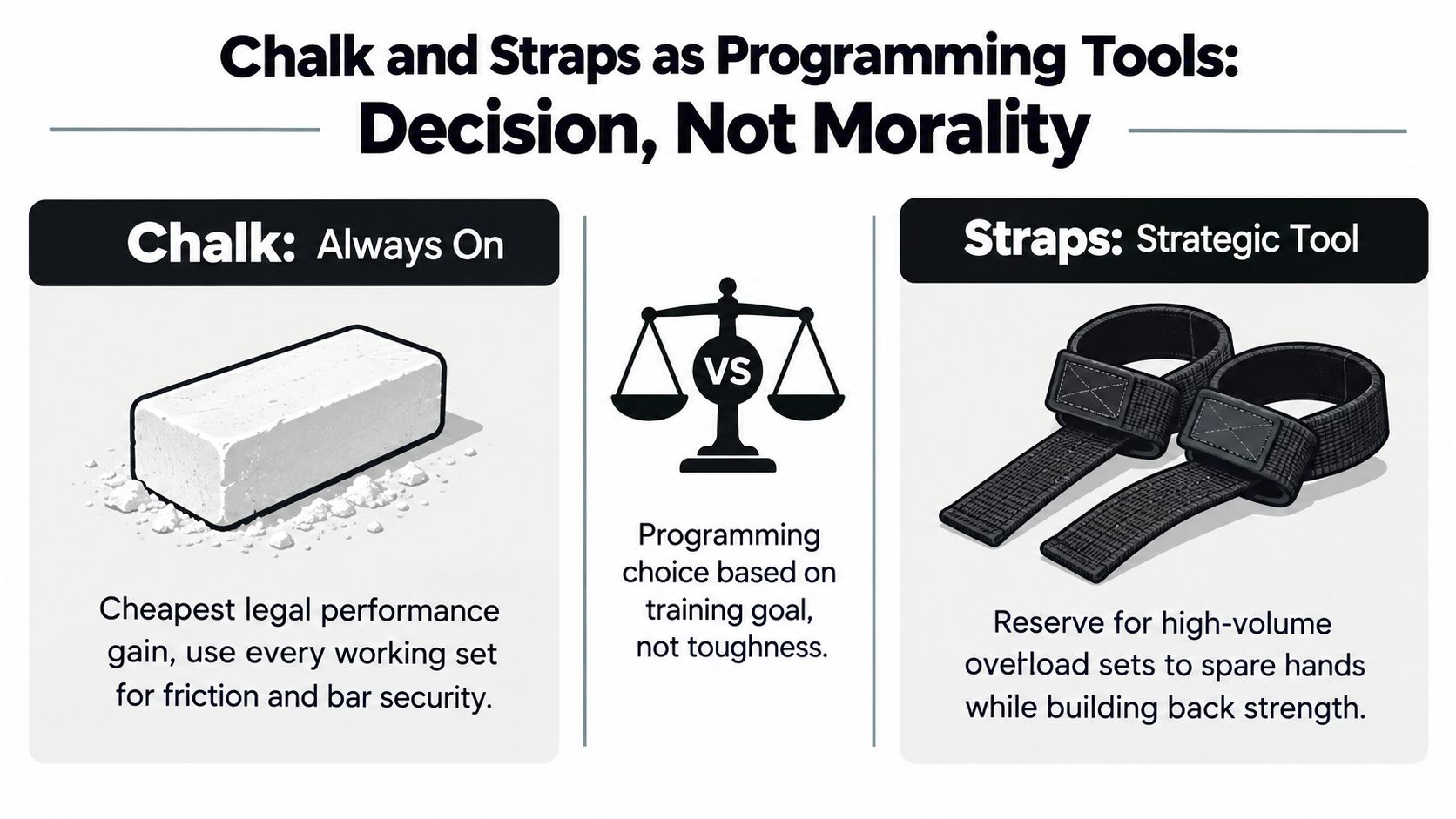
Chalk and straps aren't moral choices. They're tools that change what a set trains.
Chalk should be part of every working session. It improves friction between the hand and bar while preserving the demand on the grip. In a powerlifting meet, chalk is permitted, while straps aren't permitted in raw competition deadlifts, so competition-minded lifters need to practice creating security through hand placement, thumb pressure, and friction. Competition guidance on powerlifting grips provides useful context for that platform reality.
Straps belong on work where the target is the back, hamstrings, or hips and grip would otherwise end the set first. That includes overload deadlifts, high-repetition back-off work, rows, Romanian deadlifts, and other pulling accessories. Strapping a supplemental set doesn't erase the value of the set. It lets the intended musculature keep working.
Keep a raw exposure
Train competition grip at least once per week on a heavy single or a top set of 3 to 5 reps. Use double overhand or hook grip for that exposure, depending on your meet plan, then apply straps to the supplemental volume beyond it.
The useful question isn't “Are straps cheating?” It's “Which quality is this set supposed to develop?”
A lifter who straps every demanding deadlift may build a stronger back while leaving competition-grip capacity behind. A lifter who refuses straps on every set may cut posterior-chain volume short because the hands fail first. The layered approach solves both problems: chalk always, raw competition grip on the key set, straps for volume that has a different target.
Liquid chalk can be convenient when block chalk is messy or restricted by gym rules. Thumb tape can also improve hook-grip tolerance during high-volume blocks, but it shouldn't hide a thumb position that has never been practiced.
For portable, low-mess grip support, EVMT Liquid Chalk for powerlifting is one option. It dries quickly, is designed to reduce slippage, and is available in portable and higher-volume formats. Check your gym and federation expectations before relying on any particular chalk format.
A Six-Week Grip Progression Plan
Run this progression alongside your normal powerlifting program. Keep the main deadlift loading based on your established training percentages, and treat the grip work as a way to build exposure without compromising bar speed or recovery.
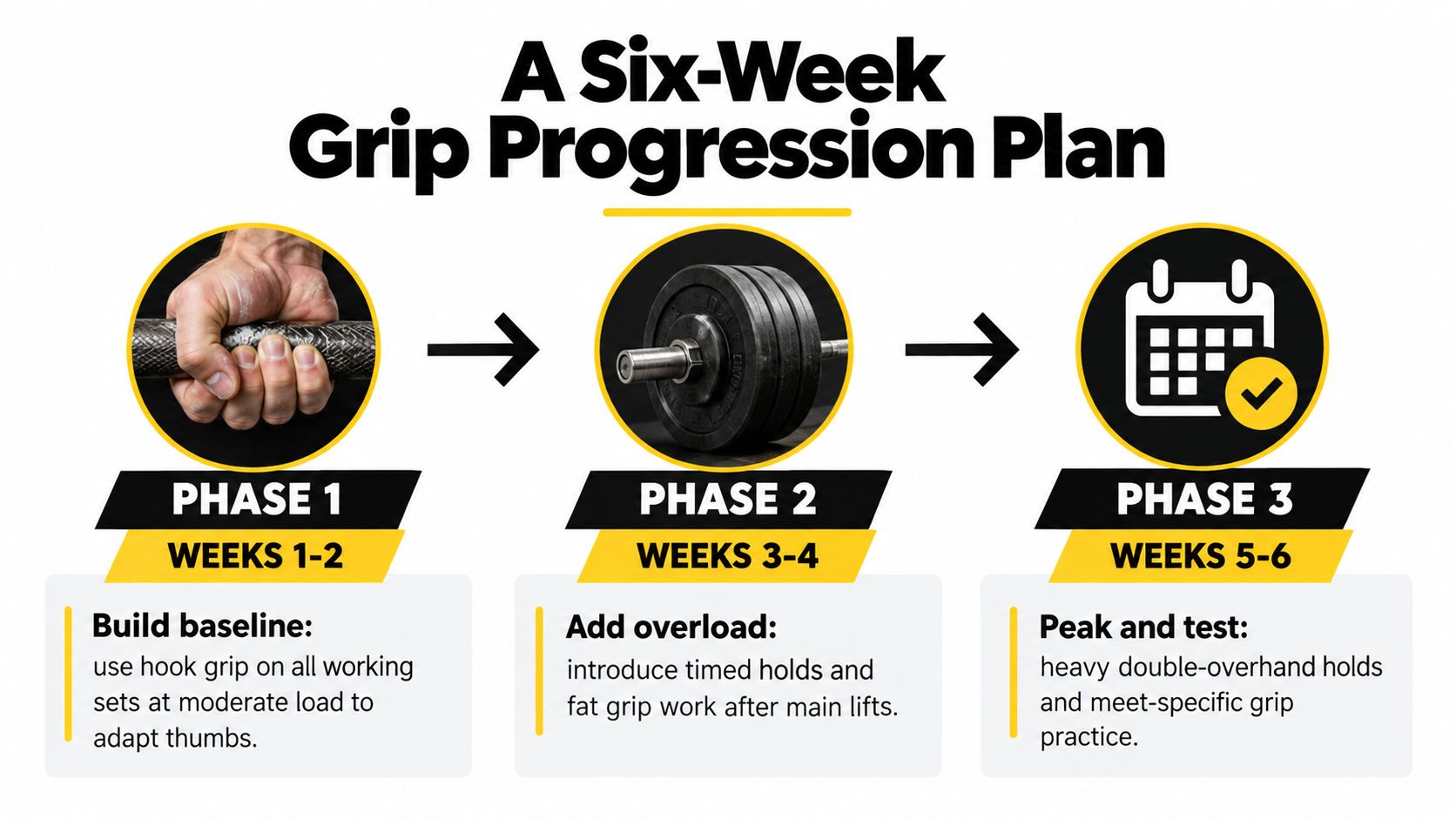
Phase one, weeks one and two
Use hook grip on all working deadlift sets at 70% to 80%. Don't wait for a heavy set to introduce it. The purpose is to teach the thumb wrap, finger closure, and pre-lift squeeze while the load remains manageable.
Add plate pinches for 3 sets of 20 seconds after the secondary posterior-chain session. Keep the plates controlled at your side and stop before the fingers peel away.
- Deadlift grip: Hook grip on every working set.
- Pinches: 3 x 20 seconds.
- Straps: Use only after the required hook-grip work, if supplemental volume needs them.
- Adjustment: If the thumb skin becomes irritated, shorten the hold time and use tape rather than abandoning the technique.
Phase two, weeks three and four
Keep hook grip on the main working sets. After the top deadlift single, perform lockout holds for 3 sets of 5 seconds. Use a load you can hold without leaning back, shrugging excessively, or letting the fingers open.
Add farmer carries as a finisher for 4 sets of 40 meters at bodyweight per hand. That target is demanding, so reduce the load if your walk becomes unstable or your thumb loses contact.
- Deadlift holds: 3 x 5 seconds after the top single.
- Farmer carries: 4 x 40 meters at bodyweight per hand.
- Plate pinches: Keep 3 x 20 seconds if recovery remains good.
- Thick-bar work: Use it only if it doesn't reduce performance on the main deadlift or the timed holds.
Phase three, weeks five and six
Practice your heaviest planned deadlift of the block with competition-legal grip and chalk. Use the grip you'll use in the meet, and don't switch to straps because the attempt feels uncertain. Reduce accessory volume during this phase so the hands arrive fresh.
Week six is the deload. Keep the competition-grip exposure, but cut the accessory work substantially and avoid grinding holds. The goal is to preserve coordination while shedding fatigue.
In week seven, test a heavy single after normal warm-ups, using only the grip, chalk, and thumb tape permitted by your competition plan. Repeat the cycle if the test moves well. If hook-grip pain or a torn callus interrupts the block, resume at the last pain-free exposure instead of forcing the calendar.
Recovery, Callus Care, and Meet-Day Setup
Grip preparation fails when skin care gets ignored. A torn callus changes how you hold the bar, creates hesitation, and can turn a planned attempt into a cautious one.
The week before the meet
File raised calluses with a pumice stone or callus shaver so the skin stays smooth rather than catching on the knurling. Apply heavy cream at night, but don't use lotion on the morning of pulls because soft, slick skin can reduce bar feel. For additional soothing hand care with fresh aloe, choose a product that supports your normal skin routine without leaving a greasy film before training.
Use light gripper or rice-bucket work on off-days only if it leaves your hands fresh. Avoid heavy holds the day before squats. If you use an NSAID or topical diclofenac, follow the product label and your clinician's guidance rather than experimenting at the meet.
Meet-day checklist
- Arrival: Confirm equipment, weigh-in timing, attempt cards, chalk, towel, nail clipper, tape, deadlift socks, and shoes.
- Before warm-ups: Put on belt and wrist wraps in the order you've rehearsed. Test the exact hand placement with an empty bar.
- Last warm-up: Use your competition grip and judge the strap decision from how secure the hands feel, not from pride. Straps are for training, not the platform.
- Before each attempt: Chalk shortly before approaching the bar. Set the thumb wrap, close the fingers from pinky to index, and squeeze before lift-off.
- Between attempts: Inspect hot spots and retape torn thumbs or split calluses without covering so much skin that bar feel disappears.
IPF deadlift rules keep the hands within the 81 cm grip marks, require both forefingers to be within and contacting the marks when using maximum grip, and prohibit reverse grip. The 2026 IPF Technical Rulebook should be your final reference because federation rules matter more than gym habit.
Build your timing around the platform, not a generic routine. Arrive, complete the weigh-in process, eat and hydrate as planned, begin warm-ups with enough margin for the flight, chalk before the final warm-up, and check skin and equipment after every attempt. That preparation keeps a small hand problem from becoming the story of your third deadlift.
Evermost LLC offers EVMT Liquid Chalk in portable and high-volume formats for lifters who want fast-drying, sweat-resistant bar contact without powder clouds. Add a clean chalk option to your powerlifting grip training and visit Evermost LLC to choose the format that fits your gym and meet preparation.