


Pole Grip for Sweaty Hands: 7 Ways to Stop Slipping
You're halfway through a spin, your palm starts to peel, and the combination falls apart before the difficult move even begins. For athletes with sweaty hands, pole grip can change from secure to unreliable in a few seconds. The answer isn't drowning your hands in the stickiest product available. It's a session routine that manages moisture before class, applies grip in a thin layer, checks friction by movement, and cleans both skin and equipment afterward.
Table of Contents
- Why Pole Hands Slip and What Actually Fixes It
- Pre-Class Prep That Lowers Sweat Before You Touch the Pole
- How to Apply Liquid Chalk So It Actually Dries and Holds
- Finding Predictable Friction Instead of Sticking Too Hard
- Mid-Session Maintenance and the Re-Chalk Rescue
- How Liquid Chalk Compares to Powder, Spray, and Gloves for Pole
- Your Pole-Grip Routine and When to See a Pro
Why Pole Hands Slip and What Actually Fixes It
Pole makes sweaty hands especially difficult because the hand has to do several jobs at once. It must hold a polished chrome or brass surface, tolerate repeated pressure over the palm and fingers, and adjust constantly between a static hold, a controlled slide, a spin, and a release. A hand that feels secure in one movement can feel dangerously sticky or suddenly slippery in the next.
The problem isn't always ordinary workout sweat. Hyperhidrosis research reports overall prevalence between 2.8% and 4.8% in nationally representative U.S. samples, while measured rates are higher in selected employee, student, and clinical groups. Primary palmar hyperhidrosis has also been reported in roughly 4.30% to 5.80% of studied populations in China, and the reported mean age of onset for palmar hyperhidrosis was 16.6 years. These figures come from different populations and methods, so they shouldn't be treated as directly interchangeable, but they show why persistent sweaty palms deserve more than a casual product recommendation. A peer-reviewed review of hyperhidrosis prevalence and onset provides that wider context.
A useful pole-grip routine starts with four layers:
- Drying: reduce moisture before the first contact.
- Applying: use a thin, even coat on completely dry skin.
- Maintaining: reapply only after removing sweat and checking the existing layer.
- Cleaning: wash the hands and wipe equipment so old residue doesn't become the next slipping problem.
Practical rule: The target isn't maximum stickiness. It's friction that feels predictable enough to hold, slide, and release deliberately.
That distinction matters. A beginner who grips too aggressively may feel safer during a static hold but lose control during a spin or release. A practical drying approach for pole grip works better when it treats sweat as a variable to manage, not an embarrassment to hide under more product.
Pre-Class Prep That Lowers Sweat Before You Touch the Pole
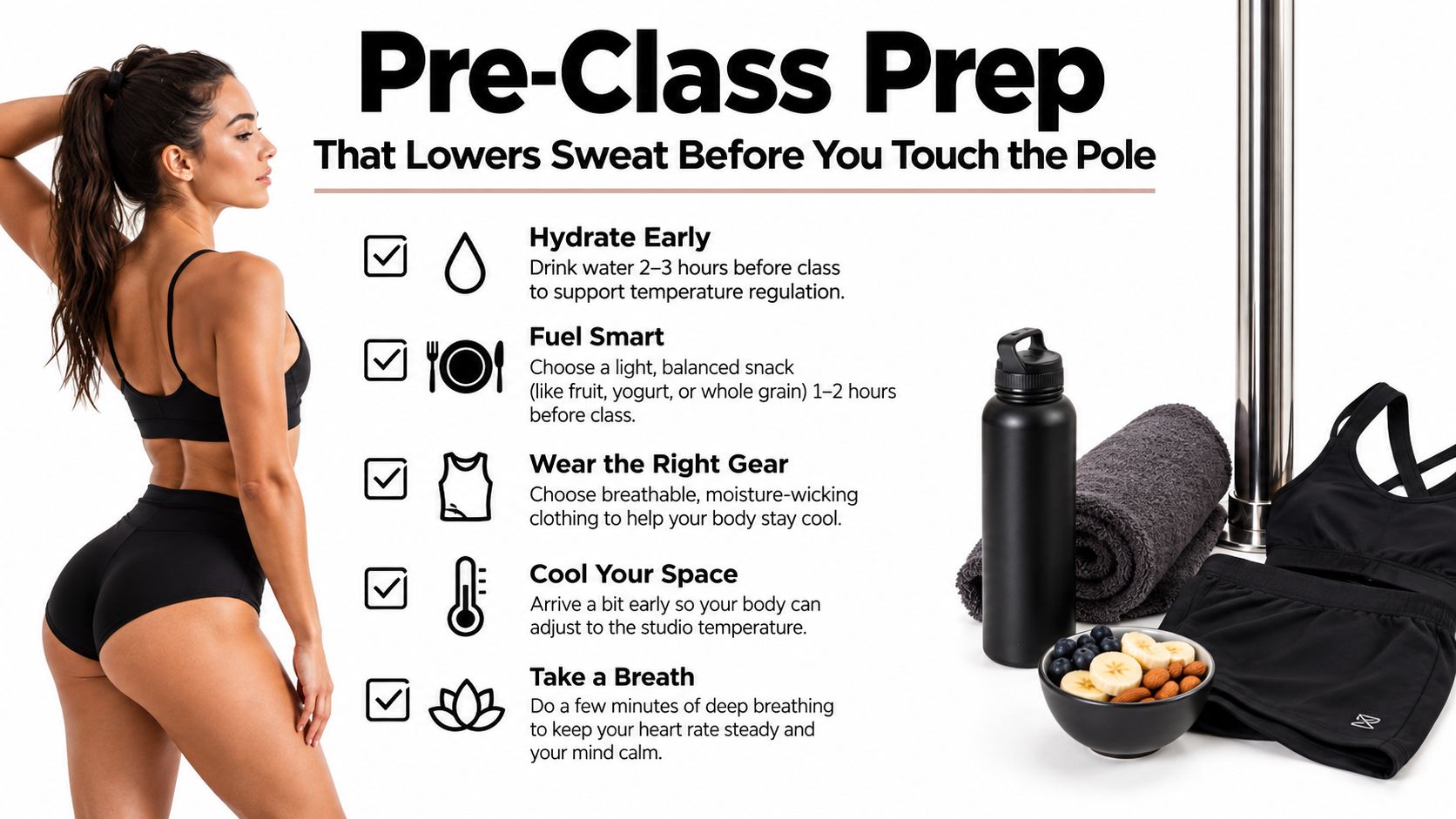
The best pole grip for sweaty hands starts before the studio. A clean, dry palm gives any grip aid a better surface, while lotion, damp skin, and rushed application can undermine the product before the first hold.
The night-before option for heavy sweating
Athletes whose palms stay unusually wet outside exercise can test a clinical antiperspirant routine rather than relying only on grip. Medical guidance recommends applying aluminum-chloride antiperspirant to completely dry palms at bedtime, leaving it on for 6 to 8 hours, then washing it off in the morning. A cool blow-dryer can help ensure the skin is dry before application. Use it nightly for approximately one week, then reduce to maintenance once or twice weekly after sweating is controlled. A two-week trial is generally enough to judge whether it helps. Clinical guidance on topical antiperspirant use also advises against wrapping or occluding treated hands because irritation risk increases.
This isn't a class-day grip product. Prescription-style antiperspirant belongs in an overnight routine, not immediately before pole practice. Burning, cracking, or dermatitis means the athlete should stop or modify use and seek dermatology advice.
The day-of checklist
- Wash gently: Use a pH-balanced soap before class, then rinse away all cleanser.
- Skip heavy creams: Avoid hand lotion, oil, or body products that can leave a slick film during the hours before training.
- Dry completely: Pat the hands first, then use a cool blow-dryer setting if moisture remains between the fingers.
- Manage stimulants: Hydration still matters, but caffeine and pre-workout stimulants can make palm sweating worse for some athletes.
- Arrive early enough: Rub the hands together briefly, snap the fingers, and let residual moisture evaporate before applying chalk.
Once the hands are clean and dry, EVMT LIQUID CHALK can be used as a magnesium-carbonate liquid chalk option for athletes who need grip on the hands without loose powder.
How to Apply Liquid Chalk So It Actually Dries and Holds
Most liquid-chalk failures come from application, not from the idea of liquid chalk itself. A damp palm, an oversized dose, or an immediate grab can turn a clean drying layer into a gummy film that transfers to the pole.
The application sequence
- Start with dry hands. Moisture dilutes the product and makes an even coat harder to form. If the palms feel cool, wet, or shiny, dry them again before opening the bottle.
- Use a coin-sized dot. Put a small amount in one palm, then spread it across both hands rather than repeatedly pouring more onto the skin.
- Cover the contact areas. Work the liquid across the palms, fingers, thumb pads, and heel of the hand. Thin coverage matters more than visibly white hands.
- Wait about 20 seconds. The wet layer should turn into a fine white film before the hands touch the pole.
- Perform a feel-test. The finished coat should look uniformly matte, with no wet shine and no sticky paste between the fingers.
A magnesium-carbonate liquid chalk such as EVMT is designed to dry in seconds and provide a clean alternative to loose powder. Applied correctly, it should leave little transferable residue on chrome or brass, and its no-dust format suits studios that restrict powder chalk. That doesn't remove the need to follow the studio's own policy or clean the apparatus as directed. The product's role is to create a controlled skin layer, not to replace responsible equipment care.
Liquid Chalk Application Quick Check
| Indicator | Too Little | Just Right | Too Much |
|---|---|---|---|
| Appearance | Bare skin still looks shiny | Even, matte film | Thick, patchy coating |
| Feel | Palm remains damp or uncertain | Dry with controlled friction | Pasty, overly tacky, or balled-up |
| Pole contact | Grip fades quickly | Hold feels secure without forcing | Product transfers or makes release awkward |
| Next move | More may be needed after checking dryness | Test the planned movement | Wipe or rinse excess instead of adding more |
A pole liquid-chalk application guide is useful for athletes who keep making the same timing mistake. The key habit is simple: spread, wait, test. Applying more before the first coat has dried usually makes the result less predictable, not stronger.
Finding Predictable Friction Instead of Sticking Too Hard
Maximum grip isn't automatically the safest grip. Pole movement requires a deliberate change between sticking to the apparatus, sliding around it, and releasing without a sudden jerk through the shoulder or elbow.
A static hold may need more friction than a momentum-driven spin. A controlled release needs less than either. If the palm feels glued to the pole, the athlete may compensate by squeezing harder, load the joints abruptly during a transition, or lose the ability to release when the movement calls for it.
Test by movement, not by hand feel alone
Use the first low-risk movement as a test rather than committing to the strongest possible coat. The useful question is:
“Can this hand hold securely, then slide off with intent?”
If the answer is no, the coat is too aggressive for that movement. Reduce the amount, wipe the palms with a clean damp cloth, or wash and restart with a thinner layer. Don't add more product because a release feels unfamiliar. A controlled slip can be part of correct movement, while an unexpected slip during a static hold signals that the surface, skin, or application needs attention.
Athletes with persistent palmar sweating should be especially careful about repeated reapplication. Medical literature describes excessive hand sweating as a condition that can impair daily activities and occur in all seasons, including winter. A clinical review of hyperhidrosis and palmar involvement notes that topical treatments are part of a stepwise care pathway, which means stronger chalk isn't always the logical next step.
The practical standard is minimum effective coverage. Use enough liquid chalk to create a dry, even contact layer, then judge it against the next movement. If a product irritates the skin, causes cracking, or makes releases unreliable, the answer is not automatically a heavier coat.
Mid-Session Maintenance and the Re-Chalk Rescue
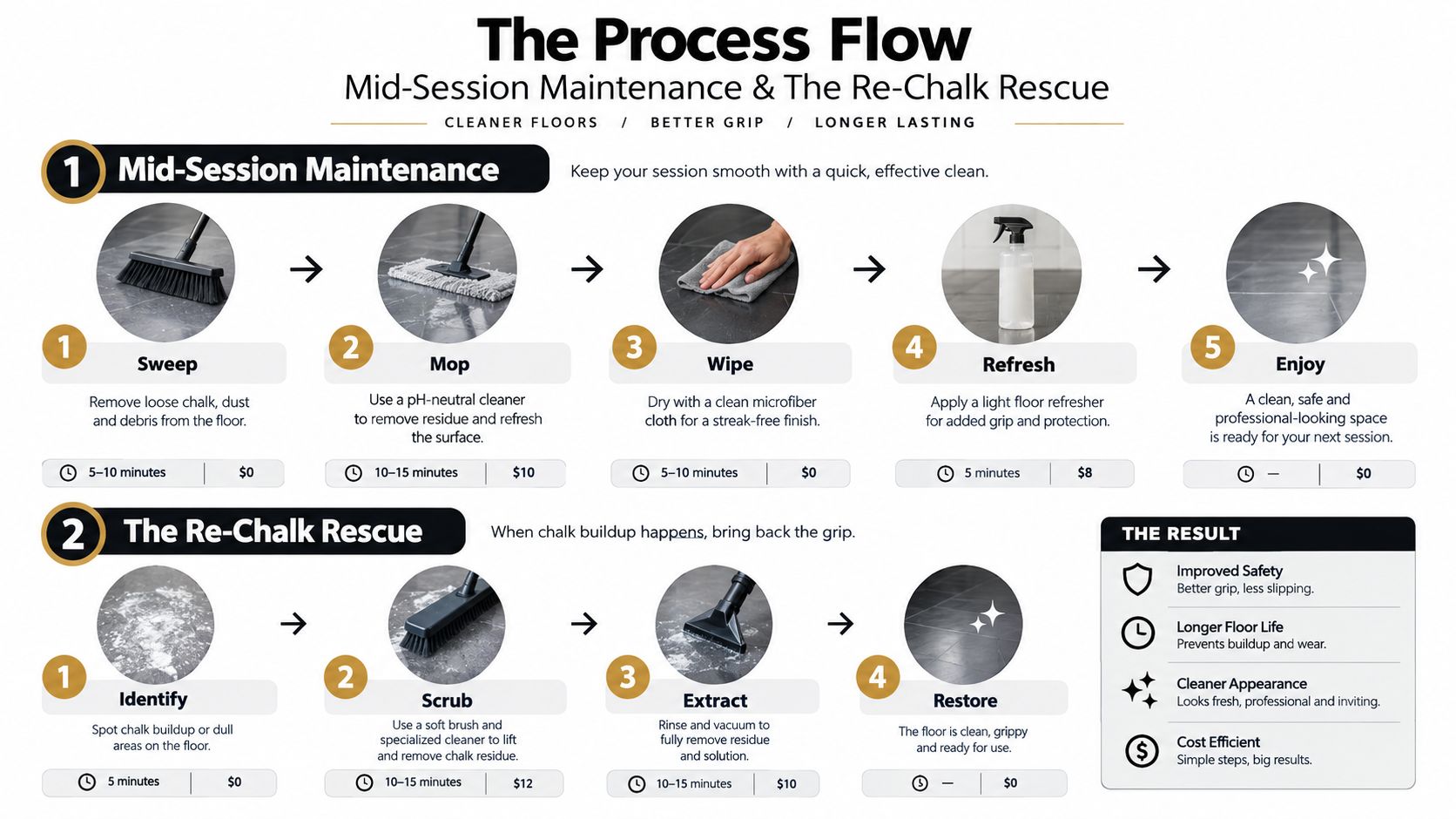
Long classes, humid rooms, and repeated contact gradually change the palm. The first coat may wear at the fingertips and the heel of the hand, while sweat creates a sheen over the areas that still look covered. Reapplication works only when the old layer is dry enough to receive it.
The rescue sequence
Keep a small microfiber towel in the training bag. When grip begins to fade:
- Stop and inspect. Look for worn patches, returning shine, or a hold that feels conditional.
- Remove moisture. Wipe the hands thoroughly, then allow a brief air-dry.
- Use half the original amount. Apply a half-dot of liquid chalk rather than rebuilding a heavy coat.
- Wait for the matte finish. Don't return to the pole while the layer still looks wet.
- Retest on a low-risk contact. Check the next hold before attempting an inversion or fast transition.
The common mistake is adding new chalk directly over sweat. That traps moisture inside the layer and can create a gummy film that fails quickly. For shorter gaps between sets, a dry towel followed by a small shake of loose chalk over a fully dried liquid layer can work when the studio permits it. That approach adds a dry top layer without asking wet skin to hold more product.
A thin, fully dried liquid chalk coat typically lasts one to two long classes for a moderate sweater, with longer performance in a climate-controlled studio and shorter performance in summer humidity. Treat that as a starting observation, not a promise. Skin moisture, pole finish, room conditions, and movement choice all change the result.
Never apply chalk directly to the pole. Apply it to the body, let it dry, and use only the amount needed. Competition rules commonly focus on transfer and cleanup. The International Pole Sports Federation allows grip products on the hands, feet, or body, but not directly on the apparatus, and its cited rules describe a 5-point penalty when grip is applied directly to the apparatus or cannot be removed within the allotted 2-minute cleaning period. The federation's approved grip information should be checked before competition because local studio and event rules may differ.
How Liquid Chalk Compares to Powder, Spray, and Gloves for Pole
Each grip category solves a different problem. Liquid chalk sits between bare skin and aggressive tack products, offering a dry, matte layer without requiring a cloud of loose powder.
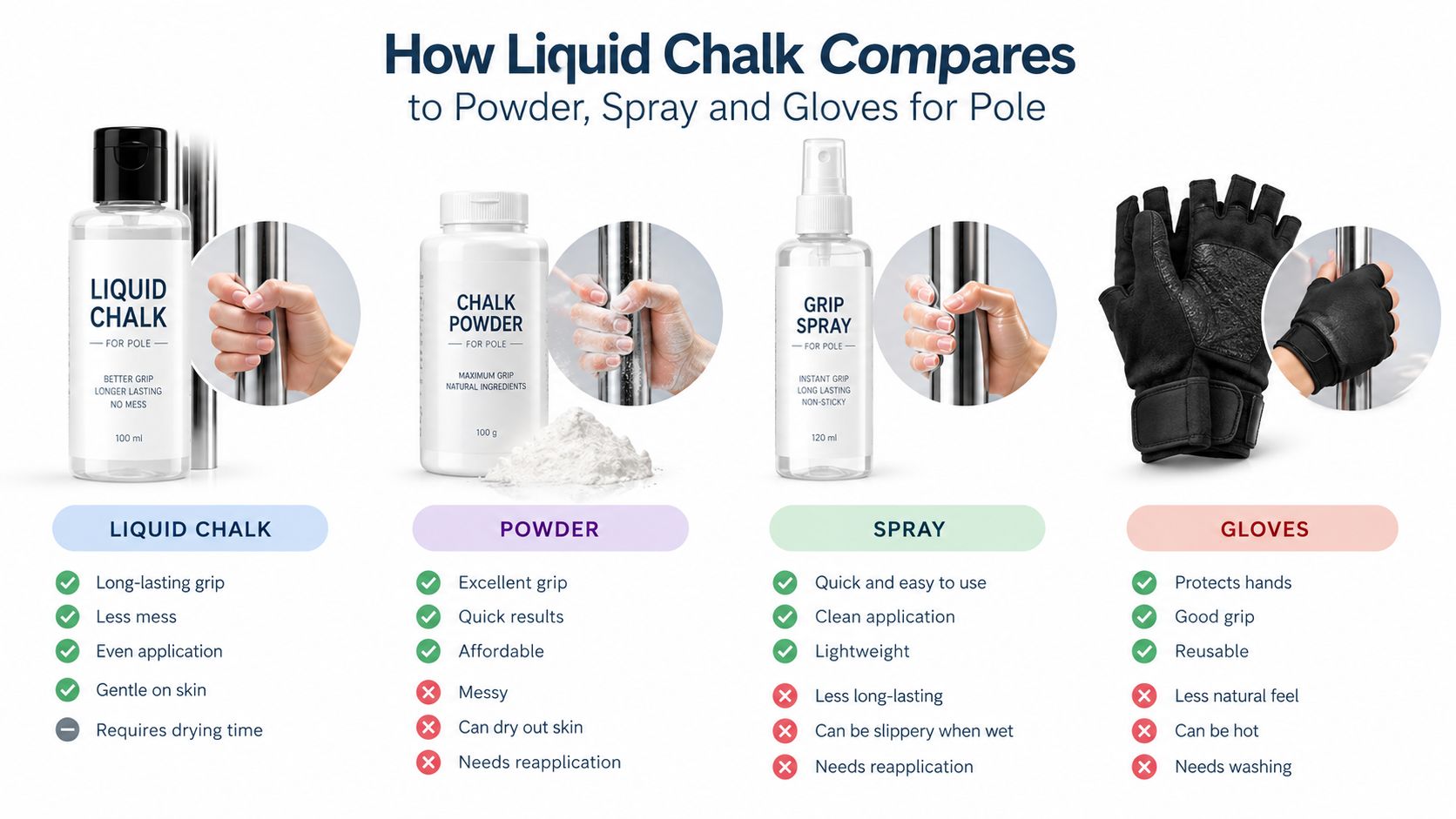
| Grip option | Where it works | Main trade-off |
|---|---|---|
| Liquid chalk | Drying sweaty palms, reducing dust, and creating a thin layer for controlled contact | Needs fully dry hands and a proper wait before use |
| Powder chalk | Adding dry friction during a long session or in a dry outdoor setting | Can spread through the room and transfer to the pole |
| Tack spray or grip glue | A specific static hold where strong adhesion matters | Can feel aggressive and make spins or releases less predictable |
| Grip gloves | Protecting damaged skin or working around a temporary tear | Reduce direct tactile feedback, which matters for pole contact |
Liquid chalk earns its place when the studio bans powder, the athlete trains at home, or airborne mess is a problem. A climbing-gym dust study found that a magnesium-carbonate suspension in ethanol produced airborne particle mass similar to prohibiting chalk entirely, while block chalk, loose powder, sieved powder, and chalk balls did not significantly reduce airborne dust. The available climbing-chalk dust research supports the practical value of a liquid format in shared spaces, although every facility still sets its own rules.
Powder can beat liquid chalk during a dry outdoor session where reapplication is easy and dust isn't a concern. Gloves can be sensible during skin rehabilitation. A tack product may suit one short static sequence, but it shouldn't become the default for every spin and release.
Pole athletes can use different options across a training week. The right choice depends on skin condition, room humidity, pole finish, movement type, and how much residue the venue accepts. More detail on choosing a pole dance grip aid can help clarify that decision without turning every session into a product test.
Your Pole-Grip Routine and When to See a Pro
A repeatable routine is easier to trust than a growing collection of grip products. The following sequence keeps the focus on dry skin, a thin layer, controlled friction, and clean equipment.
Save this session protocol
- Night before: If palms stay unusually wet, discuss a clinical antiperspirant option with a healthcare professional and use it only as directed on dry skin.
- Before class: Wash with mild soap, avoid heavy creams, dry thoroughly, and let the hands air-dry before application.
- At the studio: Apply a small amount of liquid chalk to the hands, spread it evenly, and wait until the film is completely matte.
- Before difficult movement: Test the grip on a simple hold. Reduce the coat if the hand won't slide or release deliberately.
- During class: Towel off sweat before reapplying. Never stack fresh liquid chalk over wet palms.
- After class: Wash the hands with mild soap and lukewarm water, then use a light moisturizer at home if the skin feels dry.
- On the apparatus: Apply grip only to the body. Wipe the pole according to studio instructions.
Persistent sweating deserves a medical decision point. A dermatologist is worth consulting if the hands sweat noticeably more than classmates, drip even in a cool studio, prevent participation, or develop cracking and irritation that won't settle. Clinical care can include antiperspirants and tap-water iontophoresis. Iontophoresis may produce responses in up to 90% of patients, although it requires repeated sessions and maintenance. Medical guidance on hyperhidrosis treatment options explains why grip aid should support treatment rather than substitute for it.
Two quick questions
How can an athlete find a studio that allows liquid chalk? Ask before booking, explain that the product is applied to the hands rather than the pole, and confirm the required cleanup process. A studio may allow liquid chalk while still requiring a specific wipe-down or limiting its use during assessments and competitions.
Does this routine transfer to climbing or lifting? The drying, thin-application, and reapplication habits transfer well because those activities also depend on clean skin and controlled moisture. Climbers who already use powder can apply a thin, fully dried liquid-chalk layer as a primer, then add powder normally. Research on rock contact found that chalk's effect depends on both fingertip moisture and surface texture, so a dry base layer is more useful than repeatedly adding powder to wet skin. The 2024 study on chalk and rock friction supports testing the layer against the actual surface and conditions.
Evermost LLC offers liquid chalk for athletes who need a fast-drying, low-mess way to manage sweaty hands in pole, climbing, lifting, gymnastics, and other grip-intensive training. Visit Evermost LLC to explore EVMT Liquid Chalk and choose a cleaner grip routine for the next session.