


How Heavy Is a Sandbag: 2026 Weight Guide for Training
A standard flood-control sandbag weighs about 35 to 40 pounds when filled, while training sandbags can range from roughly 10 to 200 pounds or more, depending on the workout and athlete. The number on the bag matters, but the right weight depends just as much on the fill, shape, movement, and distance.
You may be standing in a gym with a sandbag at your feet, wondering whether you should clean it, carry it, or put it back. The bag looks manageable until the load shifts halfway through the first lift and pulls your chest forward. That moment explains why “how heavy is a sandbag” has no single answer.
A flood-response bag, a commercial conditioning bag, a HYROX race bag, and a strongman loading bag serve different purposes. Treating them as the same tool leads to poor buying decisions and badly scaled sessions. The better approach is to identify the job first, then choose the load.
What a Sandbag Actually Weighs and Why It Matters
A coach watching a first sandbag clean usually sees the same sequence. The athlete grips the fabric, braces for a predictable pull, and then feels the filling move away from the body. The bag may have the same labeled weight as a dumbbell, but it doesn't behave like one.
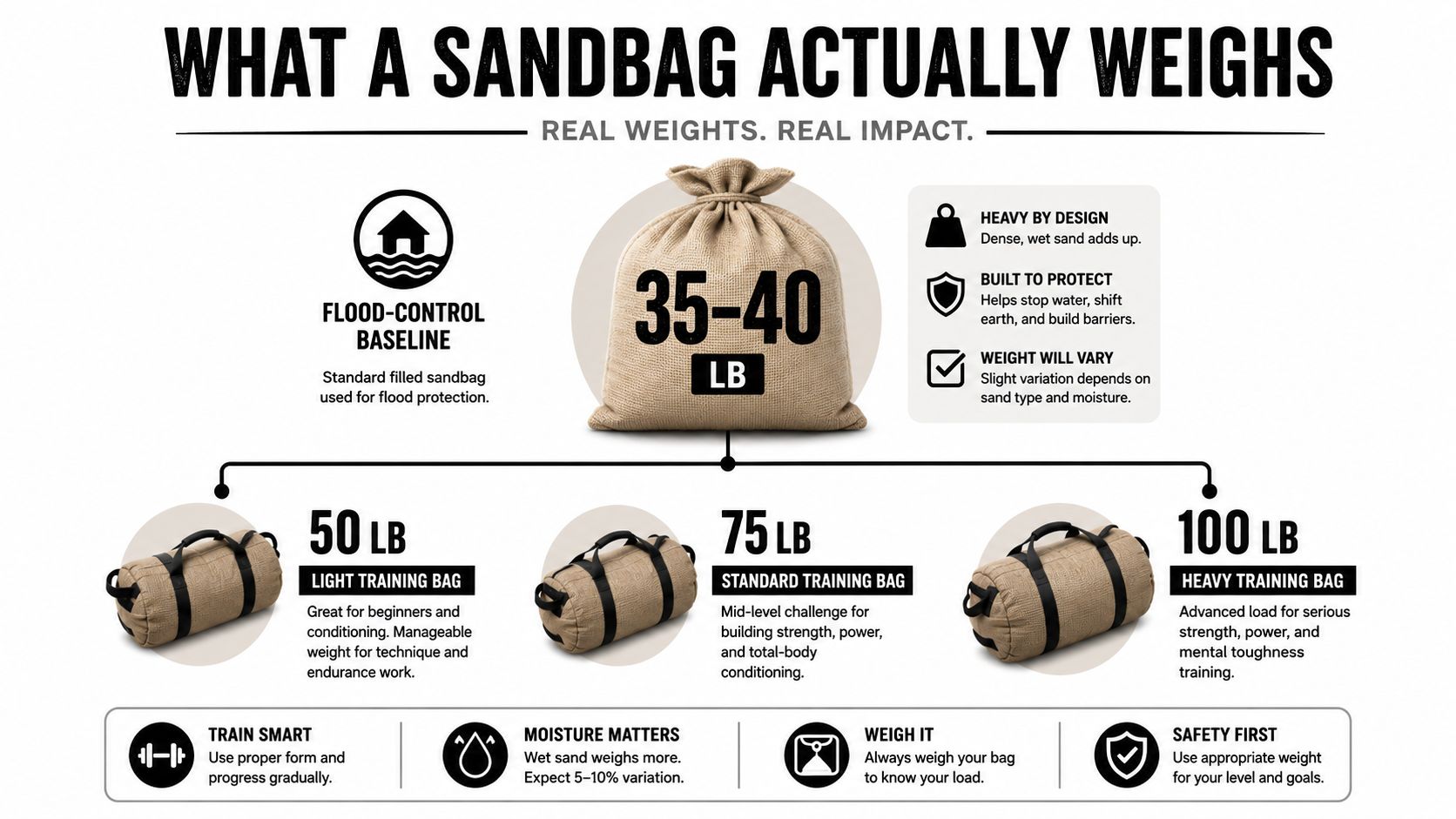
For flood control, the practical baseline is 35 to 40 pounds per filled bag. The U.S. Army Corps of Engineers flood-fight guidance summarized here explains that limiting a bag to this range makes it easier to handle, particularly when teenagers or older adults are helping with emergency deployment. A 14-inch-by-26-inch bag filled halfway with dry sand is about 35 pounds, while wet sand can push the same bag to 45 pounds or more.
That range exists for a reason. Emergency crews need enough mass for a stable barrier, but they also need workers to lift, stack, move, and reposition bags repeatedly. Filling a bag to full capacity can produce a load of 60 to 75 pounds, which makes manual deployment harder and can reduce how well the bags interlock.
Three categories, three answers
In training, the range expands substantially. Commercial bags are commonly available in load bands such as 5 to 20 pounds, 10 to 40 pounds, 20 to 80 pounds, and 80 to 120 pounds, with advanced options reaching 100 pounds or more, according to this sandbag weight guide from Anita Plastics.
That means the word sandbag can refer to:
- Flood-control bags, built for repeated handling and barrier construction.
- Gym training bags, used for cleans, squats, carries, lunges, and conditioning circuits.
- Strongman implements, designed for maximal loading, shouldering, carrying, or throwing.
The weight changes joint loading, grip fatigue, breathing demand, and the distance you can move safely. A bag that's too light may fail to challenge the target movement. One that's too heavy can turn a technical clean into a strained pull or make a carry collapse before the intended conditioning work begins.
Practical rule: Choose the purpose before you choose the pounds. The same nominal weight can feel completely different when the bag is compact, elongated, tightly filled, or loose and shifting.
Empty vs Filled Weight and How Fill Material Changes the Number
A sandbag has two weights, and shoppers often confuse them. The first is the empty shell weight shown in a product description. The second is the loaded weight you train with.
Heavy-duty polypropylene shells may weigh around 6 to 8 ounces, reinforced vinyl shells around 1 to 2 pounds, and reinforced canvas shells up to 3 pounds, as outlined in this sandbag material and weight comparison. Those figures are small beside a loaded training bag, but they matter when you're filling to a precise target or comparing a durable shell with a lighter one.
The fill creates the large difference. For a 14-inch-by-26-inch bag, the material inside can produce very different loaded weights:
| Fill Material | Approximate Weight |
|---|---|
| Rubber mulch | About 30 pounds |
| Play sand | Near 40 pounds |
| Masonry sand | Near 50 pounds |
| Pea gravel | Near 55 pounds |
| Steel shot | More than 70 pounds |
The fill comparison above is documented in the same sandbag weight reference from Anita Plastics. Two shells that look identical can therefore differ by more than 30 pounds once loaded. A rubber-filled bag may be easier to accelerate and more forgiving during carries, while a dense steel-shot configuration creates a much heavier implement without changing the outer dimensions.
Why the label isn't enough
Flood-control guidance illustrates the same issue from another angle. A 14-inch-by-26-inch bag filled halfway with dry sand weighs about 35 pounds, while wet sand in that bag can reach 45 pounds or more, according to the operational sandbag weight guidance. Moisture changes the number even when the shell and nominal fill level stay the same.
For a home gym, record the empty shell weight, the fill material, and the final loaded weight. If you use a backpack or vest alongside a sandbag, the backpack training weight guide offers useful context for comparing external loads without assuming every implement feels identical.
Common Sandbag Sizes and Weight Bands for Training
Commercial training bags make more sense when you group them by the movement they support. A light bag isn't only for beginners, and a heavy bag isn't automatically better. The right band lets you perform the intended movement with control while still creating the demand you want.
| Weight Band | Best For |
|---|---|
| 10 to 25 pounds | Technique drills, accessory carries, lunges, and movement practice |
| 25 to 50 pounds | Beginner to intermediate cleans, squats, shouldering, and general conditioning |
| 50 to 75 pounds | Harder circuits, loaded carries, repeated cleans, and advanced conditioning |
| 75 to 150 pounds or more | Heavy squats, bear-hug carries, loaded marches, and strongman-style work |
The independent workout sandbag product comparison found an average maximum capacity of 75.89 pounds and a median of 68.07 pounds across 44 examples. Most products in that comparison fell between roughly 25 and 75 pounds, although adjustable bags with capacities of 100 to 200 pounds are becoming more common.
Match the band to the movement
The 10 to 25 pound band works well when the priority is learning how to keep the bag close, maintain posture, and coordinate the hands during lunges or short carries. It can also serve experienced athletes during warm-ups or high-repetition accessory work.
The 25 to 50 pound range is the general-purpose workhorse. It suits cleans, front-loaded squats, shouldering drills, and moderate carries for athletes who already understand basic bracing. A 40-pound bag may be manageable for a controlled squat but demanding during repeated shouldering.
From 50 to 75 pounds, the bag starts to dominate the session. Carries become grip and trunk-endurance work, while cleans require more precise timing. Athletes preparing for obstacle-course events may also benefit from the movement variety described in this Telomyx OCR training guide.
Bags above 75 pounds belong in a more deliberate strength and strongman setup. Storage, floor protection, lifting space, and a reliable way to drop the bag all become part of the decision. A longer shell can also feel more difficult than a compact one at the same weight because the load spreads farther from your torso and shifts through a larger arc.
For comparison, this guide to weight sled loading can help you think about external load by task rather than by label. A carry, a drag, and a clean don't place the same demand on your body, even when the listed weight matches.
Competition Standards That Set the Sandbag Weight
Competition removes much of the ambiguity. Instead of asking what feels appropriate, athletes prepare for a specified load, movement, distance, and division.
HYROX provides a clear example. Its official equipment listing sets the sandbag-lunge station at 100 meters, with 10 kilograms for Open Women, 20 kilograms for Open Men and Pro Women, and 30 kilograms for Pro Men. Those figures are listed in the official HYROX competition equipment information.
The distance matters as much as the mass. A bag that feels reasonable for a short set may become a serious breathing, trunk-stability, and pacing challenge across the full station. Athletes can't prepare only by lifting the bag from the floor. They need to practice the prescribed load while moving under accumulated fatigue.
| Competition | Athlete Group | Sandbag Weight | Format |
|---|---|---|---|
| HYROX | Open Women | 10 kilograms | 100-meter sandbag lunges |
| HYROX | Open Men | 20 kilograms | 100-meter sandbag lunges |
| HYROX | Pro Women | 20 kilograms | 100-meter sandbag lunges |
| HYROX | Pro Men | 30 kilograms | 100-meter sandbag lunges |
| Strongman | Competition field | 100 to 150 kilograms | Loading and carrying events |
Strongman-style events operate in a different weight class. A French strongman reference on sandbag events places competition bags generally between 100 and 150 kilograms, with 120 kilograms described as a classic standard in loading medleys. These events test lifting mechanics, hip drive, bracing, grip, and movement under severe fatigue.
The distinction is important for gym owners and serious athletes. A race bag is usually a standardized conditioning implement. A strongman bag is an odd object that may be loaded onto a platform, carried, or moved through a medley. If your event has a fixed implement, train with a similar shape and fill whenever possible. This comparison of Atlas stone weights also helps clarify why strongman loading should be treated as event practice, not merely heavy general lifting.
Choosing the Right Weight for Your Training Level
Most new sandbag athletes overestimate their first working weight. They see a bag that can be hugged close and assume the load will behave like a dumbbell. It won't. The filling moves, the handles may be absent, and the bag can pull you out of position before your legs reach full effort.
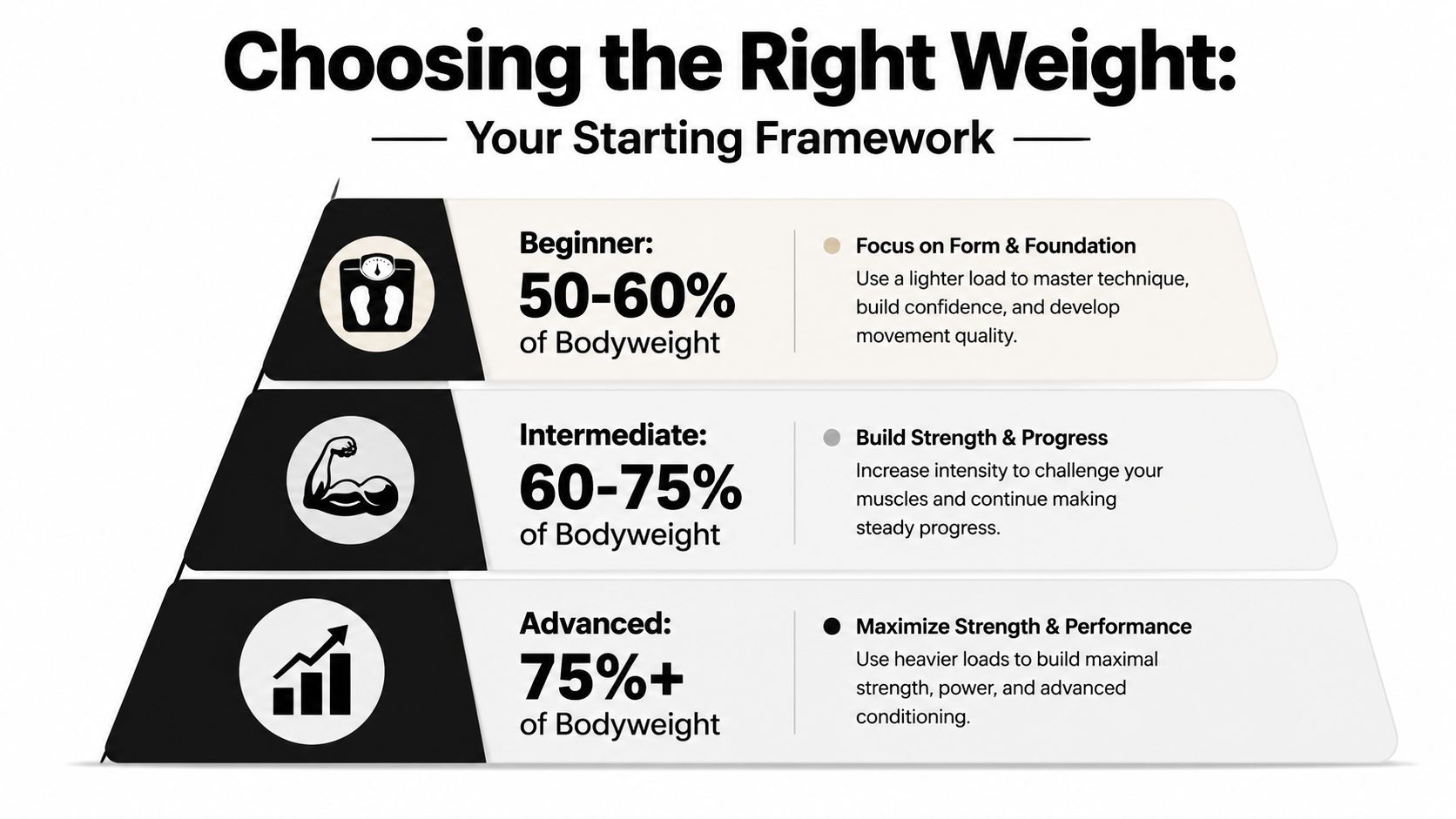
A practical starting point should consider experience, body size, and movement. One commercial training guide recommends 10 kilograms for most female beginners and 20 kilograms for most trained men, while also suggesting 10 kilograms for beginners around 60 to 70 kilograms and 20 kilograms for people already doing regular strength training. Those starting points appear in this sandbag training guide from Fitness Flohmarkt.
Foundation
Start with a light bag and make posture the first performance target. Practice deadlifts, bear hugs, front-loaded squats, and short carries without allowing the load to pull your ribs forward or twist your torso.
At this stage, the bag should let you repeat the movement with consistent breathing and a controlled return to the floor. If you can't keep the bag close, reduce the load before adding distance or speed.
Build
Move into a moderate bag when you can complete the basic patterns without compensating. Use it for carries, squats, lunges, and cleans, but don't increase weight and volume in the same session.
Community guidance for strongman-style work sometimes frames loading as bodyweight minus 20 kilograms for light, bodyweight for medium, and bodyweight plus 20 kilograms for heavy, as documented in this workout sandbag loading analysis. Those tiers aren't a universal prescription. Exercise choice, bag shape, and training age still determine whether a load is appropriate.
Performance
Heavy work belongs after you own the lighter patterns. A performance-focused athlete may use a larger bag for complex lifts, but the progression should preserve clean mechanics rather than reward barely completed repetitions.
Don't rush from a 30-pound technical bag to a 50-pound bag simply because the heavier option is available. Spend enough training time making the lighter load repeatable, then increase one variable at a time, such as load, distance, repetitions, or movement complexity.
Matching Sandbag Weight to Your Training Goal
The same athlete may need several sandbag weights because different goals demand different exposures. A carry session rewards repeatable movement and breathing control. A heavy shouldering session rewards force production and the ability to recover between difficult attempts.
Conditioning
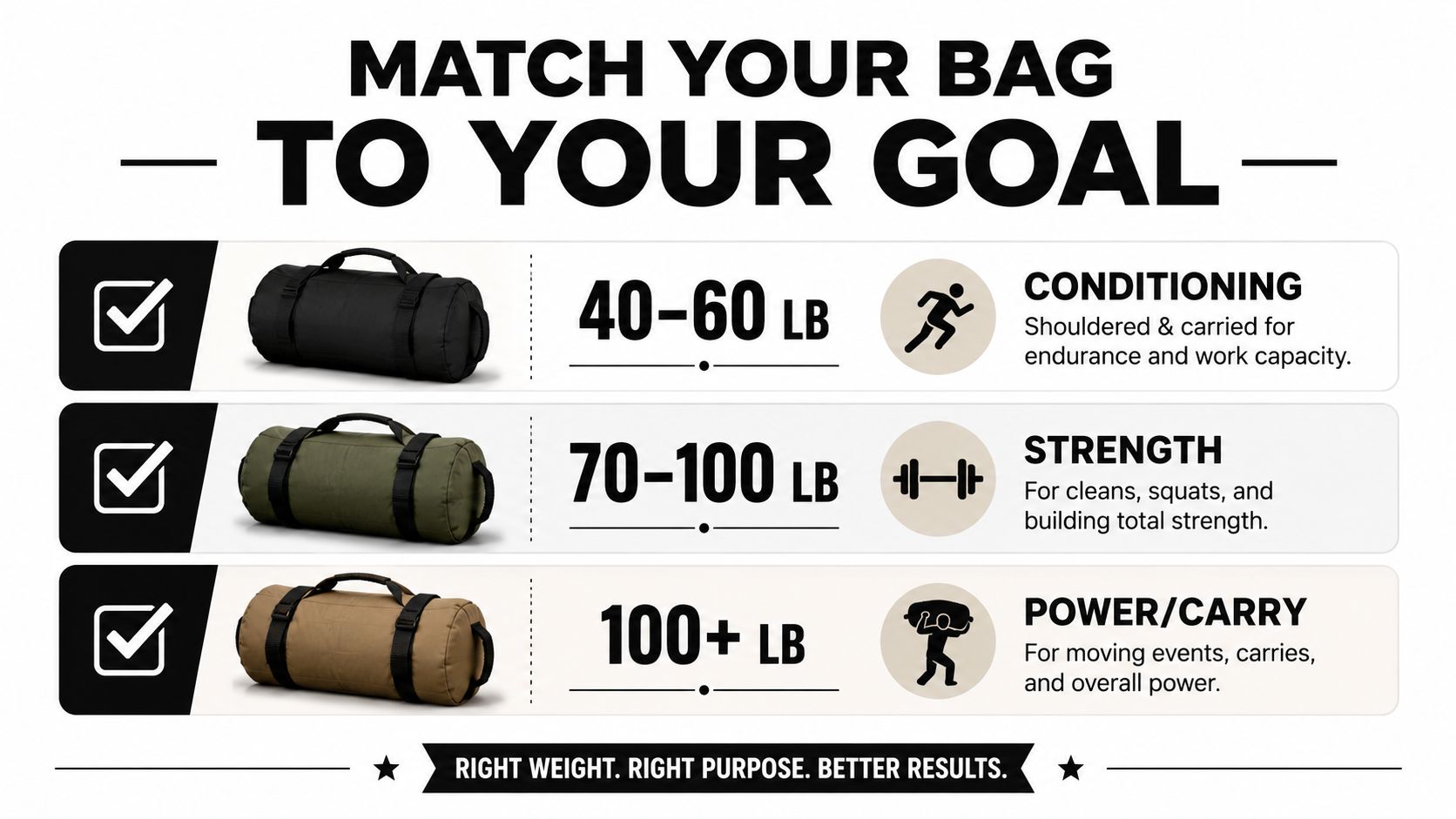
For general conditioning, select a moderate bag that you can shoulder and carry without losing posture early in the session. The workout sandbag weight comparison places many commercial options in the 25-to-75-pound area, which is broad enough to support different body sizes and exercise choices.
Use a bag that lets you move continuously, then adjust the work interval, carry distance, or exercise sequence before chasing a heavier shell. If the bag turns every repetition into a maximal effort, it isn't serving a conditioning goal.
Strength
Strength-focused training needs a heavier implement, but the movement must still be identifiable. Cleans, front squats, shouldering, and controlled carries can expose weaknesses in the posterior chain, trunk, and grip without requiring a perfectly balanced bar path.
For larger bags, clear the floor around you and decide where the bag will go if you miss. A bag that's difficult to return safely can create more risk than useful training stimulus.
Competition preparation
If you're preparing for HYROX, copy the event's load and movement rather than relying on a generic “race weight.” The official station uses a 100-meter distance and division-specific loads, so practice the bag position, lunge rhythm, breathing, and transitions together.
Strongman athletes need an even closer match. A competition bag's diameter, fabric, fill density, and height can change how it sits on the lap or chest. A lighter generic bag may help with technique, but it won't fully reproduce a heavy loading event.
Before buying, ask:
- What is the primary goal? Conditioning, strength, competition, or general movement practice?
- Which movement matters most? Carries and lunges need a different feel from cleans and loading.
- How often will you train with it? Frequent sessions usually favor a versatile, adjustable setup.
- Do you have injury limitations? Keep the starting load conservative if a movement irritates a joint or changes your bracing.
- Where will you store and drop it? Heavy bags need appropriate floor space and a controlled landing area.
Why the Shifting Load Makes Sandbag Work Different
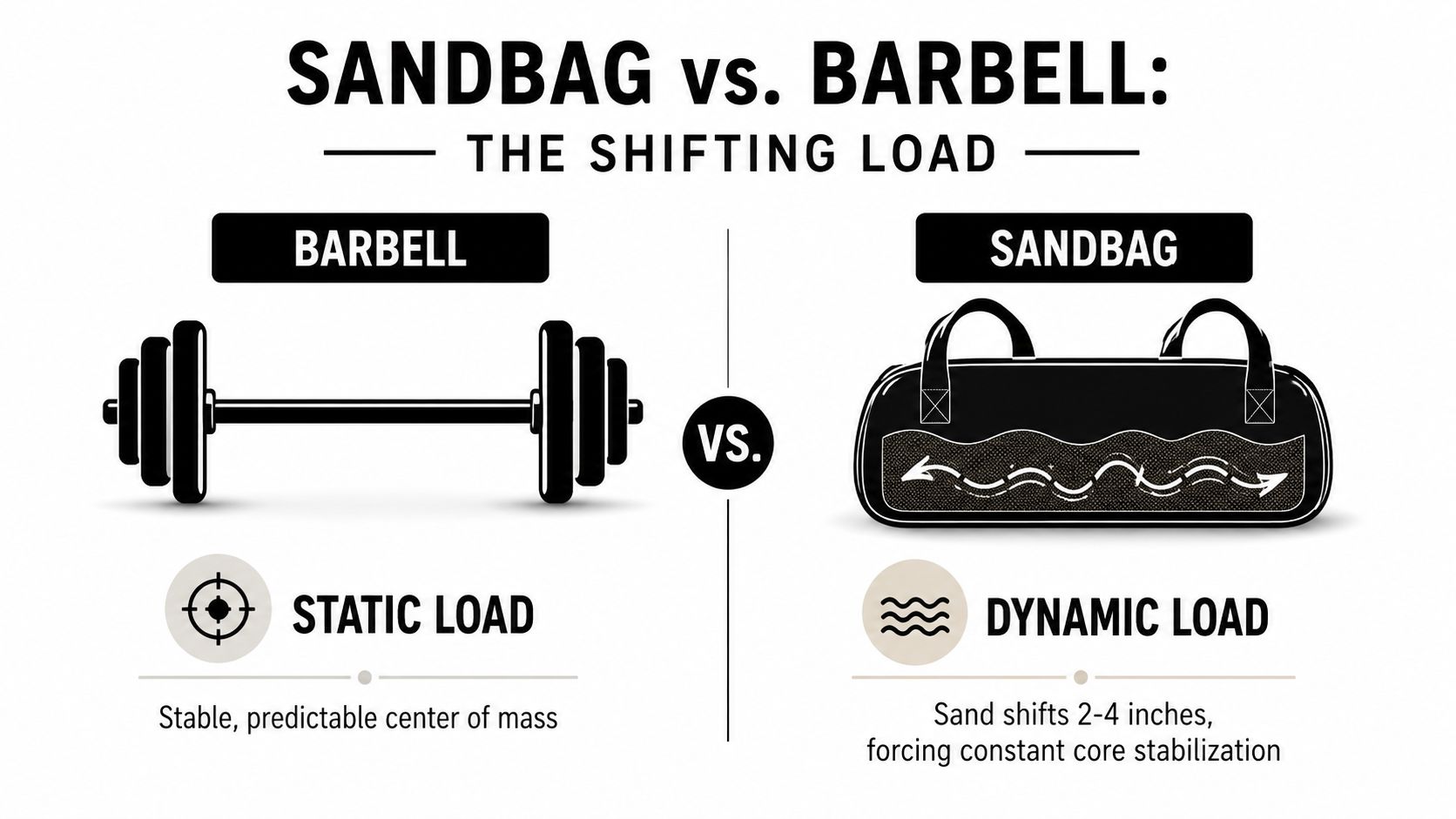
A sandbag isn't a dumbbell with a fabric cover. The filling moves as you lift, walk, squat, and change positions, so your hands and trunk must keep adjusting to a changing center of mass.
That instability increases the skill demand even when the listed weight stays constant. A 60-pound sandbag can feel more difficult than a 60-pound barbell during a carry because the bag may pull away from your body, rotate across your chest, or settle unevenly against one shoulder.
Fine sand generally packs densely and shifts more slowly. Pea gravel can slide more abruptly, while rubber crumb tends to create a different, less dense feel. These materials change the scale reading. They change how quickly the load responds to your movement.
Grip changes the exercise
Competition-style bags often lack convenient handles. You may need to squeeze the fabric, wrap both arms around the load, lap it to your thighs, or move it onto a shoulder. Each position changes the mechanics and demands a different grip strategy.
That makes sandbag work useful for awkward carries, rotational bracing, and practical strength. It also means you should judge a bag by how stable and controllable it feels, not only by the number printed on the label.
Use the sandbag movement demonstration as a visual reference for how body position and handling affect the lift. Keep the load close, brace before the bag leaves the floor, and stop the set when your technique no longer controls the shifting mass.
Evermost LLC offers clean, sweat-resistant liquid chalk for athletes who need dependable grip during sandbag carries, cleans, and high-repetition conditioning. Visit Evermost LLC to choose a formula and bottle size that fit your gym, home setup, or competition training.