


How Much Does a Weight Sled Weigh? a Practical Guide
There is no single answer to how much a weight sled weighs. Unloaded gym sleds commonly fall in the 25 to 75 lb range, with speed and magnetic designs sitting lower and power or push-pull sleds running heavier.
That spread matters because the number stamped on a sled tells you only about the frame, not the resistance you'll feel during a push or pull. Add plates, change the flooring, switch from narrow steel runners to wide skids, and the same empty sled can produce a very different training session. A useful answer starts with the sled's unloaded weight, then accounts for plates, surface, design, and your body mass.
Why Weight Sled Weight Has No Single Answer
A weight sled can range from 19.3 lb to more than 260 lb before plates, depending on its frame and resistance system. That range is why a product number alone cannot answer how difficult a sled workout will feel.
A lightweight sprint sled is built for acceleration drills, so its frame should not disrupt running mechanics. A standard gym prowler is heavier because it needs a stable chassis, upright handles, and posts that accept plates. Heavy power sleds and tank-style units can exceed 100 lb unloaded. Some commercial models list base weights of 190 lb, 200 lb, and 260 lb, with maximum loaded weights of 350 lb, 450 lb, and 690 lb (Northern Fitness sled listings).
The practical categories are broad:
- Speed-focused sleds: Some models weigh as little as 19.3 lb, which suits lighter resisted sprint work.
- Mainstream training sleds: Many gym sleds sit near the middle of the range. One fitness review describes an average unloaded sled near 70 lb, with heavier-duty units approaching 100 lb (Fitness Flohmarkt's sled push guide).
- Heavy commercial systems: Power sleds, tank-style sleds, and magnetic-resistance units can weigh far more than a basic flat-bottom frame.
The frame is only the starting point
Two sleds with the same empty weight can create different demands. Narrow runners may press into turf, while a wider skid can glide more easily across a hard floor. Magnetic and brake-style models add resistance through their mechanism, so their effective load depends on more than the plates on the posts.
Traditional prowlers rely heavily on friction. Flooring, runner material, and sled angle all change the force required. The effort goes beyond moving the frame. It reflects the combined effect of the sled, plates, ground contact, and your pushing position.
Practical rule: Treat the printed sled weight as equipment information, not a complete measure of workout difficulty.
Use a layered calculation. Identify the unloaded frame, add the plate load, then consider the surface and resistance system. Finally, relate that total demand to your body mass and training goal. A sled that feels light for one athlete may be demanding for another, even with the same equipment setup.
Typical Unloaded Weights by Sled Type
Sled categories overlap, so treat the figures below as practical reference points, not universal specifications. Real-world examples illustrate the range: a 25 lb adjustable sled, a 31 lb economy flat-bottom model, and a 68 lb Body-Solid push-pull sled. Other listed examples include a 73 lb weighted power sled, a 78 lb three-post sled, a 65 lb Rogue Slice Sled, and a 244 lb magnetic-resistance sled without plates (Body-Solid weight sled information).
| Sled Type | Empty Weight Range | Typical Plate Capacity |
|---|---|---|
| Compact speed sled | About 19.3 to 40 lb | Light to moderate plate loading |
| Standard push sled | About 45 to 75 lb | Moderate loading for general gym work |
| Prowler-style push-pull sled | About 60 to 100 lb | Multiple Olympic plates |
| Heavy-duty power or turf sled | Often 90 to 150 lb or more | High loading, depending on posts and frame |
| Specialized magnetic or brake-style sled | About 70 to 244 lb in listed examples | Resistance may come from the system as well as plates |
Speed sleds favor a lighter frame
Compact speed sleds usually keep the structure simple. A lower profile, single attachment point, and lighter steel or aluminum construction can make them easier to move between sets. They suit sprinting, marching, or light dragging, where the goal is controlled resistance without turning every effort into a slow strength push.
A 19.3 lb sled represents the lighter end of this category. The lower frame weight does not limit it to beginners. It leaves more room to adjust the training stimulus with plates or a harness, while keeping the unloaded equipment easier to carry.
Prowlers trade portability for stability
A standard push sled often weighs more because it includes upright handles and a wider base. Push-pull prowlers may add several loading posts, reinforced joints, and stronger runners. One representative Prowler weighs 36 kg empty, then reaches 76 kg with two 20 kg plates and 116 kg with four plates.
That example shows why empty weight and training load should stay separate in your notes. The frame is the starting layer. Plates create the equipment total, while body mass and the surface determine how demanding that total feels during a push or drag.
Steel frames generally weigh more and can withstand repeated use. Aluminum can reduce carry weight, but the material alone does not determine performance. Runner shape, weld quality, base width, and attachment design also affect how the sled behaves. Check the product specification rather than assuming every sled in a category weighs alike.
Magnetic sleds need a separate reading
A magnetic-resistance sled may be heavy before any plate is loaded. Its resistance mechanism adds another variable, so frame weight and drag setting should be recorded separately. A 244 lb magnetic sled without plates is not a direct substitute for a 31 lb flat-bottom sled. Their listed weights describe different equipment systems.
Before buying or programming a sled, record three details: the empty frame weight, the plate-post configuration, and whether the resistance system operates independently of the plates. Then relate the setup to the athlete using it. A fixed product number describes the tool, not the complete training load.
How Added Plates Change the Total Load
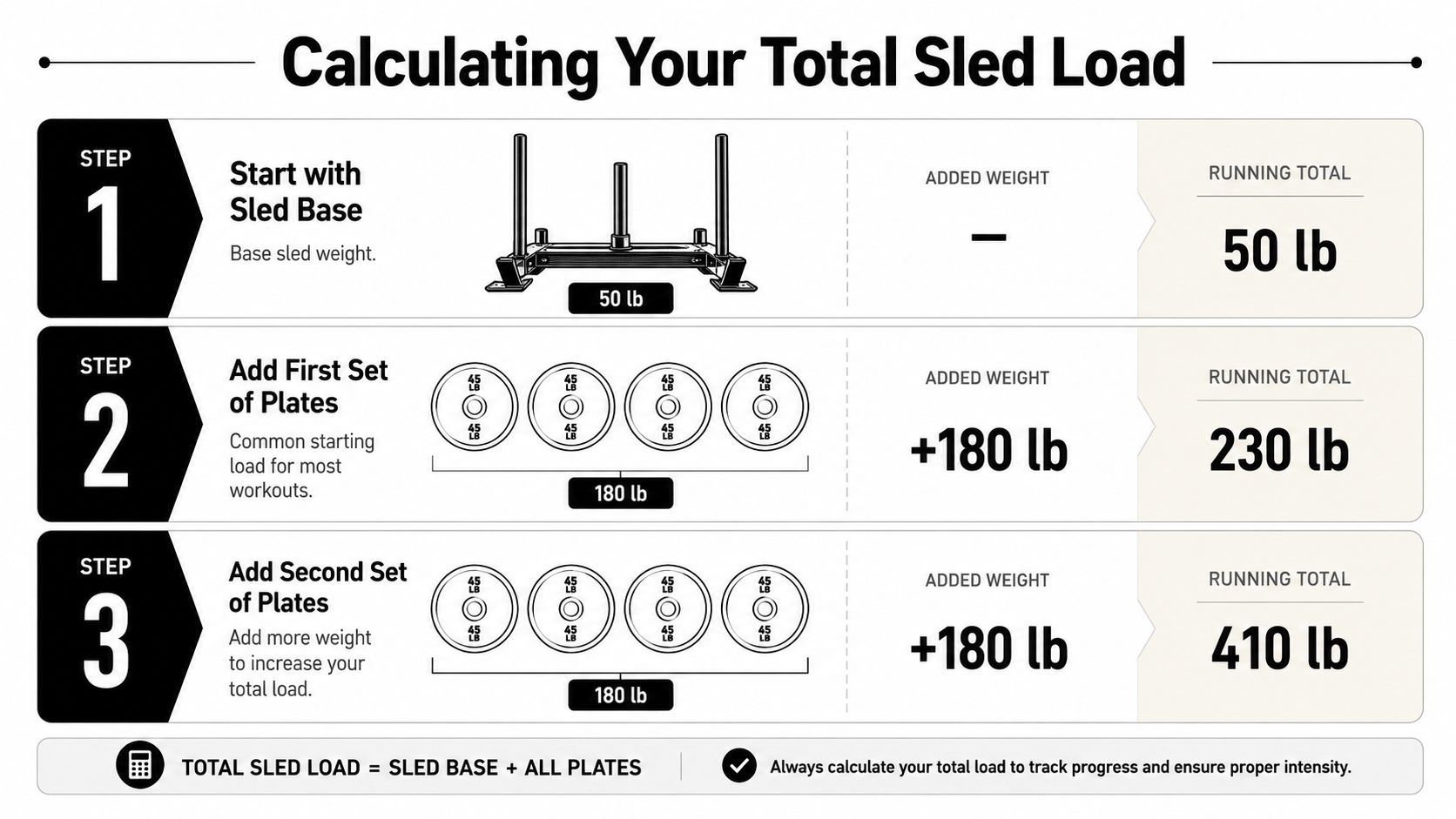
The starting point is the empty frame. A sled weighing 50 lb carries four 45 lb Olympic plates, adding 180 lb and producing an equipment total of 230 lb. Four more plates raise the total to 410 lb, while a third group of four brings it to 590 lb. The calculation stays simple, but the effort changes as the moving mass increases.
Load the posts, then check the setup
Two-post and three-post sleds provide different loading options. A three-post design spreads plates across more points and may stay steadier as the stack grows. A two-post sled can handle demanding work too, but follow the manufacturer's capacity and distribute the plates carefully.
45 lb Olympic plates suit strong athletes who need larger jumps. 25 lb and 10 lb plates allow beginners or sprint-focused athletes to adjust the load more gradually. Bumper plates can be thicker or have a different diameter, so inspect both the plates and the posts before deciding how many will fit. This guide to bumper plates explains the differences that affect loading.
The equipment calculation is:
sled frame + plates = moving equipment mass
That total does not describe the full training demand. Body mass contributes during a push because you lean into the handles and transfer force through your feet. A loaded sled can approach or exceed an athlete's body mass, yet it will still feel different from a barbell lift because the athlete's body is applying force rather than resting on the equipment.
Use a scale when the exact equipment total matters. Record the surface and distance with it, since identical plate totals can create different resistance in different settings. For body-mass-based programming, compare the equipment load with the athlete's body mass, then keep the sled, distance, surface, and loading pattern consistent enough to judge progress.
Surface, Design, and Resistance Systems
The same plate total can create very different training demands. The floor, runner design, and resistance mechanism determine how much force the athlete must produce.
A traditional plate-loaded prowler has no motor or calibrated brake. Its resistance comes from contact between the sled and the ground. Concrete, artificial turf, carpet, grass, and rubberized track flooring each produce a different result, even with the same frame and plates. Treat the empty frame and plates as the equipment load, then record the conditions that turn that mass into resistance.
Runner shape changes the feel
Narrow steel runners can press into soft turf and increase drag. Wider polymer skids may glide more easily on a hard surface. A low-profile speed sled can also feel different from a tall prowler because handle height changes your body angle and the direction of force.
A useful training record includes:
- Equipment load: Empty sled plus plates.
- Surface: Concrete, turf, carpet, grass, or rubber flooring.
- Runner design: Narrow steel blades, wide skids, wheels, or another ground-contact system.
- Distance and intent: Short heavy push, repeated conditioning effort, or fast sprint drill.
- Technique: Upright acceleration position versus a deep, force-focused push.
“I pushed 90 lb” leaves out too much context. Keep the surface consistent when comparing sessions. If you change the flooring, treat the workout as a different resistance condition instead of carrying the plate number over unchanged.
Magnetic resistance changes the comparison
Magnetic and brake-style sleds add a resistance mechanism that can make output more repeatable between sessions. The base frame still contributes to the equipment load, while the drag setting becomes another variable alongside the plates.
This setup can work well for conditioning circuits that require a steadier effort. A conventional prowler depends more heavily on ground friction, so it may feel markedly different outdoors, on turf, or on a slick indoor floor.
For movements that complement sled work, review these top resistance training exercises. Across those movements, the external load is only one part of the prescription. Surface, setup, and execution determine the demand your body experiences.
A sled log without the surface is missing part of the load prescription.
Matching Sled Weight to Your Training Goal
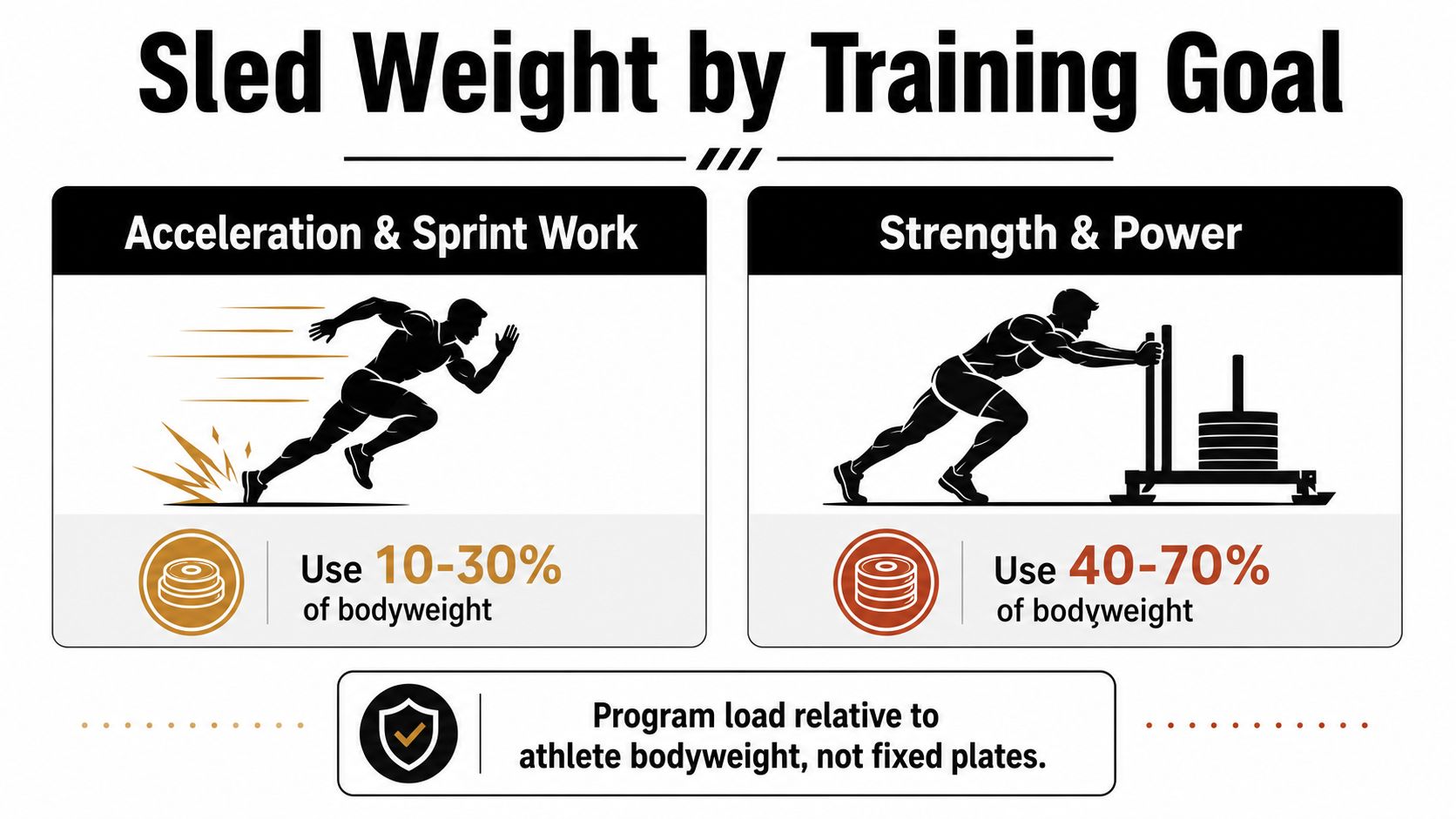
Sled mass makes more sense when you express it relative to bodyweight. A fixed plate count tells you what you loaded. A body-mass percentage tells you whether that load is likely to preserve speed, challenge force production, or create a sustained conditioning demand.
Resisted sprint research links heavier sled loading with greater activity in the vastus lateralis and gastrocnemius, along with changes in sprint kinematics, stiffness, and joint angles (research on improving sled-push power). Heavier work shifts the movement toward force production and a more forward-leaning position. Lighter work allows a faster, more sprint-like action.
Start with the goal
For acceleration and sprint-quality work, practical programming commonly begins around 10 to 20% of bodyweight. A 180 lb athlete would therefore use a loaded sled weighing about 18 to 36 lb, and an empty light frame may already provide enough resistance for the intended drill.
Strength and posterior-chain work generally uses a heavier range, often around 40 to 60% of bodyweight for short, forceful pushes. Conditioning work can sit between those aims, commonly around 20 to 40% of bodyweight, so the athlete can sustain repeated efforts without losing the basic pushing position.
One evidence-based framework places peak power near 50% of unloaded velocity, often corresponding to approximately 70 to 90% of body mass, while very heavy pushes can exceed 100% of body mass (research on improving sled-push power). Those figures describe programming relationships, not universal prescriptions. Surface, sled design, athlete experience, and distance still matter.
Let movement quality set the adjustment
Begin with the bodyweight target, then watch the athlete:
- Acceleration work: Keep the torso controlled, steps quick, and intent high. If the athlete turns the drill into a slow grind, reduce the load.
- Strength and power: Accept a slower pace, but require a firm brace and consistent leg drive. If the sled barely moves, the load may be too high for productive volume.
- Conditioning: Choose a load that allows repeatable efforts. A later interval shouldn't collapse into poor posture because the first effort was overloaded.
- Rehab-oriented work: Use conservative resistance and prioritize smooth movement, stable foot contact, and the guidance of a qualified professional where appropriate.
A low-profile speed sled fits sprint drills. A taller push-pull prowler is better suited to heavy pushes, drags, and conditioning circuits. Keep a simple record of load, surface, distance, and how quickly posture breaks down. This pulling sled workout guide can provide another practical reference when you're building push and pull sessions.
A 2025 study reported that heavy sled loads with low volume didn't acutely change countermovement jump performance 24 hours later, while 10 weeks of sled-resisted training improved relative force and sprinting outcomes (PubMed research record). The broader lesson is straightforward: choose the load for the adaptation you want, not because a certain number looks impressive.
How Competition and Olympic Sleds Are Weighted
Competition sleds show why “sled weight” must be defined carefully. In HYROX, the sled push uses fixed total loads, including the sled and plates. The Open division uses 152 kg for men and 102 kg for women, while Pro and Elite 15 divisions use 202 kg for men and 152 kg for women. The push covers 50 meters, and the sled can't be pulled during that station (HYROX sled-push standards).
| Event / Discipline | Category | Weight / Load |
|---|---|---|
| HYROX sled push | Open women | 102 kg total |
| HYROX sled push | Open men | 152 kg total |
| HYROX sled push | Pro and Elite 15 women | 152 kg total |
| HYROX sled push | Pro and Elite 15 men | 202 kg total |
| Bobsleigh | Two-woman sled minimum, excluding crew | 165 kg, about 364 lb |
| Bobsleigh | Four-man sled minimum, excluding crew | 210 kg, about 463 lb |
| Luge | General singles sled | 21 to 25 kg |
| Luge | General doubles sled | 25 to 30 kg |
| Skeleton | Maximum sled alone for men | 43 kg |
| Skeleton | Maximum sled alone for women | 35 kg |
Bobsleigh equipment can be far heavier than gym equipment. The maximum combined limits reach 325 kg, about 716 lb, for two-woman teams and 630 kg, about 1,389 lb, for four-man teams, including the applicable crew and sled combination (bobsleigh equipment standards).
Luge singles sleds must weigh 21 to 25 kg, while doubles sleds must weigh 25 to 30 kg in the general class and listed junior categories (International Luge Regulations). Skeleton limits also separate equipment from the athlete, with combined sled, athlete, and race-equipment caps of 115 kg for men and 92 kg for women (skeleton rules overview).
These sports don't use a casual “about 70 lb” estimate. Officials define the class, equipment, athlete, and combined limit so competitors face a controlled standard.
Choosing the Right Sled and Loading With Confidence
A sled's empty frame is only the starting point. For useful comparisons, separate that base weight from the plates, then judge the combined load against your bodyweight, training goal, and surface.
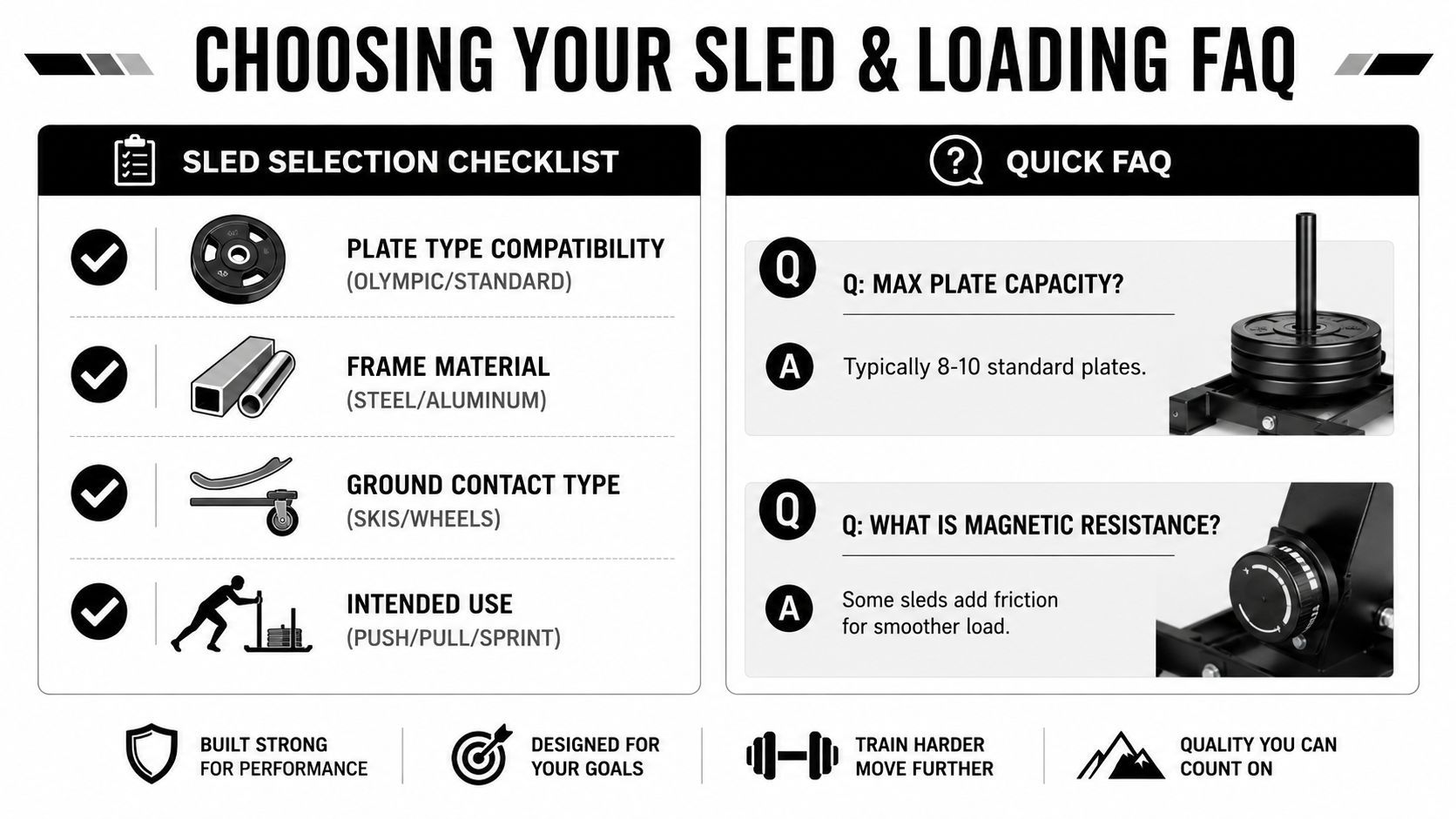
Use this selection checklist
- Define the movement: Select a low-profile speed sled for resisted sprints, or a taller prowler for pushes, pulls, drags, and conditioning.
- Check the posts: Confirm whether it accepts Olympic or standard plates, and check the maker's maximum capacity.
- Match the surface: Wide skids may work well on hard floors, while turf-focused frames can behave differently outdoors.
- Inspect construction: Steel generally favors durability and stability. Aluminum can make the empty frame easier to carry.
- Separate resistance types: Magnetic or brake-style systems create a different feel from a simple friction sled.
- Plan storage and transport: A heavy commercial frame may suit a facility but be awkward in a home gym.
Quick answers for buyers
Does the empty sled weight matter? Yes. A heavy frame uses more of the training load before you add plates. A lighter speed sled leaves more room for adjustments.
Can I compare two sleds by unloaded weight alone? No. Runner width, handle height, surface, and resistance mechanism can change the effort even when the frames weigh the same.
What should I record in my training log? Note the base weight, plate total, surface, distance, and goal. This makes later sessions easier to compare and helps you adjust load without guessing.
For more equipment and setup guidance, browse these sleds for weight training. If your session includes rope pulls, carries, or other grip-intensive work, Evermost LLC offers EVMT Liquid Chalk, a fast-drying liquid grip product designed to reduce slippage and leave minimal residue in gym or competition settings.
Before loading, weigh the frame by itself. Then add the plates and treat that combined figure as the working load. Compare it with your bodyweight and goal, because a load that suits short power efforts may not suit longer conditioning work. Record the surface as well, since the same sled and plates can feel different across flooring.
Visit Evermost LLC to compare EVMT Liquid Chalk options for sled pulls, carries, barbell work, and other grip-demanding sessions. Choose the formula and bottle size that fit your training environment, then keep your grip setup as deliberate as your sled loading.