


Hi Power Grip Explained: Strength, Psychology, and Tools
The average maximum two-hand grip force is about 997 newtons for men and 550 newtons for women, so hi power grip should be measured against physical baselines rather than vague intensity. The right grip aid can then improve hand-to-surface friction, but it can't replace strength, sound loading, or attention when fatigue arrives.
Can a climber hang longer or a lifter hold a heavy pull just by squeezing harder? Sometimes, but not always. Hi power grip has two connected meanings: the physical ability to produce force through the hand and forearm, and the mental focus needed to maintain contact when sweat, fatigue, and discomfort try to break it.
The phrase also has a historic firearms meaning. The Browning Hi-Power was designed in the 1930s by John Moses Browning and completed by Dieudonné Saive at Fabrique Nationale. Its original GP35 designation referred to “Grande Puissance,” or high power, and its defining 13-round magazine helped establish the pistol as a major service design. The platform remained commercially and militarily relevant for more than eight decades, with FN production eventually ending in 1985, Browning manufacturing continuing until 2018, and a modern “High Power” revival arriving in 2022. The historical background of Hi-Power grips explains why the term is recognized far beyond athletic training.
This article uses the athletic meaning. The useful question isn't whether an athlete can create maximum force in isolation. It's whether the hands can maintain a reliable connection to a bar, hold, pole, or apparatus, and whether a clean friction aid such as EVMT Liquid Chalk can remove sweat as the limiting factor.
Table of Contents
- What Hi Power Grip Actually Means
- How Strong Grip Relates to Athletic Performance
- How to Train Grip for Heavy Pulling and Climbing
- Liquid Chalk vs Powder Chalk vs Grip Gloves
- How Friction Products Change Grip Mechanics
- Building a Practical Grip Strategy for Your Sport
What Hi Power Grip Actually Means
For a weightlifter, hi power grip may mean holding a demanding pull long enough for the legs, hips, and back to finish the movement. For a climber, it may mean keeping the fingers engaged on a small edge while the route becomes physically and mentally stressful. In gymnastics, cheer, and pole fitness, it can mean maintaining controlled contact without slipping or repeatedly stopping to manage sweaty hands.
Those examples involve more than raw hand strength. Grip force is the measurable output. Grip endurance is the ability to repeat or sustain that output. Grip friction is the quality of contact between skin and the surface. Mental focus connects the three by helping an athlete keep pressure consistent instead of panicking, over-squeezing, or abandoning a useful position too early.
A person can have strong forearms and still lose a lift because sweat reduces contact with the bar. A climber can have enough finger strength for a hold but fail to use it efficiently because a damp fingertip slides before the muscles reach their limit. That distinction matters when choosing between training and a grip aid.
The two questions behind the phrase
The first question is, “Can the hand produce enough force?” A dynamometer, repeated hold test, or sport-specific assessment can help establish that answer.
The second is, “Can the hand keep that force connected to the surface?” Liquid chalk addresses this second problem. It doesn't turn a weak grip into a strong one, but it can reduce the moisture that causes premature slipping.
Readers comparing standards can use this grip strength standards guide to separate measurable capacity from a general feeling of being strong. That separation prevents a common mistake: adding more grip aid when the actual limiter is insufficient strength, wrist discomfort, or fatigue.
Practical rule: If the hand slips before the target muscles are challenged, improve contact. If the hand stays attached but cannot sustain force, build capacity.
The rest of the decision is straightforward. Measure the physical side, train it progressively, use friction products selectively, and keep enough attention available to recognize when pain or loss of control signals a problem.
How Strong Grip Relates to Athletic Performance
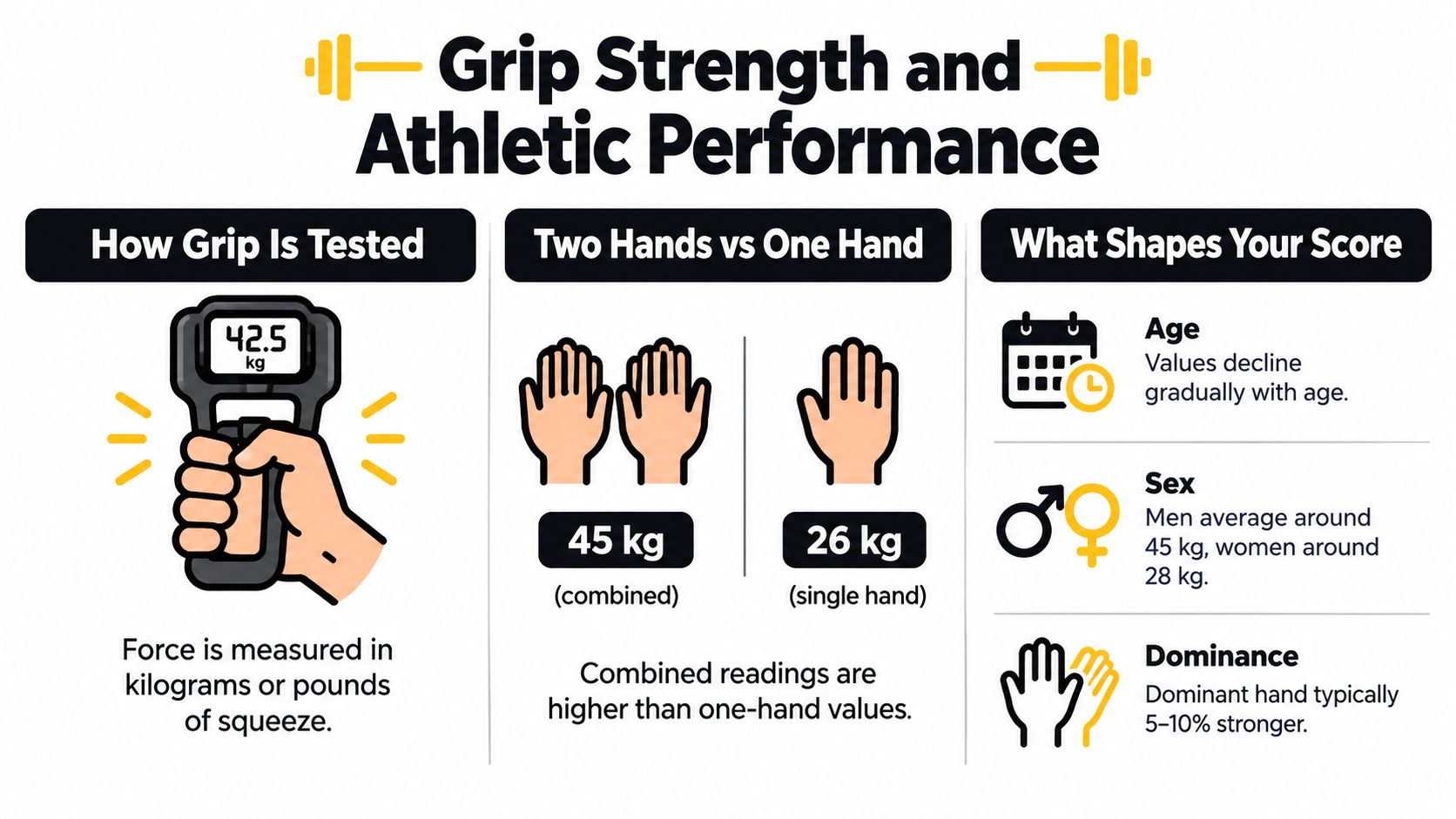
Grip testing gives “high power” a reference point. A dynamometer measures squeezing force, commonly reported in newtons, kilograms, or pounds. Two-hand testing captures combined output, while one-hand testing reveals side-to-side differences and the effect of hand dominance.
A multi-country study of 838 healthy adults from 11 countries reported average maximum two-hand grip force of 997 ± 176 newtons for men and 550 ± 110 newtons for women. Converted approximately into kilogram-force, those averages are about 101.6 kgf and 56.1 kgf. The study also reported relative grip values of 11.78 ± 1.95 N/kg for men and 8.49 ± 1.79 N/kg for women, showing why body-size-adjusted results can add useful context. The grip-force reference data support comparison without pretending that one score fits every athlete.
Why the baseline needs context
U.S. reference data show dominant-hand averages ranging from 49.7 kg among men aged 25–29 to 18.7 kg for nondominant women aged 75–79. Those figures come from different age, sex, and dominance categories, so they shouldn't be treated as a universal pass or fail line. They show that age, sex, hand dominance, and population affect the result.
A lifter who loses a bar because the fingers open may have a hand-strength ceiling. Another may have adequate force but lose contact because of perspiration. A climber may have strong open-hand capacity yet struggle on a small edge because the hold position changes the mechanical demands.
That is why grip scores work best as a starting point. They can reveal asymmetry, establish a repeatable baseline, and show whether a product is solving a friction problem or merely masking a capacity problem. EVMT Liquid Chalk provides a magnesium-carbonate liquid grip aid for weightlifting, gymnastics, rock climbing, and other grip-intensive sports, but the athlete still needs to interpret the result in context.
A useful test sequence includes:
- Measure consistently: Use the same hand position, device, effort style, and rest conditions each time.
- Compare sides carefully: A difference between hands can matter even when the combined score looks strong.
- Match the test to the sport: A squeeze score doesn't fully reproduce a pinch, hang, bar hold, or pole contact.
- Record the limiter: Note whether failure came from slipping, muscular fatigue, pain, or loss of attention.
Grip becomes a performance ceiling when the hands fail before the larger movement does. The number doesn't explain everything, but it gives the athlete a more honest starting point than the label “strong grip.”
How to Train Grip for Heavy Pulling and Climbing
Grip strength develops through progressive exposure, not a single maximal squeeze. Heavy pulling, dead hangs, plate pinches, farmer carries, and thick-bar work can all challenge the hand and forearm, but the load must rise gradually enough for connective tissues to adapt.
A practical approach begins with the sport's actual demand. A powerlifter may need sustained support during heavy pulls. A climber may need open-hand force, pinch control, or repeated contact across a long route. A gymnast or pole athlete may need reliable contact while the wrist and shoulder maintain a stable position.
Build capacity without chasing exhaustion
The athlete should place grip work where it won't undermine the main session. If the hands are already heavily taxed by pulling, adding a large amount of extra volume can turn productive stress into irritated fingers, elbows, or wrists. Short, controlled exposures are easier to evaluate than repeated efforts performed after complete fatigue.
Useful choices include:
- Dead hangs: Scale the hold so contact stays controlled, rather than turning every attempt into a desperate squeeze.
- Plate pinches: Use smooth plates to challenge thumb and fingertip coordination without confusing the exercise with a full-hand squeeze.
- Farmer carries: Keep the walk deliberate and stop when posture or hand control changes.
- Thick-bar work: Use a thicker contact surface sparingly because it changes the demand on the fingers and forearm.
Climbing sessions need the same restraint. A schedule that separates high-demand climbing from additional grip loading can help athletes avoid stacking fatigue on consecutive days. A structured resource on climbing training schedules can help place grip emphasis alongside route work instead of treating every session as a maximum test.
The grip strength training guide offers a useful companion for athletes deciding whether a failed attempt calls for more development or better contact management. A stronger grip aid can expose a weak wrist, shoulder, or movement pattern by allowing the hand to hold on while another area becomes the new bottleneck.
Better friction can help the hand stay connected. It can't make an unstable wrist safe or make fatigued tissue ready for more load.
Pain, numbness, sudden loss of control, and pronounced asymmetrical fatigue deserve a pause. Hi power grip is a system, not a contest to keep squeezing after the body has stopped producing reliable force.
Liquid Chalk vs Powder Chalk vs Grip Gloves
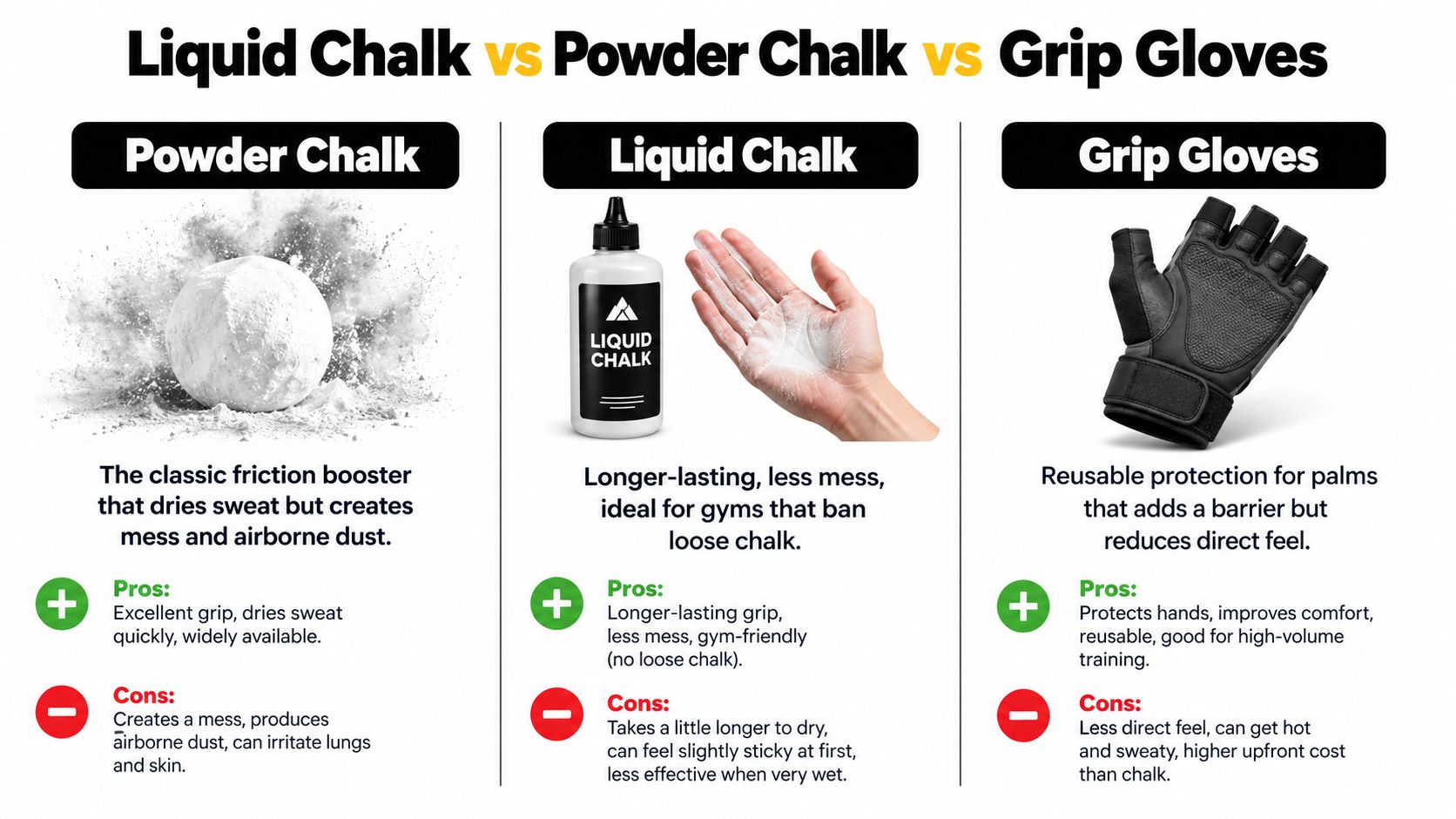
Which grip aid solves the problem you have? Powder chalk, liquid chalk, and grip gloves change contact in different ways. Powder is familiar and easy to reapply. Gloves create a physical barrier. Liquid chalk gives athletes a thin, fast-drying layer when moisture control matters and loose material is inconvenient.
What each option changes
Powder chalk absorbs moisture and can improve contact when the hand is damp. It may also spread through a training space, settle on equipment, and create cleanup problems. Controlled testing on polished steel and sandstone found that powdered and liquid chalk performed similarly in some conditions. Powder sometimes reduced friction on dry steel and tested rocks compared with an untreated finger. The surface-friction research shows why adding more powder does not guarantee better contact.
Liquid chalk dries on the skin and gives the athlete a controlled application. EVMT Liquid Chalk applies as a thin layer that dries in seconds, which is the practical difference from powder in a facility that bans loose chalk. It suits weightlifters, powerlifters, CrossFit athletes, climbers, boulderers, gymnasts, cheer athletes, pole fitness athletes, and home-gym owners who need a low-mess option. Our hand grip aid guide compares the available approaches in more detail.
Grip gloves protect the palm when skin irritation is the main concern. They also place material between the hand and equipment, which can reduce direct surface feedback and change how contact feels. Gloves can make sense for protection, but they do not replace grip training or solve moisture in the same way as chalk.
Use the main problem to choose a starting point:
| Main problem | More suitable starting point | Reason |
|---|---|---|
| Loose powder is banned | Liquid chalk | A controlled layer avoids loose chalk on the floor |
| Sweat causes early slipping | Liquid chalk or carefully applied chalk | Moisture control addresses the contact problem |
| Direct bar or hold feel matters | Liquid chalk or powder chalk | Both preserve direct skin contact |
| Palm protection matters most | Grip gloves | The glove creates a physical barrier |
| The hand lacks force | Progressive grip training | A friction aid cannot create muscular capacity |
Climbers can keep powder chalk in their normal routine while using liquid chalk as a base layer on dry hands. Apply the liquid layer, let it dry, then add powder as needed. This approach can extend coverage and reduce re-chalking without asking the athlete to abandon the chalk already used on the wall. The choice remains practical: build physical strength and mental focus through training, then use the aid that improves contact without masking the underlying limitation.
How Friction Products Change Grip Mechanics
Skin friction depends on the hand, the surface, and the moisture between them. Chalk can absorb sweat and fill microscopic gaps in a textured contact surface, but its effect changes with the material being touched and the condition of the fingertip.
Research found that chalk generally improved static friction more reliably on dry fingertips than under simulated sweaty conditions. It also found that excess buildup can alter the interface and reduce performance on some smooth or already-dry surfaces. The fingertip friction study supports a thin, even application rather than repeated heavy coating.
The climbing base-layer method
Climbers who already use powder chalk don't need to replace it. The practical sequence is:
- Apply a light coat of EVMT Liquid Chalk to dry hands.
- Let the coat dry fully.
- Add powder chalk on top as normal.
- Reapply sparingly when contact or sweat calls for it.
- Keep the hold and contacted surface free from unnecessary buildup.
The liquid layer creates another layer of grip, so the coat can last through more moves before re-chalking. Sweat must work through two layers instead of one, which can mean fewer trips to the bag during a long sport route, multi-pitch climb, or humid gym session. The method is generally less important on a short boulder problem, where the attempt is brief and re-chalking is easy.
Strength, friction, and concentration
Climbing biomechanics add another reason to avoid simplistic claims. Friction between the flexor tendons and the A2 pulley can account for up to 18% of total grip force under maximal loading, and friction rises as the proximal interphalangeal joint approaches approximately 90 degrees of flexion. The tendon and pulley model shows that stronger contact doesn't remove the internal demands of a highly flexed crimp.
The athlete's mental task is to use only the pressure needed for control. Better friction can reduce panic and unnecessary squeezing, but it can't make maximal crimping risk-free. A clean surface, a fully dry liquid layer, and deliberate reapplication support concentration. They don't override the mechanical limits of the fingers.
Building a Practical Grip Strategy for Your Sport
A useful hi power grip strategy starts with the failure point. The athlete should ask whether the hand lacks force, whether sweat causes slip, whether the venue restricts powder, or whether fatigue has made the current load unsafe. Each answer leads to a different action.
For lifters and functional-fitness athletes
Weightlifters, powerlifters, and CrossFit athletes can apply a thin coat of EVMT Liquid Chalk to clean, dry hands before heavy pulling or repeated grip work. The fast-drying format is useful when a commercial gym bans loose powder or a home gym can't tolerate dust. The athlete should allow the layer to dry, check the bar contact, and avoid adding more material just because the hand feels dry.
A peer-reviewed study of repeated grip efforts found 22.8 ± 4.53 repetitions with chalk versus 19.7 ± 4.39 without chalk for open-handed grip, with 14.4 ± 4.47 versus 9.1 ± 4.83 for pinch grip. The reported differences were statistically significant, with p = 0.006 for open-handed grip and p = 0.007 for pinch grip. The repeated-effort chalk study supports chalk as a moisture-management aid, not as a promise that every athlete will perform better in every setting.
For climbers and boulderers
Climbers should keep powder chalk in the normal process if that's what the route demands. EVMT Liquid Chalk works as the primer: dry hands, apply a thin coat, let it dry completely, then apply powder on top. The approach is most useful when sweat and repeated re-chalking interrupt long routes or humid sessions.
Competition use requires attention to the applicable rules. The 2025–2026 USA Climbing rulebook permits commercially available dry or liquid climbing chalk on the hands, while other liquids are generally prohibited unless specifically allowed. Naturally transferred chalk residue from the hands isn't itself a rule violation. The current USA Climbing rulebook should still be checked alongside local event requirements.
World climbing regulations also distinguish permitted hand chalk from substances that alter holds or climbing surfaces. Liquid chalk should dry on the hands, stay limited to normal hand application, and never be deliberately transferred onto holds. The IFSC regulations provide the relevant framework, but venue-specific rules can add restrictions.
For gyms, poles, and apparatus
Gymnasts, cheer athletes, and pole fitness athletes often need controlled contact without a cloud of loose powder. A liquid layer can be applied directly to the hands, allowed to dry, and washed off after training. Athletes with sensitive skin or airways should use the smallest effective amount, keep ventilation in mind, and follow medical advice for persistent respiratory symptoms.
The stop signals remain simple: wrist pain, numbness, loss of bar control, or uneven fatigue. When those signs appear, better friction isn't the next step. The load, contact position, or session needs reassessment.
For athletes and home-gym owners who want a clean, portable grip aid, Evermost LLC offers EVMT Liquid Chalk in single bottles and multi-packs for grip-intensive training. Visit Evermost LLC to choose a liquid chalk option suited to lifting, climbing, gymnastics, pole work, or a dust-sensitive training space.