


Best Liquid Chalk for CrossFit: Grip That Lasts the WOD
The search for the best liquid chalk for CrossFit usually starts in the same place. A bar slips on touch-and-go deadlifts, the pull-up bar starts feeling slick halfway through a round, or a gym posts a no-powder-chalk rule and suddenly the old routine stops working.
That's where liquid chalk earns its place. It solves a real training problem. It keeps hands drier, it cuts the mess, and it works in gyms where loose chalk isn't welcome. But there's one catch many buyers miss. What dominates in training doesn't automatically carry over to competition day. That gap matters more in CrossFit than in almost any other grip-heavy sport.
Table of Contents
- Why Your Grip Fails at Critical Moments
- How Liquid Chalk Creates Lasting Friction
- Comparing Top Liquid Chalk Options for Athletes
- Applying Chalk for Different Workout Demands
- The Critical Issue of Competition Legality
- Making the Final Choice for Your Training
Why Your Grip Fails at Critical Moments
A missed rep often looks like a strength problem when it's really a hand problem.
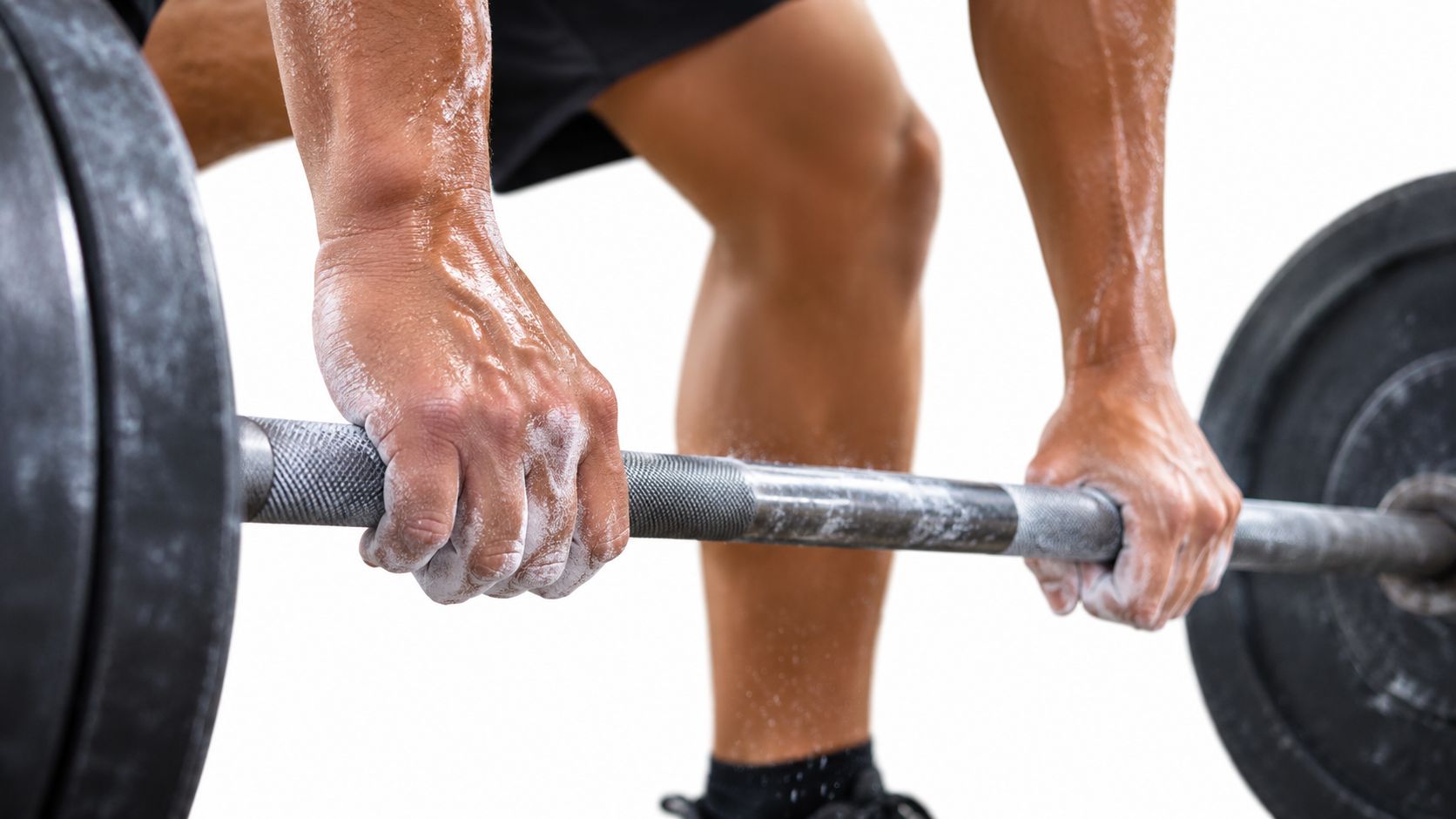
On a heavy pull, the legs and back can still be driving while the fingers start opening. In a high-rep workout, the engine can feel fine while the bar gets slippery from sweat, old chalk, and fast transitions. CrossFit exposes that weakness because the hands don't get asked to do just one thing. They have to hold a barbell, hang from a rig, catch a kettlebell, and survive repeated contact across a session.
Why sweat changes the outcome
Grip failure usually shows up when sweat gets involved. Dry hands can tolerate small technique mistakes. Wet hands usually can't.
That's why athletes dealing with sweaty palms tend to notice grip issues earlier and more often. For anyone fighting that problem consistently, a focused guide on stopping sweaty palms during training is often more useful than another generic chalk roundup.
Practical rule: If the hands are the first thing to fail, the grip setup is limiting the workout before conditioning or strength does.
Traditional loose chalk still works well in many training settings, but it has trade-offs. It spreads everywhere, transfers onto clothing and equipment, and can get pasty once sweat builds. Liquid chalk approaches the same problem differently. Instead of sitting loosely on the skin, it dries into a thin layer that stays put better and keeps the setup cleaner.
Why this matters more in CrossFit than in simple lifting
A powerlifter can set up for one heavy attempt. A CrossFit athlete often has to move from station to station without much downtime. That makes grip management less about one perfect application and more about repeatability under fatigue.
The category matters outside CrossFit too. Climbers have dealt with the same issue for years, especially on longer sessions where sweat buildup gradually breaks down friction. Anyone interested in how grip strategy changes on sustained efforts can learn something from HYDAWAY Bishop climbing beta, where conditions and surface feel shape every decision.
A good liquid chalk choice for CrossFit has to handle that same reality. It needs to dry fast enough for training flow, hold up long enough to matter, and avoid turning every bar, kettlebell, and rig post into a dusty mess.
How Liquid Chalk Creates Lasting Friction
Liquid chalk works when it forms a dry, even barrier before the next effort starts. That sounds simple, but performance depends on how fast the formula sets and how well that layer stays intact once the workout gets chaotic.
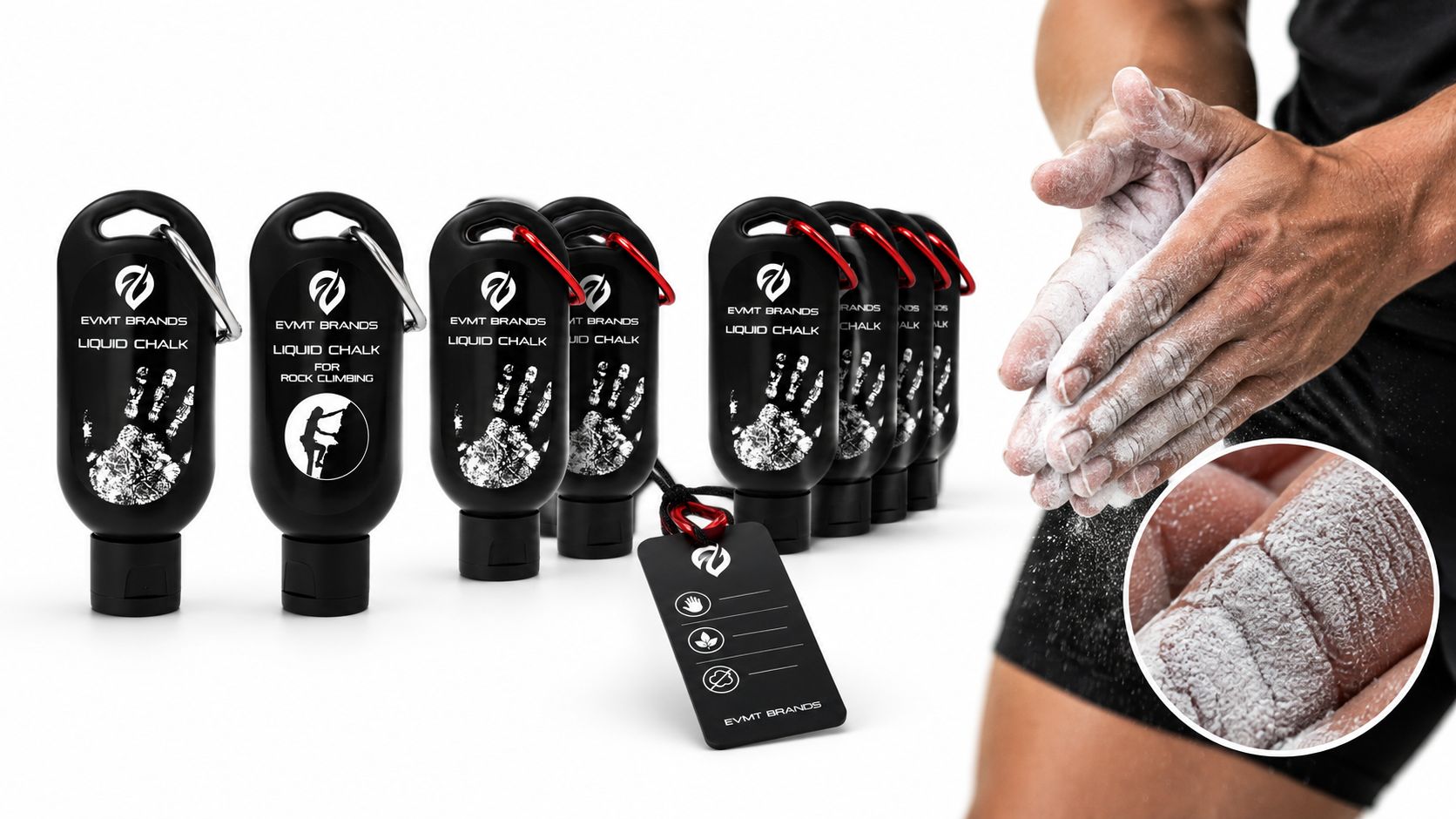
One reason athletes prefer it in shared gyms is simple. It's built to dry into a thin film instead of floating around as airborne dust. An independent review of an alcohol-based formula reported drying in about 8 to 10 seconds at room temperature and 12 to 15 seconds in colder conditions, while also noting almost no airborne dust and only minor residue that could be wiped off with a dry cloth (independent review on liquid grip chalk behavior).
Dry time matters more than people think
In CrossFit, grip quality is only part of the answer. Readiness speed matters too.
Benchmark-style testing published by an industry source measured typical liquid chalk dry times at 25 to 30 seconds for a 1 ml application under 55 to 65% relative humidity and 75 to 85°F, with residue scored at 1.0 to 1.5 out of 5 after five wipes. That's a useful buying lens for mixed-modal training. If a formula dries quickly and leaves low transfer, it costs less time between stations and creates less cleanup on bars and clothing.
For athletes sorting through formula differences, a guide on what drying formulas change in practice can help separate actual use cases from vague marketing language.
Friction gains aren't automatic on every surface
Some buyers get misled. Liquid chalk doesn't guarantee better grip on every implement.
Independent testing on grip-enhancing agents found that liquid chalk didn't make a meaningful difference to grip on steel compared with bare hands, and the same work showed benefits were highly surface-dependent (surface-dependent grip testing on steel and other materials). That fits what athletes feel in real training. A formula might feel excellent on a pull-up bar, fine on a kettlebell, and less noticeable on a smooth barbell shaft.
A liquid chalk that feels mediocre on polished steel can still be useful if it stays clean, dries fast, and helps manage sweat across the rest of the session.
That's why the best liquid chalk for CrossFit isn't just the tackiest option on paper. It's the one that matches the actual contact pattern of the workout.
For reference, EVMT LIQUID CHALK is positioned for weightlifting, gymnastics, rock climbing, and sports, with 11 variants across option1, option2, and option3 in the current catalog snapshot. That matters because CrossFit athletes don't all need the same feel. A heavy barbell day and a long, sweaty mixed workout often call for different priorities.
Comparing Top Liquid Chalk Options for Athletes
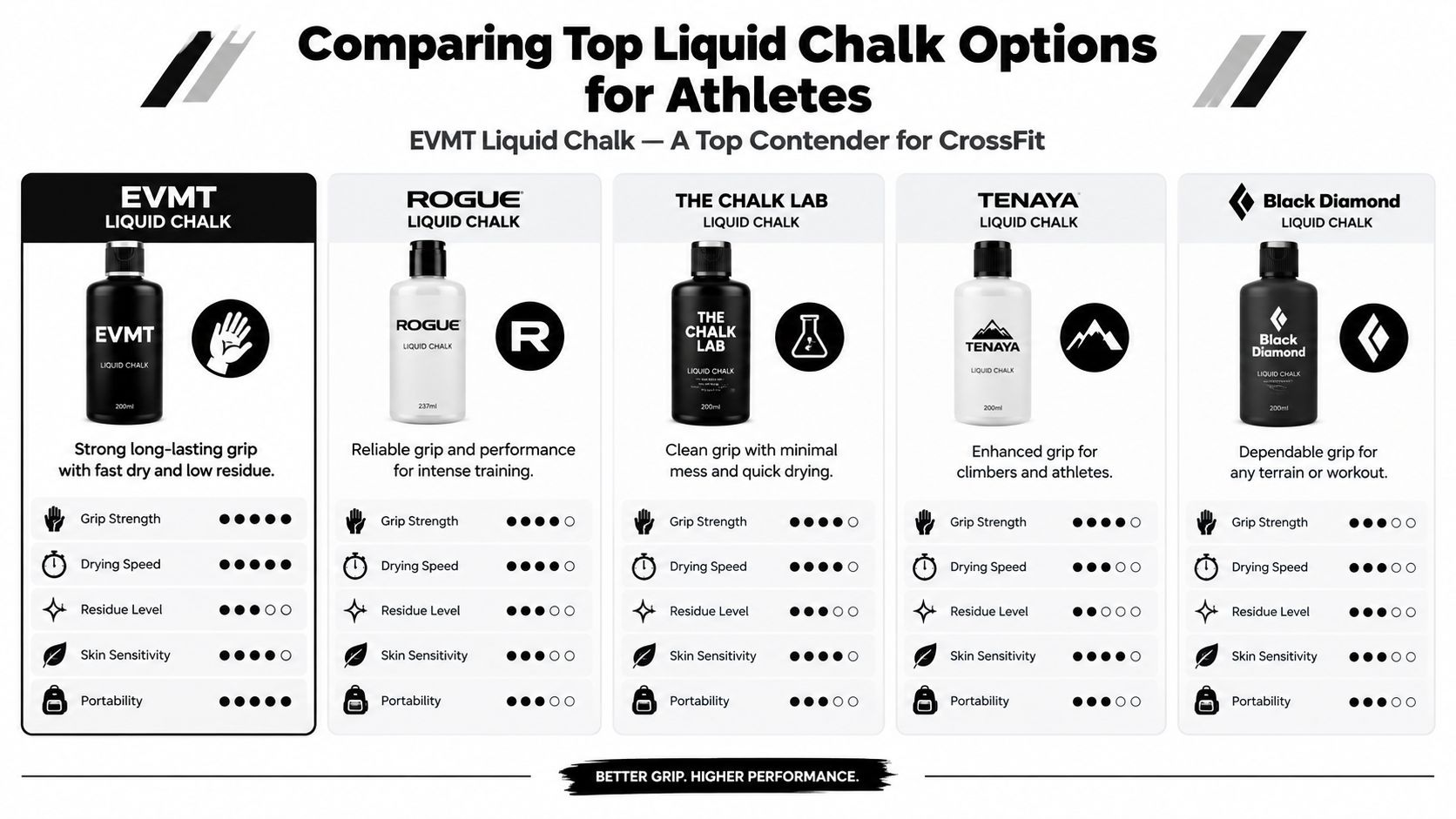
Most athletes don't need a giant roundup. They need a way to sort formulas by what affects training.
The useful filters are straightforward. How fast does it dry. How much residue does it leave behind. Is it easy to carry from warm-up to workout floor. And does the feel suit heavy singles, repeated barbell cycling, or long grip-fatigue sessions.
Here's the practical comparison framework.
| Brand | Best For | Drying Time | Residue Level | Portability |
|---|---|---|---|---|
| EVMT Liquid Chalk | CrossFit training, weightlifting, gymnastics, climbing | Fast-drying formula | Low mess by design | Offered in portable and larger bottle formats |
| Liquid chalk option with thinner feel | Quick touch-ups and lighter coverage | Can feel fast to apply | Usually low if applied sparingly | Easy to carry |
| Liquid chalk option with thicker coating | Heavy pulls and stronger palm coverage | Often needs more set time | Can build up if overapplied | Varies by bottle size |
| Gym-focused dust-free formula | Commercial gyms with powder restrictions | Usually moderate to fast | Chosen for cleanliness | Generally bag-friendly |
| Surface-specific formula | Athletes who prioritize one implement type | Depends on formulation | Depends on application | Varies |
What separates a good CrossFit formula
CrossFit creates two very different chalk demands.
For high-rep WODs, the priority is usually quick drying, low mess, and a film that doesn't feel gummy during transitions. A formula that takes too long to set or leaves too much transfer becomes a nuisance fast. It interrupts pacing and leaves residue on everything touched.
For heavy barbell work, the priority shifts. Coverage across the fingers, thumb, and contact zones matters more than shaving a few seconds off application. Some athletes prefer a formula that feels a bit more substantial here, especially on deadlift and pull-focused days.
A broad guide to choosing the best liquid chalk by use case is more helpful than a generic ranking because the right pick depends on whether the session is grip-endurance heavy or load-dominant.
The features worth paying attention to
Instead of chasing hype, buyers should screen options against these points:
- Dry-down behavior: A formula that sets cleanly helps during interval work and quick station changes.
- Mess control: Dust-free use matters in home gyms and in facilities that ban powder chalk.
- Carry format: Small bottles are easier to keep nearby during class, while larger bottles make more sense for regular home-gym use.
- Intended feel: Some athletes want broader palm coverage. Others want a lighter layer that doesn't interfere with fast hand turnover.
The best liquid chalk for CrossFit usually isn't the most aggressive formula. It's the one that fits the session without getting in the way.
That's where EVMT's multi-formula approach makes practical sense. Different formulas let athletes choose for broad coverage, bar contact, or more precise grip demands, and the product line is also offered in portable 50 ml bottles and larger 250 ml sizes. That setup suits athletes who move between class workouts, open gym lifting, and home training without wanting the same bottle format for every use.
Applying Chalk for Different Workout Demands
Buying the right bottle helps. Applying it correctly is what makes it work.
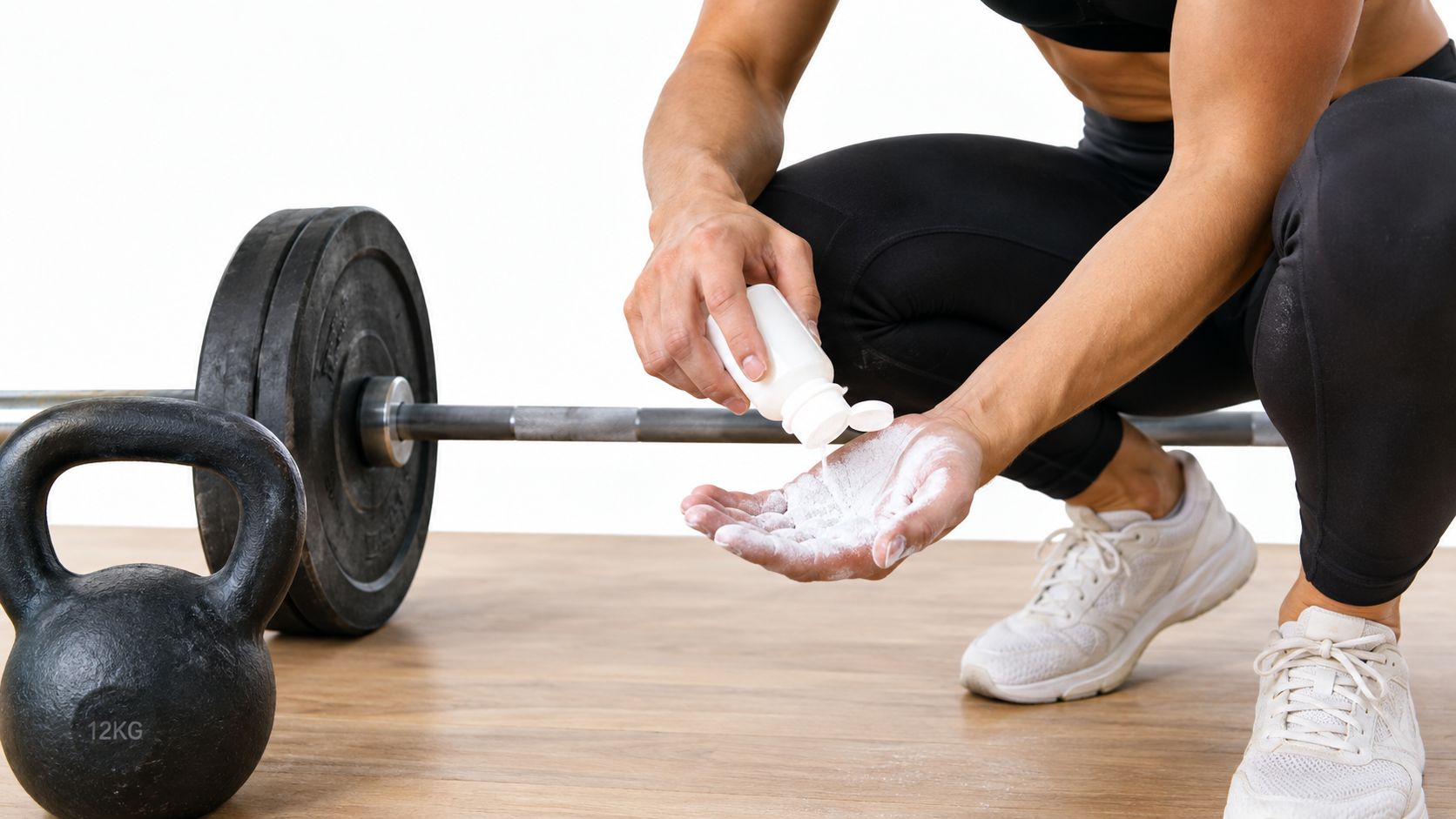
A lot of grip complaints come from bad timing or too much product. Liquid chalk needs to set on the skin. If an athlete grabs the bar too early, some of the layer ends up on the equipment instead of the hand.
The base rule for every workout
One climbing guide gives advice that transfers perfectly to CrossFit. Apply liquid chalk first, then wait until the alcohol smell fades and the hands feel completely dry, typically 20 to 30 seconds, before touching the surface (guide to letting liquid chalk fully set before use).
That delay matters most in workouts where there's a temptation to rush straight into the first barbell set or first trip to the rig.
How to apply for heavy barbell work
On deadlifts, cleans from the floor, and snatch pulls, a slightly more deliberate application tends to work better than a quick smear.
- Start with clean hands. Old sweat and leftover chalk reduce consistency.
- Cover the palm contact zones first. Then work into the fingers and thumb.
- Give it time to set fully. If the layer still feels wet, it isn't ready.
- Check for even coverage. Heavy work punishes missed spots.
This style suits sessions where a secure initial connection matters more than rapid reapplication.
How to apply for high-rep WODs and gymnastics
Metcons change the equation. The athlete needs enough grip help to stay dry, but not so much product that it cakes, transfers, or distracts during movement.
For that kind of session, the better approach is usually:
- Use a lighter coat: Enough to create a dry layer, not enough to build thickness.
- Focus on fingers and callus zones: Those are often the first points to slide on rig work.
- Reapply during natural breaks only: Do it before a pulling station, not after grip has already gone.
A targeted layer also helps on ring work and kipping movements, where too much buildup can feel awkward rather than helpful.
Chalk should support movement, not become another thing the athlete has to manage mid-WOD.
When powder still has a place
This matters for athletes who cross over into climbing or already like a mixed setup. Liquid chalk doesn't have to replace powder completely. One independent climbing guide recommends using liquid chalk as a base layer under powdered chalk, and another notes that it's especially practical in gyms that restrict loose chalk because it dries fast, leaves no dust cloud, and can be topped up with powder (independent climbing guidance on liquid chalk as a base layer).
That same logic can help in long training sessions where the athlete wants a clean starting layer before adding traditional chalk as needed.
The Critical Issue of Competition Legality
A lot of articles about the best liquid chalk for CrossFit skip the most important buyer question. Can it be used in competition?
For sanctioned CrossFit competition, the answer is unusually clear. CrossFit's 2023 and 2024 Games rulebooks permit magnesium carbonate chalk on the body and attire but prohibit adhesive substitutes used in place of chalk, including liquid chalk, liquid adhesives, rosin, waxes, sandpaper, and tacky products (CrossFit Games rulebook language on chalk and prohibited substitutes).
Why this changes the buying decision
That means liquid chalk sits in a very specific lane for CrossFit athletes. It's primarily a training tool, not a competition default.
That distinction affects expectations. If an athlete trains year-round with liquid chalk because it's cleaner, dries quickly, and works in a no-dust gym, that's a good use case. But if that same athlete assumes the bottle can go straight onto the competition floor, that assumption can create a problem late in the season.
A CrossFit community discussion from January 2024 also states plainly that liquid chalk isn't allowed in competitions, which lines up with the official rulebook and shows that athletes are actively running into this issue during event prep (CrossFit community discussion on competition use of liquid chalk).
The practical takeaway
The best buying strategy is to separate training grip from competition legality.
- For daily classes and open gym sessions, liquid chalk can be the cleaner and more convenient answer.
- For sanctioned events, athletes should expect to rely on traditional magnesium carbonate chalk unless organizers specifically approve something different.
- Anyone serious about competing should practice both ways. Training only with a prohibited grip aid can leave the hands feeling different when it matters.
This is one of the few areas where the category is less flexible than buyers expect. In CrossFit, liquid chalk has become common enough to be named directly in elite-sport rules. That tells athletes two things at once. It matters, and it isn't automatically legal.
Making the Final Choice for Your Training
The right choice comes down to what problem needs solving first.
If the gym bans powder chalk, the answer is obvious. A liquid formula becomes the practical option because it keeps dust off the floor, bars, and surrounding equipment. If the bigger issue is sweaty hands during long sessions, the focus shifts to formulas that dry fast and leave a reliable barrier before the next set starts.
Match the formula to the session
The simplest mistake is buying one bottle and expecting it to feel ideal for every workout.
A better framework looks like this:
| Training situation | What matters most | Better chalk profile |
|---|---|---|
| Heavy deadlifts, pulls, and grip-limited barbell work | Secure hand contact and full palm coverage | A formula that supports slightly more deliberate application |
| Fast mixed-modality WODs | Quick set time and low transfer | A fast-drying, lighter-feel formula |
| Shared commercial gym | Clean use and no airborne dust | A low-mess liquid formula |
| Home gym with strict cleanliness standards | Minimal residue on bars and floors | A dust-free option with easy wipe-down |
| Training for sanctioned competition | Familiarity with legal setup | Traditional magnesium carbonate chalk for event prep |
What works and what usually doesn't
Some trade-offs are predictable.
What tends to work
- Clear dry-down: The athlete knows when the hands are ready.
- Thin, even layers: Better than thick application for most CrossFit use.
- Portable bottles: Easier for classes, open gym, and fast station changes.
- Use matched to movement: Lighter on long conditioning pieces, fuller coverage on heavy pull days.
What usually fails
- Applying too much: Thick layers can feel clumsy and break down poorly.
- Touching the bar too early: Product transfers off the hand before it sets.
- Ignoring competition rules: A training favorite can still be unusable on event day.
- Expecting the same result on every surface: Barbell steel, pull-up bars, kettlebells, and ropes don't all respond the same way.
Buy for the most common training problem, not the broadest marketing claim.
Where EVMT fits
For athletes comparing options inside that framework, EVMT Liquid Chalk is a sensible fit when the main priorities are dust-free use, fast drying, and choosing a format that matches how the athlete trains. Evermost LLC sells one product line, EVMT Liquid Chalk, in single bottles and multi-packs. It's a magnesium-carbonate liquid chalk designed to dry in seconds, make no dust, leave no residue on bars or poles, and work in gyms that ban powder chalk.
That product setup also makes sense for varied users, not just CrossFit athletes. Weightlifters, powerlifters, climbers, gymnasts, cheer athletes, pole fitness athletes, and home-gym owners often run into the same friction, sweat, and cleanup problems.
The strongest reason to choose liquid chalk for CrossFit isn't that it replaces every other chalk option. It doesn't. The strongest reason is that it solves the daily training problem well. It keeps the hands drier, keeps the gym cleaner, and helps the athlete move through sessions without hauling a dust cloud around.
For most buyers, that's the answer to the best liquid chalk for CrossFit. Pick the formula that suits the workout, apply it correctly, and remember that training convenience and competition legality aren't the same thing.
Evermost LLC offers EVMT Liquid Chalk in formats built for grip-heavy training, from CrossFit classes to home-gym sessions where powder chalk isn't practical. Athletes who want a cleaner way to manage sweat and keep grip more consistent can explore the full range at Evermost LLC.