


Grip Spray for Sweaty Hands: Where It Beats Chalk in 2026
You're three reps from a heavy pull and the bar starts to skate. The chalk bucket has already dusted the floor, the knurl, and the rack beside you. Sweat is the problem. Loose powder was the habit. The gym may not want that cloud.
Grip spray is a moisture step, not a universal friction boost. It is liquid chalk: magnesium carbonate you rub onto clean skin and let dry before you touch a bar, hold, or pole. It helps most when sweat is what makes you slip. It can work against you when you stack it on already dry skin. A venue rule often decides the choice before grip even comes up.
Table of Contents
- Grip Spray Compared With Other Grip Aids
- Where Gyms and Studios Allow Grip Spray
- How Grip Spray Works on Sweaty Hands
- How to Apply Grip Spray and Wash It Off
- Which Sports Grip Spray Suits Best
- Layering Liquid Chalk Under Powder for Climbers
- Choose Grip Spray Only After Checking Your Venue
Grip Spray Compared With Other Grip Aids
Four formats answer the same slip: sweat between skin and steel, rubber, or a hold. They split on dust, residue, and whether the room will let you use them.
Grip spray, also called liquid chalk, goes on clean hands and dries into a film. Spray bottles and squeeze bottles are the same category. Loose powder, a chalk ball, and a block all shed dust, only at different rates. A gym chalk alternative is the comparison to read before you buy, because the format has to survive your hands and the house rules.
| Grip aid | Form | Dust | Residue on equipment | Typical use | Venue acceptance |
|---|---|---|---|---|---|
| Liquid chalk or grip spray | Liquid applied to hands, dries before use | Low, no airborne powder | Minimal once dry | Lifting, climbing base layer, gymnastics, pole hands | Often allowed where loose chalk is banned; confirm policy |
| Loose powder chalk | Loose powder in a bucket or palm | High, spreads into the air | Visible on bars, poles and holds | Climbing, gymnastics, lifting | Frequently banned by gyms and climbing walls |
| Chalk ball | Mesh ball filled with powder | Moderate, dust when squeezed | Some, tied to how hard you squeeze | Climbing and lifting | Often allowed where loose chalk is banned; confirm policy |
| Chalk block | Compressed block rubbed on hands | High, dust when rubbed | Visible on holds and bars | Climbing | Usually restricted where dust matters |
Liquid stays on the skin, so bars and poles stay cleaner. You wait until the film is dry before you grab anything. Loose powder is instant, then it travels through the room and sticks to steel, rubber, and holds. A chalk ball cuts the mess next to an open bucket, and it still releases powder when you squeeze it. A block looks tidy in a bag and sheds dust the moment you rub it.
A simple buying rule
Choose a liquid format when the venue restricts loose chalk, or when sweat is the failure. Keep powder when the venue allows it and your sessions stay short and dry. I would not treat grip spray as a stronger version of powder. It is the moisture step you can still use when a cloud of chalk is the thing the gym will not accept.
Where Gyms and Studios Allow Grip Spray
A bottle that dries on your skin still fails the session if the venue bans it. Read the written rule before you buy. Product names do not match policy language, and a ban on loose chalk is not the same as a ban on every grip aid.
| Venue setting | Rule | What it allows | What it means for grip spray |
|---|---|---|---|
| Climbing gym banning loose chalk (Dartmouth College example) | Loose chalk prohibited | Chalk balls, chalk socks and liquid chalk allowed; liquid provided free | Liquid is the format to bring; confirm the wording |
| Pole sport competition | Approved grip products on hands, feet or body only | Direct application to the pole is not allowed | Thin hand film only; residue after the cleaning period can draw a penalty |
| Gymnastics uneven bars | Only chalk and water may be placed on the rails | Accepted chalk product on hands | Keep product off the rails; meet officials decide acceptance |
| Commercial gym with dust restriction | Each gym writes its own dust policy | Some allow liquid chalk or chalk balls; some ban all chalk or all grip products | Check the written policy before you pack a bottle |
The Dartmouth College climbing gym prohibits loose chalk to protect air quality and reduce dust, while allowing chalk balls, chalk socks, or liquid chalk, and it provides liquid chalk for free. That wording is the lesson. "No loose chalk" can still leave liquid chalk on the table. It does not mean every gym will accept every formula.
Pole sport treats grip as a venue-safety issue. Competition rules commonly allow approved grip products on the hands, feet, or body. Direct application to the pole is not allowed, and hard-to-remove residue may draw a penalty after the cleaning period. A dry film on skin is the use. A coat wiped onto the apparatus is the mistake.
USA Gymnastics apparatus requirements for uneven bars state, "No other substance besides chalk and water may be placed on the rails." Put an accepted chalk product on the hands. Leave the rails alone. Meet officials decide whether a given liquid formula counts.
Why dust rules exist
Facilities write dust rules because airborne chalk is a room problem, not only a grip problem. A university analysis of gymnastics facilities found total and respirable magnesium-carbonate concentrations at a minimal percentage of OSHA comparison limits, yet still recommended reducing airborne chalk, as covered in this gymnastics chalk air note. Liquid chalk that dries on skin answers that concern more directly than an open bucket.
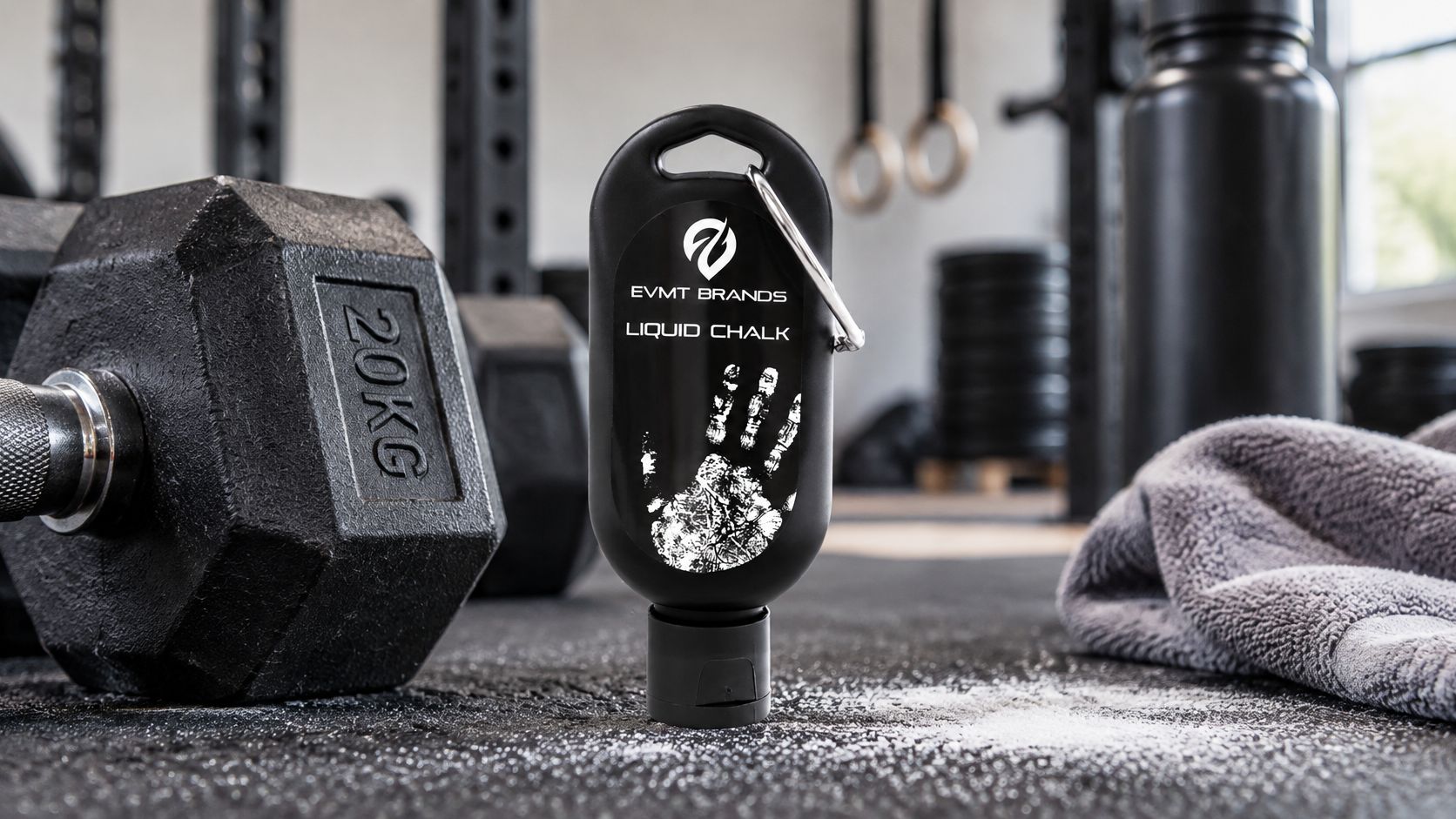
EVMT LIQUID CHALK is a magnesium-carbonate coating applied to the hands rather than tossed into the air, which is why it fits dust-restricted floors for lifting, gymnastics, climbing, and similar sports. I would still confirm the written policy before packing a bottle, especially where the rule bans all chalk or all grip products. Keep the film on skin. A dry hand and a coated bar are not the same thing.
How Grip Spray Works on Sweaty Hands
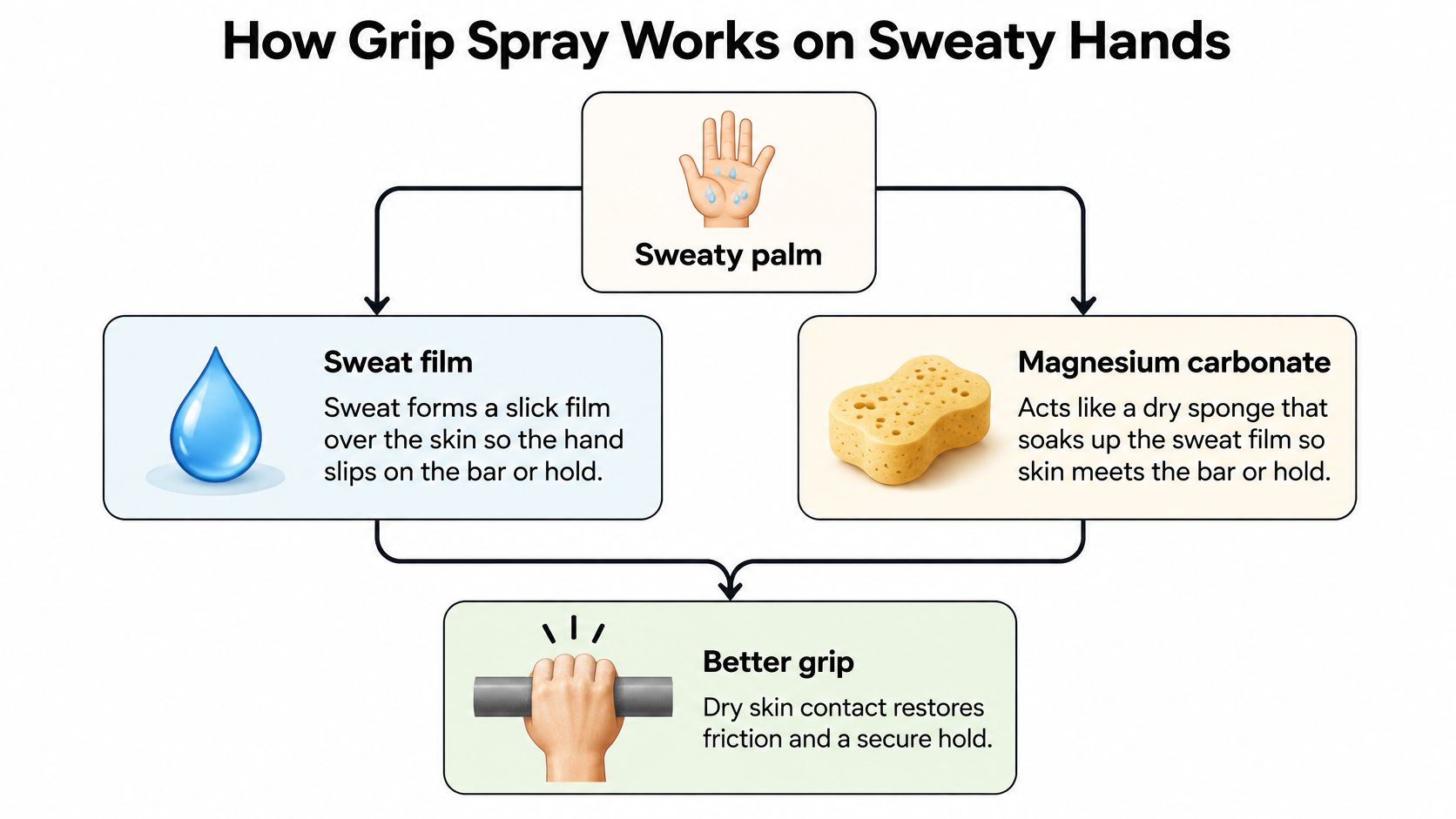
Third set, palms wet, the bar starting to skate in the knurl. That is the condition this product is for. Sweat lays a thin film over the palm, and that film turns skin slick against steel or rock. Magnesium carbonate works like a dry sponge. It soaks up that film so skin meets the bar or hold again. Grip spray manages moisture and leaves a thin layer on the skin. Use it when sweat is the limiter, not as a universal grip boost. Venue rules still decide whether that film is allowed at all.
When it helps and when it backfires
Sweaty hands on a knurled bar, a damp hold, or a polished surface are the cases where moisture control earns its place. Dry hands are different. Too much product can over-dry the skin and cut pliability. Loose particles can sit between the finger and the surface and act like a slipping layer.
A 2001 laboratory study found that chalk lowered friction between fingertips and rock in some circumstances, because it dried the skin or because loose particles formed a slipping layer. Later pull-up testing found chalk improved repetitions on specific weighted sets. That narrow result does not prove chalk improves every lift, grip style, skin condition, or surface. Sweat, skin oils, knurling, rubber, rock texture, pressure, and dose all change the outcome.
Practical rule: Judge the session by reps finished and time held, not by how dry the hands feel.
In the Northern Arizona University climbing trial, 19 experienced recreational climbers showed no statistically significant differences in coefficient of friction, force distribution, or muscular activity, yet they held on longer with magnesium-carbonate chalk: 62.9 ± 36.7 seconds compared with 49.3 ± 25.2 seconds without it (P = .046). In the NAU trial, climbers held on longer with chalk even when friction did not change.
A 2024 Loughborough University study measured fingertip-to-rock static friction on sandstone, granite, dark limestone, and light limestone at 5, 10, and 15 N. Chalk generally had a more positive effect on dry fingertips than under simulated sweaty conditions, and it made friction more consistent across most conditions. Consistency matters on a long set. A liquid that dries on skin also stays out of the air, unlike loose powder.
If sweaty palms are the weekly limiter, start with the steps in how to stop sweaty palms, then test one thin coat against your usual routine. Count completed reps, failed hangs, and bar slips. Ignore the "my hands feel chalky" signal. I would not buy until the written house rule allows a dry film on skin. A coat that holds in a lab still loses the session if the floor bans it.
How to Apply Grip Spray and Wash It Off
The bar is loaded, the palms are already damp from the warm-up, and the first heavy pull is one set away. A thin, even film on clean skin is the target, and the hand should feel dry before that pull. Product on a wet or lotion-coated palm sits in patches, so one side grips and the other skates. Classic liquid chalk from Evermost LLC is built for gym, CrossFit, gymnastics, dance, and sports: it reduces hand sweat, improves grip once the coat is dry, and washes off with soap and water.
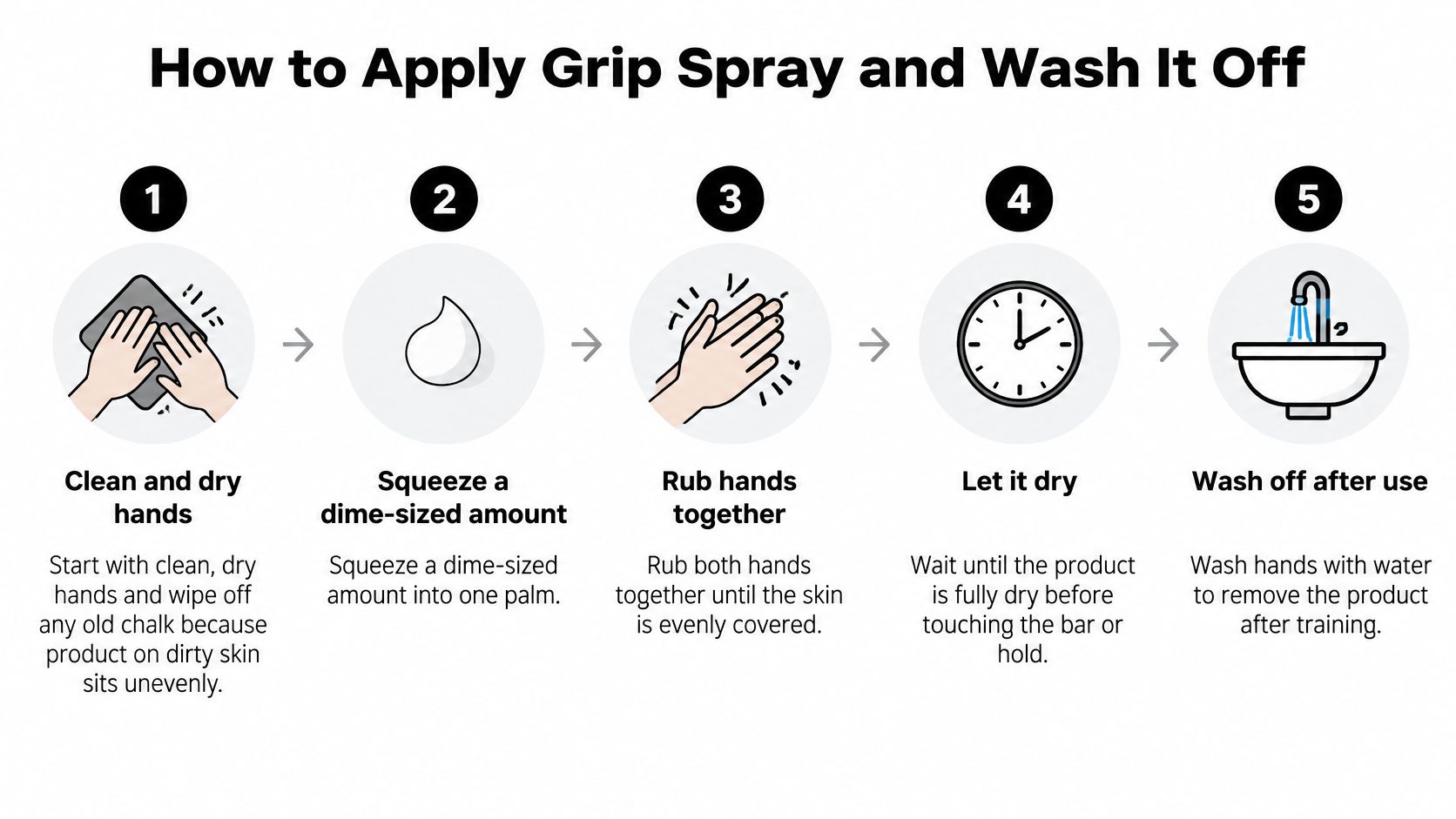
- Clear the skin first. Wipe off old chalk, lotion, and sweat before you open the bottle. A coat on dirty skin never lays down as one film. Putting it on while the hands are still damp thins the layer so it never sets.
- Measure a dime. Squeeze that amount into one palm. Evermost LLC's method is the same: a dime-sized amount, rubbed until the hands are fully coated, then left to dry. A heavy blob feels safer and usually becomes a granular or sticky layer that cuts skin contact.
- Spread it past the palms. Work both palms, the fingers, and the thumb web until no pools remain. A deadlift still slips when the thumb web is bare, even if the palms feel coated.
- Let the film set before contact. Touching a bar, rock, or pole while the coat is wet transfers residue onto the equipment and leaves a slick patch on the skin. Use the last part of the warm-up as the wait. Dry skin, then load.
- Match the second layer to the venue. Where loose chalk is allowed, add powder only after the liquid is dry. Powder on a wet coat traps moisture and creates slip. If the gym bans loose chalk, the dry film is the whole aid. House rules decide that, not how strong the grip feels.
- Recoat when the film is gone. Do not stack coats on a timer. A fresh heavy layer over a half-worn one brings back the granular feel. One thin reset beats three thick ones. I would rather pause for a bare palm than keep pulling on a half-dead film.
- Wash with soap and water. After the session, soap breaks the film without scrubbing skin raw. Leaving it on and coating again the next day is how residue builds and how cracked skin gets worse.
What a set coat looks like
The coat should look dull, not shiny, and it should not transfer when you tap a dry towel. The first pull or first hold should stick without a mid-rep reset.
A glassy hand means too much product, or you grabbed before it dried. Sweat control is the job of one thin film. It will not fix a wet start, a banned powder layer, or a coat you never let set.
Alcohol-based formulas can sting cracked skin. Patch-test on intact skin, and skip broken areas.
Which Sports Grip Spray Suits Best
Match the aid to the grip failure, not to the sport name on the bottle.
| Activity | Main grip problem | What grip spray does | Watch for |
|---|---|---|---|
| Weightlifting and powerlifting | Sweaty palms slip on the bar during heavy sets | Coats hands to control sweat before bar contact | Thick coats can reduce feel on the bar |
| CrossFit and high-rep workouts | Hands get wet across many movements | Keeps moisture controlled through the session | Re-apply by feel, not on a timer |
| Rock climbing and bouldering | Moisture fails on small holds and crimps | Adds a dried film, used as a base under powder on long routes | Check gym rules on loose chalk |
| Gymnastics and cheer | Clean, controlled grip on bars and rings | Gives a hand layer without loose powder | Keep the rails free of any product |
| Pole fitness | Grip on the body during spins and holds | Thin film on hands only | Direct pole contact can draw a penalty in competition |
Lifters gain the most when sweat, not a dry hand, is what breaks the set. A sweaty palm on sharp knurl loses the bar before strength does. A dry palm buried under a thick coat loses feel and can tear skin instead. High-rep sessions wet the hands across pulls, carries, and bar changes, so one controlled film at the start beats a powder cloud between movements.
Routes, humid rooms, and poles
Long sport routes and humid gyms suit a dried liquid film better than a short boulder problem, because sweat builds across many moves. A four-move boulder rarely needs a base layer. A humid lead wall often does. Climbers who already carry powder should treat liquid as that base, not as a swap, and the next section walks through the order.
Pole athletes need grip on skin while the apparatus stays clean. A thin hand film fits that split. Spraying or rubbing product onto the pole does not. Studio and federation lists still win, so check them before competition day. Sweaty-hand pole work is covered in more detail in this pole grip for sweaty hands note.
Grip spray does not fix weak grip strength, a bar you never set in the hand, or steel that is polished smooth. Use it beside sound setup and equipment that bites. If the hands are already dry and the session is short, powder or nothing may be the better call.
Layering Liquid Chalk Under Powder for Climbers
Halfway up a long pitch, the chalk bag is a move you do not want to make, and the hold is already damp. Loose powder on bare skin would have brushed off two clips earlier. A dried liquid base still gives that powder something to cling to.
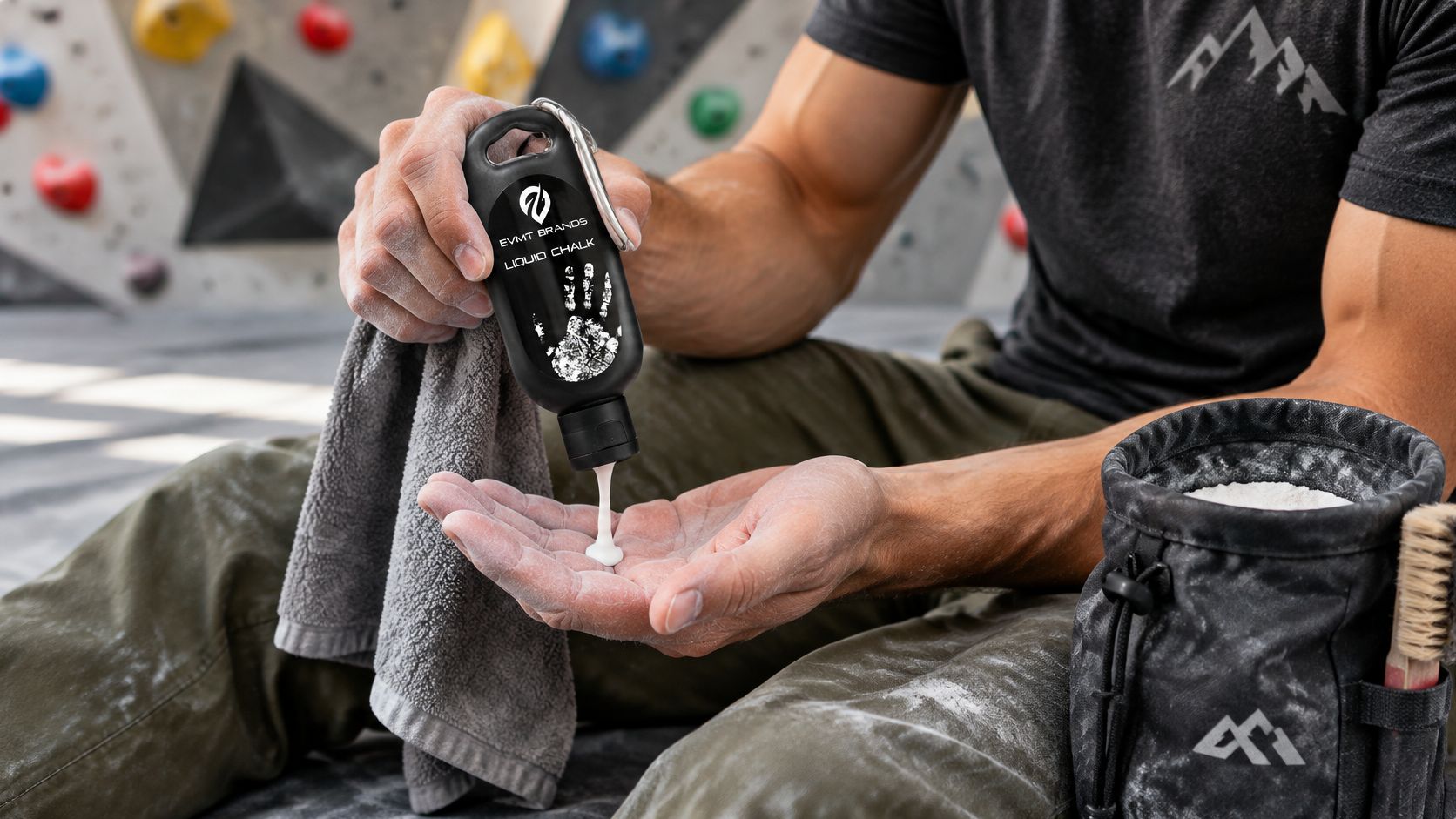
Climbers can use EVMT Liquid Chalk as a primer under regular loose chalk for better adherence and longer grip on tough routes. Treat the liquid as the moisture layer and the powder as the layer you can refresh. Sweat has to work through both before the hold goes slick, so the dip in the bag comes later, not after every hard move.
Powder only after the film is dry
Follow the thin-coat method from the application steps: rub it in, leave no pools, and wait until palms and fingers look matte. Old powder left on the skin makes the liquid sit in lumps, so start from a clean hand. Only then add loose chalk, and only as much as the gym or the crag allows.
If you powder while the liquid is still wet, you seal moisture against the skin. The palm feels sticky for a second, then the hold skates. A shiny coat mid-pitch means the film is used up. Find a stance long enough for a fresh thin layer to dry, then chalk once. Stacking more powder on a greasy base turns both layers into paste, and paste does not hold.
Expect more moves before you re-chalk. A wall or an outdoor crag can allow liquid chalk and still restrict loose powder, so confirm both formats before you leave the house.
Choose Grip Spray Only After Checking Your Venue
A coach waves you off the platform because the bottle in your bag is not on the gym's approved list. The chalk would have dried fine. The session still stops.
Permission comes first. Bottle size, skin tolerance, and dry time come after that.
Once liquid chalk is allowed, match the bottle to the week you train. A 50 ml bottle with a carabiner fits a gym bag or a climb day. A 250 ml bottle fits daily lifting or a shared station that burns through product. Subscriptions save 20%, U.S. shipping is free on orders over $20, and returns run 30 days if the venue later refuses the bottle.
Some alcohol-based formulas sting cracked skin. Washing and drying every session also wears the skin barrier down. Patch-test on intact skin, and leave splits and blisters bare. Build the dry time into the warm-up. If you only have the walk from the bench to the bar, the film is still wet when you pull.
I treat a verbal "yeah, chalk is fine" as incomplete until the posted rules name liquid chalk.
Desk check before you pay:
- The written rule names liquid chalk, or does not ban it.
- You want a 50 ml carry bottle, or a 250 ml bottle for daily use.
- Skin is intact, or you have patch-tested and will leave broken skin bare.
- The warm-up leaves time for one coat to go matte before the first hard pull.
Evermost LLC makes fast-drying liquid chalk with magnesium carbonate for lifting, climbing, gymnastics, dance, and other sessions where sweat or house rules make loose powder a poor fit. It absorbs moisture without a dust cloud, and the climbing formula can sit under powder when the wall allows both. Bottles and sizes are at Evermost LLC.