


Chalk for Pole Dancing: Liquid vs Powder Picks
A hand slips halfway through a spin, and suddenly the routine feels less like choreography and more like damage control. Sweat, natural oils, a polished pole, and the wrong grip product can turn a secure hold into an unpredictable release, especially when fatigue starts to affect hand pressure.
The right chalk for pole dancing isn't the product that feels stickiest in the bottle. It's the product and amount that keep contact predictable for the movement, pole finish, skin condition, and studio rules in front of you.
Table of Contents
- Why Grip Fails Mid Routine
- What Chalk Actually Does for Pole Grip
- Liquid Chalk vs Powder Chalk vs Rosin
- How to Apply and Remove Chalk Safely
- When Chalk Can Reduce Safety Instead of Helping
- How to Choose the Right Formula for Your Hands and Pole
- Real Scenarios That Show Grip Choices in Action
- Practical Routine for Cleaner, Safer Grip Sessions
Why Grip Fails Mid Routine
The failure usually happens during a transition. A dancer holds a position, prepares to change hand placement, and feels the top hand begin to slide. The instinct is to squeeze harder, but that can increase fatigue and make the next movement less controlled.
Sweat is only one part of the problem. Skin oils, a warm studio, a highly polished pole, and residue left by an earlier application can all change the contact between hand and metal. A product that helped during a static hold may feel too slick during a spin or too sticky when the dancer needs to release smoothly.
Practical rule: Grip should support control, not force the hands to stay attached at every cost.
Pole sport asks the hands to manage body weight through climbs, inversions, static holds, and transitions. Research describes vertical poles reaching up to 3 meters high, with diameters ranging from 40 to 50 millimeters, while requiring substantial grip strength, coordination, and control. The historical and sporting overview of pole helps explain why grip management matters beyond simple hand comfort.
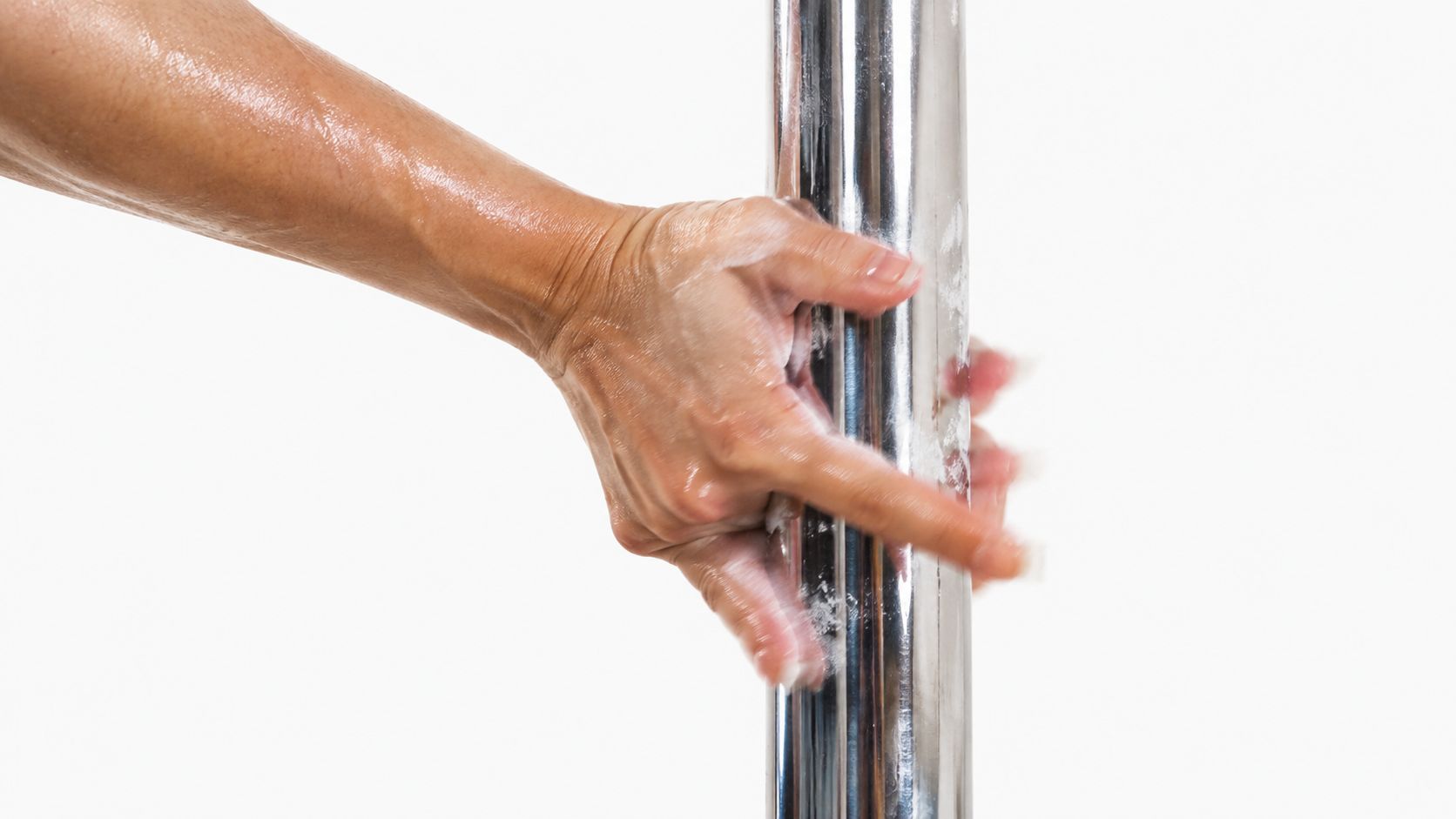
The moment product choice matters
A sweaty beginner may need a thin drying layer before climbs. A dancer with naturally dry hands may need little or no chalk, particularly if the routine includes controlled spins and releases. An experienced athlete on a polished pole may deliberately reduce product before a handspring because excess residue can make the contact feel inconsistent.
That's why chalk isn't a substitute for grip awareness. It's one part of a system that includes clean skin, a wiped pole, suitable hand pressure, and a clear understanding of what the venue permits. Dancers looking for more background on hand preparation can also review this guide to pole fitness grip.
What Chalk Actually Does for Pole Grip
Magnesium carbonate chalk helps manage moisture on the skin. When sweat makes the palms slick, a thin chalk layer can absorb some of that moisture and create a more consistent surface for contact with the pole.
It isn't glue. Chalk doesn't guarantee that a hand will stay fixed to metal, and adding more doesn't automatically create more friction. A dry, loose coating can shift under pressure, especially when particles move against one another or build into a thick layer.
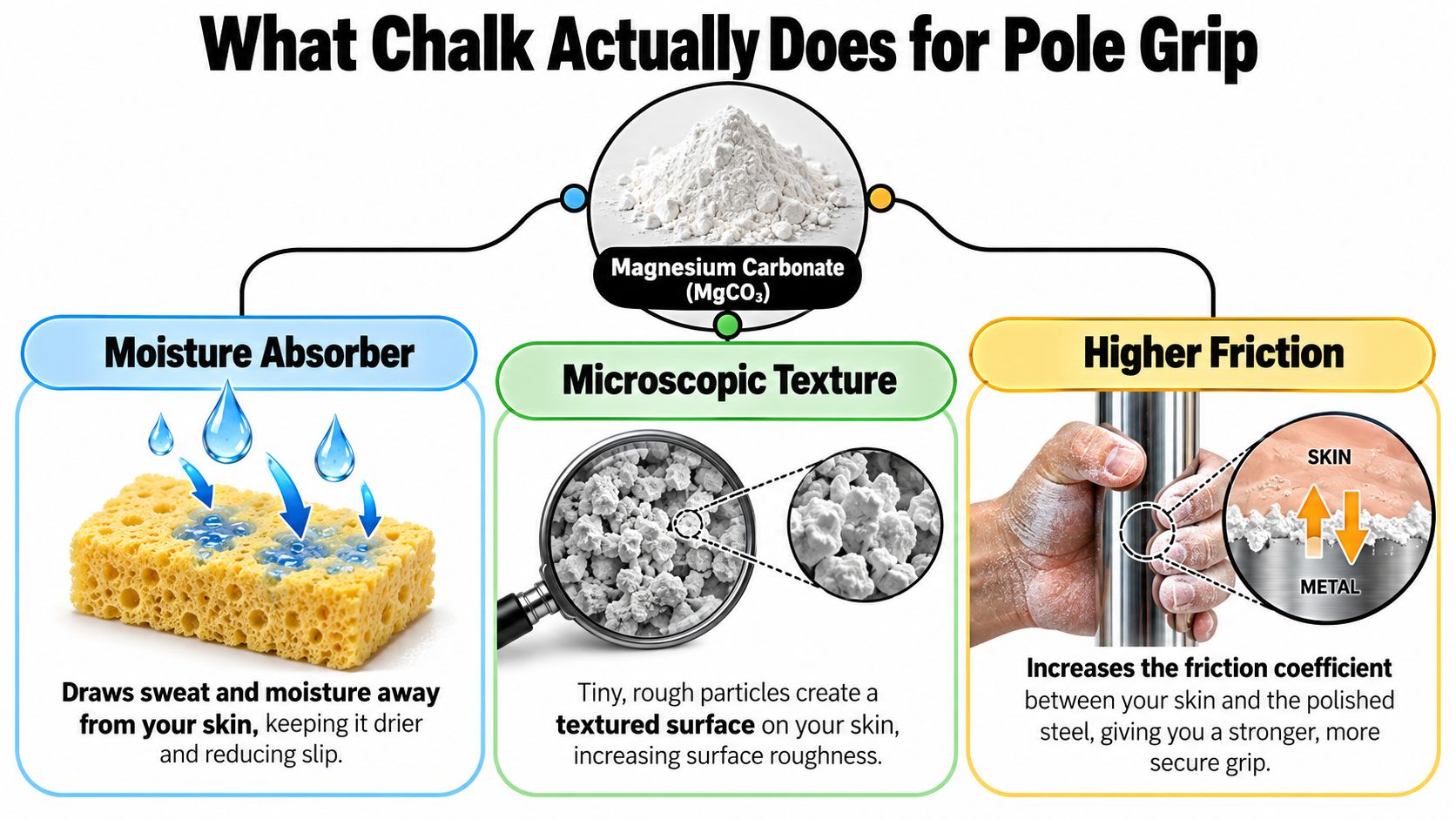
Moisture control comes first
The most useful mental model is a temporary moisture-management layer. Clean, dry skin gives the product a better starting point. A small amount can help when sweat is the reason contact is failing, but the same application can become counterproductive when the hands are already dry.
Research on grip-enhancing agents, including powdered and liquid chalk, found that liquid chalk wasn't automatically more frictional than bare skin on a dry surface. Its main mechanical role was forming a temporary layer, while powdered chalk performed worse in some trials because particles could act like a solid lubricant. The University of Leeds friction assessment supports testing product quantity instead of assuming that a heavier coating is safer.
Evidence from climbing also shows why magnesium carbonate remains useful when sweat interferes with contact. A 2018 study found that climbers averaged 22.8 open-handed repetitions with chalk compared with 19.7 without chalk, and 14.4 pinch-grip repetitions compared with 9.1 without chalk. The peer-reviewed climbing study offers useful support for moisture control, though climbing holds and pole surfaces aren't identical.
Liquid Chalk vs Powder Chalk vs Rosin
Each grip aid changes the hand and the training environment differently. Liquid chalk forms a layer on the skin, powder delivers loose magnesium carbonate directly, and rosin creates a tackier feel rather than just managing moisture.
Liquid chalk is usually the cleanest option for a shared studio or home gym. It spreads over the palms and fingers, dries quickly, and avoids the airborne cloud associated with loose powder. Powder is familiar and easy to add in small amounts, but it can disperse through the room and accumulate on the pole. Rosin can feel strongly adhesive, yet that tack may interfere with controlled releases and can attract debris.
| Option | Grip Style | Mess Level | Venue Fit |
|---|---|---|---|
| Liquid chalk | Drying layer that manages sweaty skin | Low when applied sparingly | Often suitable where powder is restricted, subject to studio rules |
| Powder chalk | Loose moisture-control coating | Higher, with airborne dust and residue | Depends heavily on venue policy and cleanup standards |
| Rosin | Tacky, adhesive feel | Variable, with residue concerns | Suitable only where the studio or event explicitly allows it |
The trade-off during movement
A static hold can make a product feel excellent because the hand stays in one position. A spin, transition, or handspring tests something different. The hand may need to rotate, release, or change pressure quickly, so maximum tack isn't always the same as maximum control.
Liquid chalk suits dancers who want a fast application without loose powder spreading through the room. Powder may appeal to someone who already knows exactly how much their skin needs, but it demands more attention to dust and pole cleaning. Rosin belongs in a separate category because its sticky sensation can change how the hand releases from metal.
Venue rules decide the final choice. Some studios permit only liquid chalk, while others restrict grip products altogether. A product that works in a private training space may not be permitted in class or competition, so the policy should be checked before application.
How to Apply and Remove Chalk Safely
Apply chalk with control. The goal is a thin, even layer suited to your skin moisture and pole finish, not the heaviest coating possible.
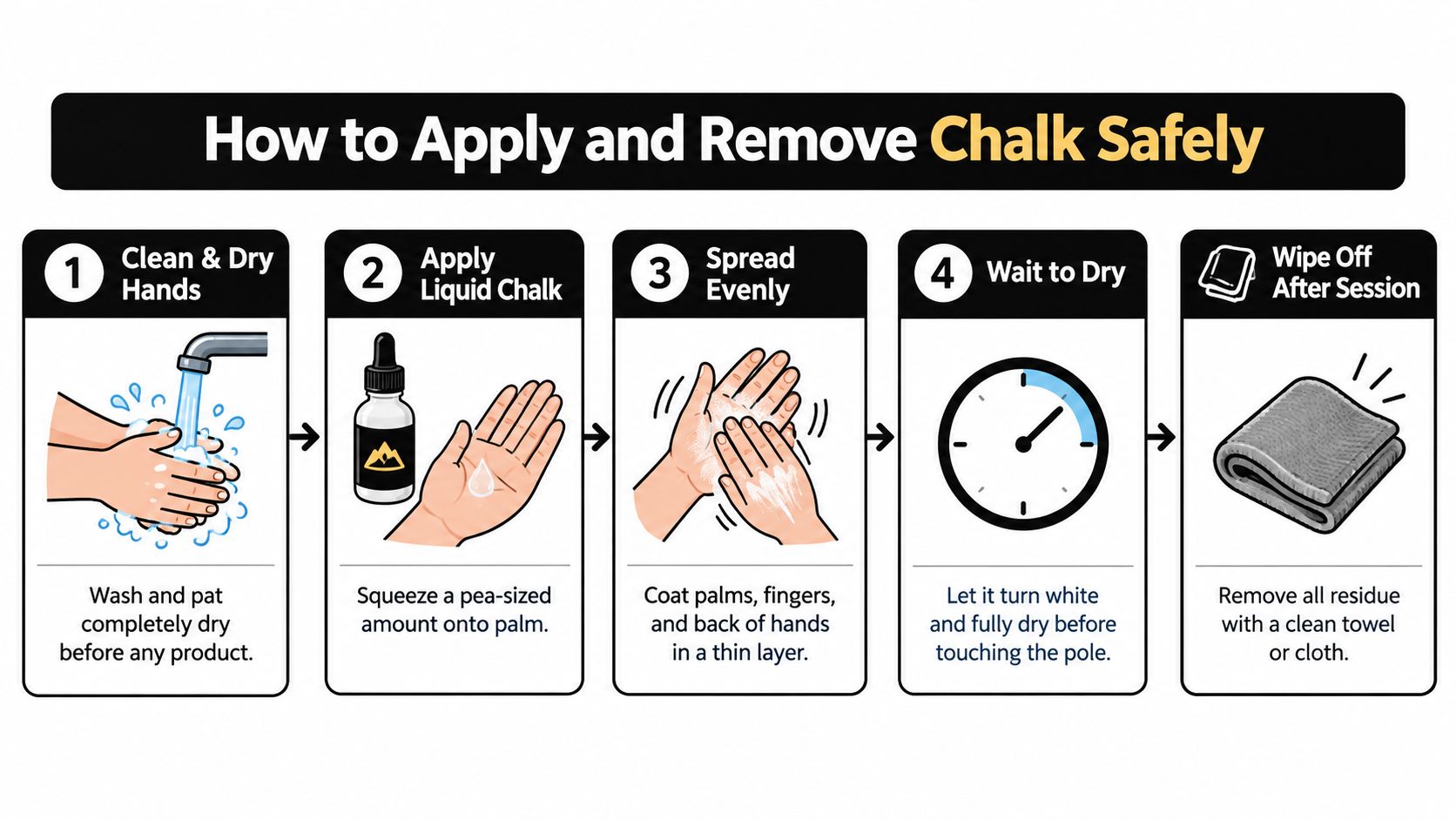
A repeatable application routine
- Wash and dry the hands. Remove lotion, oil, and old residue. Pat the palms and fingers fully dry.
- Shake the bottle. This distributes the liquid chalk before application.
- Use a small amount. Spread it across the palms, fingers, and other contact areas. A thin layer gives you a clearer grip check than a heavy coating.
- Let it dry fully. Liquid chalk commonly looks dry after a few seconds, but contact with the pole should wait until the layer has set. Studio guidance on clean, dry hands and liquid chalk application recommends a small application, drying time, and reapplication only when needed. For more detail on drying time and reapplication, see our guide to liquid chalk for pole grip.
- Test before aerial work. Start with a low-demand movement. Check whether the hand feels secure, overly dry, or covered in excess product before attempting rotation or inversion.
Reapply in response to sweat, not nerves. If contact remains predictable, another layer may only add residue. If the pole feels dusty or coated, clean the surface before applying more chalk.
Removal protects the next session
After training, wash your hands with mild soap and water to remove dried residue. Clean the pole according to studio procedure, especially around areas used for spins, transitions, and hand changes.
Good cleanup protects both grip quality and the next athlete. Residue can alter the surface, while repeated layers may make contact less predictable even when the original application was appropriate.
When Chalk Can Reduce Safety Instead of Helping
The assumption that more chalk always means more grip causes avoidable problems. On dry hands, a thick layer can add loose material where the athlete needs direct skin-to-metal contact. On polished metal, that excess can move under load and create an unexpectedly slippery feel.
The risk becomes more obvious during high-torque movements. A dancer may feel secure during a static hold, then lose predictability while entering a spin, changing hand position, or attempting a handspring. Heavy residue can also make controlled release harder, which matters when the movement depends on letting the hand slide or rotate at the right moment.
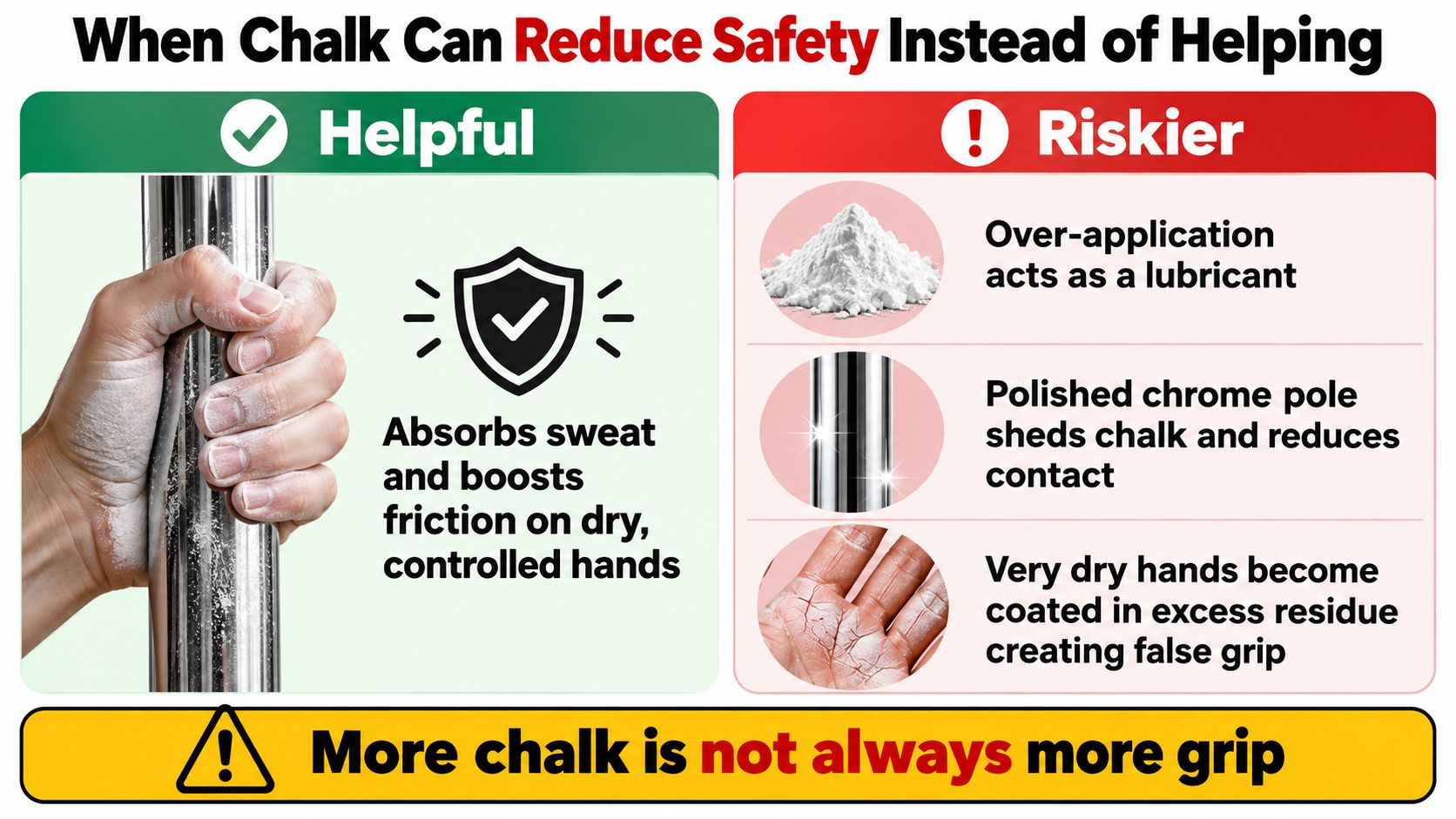
A simple decision guide
- Sweaty hands and dry skin-free contact: Try a small liquid layer, allow it to dry, and reassess during warm-up.
- Naturally dry hands: Start with no product or the smallest possible amount. Add chalk only if the hand begins to slide.
- Polished pole: Use less than intuition suggests. A thick coating can behave unpredictably on a smooth finish.
- Moves requiring controlled release: Avoid heavy residue before spins, transitions, and handspring variations. Secure contact must still allow deliberate movement.
- Leg or torso contact: Consider whether extra hand grip will make the rest of the movement harder to control. Maximum hand adhesion isn't always the objective.
Competition rules make residue more than a personal preference. Guidance from the Pole Sports & Arts World Federation allows magnesium only with extreme caution because residue can create a hazard for the next athlete. Grip products must not be applied directly to the apparatus, and residue that cleaners can't remove within the allotted time can be penalized.
How to Choose the Right Formula for Your Hands and Pole
Formula selection starts with the condition causing the slip. If sweat is the problem, a fast-drying liquid layer is a logical starting point. If the hands are already dry, the correct choice may be less product, a lighter application, or none at all.
Pole finish matters just as much. A polished surface can expose the downside of loose residue quickly, while a coated surface may respond differently. Neither finish makes one product universally correct, so the warm-up should be treated as a test rather than a formality.
EVMT Liquid Chalk is a magnesium-carbonate liquid chalk that dries in seconds, makes no dust, leaves minimal residue on bars or poles, and is allowed in gyms that ban powder chalk. For a dancer choosing a liquid formula, those properties address the practical concerns of shared rooms, home spaces, and venues that restrict loose powder.
Use this selection checklist
- Identify the problem: Sweat, oil, dry skin, dust restrictions, or inconsistent pole cleaning.
- Check the venue: Confirm whether liquid chalk is allowed and whether the studio has specific rules for the apparatus.
- Apply minimally: Coat the hands rather than the pole, then wait for complete drying.
- Test the movement: Check a basic hold, a controlled transition, and the first movement that normally exposes slipping.
- Inspect the surface: If the pole feels coated, stop applying and clean it according to venue procedure.
The best chalk for pole dancing is conditional. A product can be technically suitable and still be wrong for a particular session if the athlete's hands, the pole, or the rules have changed. More detail on choosing a pole dance grip aid can help dancers build that decision into their preparation.
Real Scenarios That Show Grip Choices in Action
A beginner enters a humid studio with damp palms and loses control during a climb. A small amount of liquid chalk, dried completely before contact, can manage that moisture without filling the room with loose powder. The dancer should still test a basic hold and a controlled transition before attempting an inversion. Chalk supports contact, but it cannot replace gradual skill development or awareness of how the pole feels under load.
A competition athlete has tighter constraints. Organized pole has made consistent grip strategically important, and the International Pole Sports Federation's history places its founding in 2009, during the sport's move into formal international competition. Use the thinnest permitted layer, keep product off the apparatus, and confirm that residue can be removed within the event's rules. A formula that works in training may be unsuitable under competition conditions.
A trained dancer on a polished pole may feel less secure after reapplying. Stop adding product, wipe away excess, and retest a controlled release or rotation. The issue may be a film between skin and metal, especially when the surface already provides enough contact.
Chalk choice follows conditions. Skin moisture, pole finish, movement type, and venue policy determine whether chalk improves control or creates a hazard. A climbing hold, a static inversion, and a fast spin can require different decisions during the same session.
Practical Routine for Cleaner, Safer Grip Sessions
Before class, wash and dry the hands, check the studio policy, and apply the smallest useful amount. Let it dry fully, then test contact during warm-up before committing to an inversion or high-torque transition.
During training, reapply only when sweat materially reduces control. If the grip feels false, loose, or unusually sticky, stop and inspect the hands and pole instead of adding another layer. Wipe the contact area regularly so residue doesn't accumulate for the next attempt or athlete.
After class, wash the product from the hands and follow the venue's cleaning process for the pole. This routine keeps chalk focused on moisture management, where it helps most, rather than turning it into a thick coating that creates uncertainty.
Evermost LLC offers liquid chalk for athletes who need cleaner grip management across pole, lifting, climbing, gymnastics, and other grip-intensive training. Visit Evermost LLC to explore single bottles and multi-packs, then choose a practical option for sweaty hands, low-dust venues, and controlled pole sessions.