


Cable Row Grip Guide: Types, Technique, and Programming
You're at the seated cable row station, the stack is loaded, and your hand automatically closes around the V-bar. The first reps feel solid, but by the end of the set your forearms are burning, your shoulders are creeping upward, and the back work you wanted has turned into a contest between your grip and your biceps.
That outcome isn't always a strength problem. The cable row grip changes your wrist position, elbow path, shoulder rotation, range of motion, and the way you share work between the lats, rhomboids, middle trapezius, rear delts, and elbow flexors. The right attachment won't replace progressive training, but it can make a difficult movement easier to standardize and a weak link easier to identify.
Why Your Cable Row Grip Matters More Than You Think
You sit at the cable row, load the stack, and choose the V-bar by habit. The first reps feel strong. Later, your forearms tighten, your shoulders rise, and the set becomes a grip and biceps exercise instead of the back-focused work you intended.
The handle changes more than hand comfort. It sets your wrist position, elbow route, shoulder rotation, and finishing position, which alters how the lats, rhomboids, middle trapezius, rear delts, and elbow flexors divide the work. Biomechanical guidance on cable-row grip variations explains these differences through elbow travel, scapular movement, and the muscles best positioned to contribute.
A close attachment usually keeps the elbows nearer the ribs and gives the forearms a more comfortable line. A wide overhand bar sends the elbows farther outward, asking more from the muscles that bring the shoulder blades together. An underhand handle can feel powerful because the biceps assist strongly, but that advantage becomes a limitation if the elbows bend before the upper arms move behind the torso.
Your grip also exposes a weak link. If your forearms fail first, the back may still have useful work available. Review your setup, then address the limitation with targeted grip strength training rather than changing attachments at random. Wrist position and handle choice can reduce unnecessary strain, but neither removes the need to control the shoulder and elbow path.
Practical rule: Choose the attachment based on which part of the pull you want to make hardest, not on which handle happens to be attached.
A seated cable-row study compared seven row variations and found greater peak force when shoulder abduction was closer to 0 degrees across pronated, supinated, and neutral grips. Force declined as abduction moved toward 60 and 90 degrees, showing that arm angle affects what you can produce during the lift. Read the full study on seated cable-row force.
No handle wins every situation. Choose the grip that matches your goal, tolerates your wrists, and lets you repeat the same movement while progressing load and control.
The Main Cable Row Grip Types Explained
Start by identifying the hand position, then look at spacing and attachment shape. Those three details tell you more than the handle's nickname.
- Pronated grip: Your palms face down on a straight bar, usually with the hands outside shoulder width. A wider overhand grip moves the elbows farther from the torso and generally increases the demand for scapular retraction and upper-back work. A closer pronated grip keeps the elbows nearer the body and can provide a more balanced pull.
- Supinated grip: Your palms face up, usually on a straight bar or angled attachment. This position tends to involve the biceps more and can create a direct path toward the lower abdomen. Keep the wrists stacked rather than letting them fold backward.
- Neutral grip: Your palms face each other on parallel handles. A close neutral handle usually feels strong and wrist-friendly because the elbows can track alongside the torso. It's often the most straightforward starting point for consistent loading.
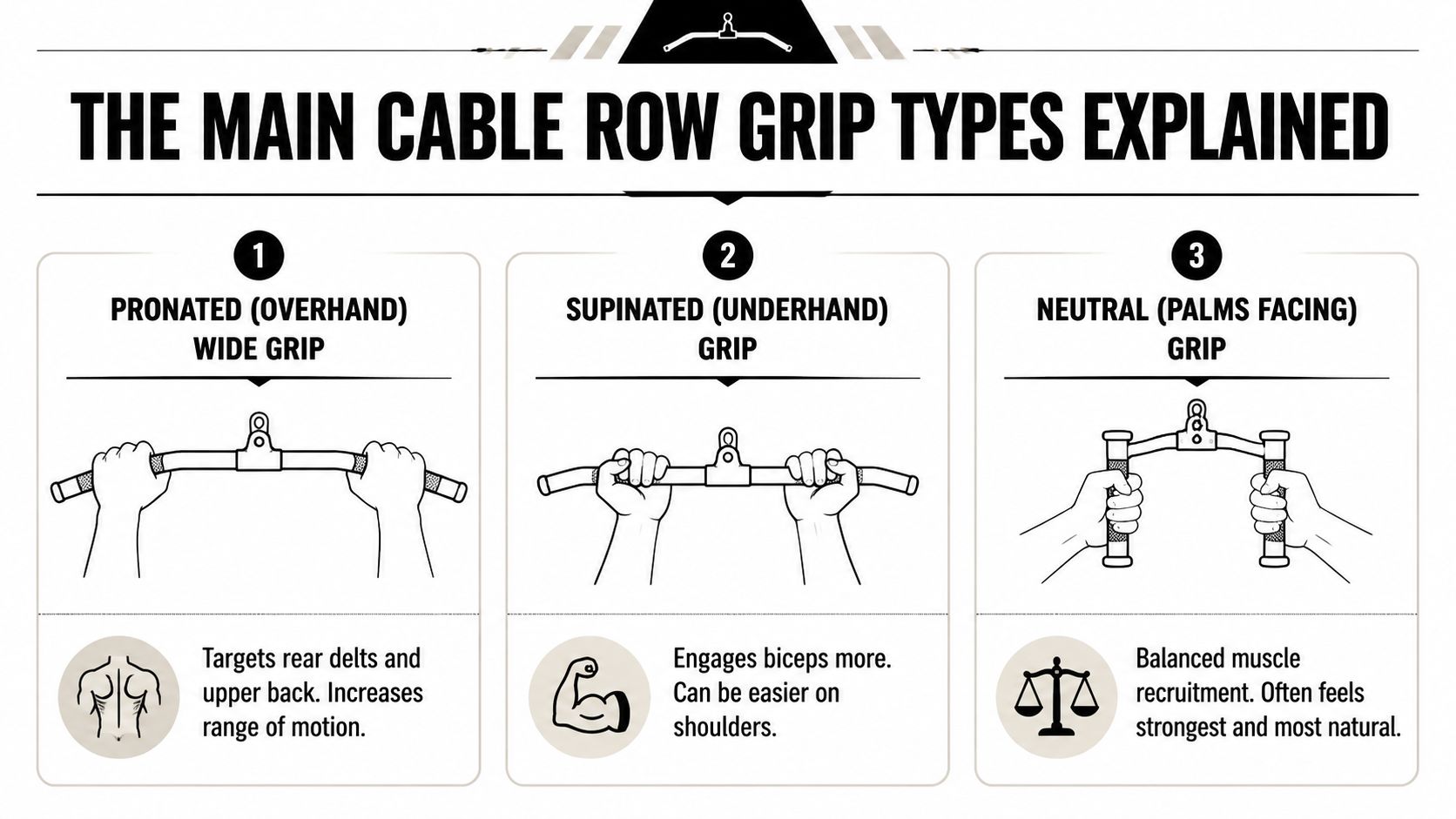
The V-bar deserves a precise description. Lifters commonly call it neutral, but it isn't a strict neutral grip in the anatomical sense because the palms angle inward toward each other rather than facing perfectly parallel. That angled hand position often gives the elbows a natural route close to the ribs and lets many athletes use substantial load.
A rope attachment allows each hand to move more independently. You can separate the ends near the finish, but the rope may shorten the effective range if you stop before the hands reach the torso. A single-arm D-handle creates a unilateral row and introduces a stronger anti-rotation demand because your torso has to resist twisting toward the working side.
A wide lat pulldown-style bar can also be used for rows. Its broad overhand spacing encourages more horizontal arm movement and makes the upper back a larger part of the finish. The attachment catalog matters only when it helps you choose deliberately. The next question is what each grip changes in the actual pull.
Biomechanics and Muscle Activation by Grip
Grip choice changes the path of the upper arm, the amount of shoulder extension available, and how much the elbow flexors assist. It does not isolate one muscle. A pronated wide grip usually increases horizontal shoulder movement and scapular retraction, bringing the rhomboids, middle trapezius, and rear delts into a larger role. A supinated grip combines shoulder extension with a stronger mechanical position for the biceps. A close neutral grip generally sits between those demands.
Shoulder position also affects force production. The 2023 force study found that peak force was higher when the arm stayed closer to 0 degrees of abduction and fell as it moved toward 60 and 90 degrees. Use that finding to set a comfortable elbow path, not to force every row into one identical position.
Handle design can change performance as well. An EMG comparison reported a higher 1-repetition maximum with a wrist-flexed handle, 115.2±17.4 kilograms versus 112.5±17.6 kilograms, with the difference reported as p<0.003. Biceps brachii activity was also higher with that handle. Review the seated-row handle comparison.
| Grip Type | Lats | Mid/Upper Back | Biceps | Core Demand | Wrist Stress |
|---|---|---|---|---|---|
| Pronated wide | Moderate | High | Moderate | Moderate | Moderate |
| Supinated close | High | Moderate | High | Moderate | Moderate |
| Neutral V-bar | High | Moderate to high | Moderate to high | Moderate | Often manageable |
| Rope | Moderate to high | Moderate | Moderate | Moderate | Adjustable |
| Single-arm D-handle | High on the working side | Moderate | Moderate | High | Adjustable |
A broader cable-resistance study examined handle variations in seated rows and related pulling movements with eleven recreationally trained men and ten women. The results support changing handles for a purpose, since grip position can alter muscle activity and force distribution rather than serving as a cosmetic equipment swap. Access the broader handle-type research.
Your limiting factor may still be the hand. If the handle opens your fingers before the back reaches technical failure, address grip capacity through grip strength training, then reassess whether the attachment or the grip is limiting the row.
Technique Cues and Execution Tips for Each Grip
Set the station before you choose the attachment. Place your feet firmly on the platform, keep a soft bend in the knees, and start with the arms extended far enough for the shoulder blades to glide forward without the torso collapsing. Keep the trunk quiet, let the upper arm initiate the pull, and allow the shoulder blades to move naturally rather than pinning them back before the rep begins.
Pronated wide grip
Use a straight bar or wide lat bar and keep the chest tall without flaring the ribs. Pull the elbows back and slightly out, then bring the bar toward the lower sternum or upper abdomen. The common error is shrugging at lockout.
Correction cue: “Shoulders away from ears, elbows wide but not high.”
Supinated close grip
Stack the wrists over the forearms and keep the elbows close to the ribs. Think about driving the upper arms backward toward the hips instead of curling the handle into your body. Lifters often yank with the biceps because the underhand position makes elbow flexion feel immediately available.
Correction cue: “Move the elbows first, then let the hands follow.”
Neutral grip and V-bar
The close neutral handle usually gives you a natural elbow track. Brace the feet and pelvis, keep the torso steady, and pull the attachment toward the lower abdomen while allowing the elbows to pass the ribs if your shoulder position remains comfortable.
The V-bar can also encourage rotation because the hands meet at an angle. Brace your midsection as if someone is trying to turn your shoulders, and don't let one elbow finish far ahead of the other.
Rope and single-arm D-handle
With a rope, keep the wrists relaxed and separate the rope ends slightly as they approach the torso. Don't force a dramatic external rotation if it makes the shoulder roll forward. With a D-handle, resist turning toward the working arm and keep the nonworking side anchored.
The best self-check is simple: if the handle reaches your body only because your torso swings backward, reduce the load. A controlled return with a full shoulder-blade glide gives you a more useful rep than an impressive stack number.
Programming Your Cable Row Grip by Goal
Handle choice works best as a small programming adjustment inside a stable plan. Keep the seat, torso position, range of motion, and effort reasonably consistent so you can tell whether performance is improving. Swap attachments to change the mechanical emphasis or manage joint tolerance, not because every grip needs its own completely separate program.
| Training Goal | Best Grips | Loading and Rep Target |
|---|---|---|
| Lat width and loaded stretch | Supinated close, neutral, closer pronated | Use a load you can control through a long reach and a deliberate eccentric |
| Upper-back thickness | Pronated wide, wider neutral | Use a pause near the torso and keep the elbows moving back rather than up |
| Arm and brachialis contribution | Supinated, rope | Use as accessory rowing after your main back work |
| Balanced pulling strength | Neutral, pronated, supinated rotation | Distribute different attachments across sessions and track performance by exercise |
For lat-focused work, a close neutral or supinated grip often gives the elbows a path toward the hips. Keep the return controlled and avoid cutting off the stretched position. For upper-back density, use a pronated or wider attachment and make the finish deliberate, with the shoulder blades moving together without a shrug.
A useful weekly rotation might place a neutral V-bar row first when you want a stable heavy pull, a wide pronated row later for upper-back emphasis, and a rope or supinated row after that for a shorter, higher-effort finisher. The exact loading should follow your technique. A grip that lets you use more weight but forces partial reps isn't automatically the better choice.
If you're organizing rows inside a broader physique-focused plan, this functional bodybuilding program guide can help frame grip changes as part of movement selection rather than random variation.
What Grip Choice Actually Changes and What It Does Not
Changing a handle doesn't remodel your back by itself. It changes forearm orientation, shoulder position, elbow travel, and the muscles most likely to become the limiting factor. Those changes matter, but they're smaller than the effect of performing repeatable reps through a useful range of motion while gradually increasing the work you can handle.
Mainstream commentary on seated cable rows argues that grip changes probably shift emphasis only modestly and that their practical effect on long-term hypertrophy may be limited. This review discusses the difference between short-term activation changes and the larger drivers of muscle growth.
That perspective is valuable because many lifters spend more time hunting for the perfect attachment than improving the actual set. If your elbows stop short, your torso heaves, or your shoulders stay pinned in a cramped position, another handle won't solve the main problem.
The contrarian answer: Pick the grip that lets you pull hard, control the stretch, and repeat the same standard next session.
Grip changes can still serve a clear purpose. Rotate between a neutral attachment and a pronated bar when one position begins to irritate your elbows. Use a single-arm handle when you need to notice side-to-side differences. Choose a rope when a fixed handle forces your wrists into a position you can't maintain comfortably.
The reliability evidence is also useful. A recent paper on the seated unilateral cable row found very high test-retest reliability across most contraction types and force measures, which supports the exercise as a stable way to compare performance. It doesn't prove that one grip is a magic hypertrophy lever. It supports a more practical conclusion: standardize the variation you care about, then judge progress by clean performance rather than by novelty.
Grip Fatigue, Skin Care, and Grip Aids That Hold Up
A cable row can fail at the hands before the back reaches its productive limit. Sweat reduces friction, knurled handles expose rough calluses, and repeated open-hand pressure can make the skin on the fingers and palms the first thing that stops a set. Loose chalk may help, but many commercial gyms limit airborne dust, and some shared spaces don't want powder settling on benches and machines.
Straps are another option. They're useful when the goal is to keep the back working after the grip has become the limiting factor, but they shouldn't automatically replace grip development on every set. Use them selectively, especially on high-volume work or when you're trying to isolate back fatigue without turning the session into a forearm test.
EVMT Liquid Chalk is a fast-drying, sweat-resistant grip aid designed to create a thin barrier without the airborne mess associated with loose chalk. Apply a light layer before warm-up sets, let it dry fully, and reapply between heavy working sets only if the hands begin to slide. Remove it with soap and water after training, and keep calluses filed rather than allowing thick edges to catch on handles.
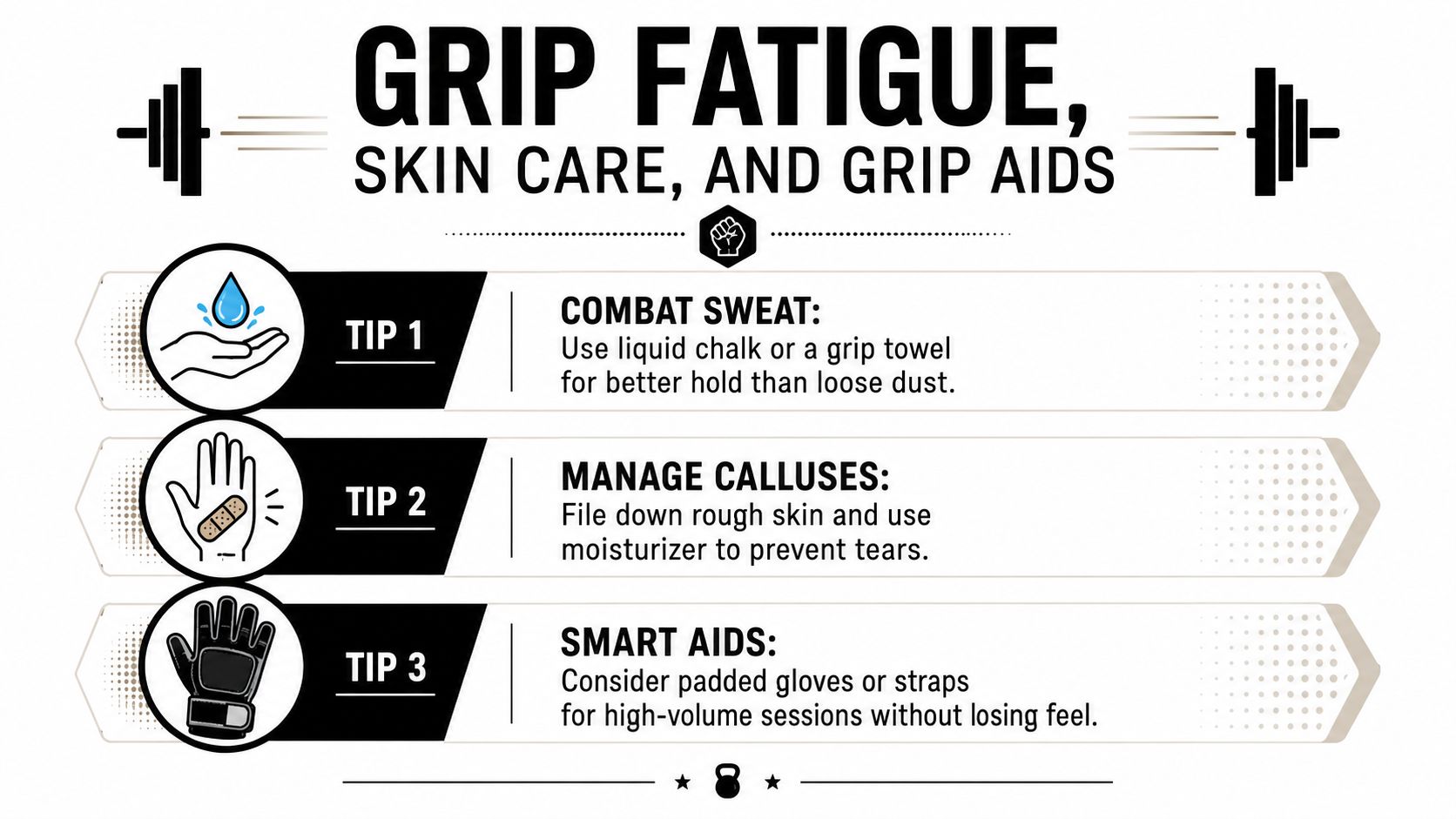
Skin-care rule: Smooth calluses are easier to manage than torn calluses. File rough edges, wash off residue, and don't train through an open tear.
Competition rules deserve attention. British Weight Lifting's technical rules permit chalk, specifically magnesium carbonate, while another grip-tool rule set allows powdered magnesium carbonate but specifically disallows liquid chalk and tacky products. Review the British Weight Lifting technical competition rules. Rules vary by federation, event, and venue, so confirm the exact policy before assuming a training product is platform legal.
For athletes also exploring recovery and broader training habits, these CBD fitness tips provide a separate resource. They don't replace grip preparation, skin care, or sensible load management.
A short warm-up can reduce the shock of heavy pulling. Use light wrist curls, a brief rice-bucket drill, and extensor stretches before the first demanding row, then stop the warm-up before the forearms become fatigued. The aim is readiness, not pre-exhaustion.
More practical guidance on application and training use is available in this guide to liquid chalk for weightlifting.
Common Mistakes to Fix and How to Apply This on Your Next Pull Day
Handle selection won't rescue poor execution. The same four errors appear with a V-bar, wide bar, rope, or D-handle, and each one changes the exercise more than a small grip adjustment.
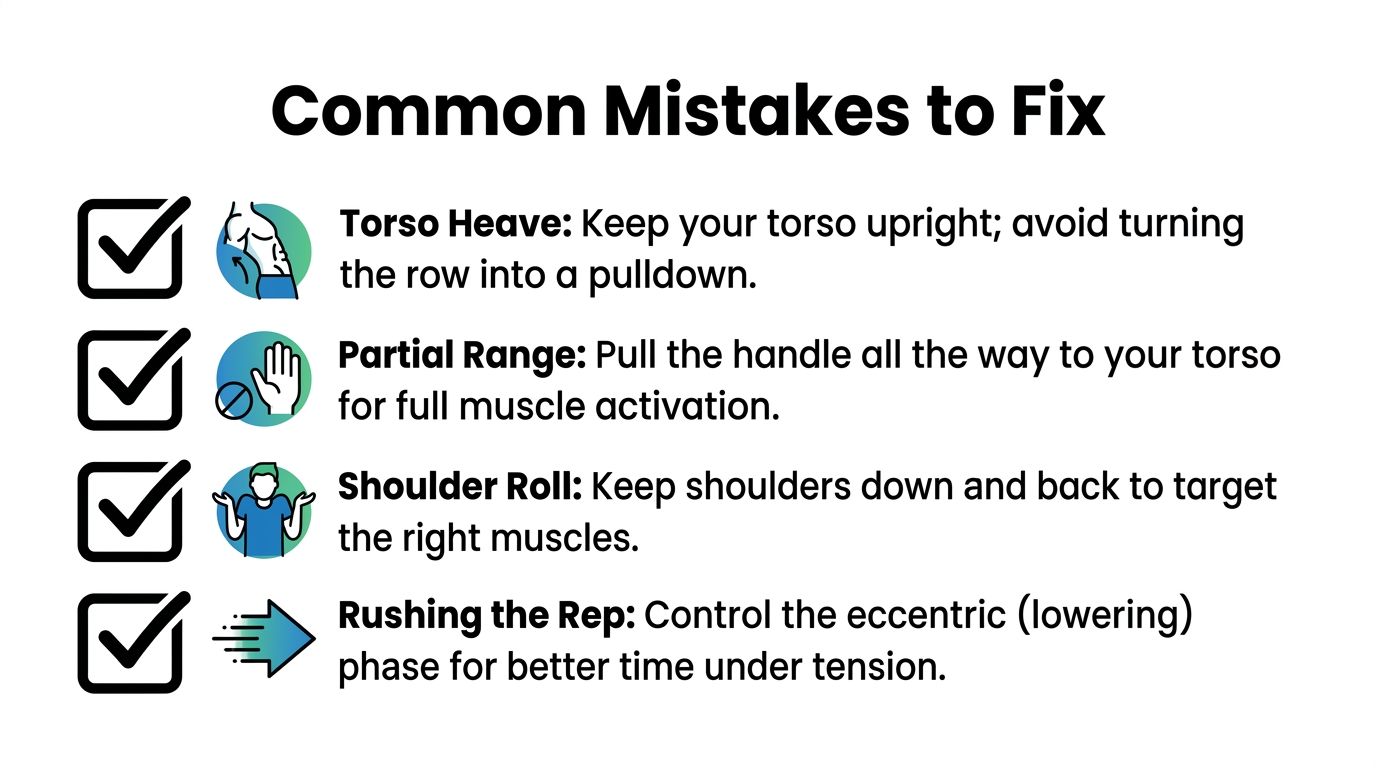
- Torso heave: Leaning sharply backward turns the horizontal row into something closer to a pulldown and makes your lower back help start the rep. Keep the chest tall, ribs controlled, and torso angle stable.
- Partial range: Stopping the handle near the navel or before the elbows travel behind the ribs cuts off the finish. Lower the load until the handle can reach the torso without losing position.
- Elbow flare: Driving the elbows high and wide can shift work toward the rear delts and upper traps. Pull back rather than up, and choose a width that lets the shoulders move smoothly.
- Shrug finish: If the shoulders rise at lockout, the upper traps may dominate while the intended back muscles lose a clean contraction. Think “long neck” as the handle approaches you.
A practical pull-day template needs only a few deliberate choices:
- Neutral-grip heavy row: Use the V-bar or another close neutral-style attachment for your primary horizontal pull. Keep the torso braced and record load, reps, and whether the final set stayed technically consistent.
- Pronated wide row: Move to a wider bar for upper-back density. Use a visible pause at the torso and don't chase load if the elbows stop short.
- Supinated or rope finisher: Choose the position that gives you a clean lat and biceps-focused finish without wrist collapse. Reduce the load enough to keep the return controlled.
A competition-minded lifter should separate gym convenience from platform legality. Chalk may be allowed in a federation while liquid or tacky formulations are prohibited, and handle rules can differ as well. Check the meet's written regulations before relying on a specific grip aid or attachment.
Watch the setup and execution in motion here:
Before your next pull day, ask one question: Which part of the cable row is limiting me right now, the back, the elbows, the wrists, or the skin on my hands? Choose the grip and aid that address that bottleneck, then keep the rest of the movement consistent enough to measure progress.
Evermost LLC offers liquid chalk and grip-focused training products for athletes who need a cleaner hold on cable attachments, bars, and other pulling tools. Visit Evermost LLC to review the available grip options and choose a setup that fits your cable-row training environment.