


Bouldering vs Top Roping: Which Climbing Style Fits You
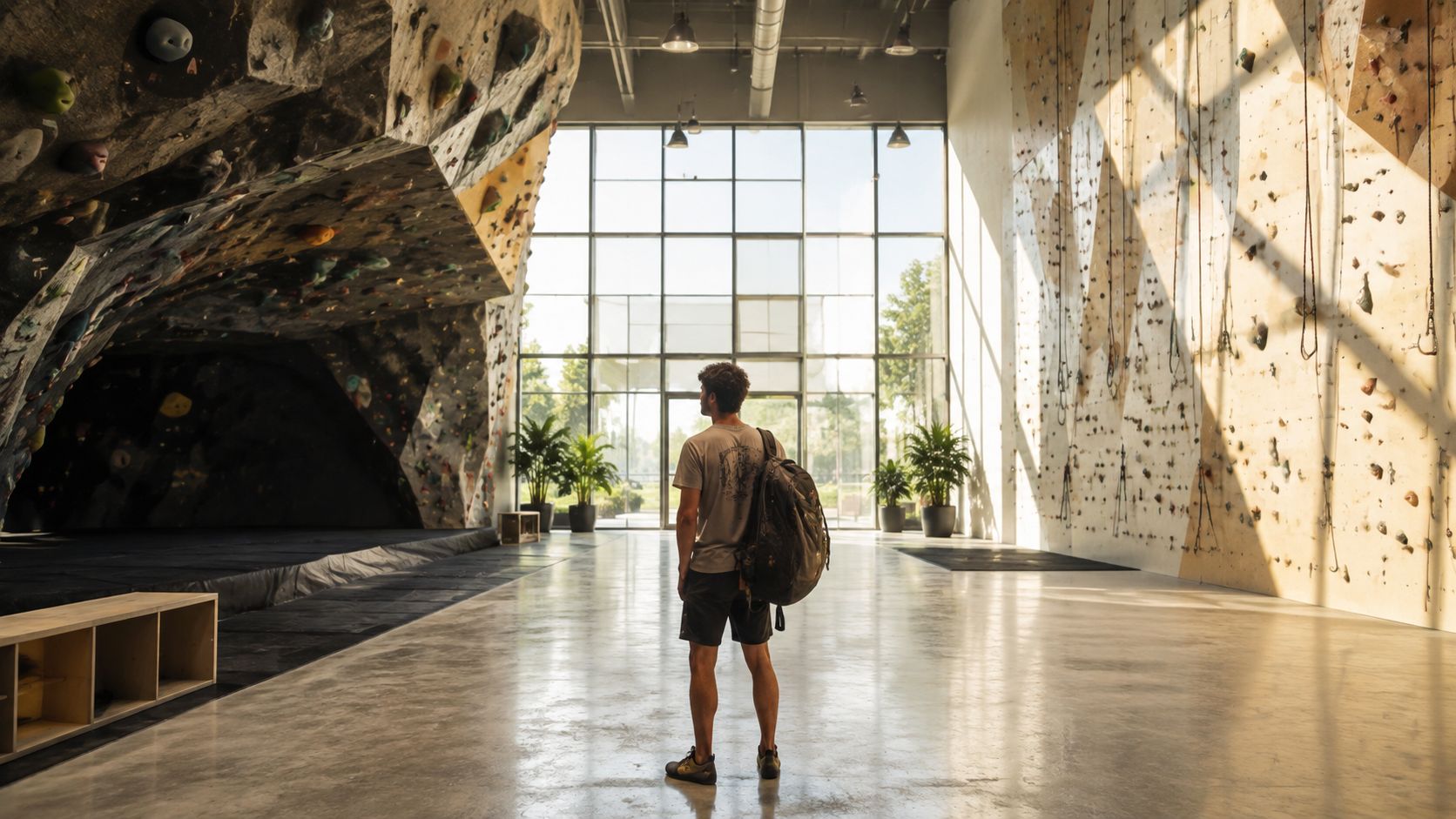
You're standing at the gym entrance with a climbing bag over one shoulder, looking toward two very different sessions. The bouldering cave promises short problems, repeated attempts, and no harness. The top-rope wall offers a longer route, a belayer, and a chance to keep moving above the mat. Both can make you stronger, but they load your fingers, grip, shoulders, and recovery system in different ways.
The useful question in bouldering vs top roping isn't which discipline is universally better. It's which format matches your current goal, your tolerance for repeated high-intensity efforts, and the type of climbing you want to perform under pressure. The comparison below focuses on the trade-off many climbers miss: bouldering often concentrates more intensity into fewer moves, while top roping can provide more continuous movement with a different grip-management challenge.
Walking Into the Gym With a Decision to Make
A climber with limited time might spend a two-hour session moving between the same bouldering problem and the top-rope wall, but those sessions won't feel alike. On the bouldering side, the wall is lower, the landing zone is padded, and the main equipment is usually shoes, chalk, and a way to keep the landing area clear. You can work alone, watch another climber solve a sequence, and try the same moves immediately.
Top roping changes the logistics before the first move. You need a harness, a rope system, and a trained belayer or a gym-managed alternative. The climber is belayed from below and ascends without clipping protection, while rope tension and belayer communication become part of the movement experience. That system reduces the distance of an uncontrolled fall compared with climbing above your last piece of protection, but it doesn't remove the need for careful checks and attentive belaying.
What changes during a typical session
Bouldering tends to interrupt the climb with rests on the ground. You attempt a sequence, assess the failure point, brush or inspect holds, then decide whether to change your feet, body position, or pacing. The work is concentrated, and a short problem can demand a powerful pull, a precise toe placement, or a fast coordination move.
Top roping creates a different rhythm. You climb continuously, look for rests on the wall, shake out one hand while the other maintains contact, and manage breathing as fatigue builds. A successful session depends less on one explosive move and more on preserving enough grip quality to finish the route without wasting movement.
Practical rule: Choose the format that trains the quality you currently lack, not simply the one that feels most comfortable.
A practical gym bag also needs to support the way you move through the facility. If you carry shoes, chalk, tape, a water bottle, and a change of clothing between training areas, you may find it useful to choose a gym tote from Urban Totes that keeps climbing essentials separate and accessible.
The decision therefore rests on several connected factors:
- Height and falling: Top roping lets you work higher on the wall with rope support. Bouldering keeps the movement close to the floor but makes repeated landings and downclimbs part of session management.
- Equipment and partners: Bouldering has a lower equipment barrier. Top roping adds harness and belay responsibilities.
- Movement style: Bouldering rewards power, coordination, and problem solving. Top roping rewards endurance, efficiency, and grip conservation.
- Session structure: Bouldering is built around attempts and recovery between efforts. Top roping asks you to manage fatigue across a longer continuous effort.
How Bouldering and Top Roping Became Separate Disciplines
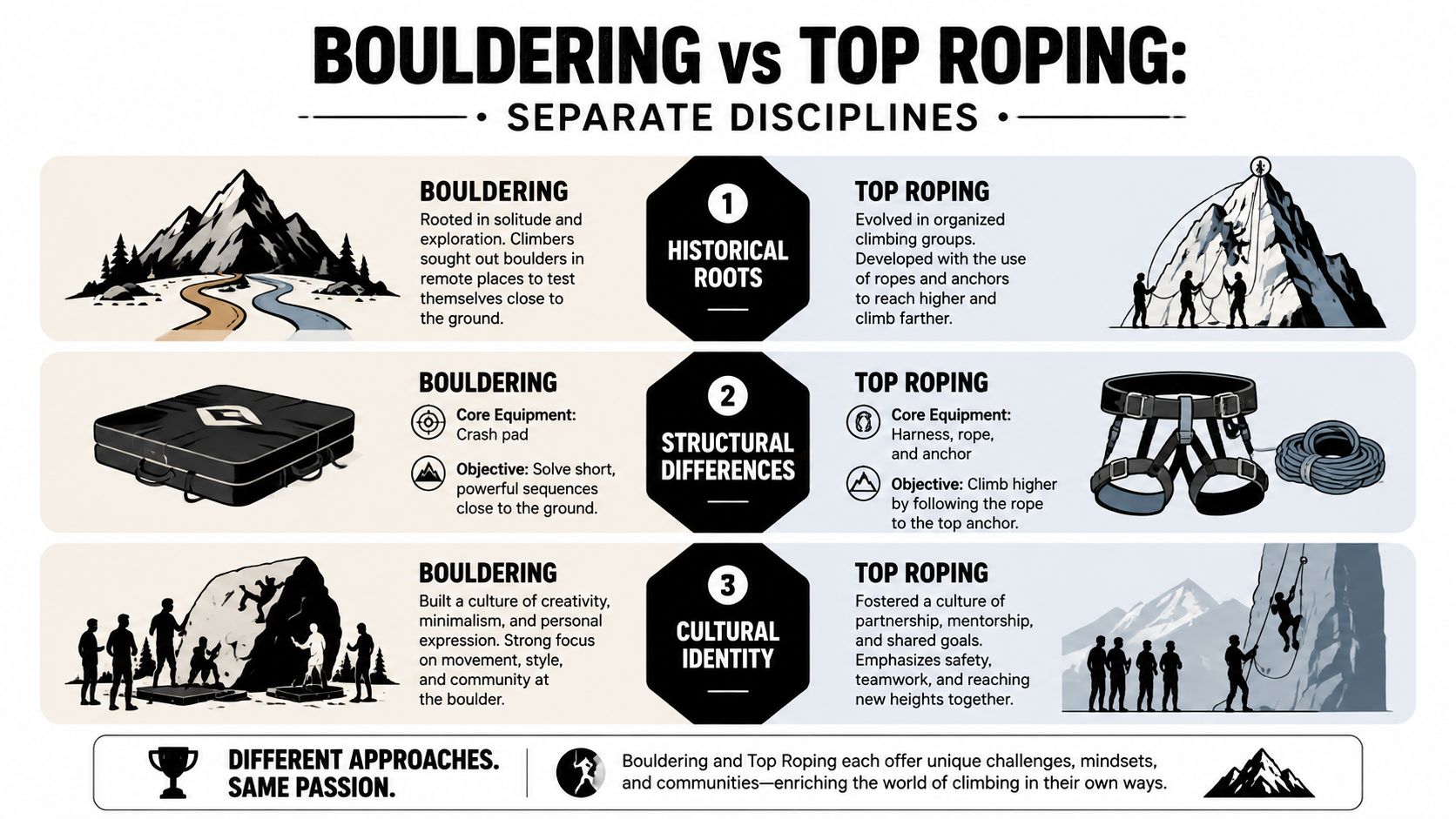
Bouldering and top roping developed around different answers to the same basic problem, how to challenge a climber while controlling the consequences of a fall. Modern international competition formalized bouldering as a standalone discipline through the International Federation of Sport Climbing, or IFSC. In the IFSC rules, bouldering is scored through short problems using attempts, zone points, and tops, without rope protection.
Top rope is treated as a roped format rather than a separate medal discipline in that competition structure. The IFSC describes top-rope routes as being “belayed from the ground,” which reflects a different safety model and a different performance objective. The climber aims to sustain movement through a continuous ascent instead of solving a short problem through a limited series of high-intensity attempts. (IFSC competition rules)
Two formats, two skill models
Bouldering became especially compatible with indoor gyms because it needs less vertical space and less belay infrastructure. A gym can build many short problems in a compact area, reset them regularly, and score performance by attempts and completion. That setup supports experimentation. Climbers can focus on body tension, foot precision, compression, coordination, and powerful movement without managing a rope.
Top roping became a natural entry point for many new climbers because the rope system reduces fall distance. The climber still has to learn communication, harness use, belay procedures, and movement technique, but the format allows sustained practice on taller terrain. That makes it useful for building confidence with height and learning how to rest, pace, and climb efficiently.
The distinction isn't merely historical. It affects how gyms organize space, how competitions judge performance, and how coaches prescribe training. Bouldering asks, “Can you solve this sequence with the fewest useful attempts?” Top roping asks, “Can you maintain efficient movement and grip quality until the route is complete?”
Why neither format replaces the other
A strong boulderer may have excellent maximum pulling power but lose efficiency on a long route. A capable top-rope climber may move smoothly for a sustained period but struggle with a single steep crux requiring rapid force production. Those gaps aren't evidence that one format is incomplete. They show that each discipline develops a different part of the climbing skill set.
For serious athletes, the useful approach is to treat them as complementary tools. Use bouldering when the priority is high-quality power and movement problem solving. Use top roping when the priority is continuous climbing, pacing, and technical efficiency.
Comparing Safety and Injury Risk Across Both Formats
A climber deciding between a first bouldering session and a top-rope route is choosing more than wall height. The format changes fall exposure, how often the fingers are loaded near their limit, and how fatigue affects movement quality.
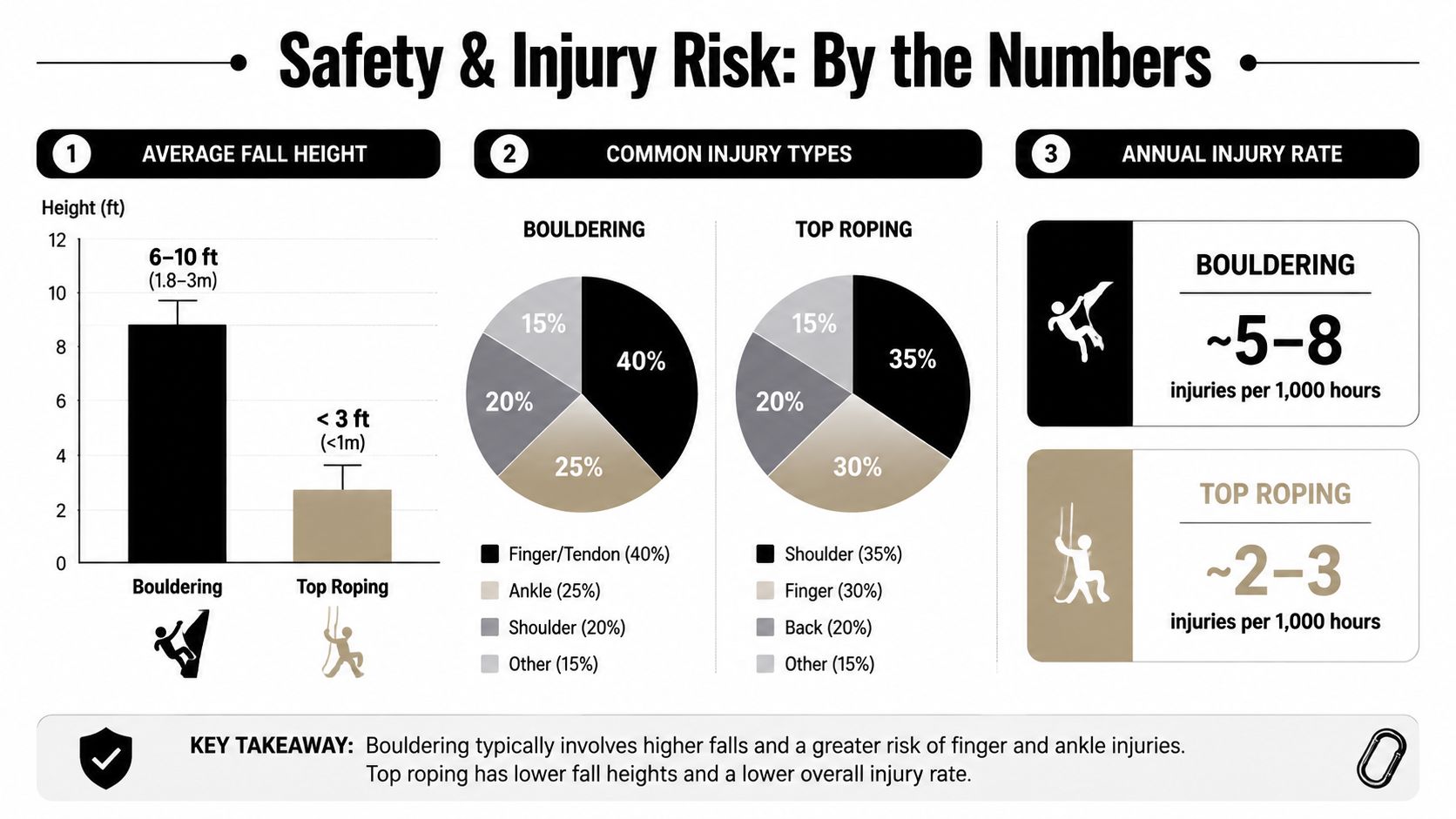
Top roping generally reduces acute fall risk, but it is not risk-free. A large German indoor study tracked 515,337 climbing wall visits over five years and recorded 32 acute injuries overall, including 6 in bouldering, 7 in top roping, and 16 in lead climbing. The overall rate was 0.02 injuries per 1,000 hours of climbing activity. (German indoor climbing injury study)
A later review summarized in Current Sports Medicine Reports estimated a mean injury incidence of 2.71 injuries per 1,000 hours across eight primary studies of sport climbing and bouldering. One competition study reported 1.47 injuries per 1,000 hours for competitive bouldering, compared with 0.29 for rope climbing. Those studies used different populations and methods, so the figures should guide context, not predict the risk of every gym session.
Fall mechanics explain only part of the difference
Fall factor equals the distance fallen divided by the length of rope available. Bouldering has no rope to absorb fall energy, so mats, landing technique, and spotting affect the outcome. In top roping, the rope runs from the climber to the anchor and back through the belayer, producing a much lower effective fall factor than lead climbing. (Fall-factor mechanics)
The rope does not remove every hazard. A climber can land awkwardly, swing into the wall, catch a hold poorly, or overload a shoulder while fighting to stay on. The system also depends on correct equipment use, clear communication, and attentive belaying.
Outdoor trauma data from Sweden recorded 38 climbing-related injuries from 2008 to 2019, including 9 bouldering injuries, or 24%, and 3 top-rope or self-belaying injuries, or 8%. Top roping represented a smaller share in that dataset, but the risk was still present.
Overuse changes the coaching conversation
Falls are obvious. Finger loading accumulates across repeated attempts and often shapes the more important coaching decision. Research on indoor climbers found that people who bouldered or led more than they top roped had a higher probability of climbing injuries, with the fingers identified as the most common injury site. (Indoor climber injury patterns)
Manage training load before technique deteriorates. If finger precision fades, the grip becomes desperate, or you start cutting feet on moves normally under control, end the limit work. Reviewing how to tape fingers for climbing can support protection decisions, but tape should not conceal pain or justify more loading.
Climbers with broader back concerns should separate climbing decisions from general conditioning. Advice on running safely with back problems can help frame questions about impact and exercise tolerance, while persistent symptoms warrant a climbing-specific assessment.
Training Benefits and Physical Demands Side by Side
You can leave a bouldering session after only a few hard moves and still have placed a heavy load through your fingers. A top-rope session may feel easier move by move, yet the longer time on the wall can create substantial forearm and grip fatigue. Both formats improve technique, strength, and confidence, but they stress those qualities differently.
Bouldering concentrates demanding movement into short sequences. A hard pull, dynamic reach, or high-tension foot move is followed by recovery before the next attempt. Top roping distributes work across a longer ascent, requiring you to lower effort, climb with straighter arms, find rests, and keep your hands from gripping harder than necessary. Bouldering suits high-quality power practice. Top roping suits movement volume and endurance.
Training Demands Comparison
| Attribute | Bouldering | Top Roping |
|---|---|---|
| Primary quality | Explosive power and movement problem solving | Endurance and sustained movement |
| Grip demand | High intensity over short sequences | Continuous grip management over longer routes |
| Typical rest pattern | Full recovery between attempts | Rest positions while remaining on the wall |
| Technical emphasis | Coordination, body tension, precise crux execution | Efficiency, pacing, breathing, and route reading |
| Main workload concern | Repeated maximal efforts and finger stress | Cumulative fatigue and declining movement quality |
| Best training use | Power, limit movement, and tactical attempts | Volume, aerobic capacity, and efficient technique |
Match the format to the adaptation
For maximum strength, choose a small number of difficult boulder problems and stop before fatigue changes your movement. The quality of each attempt matters more than collecting tired repetitions. A practical power session includes a thorough warm-up, carefully selected problems, and generous rest while footwork and body tension remain precise.
For endurance, top roping provides repeated practice in relaxed movement. Use easier terrain to rehearse quiet feet, controlled breathing, and deliberate rests. If your forearms flood quickly, gripping harder is rarely the complete answer. Reduce unnecessary tension, improve route efficiency, and learn to release effort whenever the holds allow it.
The hidden trade-off is finger load per effort. Bouldering places more intensity into fewer, often more explosive moves, so each attempt can demand high force from the fingers. Top roping usually lowers the finger load of an individual move while raising total movement volume. A long route session can still produce meaningful cumulative fatigue, especially when declining grip quality leads to tighter holds and poorer mechanics.
Your hands should determine the choice, not the wall label. A climber returning from finger pain may need route volume with controlled intensity, while a healthy climber preparing for hard boulders may need fewer attempts and longer recovery. Track how your grip feels during the session and the following day, then adjust volume before technique deteriorates.
Coaching observation: A climber who needs endurance should not turn every top-rope route into a fight. A climber who needs power should not turn every bouldering attempt into an exhausted grind.
Chalk strategy follows the same logic. On a boulder, use enough chalk for reliable friction through a short sequence, then reset between attempts. On a route, preserve grip quality without repeatedly coating holds or using chalk to hide excessive hand tension. Chalk manages moisture. It does not replace pacing or efficient gripping. A structured training plan for climbing can place bouldering and route work within a broader progression instead of turning every session into a test.
Competition Formats and Performance Under Pressure
Competition exposes the practical difference between the two disciplines. In bouldering, athletes solve multiple short problems, manage attempts, and decide when another try is worth the recovery cost. A climber can fail on the same move several times, identify a better method, and still produce a strong result if the final attempt is efficient.
Top-rope competition rewards a different kind of composure. USA Climbing's 2023–2024 rulebook specifies a qualification round with two non-identical routes, “A” and “B,” for each starting group. Semifinals and finals use a single route per category and are attempted without demonstration. (USA Climbing 2023–2024 rulebook)
That structure changes preview strategy. Athletes must read enough of the route to anticipate rests and cruxes, then conserve grip across qualification efforts. A climber who burns too much energy early may reach the decisive section with poor hand quality, even if the opening sequence looked effortless.
What the current top-rope format demands
USA Climbing's 2025–2026 rulebook describes top-rope events with two rounds. Qualifications use 2 or 3 routes, a 6-minute climbing time, and flash format. Finals use 1 route, onsight format, with a 6-minute time limit. (USA Climbing 2025–2026 rulebook)
The format creates a clear performance problem:
- Qualification management: Multiple climbs require athletes to preserve grip and attention across repeated efforts.
- Preview discipline: Flash and onsight conditions reward reading before movement, not improvising after every mistake.
- Final execution: One timed final route leaves no second attempt to repair a poor pacing decision.
- Grip control: Strong fingers help, but relaxed hands, efficient clipping-free movement, and usable rests determine how much strength remains late in the route.
Bouldering competitors need a different tactical skill. They must track attempts, recognize when a sequence needs a technical change rather than more force, and switch methods quickly between problems. The best format for you is the one that aligns with how you handle uncertainty. If you enjoy solving movement puzzles under limited attempts, bouldering may suit your competitive instincts. If you prefer route reading, sustained effort, and one committed ascent, top roping may provide the better test.
Combining both can build a more complete competition base, provided you control total finger and pulling load rather than adding hard sessions without adjusting recovery.
Choosing the Right Discipline for Your Goals
Start with the outcome you want from the next training block. A beginner who wants a simple first visit may prefer bouldering because the equipment and partner requirements are limited. A beginner who wants height exposure or feels uncomfortable landing on mats may feel more confident starting with top roping under competent instruction.
The choice becomes clearer when you separate goals from preferences.
If your main goal is strength
Choose bouldering when you want powerful movement, intense crux practice, and short attempts with full recovery. Keep the session focused. Stop adding limit attempts once your fingers lose precision or your body starts compensating with uncontrolled swings.
Top roping still helps strength indirectly through repeated pulling and body tension, but it isn't the most efficient standalone format for maximum force. Use it to reinforce technique between harder bouldering sessions.
If your main goal is endurance
Top roping gives you the clearest environment for sustained movement. Select routes that let you practice breathing, relaxed shoulders, straight-arm positions, and deliberate rests. The objective isn't to climb every route at maximum intensity. It's to make efficient movement automatic before fatigue arrives.
Bouldering can support endurance through linked problems and controlled repeats, but the short format makes it easier to rest completely between efforts. That can be useful for power endurance, but it doesn't perfectly reproduce the continuous demands of a longer route.
If your priority is managing recovery
Use top roping for technical volume when your body tolerates continuous climbing better than repeated maximal attempts. Use easier bouldering for movement practice, but don't mistake a low-grade problem for low workload if you keep repeating powerful moves.
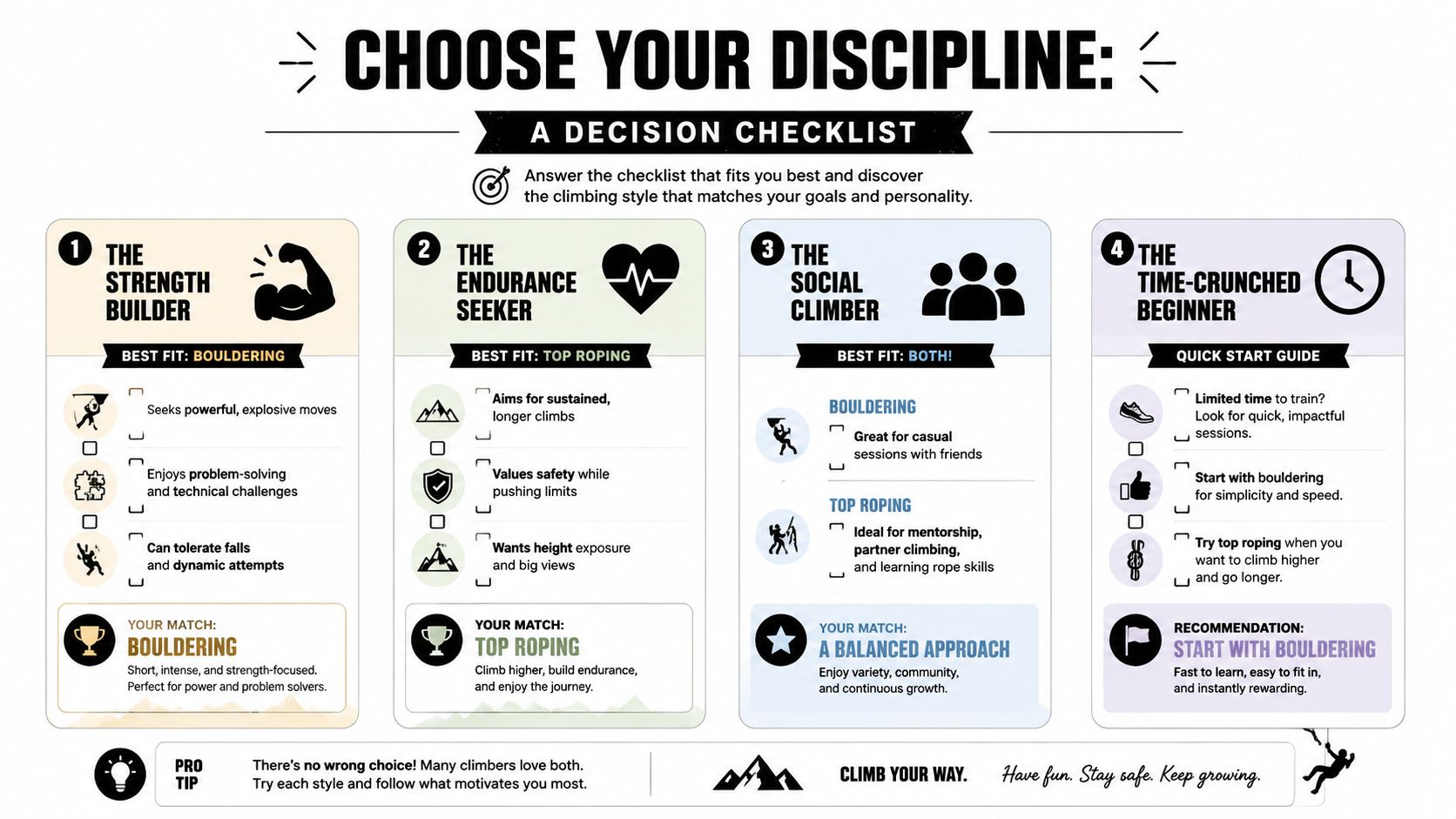
A simple weekly decision framework looks like this:
- Strength builder: Prioritize bouldering, with top roping for technique and low-intensity volume.
- Endurance seeker: Prioritize top roping, with selected bouldering for power maintenance.
- Social climber: Bouldering works well for shared problem solving. Top roping adds belay practice and longer partner-based sessions.
- Time-crunched beginner: Choose the format that your gym can support without rushed safety decisions. A focused bouldering session may be simpler, while a short top-rope session can be more productive if instruction and equipment are readily available.
Gear should support the plan. Bouldering calls for shoes, chalk, and a clean landing area. Top roping adds a properly fitted harness, an appropriate belay device, and a partner who understands the gym's procedures. If you're returning from an injury, choose the format that allows controlled intensity and clear stopping points rather than chasing a grade that forces compensation.
Gear Essentials and Grip Management Strategies
The equipment difference is straightforward, but the grip strategy requires more judgment. Bouldering sessions usually revolve around shoes, chalk, brushes, and safe landing practices. Top-rope sessions require shoes, a harness, a rope system, and a belay device, with the belayer's attention forming part of the safety system.
In either format, chalk should support friction without becoming a substitute for good movement. Dry your hands before a serious attempt, apply enough product to manage sweat, and avoid repeatedly coating already-dry skin. Excess chalk can build on holds and may make certain surfaces feel less predictable.
Build the session around grip quality
For bouldering, apply grip aid before a high-intensity attempt and reassess between problems. Clean holds when appropriate, keep brushes available, and treat the first sign of sloppy gripping as a signal to rest or end the hard portion. Repeatedly pulling through deteriorating hand position is how a productive power session turns into unnecessary finger stress.
For top roping, use rests on the route to shake out, breathe, and restore hand control. A small amount of chalk at a planned rest can be more useful than excessive application at the start. The goal is to arrive at the crux with usable grip, not to spend your best hand strength fighting every easy hold.
EVMT Liquid Chalk is one gym-approved option for climbers who want a fast-drying, low-mess grip layer. It dries in seconds, produces no dust clouds, and can be used alone or as a primer beneath loose chalk. Climbers comparing formulas and application methods can review liquid climbing chalk before choosing a product for bouldering or route sessions.
A clean setup also matters when a group documents training days, especially for clubs coordinating athletes and coaches. Tools such as EventUploader for sports clubs can help teams organize shared photos without turning the climbing session itself into a distraction.
The practical recommendation is simple. Choose bouldering for concentrated power and technical problem solving, top roping for sustained movement and endurance, and both when your recovery plan can support the combined workload. Keep the equipment clean, manage chalk deliberately, and end hard attempts when grip quality stops matching your technique.
Evermost LLC offers EVMT Liquid Chalk for climbers who need a fast-drying, gym-approved grip solution without powder clouds, whether they're working short bouldering problems or longer top-rope routes. Visit Evermost LLC to compare climbing-focused options and choose a format that fits your training setup.