


Best Gymnastics Grips for Performance and Safety
You're halfway through a release when the bar starts to slide. Your hands feel hot, the grip isn't sitting where it did during warm-up, and the next movement depends on letting go at exactly the right moment. That's when most gymnasts discover that the best gymnastics grips aren't necessarily the thickest, stiffest, or most expensive pair. They're the pair that fits correctly, matches the event, and still behaves predictably after repeated training.
A grip changes the way your hand interacts with the apparatus. It can protect skin, manage friction, and support a more consistent hold, but it can also shift, bunch, or interfere with release mechanics when the sizing or design is wrong. This guide connects grip construction with hand biomechanics, fit, break-in timing, replacement decisions, and chalk strategy, so you can choose equipment that holds up when pressure rises.
Why Gymnasts Wear Grips and What They Actually Do
A gymnastics grip has two jobs. It protects the hand from repeated abrasion, and it helps the gymnast maintain a stable connection with a moving apparatus. On uneven bars, high bar, and rings, the hand isn't just squeezing a stationary object. It's rotating, opening, closing, and absorbing changing loads while the body moves around the apparatus.
Leather and synthetic grips place a protective layer between the palm and the bar. Their finger channels help distribute shear away from vulnerable calluses, while the palm section reduces direct abrasion during swings, casts, and releases. They don't eliminate friction. They manage where that friction acts, which is why a grip that shifts or folds can create a new problem instead of solving the original one.
The bar still has to feel predictable
A grip also alters bar feel. A thin training grip may let an athlete sense the bar more directly during basic swings, while a stiffer competition-style grip can provide more structure during advanced circling and release work. Neither design automatically improves technique. The gymnast still has to learn how the hand closes over the bar and how the grip moves during each skill.
That learning process matters for younger athletes and developing routines. Coaches often pair grip practice with controlled drills, such as the youth sports practice drills collected by Vanta Sports, so athletes can build hand positioning before adding difficult release demands.
Practical rule: A grip should support the hand without taking over the hand's job.
The grip must stay aligned with the palm and fingers. If it's too loose, the material can bunch and increase rubbing. If it's too tight, the finger holes and wrist strap can restrict natural movement. Fit and timing therefore matter more than a logo on the strap.
Grips work as part of a system
Chalk, wristbands, tape, and callus care still matter. Chalk helps manage moisture, tape can protect vulnerable skin, and regular skin maintenance reduces rough edges that catch on the bar. Gymnastics guides describe grips as protective equipment that works alongside chalk rather than replacing it, particularly during high-repetition bar work (Gyminny Kids explains the relationship between grips and chalk).
The useful question isn't “Which grip is strongest?” It's “Which grip gives this athlete secure contact, enough hand feedback, and reliable release behavior for the work they perform?”
Main Types of Gymnastics Grips Explained
The four useful categories are leather, synthetic, dowel, and non-dowel grips. These categories overlap. A grip can be leather and doweled, or synthetic and non-doweled. Material influences how the grip molds and handles moisture. The dowel determines how the grip helps retain the hand on the bar.
Friction is the connecting idea. Research on hand friction shows that skin moisture, material, and surface texture can substantially change the coefficient of friction at the hand interface (biomechanics research on hand friction). A grip must therefore behave consistently at both contact points, between skin and grip and between grip and bar.
Leather and synthetic constructions
Leather grips offer a familiar, responsive bar feel. They gradually mold to the athlete's hand and can become comfortable with careful break-in, but they need protection from excessive moisture and careless storage. Leather also stretches, so a pair that fits well initially can become too loose if the finger holes and palm length aren't monitored.
Synthetic grips generally maintain their shape more consistently in humid or sweaty environments. Low-stretch constructions can suit athletes who want less material movement during repeated bar work. They may feel less naturally molded than leather, but that consistency can be valuable in a busy gym where conditions change across sessions.
Dowel and non-dowel designs
A dowel grip includes a rod inside the finger channel. The dowel can help the hand maintain a secure relationship with the bar during giants, long swings, and releases. That support comes with a responsibility. The athlete must understand how to open the hand and clear the bar, because a dowel that catches at the wrong moment can contribute to grip lock.
A non-dowel grip depends more on palm tension, hand position, and wrist-strap adjustment. It usually gives learners more direct feedback and can suit athletes who are still developing basic bar mechanics or working on rings where release behavior differs.
Buckle and hook-and-loop closures are fit choices, not automatic quality rankings. Buckles can provide a fixed feel, while hook-and-loop straps allow quicker adjustment. The right closure is the one the gymnast can secure consistently without creating pressure points.
| Grip Type | Material | Break-In Time | Bar Feel | Best For |
|---|---|---|---|---|
| Non-dowel beginner grip | Leather or synthetic | Usually shorter | Direct and tactile | Learners and basic bar skills |
| Dowel grip | Leather or synthetic | Depends on stiffness | Structured hold | Advanced high-bar and uneven-bar work |
| Leather grip | Natural leather | Gradual molding | Responsive and traditional | Athletes who prioritize feel |
| Synthetic grip | Low-stretch synthetic | Often simpler adjustment | Consistent across conditions | Sweaty or humid training environments |
For a more detailed comparison of construction choices and fit considerations, review this gymnastics grips comparison from EVMT. A simple decision rule works well: choose non-dowel for learning, dowel for advanced bar work under qualified coaching, leather for natural feel, and synthetic for consistent low-maintenance use.
How to Size Gymnastics Grips for the Right Fit
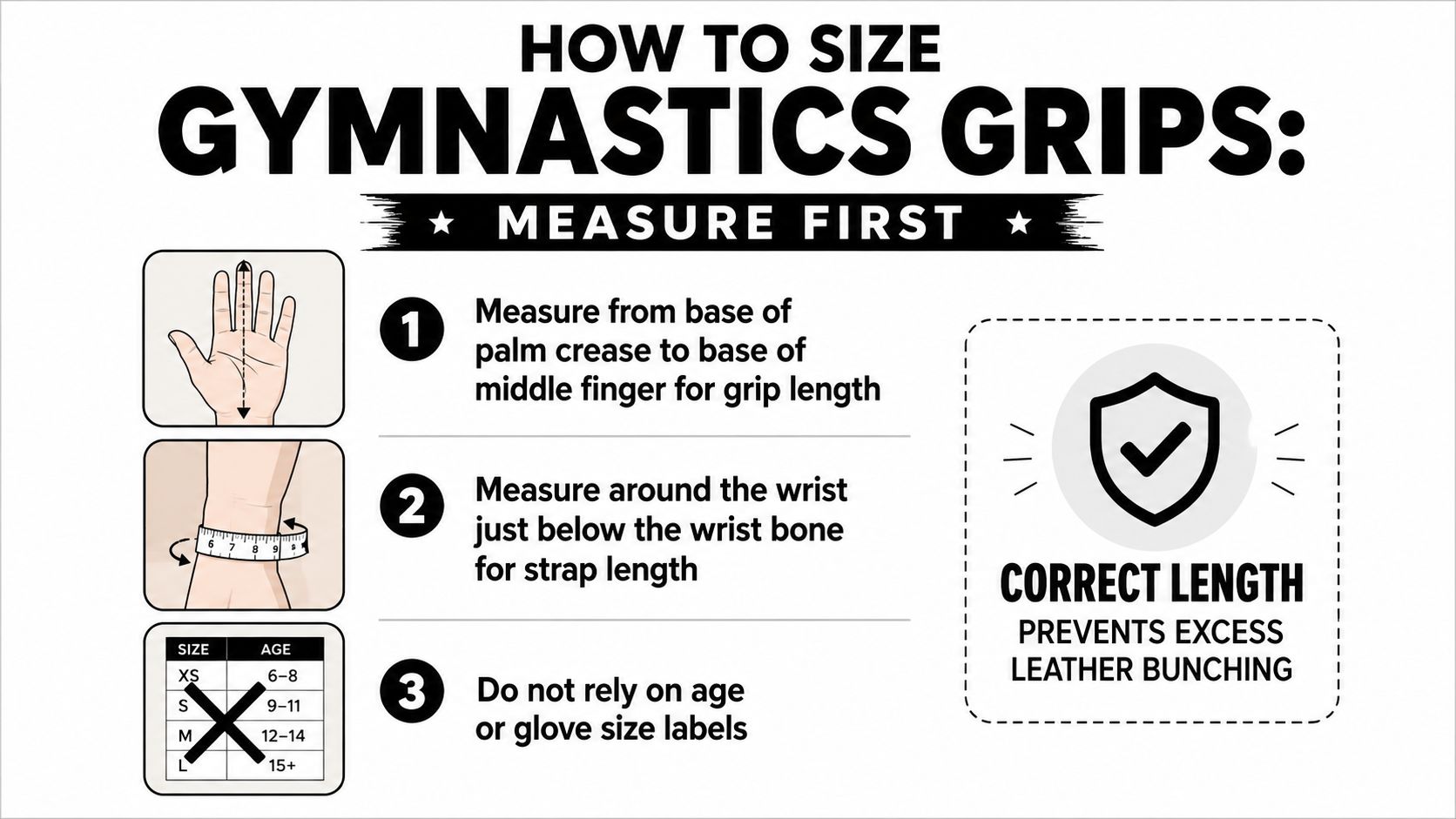
Don't size gymnastics grips by age, height, or ordinary glove size. Measure the hand, then compare that measurement with the specific manufacturer's chart. Grip patterns vary, and a label that fits one brand may not fit another.
Measure before adjusting
Measure from the base of the palm crease to the base of the middle finger for grip length. Some guides describe fingertip-to-palm measurement as the starting point, but the important practice is consistency. Use the same landmarks each time and follow the chart supplied with the grip.
Then measure around the wrist, just below the wrist bone. This helps you choose a strap with enough adjustment range to sit securely without compressing the wrist.
Finger holes should feel snug, not painful. The fingers should reach the bottom of their channels without forcing the leather to pucker. New leather holes are often intentionally close-fitting because leather stretches, but widening should be gradual and controlled.
Check the grip on the bar
Place the grip on the hand and position the palm guard so it follows the heel of the hand. The wrist strap should sit on the back of the wrist, and you should be able to slide roughly two fingers beneath the strap without losing stability.
An oversized grip can shift during giants, creating folds and uneven pressure. An undersized grip may pull at the finger joints and limit hand control. Don't test a new pair for the first time during a full routine. Use low-intensity swings, casts, and coached bar drills first.
Keep this checklist in your gym bag:
- Length: Does the palm section align without excess bunching?
- Finger reach: Do the fingers reach the channel bottoms comfortably?
- Wrist circumference: Does the strap have useful adjustment range?
- Strap tension: Is it secure without pressure or numbness?
- Bar test: Does the grip stay aligned during controlled movement?
Use the video below as a visual supplement, then confirm the final fit with your coach and the manufacturer's chart.
Grip Lock Safety and the Fit Trade-Offs Nobody Talks About
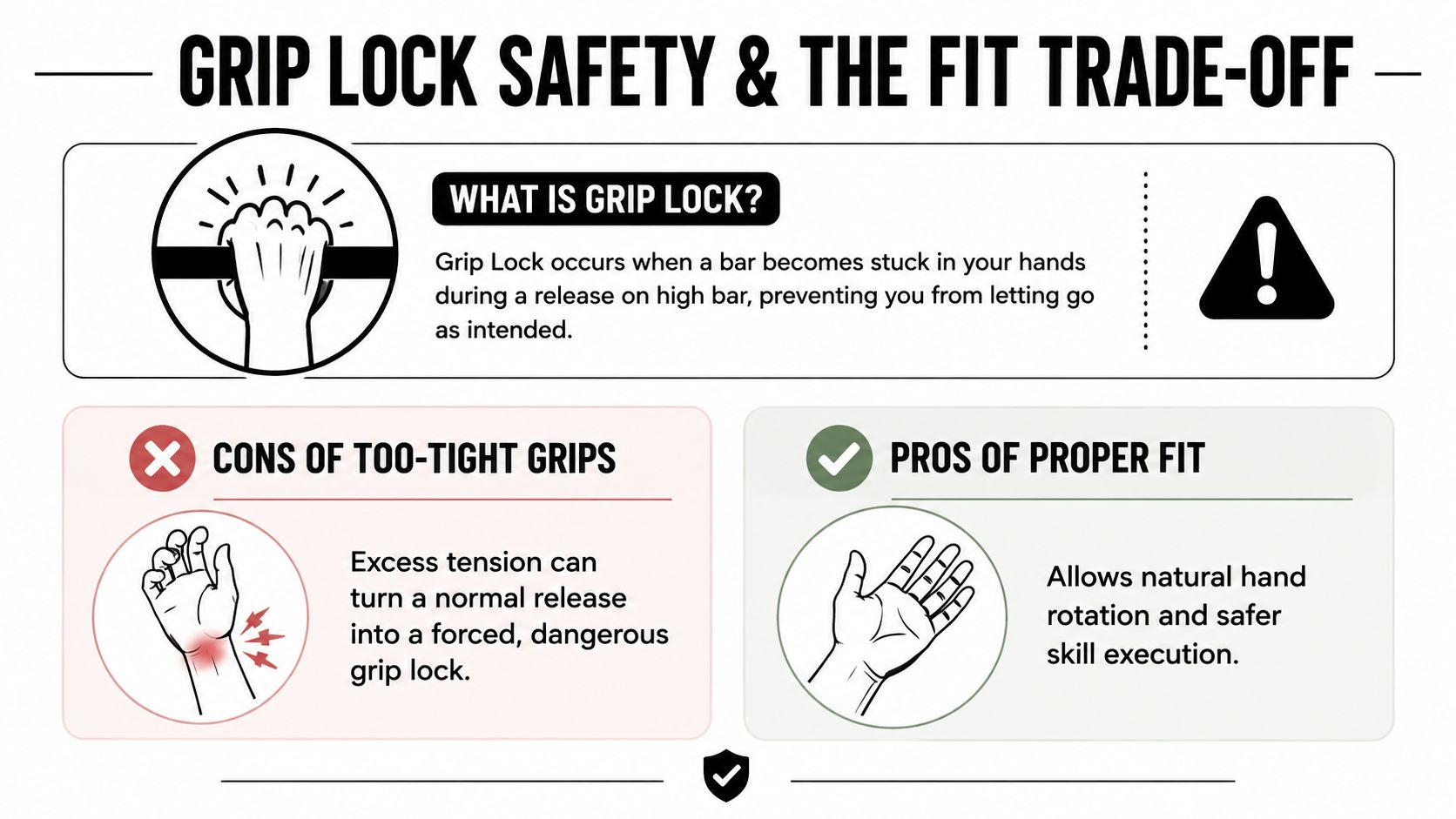
A stiffer grip doesn't automatically create a safer grip. More structure can help during advanced bar skills, but excess stiffness, excessive length, poor finger-hole placement, or a strap that restricts rotation can prevent the hand from releasing naturally.
Grip lock is a serious injury mechanism associated with dowel grips on high bar, rings, and uneven bars. Medical literature describes acute radius and ulna fractures in grip-lock injuries and notes that the mechanism is more common when grips are worn, stretched, or too large (medical review of grip lock).
Why dowel geometry changes the risk
The dowel helps retain the grip on the bar, especially when the athlete's hand is loaded through a swing. That same retention becomes dangerous if the fingers can't clear the bar during a release. A grip that has stretched, shifted, or become oversized may catch differently from a new, correctly fitted pair.
A 2023 systematic review found that 82.6% of gymnasts who sustained grip-lock injuries had used dowel grips (systematic review data on grip lock). This doesn't mean every dowel grip is unsafe. It means dowel selection, fit, break-in, coaching, and replacement deserve serious attention.
Medical guidance in that review recommends checking grip fit every 3 to 6 months and keeping an extra well-fitting pair available (the same medical review). A backup pair should be familiar and broken in, not newly opened before competition.
Recognize excessive tension
Red indentations, restricted finger-joint flexion, and delayed releases are warning signs. So is a gymnast changing hand position repeatedly because the grip feels trapped or difficult to open.
Beginners and low-repetition athletes often have less reason to accept the risks and demands of a rigid dowel. A soft leather non-dowel or a less restrictive design may offer better control while the athlete learns how the hand rotates around the bar.
A protective layer is useful only when the athlete can still release, rotate, and control the hand naturally.
Choosing Grips by Event and Training Style
The apparatus determines what the grip must tolerate. Uneven bars and high bar demand repeated swings and transitions. Rings create different pressure patterns during support and hanging work. CrossFit-style training may combine pull-ups, toes-to-bar, muscle-ups, and fast changes between movements, so a grip that feels secure during a static hang may become awkward during a rapid release.
Match coverage to movement
Uneven bars usually favor a relatively thin leather dowel grip for athletes performing advanced circling and release skills. Some gymnasts prefer finger-only coverage for more bar feedback, while others need a broader palm section as training volume rises.
High bar creates similar demands but often involves powerful swings and release timing. A dowel can support hand security, but the athlete must be fully comfortable with the release mechanics before using a stiffer design at speed.
Rings require a different compromise. A wider palm and reinforced leather or synthetic construction can protect the hand during repeated support and hanging work, but excessive material can interfere with transitions. Test the grip during controlled ring-specific movements rather than assuming a bar grip will transfer perfectly.
Still rings, muscle-ups, and high-repetition functional fitness often benefit from minimalist fabric or synthetic designs. These can reduce bulk during fast transitions, especially when paired with chalk and careful hand preparation.
| Event or Style | Recommended Grip Type | Coverage | Chalk Pairing |
|---|---|---|---|
| Uneven bars | Thin leather dowel for advanced work | Finger-only or moderate palm coverage | Loose magnesium for routine-specific preparation |
| High bar | Structured dowel grip after coached progression | Moderate to broad palm coverage | Chalk chosen for secure contact without caking |
| Rings | Reinforced leather or synthetic | Wider palm coverage | Chalk applied lightly to manage moisture |
| Muscle-ups | Minimalist synthetic or fabric | Low-bulk palm coverage | Liquid chalk can reduce mess during rapid transitions |
| CrossFit-style bar work | Synthetic or minimalist grip | Coverage based on release demands | Liquid chalk for portable, cleaner application |
Chalk can improve output under grip-demanding conditions. In one controlled study, athletes completed 11.1±5.1 repetitions with magnesium carbonate chalk compared with 9.1±3.1 without it, a 22.5% increase (controlled chalk performance study). Another study found that hand guards reduced perceived local pain during static hang tasks, supporting the value of protective equipment for comfort as well as friction management (hand-grip enhancement research).
Loose chalk works well when apparatus rules and gym ventilation allow it. EVMT Liquid Chalk is a cleaner option for sweaty training environments or shared facilities, where athletes want an even application without a powder cloud. Competition rules still control the choice. In women's artistic gymnastics under USAG settings, chalk isn't permitted on the vault table or runway, and chalk on the hand-placement mat must be removed by the end of the rotation (USAG women's rules). International Gymnix's combined manual permits chalk on uneven bars and small chalk markings on balance beam, but prohibits spreading magnesia on the floor exercise mat and restricts chalk or tape on the vault table (International Gymnix manual).
Break-In, Care, and When to Replace Your Grips
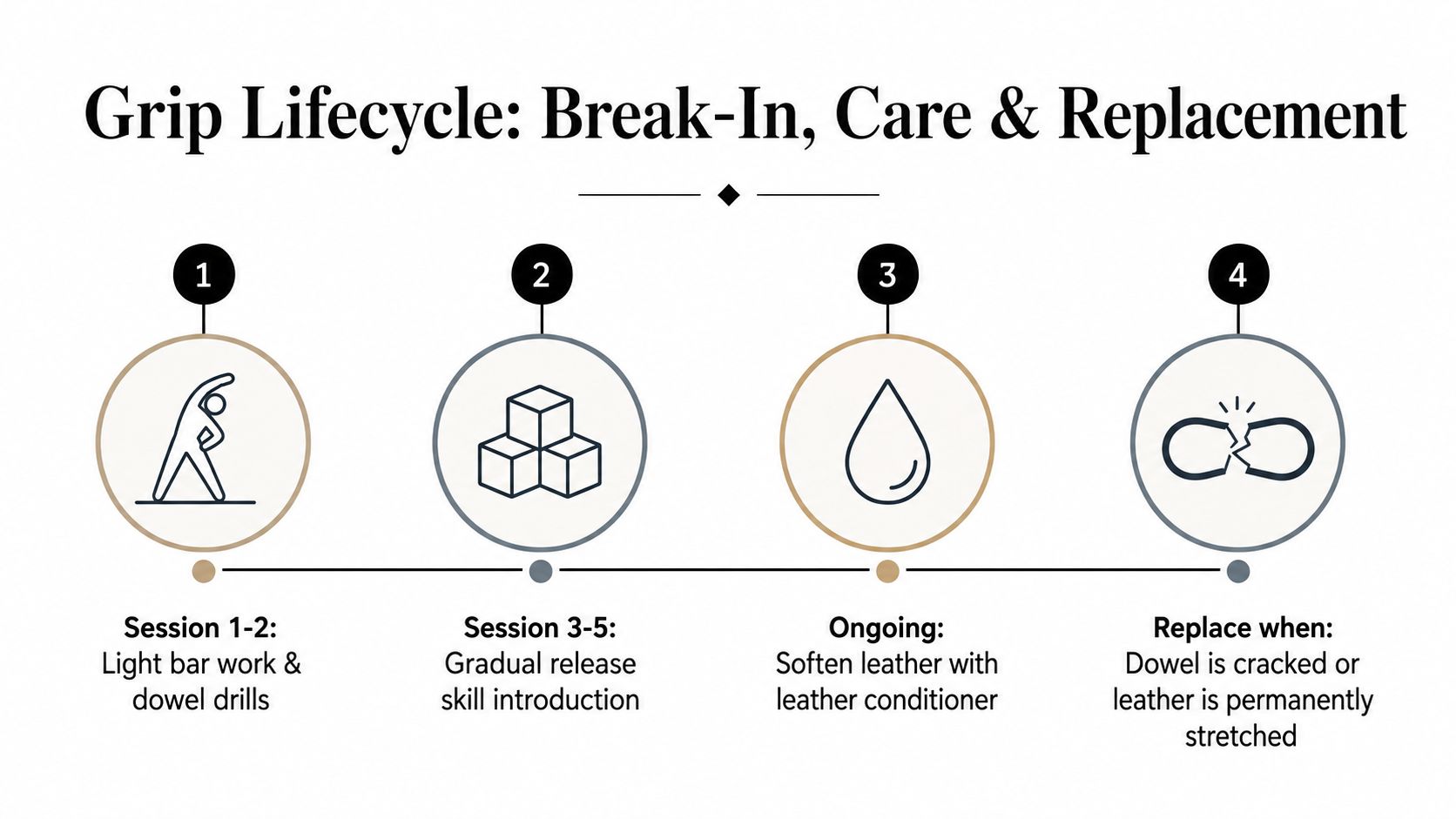
A new grip should earn its place gradually. Start with light bar work, not full-speed releases. The purpose of break-in is to let the material conform to the hand and bar while the athlete learns how the grip folds and opens.
Use a controlled three-to-five-session progression
During sessions 1 and 2, use easy swings, support holds, casts, and dowel-bending drills under coaching. Check whether the finger holes stay aligned and whether the palm section folds cleanly.
During sessions 3 through 5, introduce more demanding transitions and release preparation only if the grip remains predictable. Break-in recommendations commonly place this process at 3 to 5 sessions (GymnasticsHQ guide to gymnastics grips). Synthetic grips may need little more than careful finger-hole and strap adjustment, while leather needs gradual molding.
Don't soak leather. If you use a grip-conditioning product, apply it sparingly and follow the manufacturer's directions. Controlled moisture and gentle hand shaping are safer than saturating the material, which can weaken or distort it.
Maintain the surface and inspect the structure
After training, remove loose chalk, let the grips dry flat, and store them where air can circulate. Avoid leaving damp grips compressed inside a closed bag. A grip brush can remove caked residue, but aggressive brushing can also wear the working surface.
Rotate between pairs when your training schedule permits. Keep a familiar backup pair available for meets and high-pressure sessions. For related hand-protection practices, see this guide to gymnastics hand rips and prevention.
Premium leather grips may last 1 to 3 years with regular training, while budget options may last 6 to 12 months in high-volume use (grip durability and replacement guidance). Treat those as planning ranges, not guarantees. Replace the pair when you see cracking, thinning around finger holes, loose stitching, shifting dowels, worn closures, or permanent stretching. If the grip behaves differently from the way it did during its last safe session, retire it before a routine exposes the problem.
Pairing Grips With Liquid Chalk for Reliable Hold
Liquid chalk works best as part of hand preparation, not as a substitute for correctly sized grips. The aim is to create a more consistent surface between the palm, grip material, and apparatus, especially when sweat causes micro-slippage.
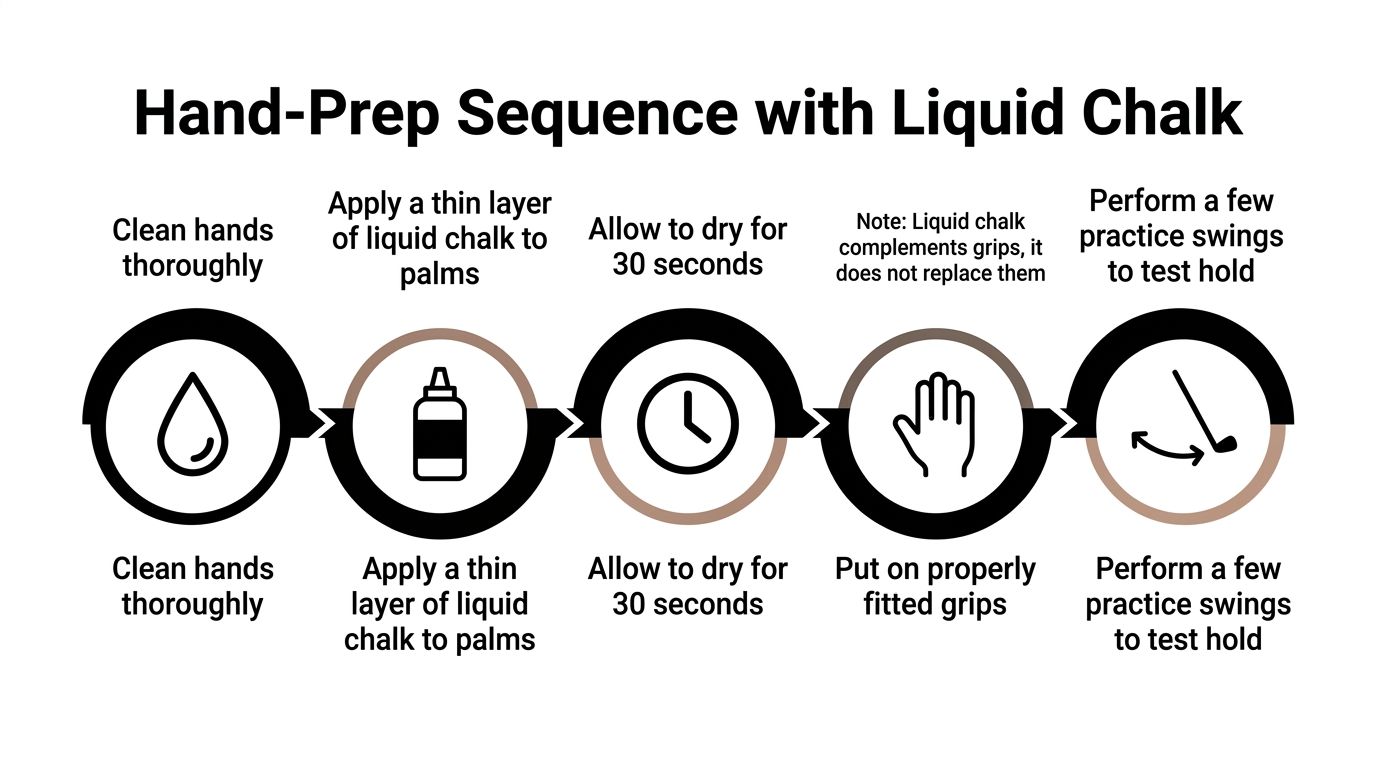
Start with clean, dry hands. Apply a thin, even layer of liquid chalk to the palms and the areas that contact the grip. Let it dry fully before putting on the grips. The result should feel dry and lightly textured, not thick or cracked.
A practical pre-set sequence
- Clean thoroughly: Remove old chalk, sweat, and skin oils.
- Apply lightly: Spread liquid chalk across the palm rather than creating a heavy patch.
- Allow it to dry: Wait until the film feels dry before fitting the grips.
- Secure the grips: Check finger reach, palm alignment, and wrist-strap tension.
- Test the hold: Perform controlled swings before starting the main set.
Liquid chalk forms a magnesium carbonate film that can reduce moisture at the hand interface. A peer-reviewed report found that magnesium carbonate powder improved handgrip dynamometer results compared with no chalk use in both hands and across genders (Gazzetta Medica Italiana report on magnesium carbonate). That supports a simple coaching observation: chalk isn't decorative, but more chalk isn't always better.
EVMT Liquid Chalk is one option for athletes who want a fast-drying, portable liquid formula alongside properly fitted leather or synthetic grips. It can be applied before the first set and reapplied when the film has worn away during a long session. Test the combination in ordinary training first, because different grip surfaces absorb, retain, or shed chalk differently.
For a more detailed routine, use this liquid chalk guide for gymnastics. Keep apparatus rules in mind, particularly for competitions where chalk may be restricted on specific surfaces.
Buying Checklist and Quick Answers for Smart Shoppers
A good purchase starts with fit, not color or brand recognition. Before ordering, confirm the grip's intended event, material, dowel design, closure, and adjustment range.
Pre-purchase checklist
- Finger holes: They should hold the fingers securely without pain, puckering, or restricted movement.
- Palm width: The guard should protect the working area without creating excess material at the wrist.
- Dowel choice: Select non-dowel for foundational work and dowel only when the athlete's skills and coaching support it.
- Closure: Check whether a buckle or hook-and-loop strap provides the most consistent adjustment for the athlete.
- Material: Choose leather for a molded feel or synthetic material for more consistent shape in sweaty conditions.
- Replacement plan: Inspect the pair regularly rather than waiting for a tear during training.
Should beginners wear grips? Not automatically. A beginner may benefit from a non-dowel design once bar volume, skin irritation, or coach-directed skill progression makes hand protection useful. The athlete should first be able to control the hand without relying on a dowel.
How tight should the wrist strap feel? Secure, but not restrictive. The grip should stay aligned while allowing natural wrist and finger movement. Red marks, numbness, or a delayed release indicate that the fit needs attention.
Do dowels suit smaller hands? They can, but the grip must be specifically sized and introduced under coaching. A narrower design may preserve bar feel, while an oversized dowel can create unnecessary retention and release concerns.
When should a pair be retired? Replace it when the leather cracks, finger holes stretch permanently, stitching loosens, the dowel shifts, or the closure no longer holds reliably. Wear matters more than age alone.
How should liquid chalk fit into a new setup? Apply a thin layer to clean hands, let it dry, then put on the grips and test controlled swings. Don't introduce new grips, new chalk, and a competition routine at the same time.
Measure your hand and wrist, select a grip construction from the comparison tables, and test the grip-and-chalk combination during a low-stakes training block before using it in competition. A measured, coached trial will tell you far more than a product label.
Evermost LLC offers EVMT Liquid Chalk for athletes who want a portable, fast-drying grip aid to use with properly fitted gymnastics grips in training or approved competition environments. Visit Evermost LLC to compare liquid chalk options and build a cleaner hand-prep routine around your apparatus, grip material, and training demands.