


Vertical Box Jump: Master the Technique Safely
The popular advice is simple: keep adding height to the vertical box jump. That advice is often wrong. A taller box can reward aggressive knee tucking and deep hip flexion instead of a higher takeoff, while a poor landing can turn a power exercise into a joint-loading problem.
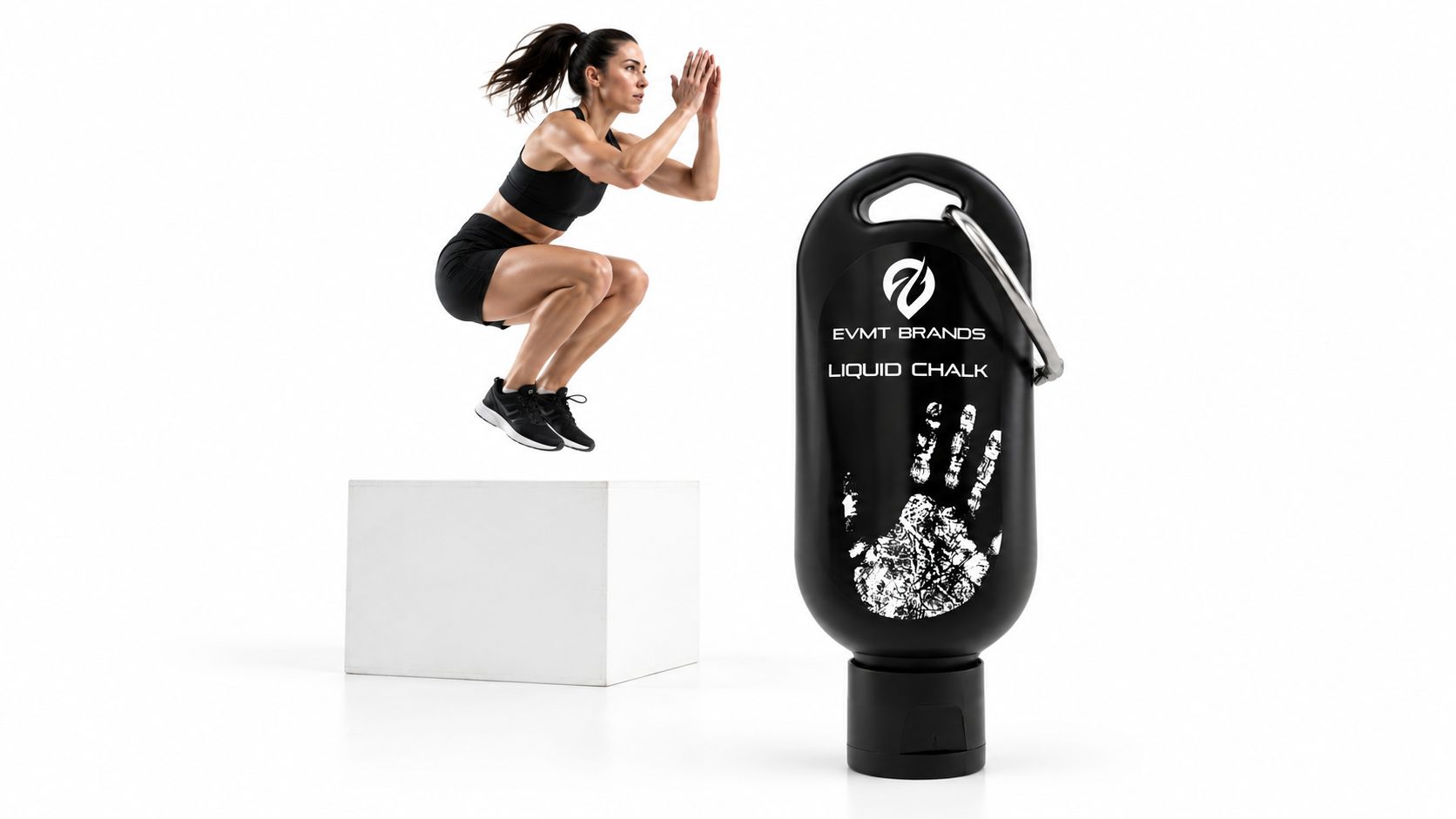
Grip still matters, especially for athletes moving between lifting, climbing, gymnastics, cheer, and pole work. Sweaty hands can make setup and support less reliable, while powder chalk can create dust or violate a facility's rules. A fast-drying liquid chalk can solve that practical problem without changing the standard for jump quality.
Table of Contents
- Why Your Box Height Might Be Wrong
- Proper Takeoff Mechanics
- Flight and Landing Sequence
- Progression Criteria and Programming
- Common Technical Errors
- Training Integration and Frequency
Why Your Box Height Might Be Wrong
A box-jump height isn't the same thing as vertical-jump height. The historical Sargent jump-and-reach test measures the difference between standing reach and the highest point reached during a maximal jump. A box jump measures whether the athlete can land on a raised surface, so the result also depends on how much the hips and knees flex during flight. The documented history of vertical-jump testing makes that distinction clear.
An athlete can therefore land on a high box without moving the center of mass proportionally higher. The body folds into a compact shape, the feet reach the platform, and the number looks impressive. The actual takeoff may have changed very little.
The misleading measurement
A box jump works well as a power exercise when the height encourages a forceful takeoff and a controlled landing. It works poorly as a standalone test of explosive ability when the athlete keeps raising the platform and compensates with more knee tuck.
| Metric | What It Actually Measures | Common Misinterpretation |
|---|---|---|
| Box-jump height | Takeoff plus landing position and joint flexion | A direct measure of vertical leap |
| Countermovement-jump height | Displacement from a fixed reference | The same result as clearing a box |
| Force-time data | How force and impulse develop | A simple height score |
| Landing quality | Balance, alignment, and control on contact | An optional detail after clearance |
A 2022 assessment of 543 NCAA Division I athletes from 15 sports found meaningful differences between men's sports and between women's sports, with both comparisons reported at p < 0.001. The reported movement-signature averages were 49.8 ± 10.2 during loading, 47.0 ± 9.9 during explosive transition, and 55.5 ± 10.2 during propulsion. Those findings support sport-specific interpretation, not one universal box target. The athlete dataset and its reported movement signatures also reinforce the need to standardize the testing setup.
Practical rule: If the box gets higher but the takeoff looks the same and the landing gets more folded, the score has improved more than the jump has.
Lowering the box can produce a more honest test. A fixed reference, a measured countermovement jump, or force-time information will tell a coach more about actual power than a platform that allows excessive hip and knee flexion. The tallest box cleared can be useful as an exercise milestone, but it shouldn't be treated as proof of superior vertical-jump performance.
Proper Takeoff Mechanics
The takeoff starts with a stable setup, not a frantic dip. Stand with the feet about shoulder-width apart, keep the toes slightly turned out, and let the knees stay soft. The hips should move back while the torso remains controlled, creating a loaded position from which the athlete can drive through the floor.
The arms provide meaningful momentum. Swing them back as the hips and knees load, then drive them forward and upward as the legs extend. The cue is to push the ground away, not to pull the feet toward the box. That intent helps coordinate the hips, knees, and ankles instead of making the knees do all the work.
Build force before leaving the floor
The trunk should remain organized through the dip. A collapsed torso leaks force and makes the takeoff less predictable, while an exaggerated forward lean can send the athlete into the box rather than up and onto it.
Use these checks before increasing height:
- Foot pressure: Keep the whole foot connected to the floor during the loading phase.
- Knee tracking: Let the knees follow the direction of the toes instead of falling inward.
- Hip extension: Finish the drive through the hips rather than cutting the movement short.
- Arm drive: Coordinate the arm swing with the leg extension, not after it.
- Grip control: If sweaty hands affect contact with a support, pole, or nearby surface during mixed training, EVMT LIQUID CHALK provides a magnesium-carbonate liquid layer for weightlifting, gymnastics, rock climbing, and sports.
A controlled takeoff doesn't require a long run-up. In many gym settings, a standing countermovement jump is easier to repeat and compare. If an athlete uses an approach, the approach must stay identical across trials, because extra forward speed changes the task.
The same principle applies when the box jump appears alongside posterior-chain work. Movement quality should remain the priority, whether the session also includes an exercise such as this reverse hyperextension on a bench. A jump performed after the athlete has lost trunk control isn't a productive maximal effort.
Flight and Landing Sequence
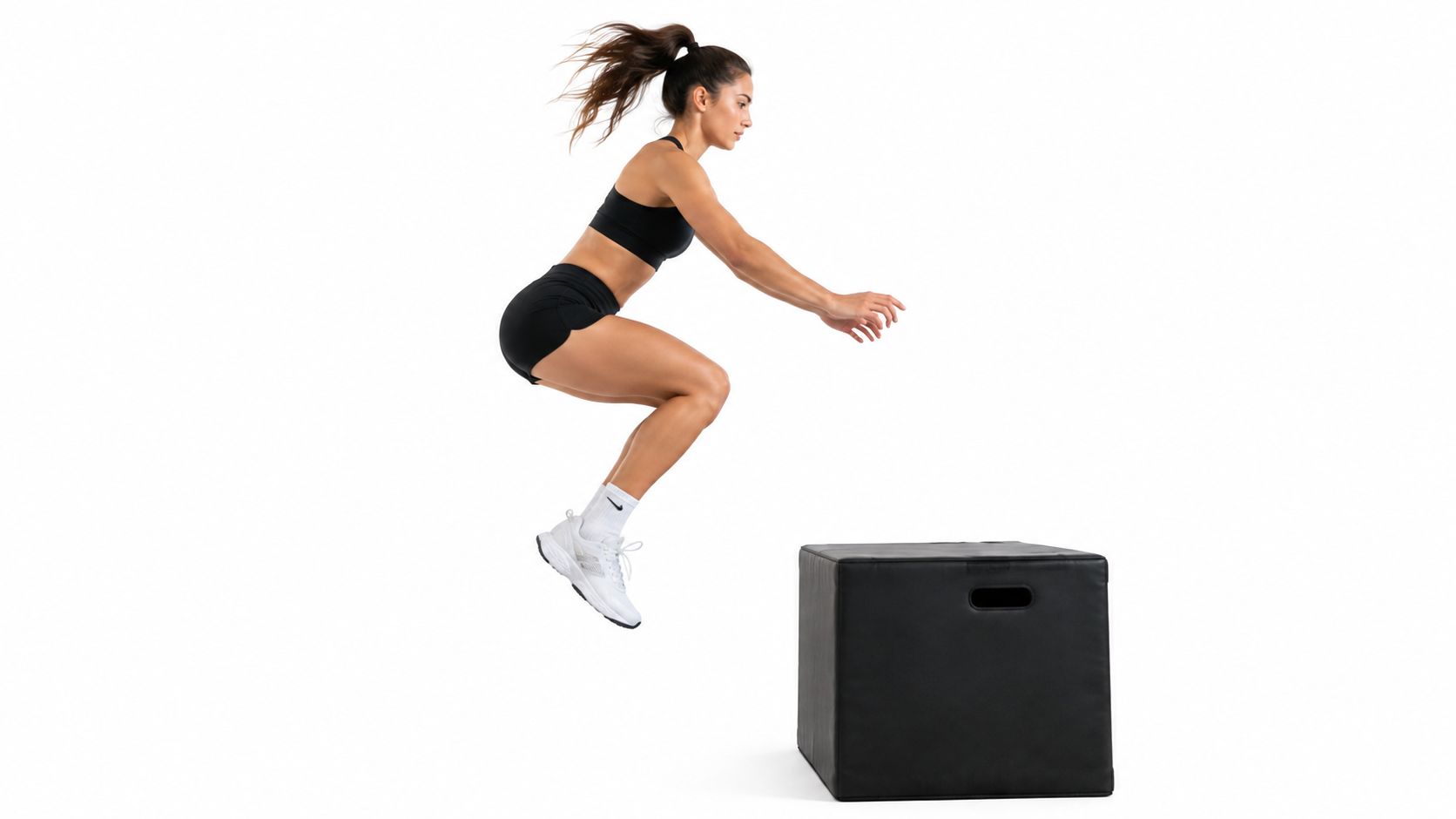
Once the feet leave the floor, the athlete needs enough tension to control the body without turning the jump into a tuck. Keep the trunk braced, maintain active hip control, and bring the feet toward the platform only as much as needed to land safely. The goal is to clear the box with a genuine takeoff, not to fold into the smallest possible shape.
The landing should be quiet and deliberate. Both feet should contact the box together, with the feet fully supported rather than reaching for the front edge. The knees should track over the toes, and the hips and knees should flex together to absorb force while the trunk stays controlled.
What a good landing sounds like
A quiet footfall doesn't mean a rigid landing. It means the athlete is absorbing force through the ankles, knees, hips, and trunk instead of allowing one joint or one side to take the full load. The weight should remain centered, and balance should be established before the athlete steps down.
Use a simple landing audit:
- Listen for impact. A loud landing often signals poor absorption or a height that exceeds current control.
- Check symmetry. Both feet should arrive together, with no visible shift toward one side.
- Watch the knees. Valgus, or inward collapse, is a reason to stop the attempt.
- Check the trunk. Forward collapse or lateral drift indicates that the athlete has lost control.
- Confirm full support. The feet shouldn't land partly on the edge.
A higher surface can increase landing demand even when the jump itself looks successful. In a controlled comparison of 30 cm and 45 cm landing boxes, the higher condition produced greater vertical ground-reaction forces and higher hip-abduction, knee-external-rotation, and ankle-internal-rotation moments, with especially increased rotational loading in the non-dominant limb. The landing-height comparison supports choosing the lowest platform that permits a powerful takeoff and repeatable landing.
Stepping down is usually the cleaner choice after a successful repetition. Jumping from the box adds another drop landing, which is a separate impact exposure and can compound fatigue.
Athletes who also train with knee support should understand that knee sleeves for a workout can't replace sound landing mechanics. A sleeve may change comfort or warmth, but it doesn't make an unstable or poorly chosen box safe.
Progression Criteria and Programming
Progression should be earned through repeatable execution, not tested through optimism. A technically controlled assessment can use a dynamic warm-up of 5 minutes of cycling, followed by two sets of five submaximal countermovement jumps onto approximately 15 cm and 30 cm boxes. Maximal trials can then use an arm swing without knee tucking during takeoff, with three successful trials at each relative height, approximately 30 seconds between jumps, and 1 minute of recovery after each height. The controlled box-jump protocol gives coaches a practical structure for reducing noise in the result.
The same research found that box height generally didn't change propulsive performance in recreationally trained men and women. That means a higher landing may reflect a different landing strategy rather than a more forceful takeoff.
Advance only when quality survives
Three clean repetitions are a useful gate. Each repetition should show a quiet, balanced landing, full foot support, consistent knee tracking, and no aggressive tuck. If one of those standards disappears, the current height is already challenging enough.
| Current Height | Required Performance | Progression Criteria |
|---|---|---|
| Comfortable platform | Forceful takeoff with stable landings | Repeat the same setup consistently |
| Challenging platform | Three successful trials without edge contact or balance loss | Reassess alignment and landing noise |
| Maximal test height | Fresh attempts with no compensation | Increase only if all quality standards remain intact |
A conservative progression can use increases of no more than 5 centimeters per step, followed by an immediate reassessment of landing quality. This isn't a rule for chasing a number. It's a ceiling on how quickly the landing demand changes.
For general athletic development, moderate boxes with crisp repetitions are usually more useful than repeated maximal attempts. The athlete should test when fresh, not after heavy lower-body fatigue. A coach reviewing broader movement quality can also use the principles discussed in this functional bodybuilding program resource, while keeping the box-jump standard specific to the athlete's actual landing performance.
Common Technical Errors
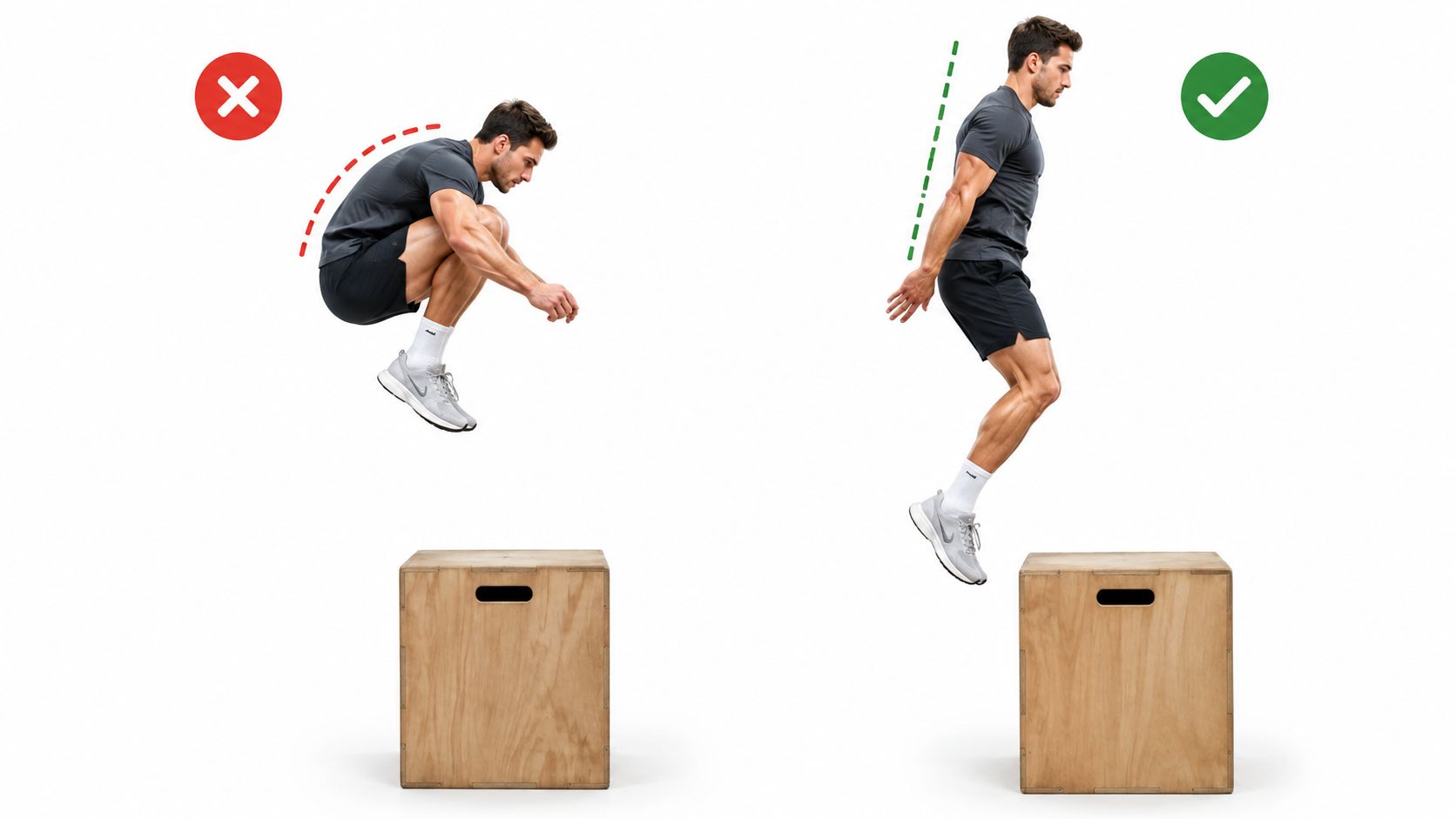
The most obvious failure is also the most misleading. An athlete reaches a high box by pulling the knees sharply toward the chest, then assumes the jump has improved. That strategy reduces the amount of true vertical displacement required while placing the athlete in a poor position for impact.
Error one, excessive knee tuck
Excessive knee tuck hides inadequate takeoff height and forces the athlete to land in deep hip and knee flexion. It can also shift the movement away from a clean power expression and toward a rushed, compressed landing.
The correction is straightforward. Lower the box, jump with a genuine maximal intent, and allow only the hip and knee flexion needed to land with the feet fully supported. If the athlete must visibly fold to reach the surface, the box is too high for a quality repetition.
Error two, edge contact
Landing close to the edge leaves little margin for error. A partial foot placement can make the ankle unstable, while a last-second reach often produces a loud, asymmetric landing.
The box should be low enough that the athlete can land in the middle with both feet. A coach should stop the set after repeated edge contact rather than treating each barely completed repetition as useful practice.
Error three, asymmetry and noisy impact
A shift to one side increases the chance that one limb absorbs more force. A loud landing, heel lift, knee valgus, or forward trunk collapse signals that the athlete isn't distributing impact through the full kinetic chain.
These aren't cosmetic faults. The higher landing condition in controlled research produced greater vertical ground-reaction forces and altered rotational joint moments, particularly on the non-dominant side. The published landing analysis provides a reason to treat asymmetry as a progression limit, not something to fix after the platform gets higher.
Stop signal: Loss of balance, inward knee movement, loud contact, heel lift, or a collapsing trunk means the repetition has ended, even if the athlete stays on the box.
Athletes building broader safety habits can consult this guide to staying injury-free for athletes, but no general checklist replaces an appropriately sized box and direct supervision when technique is deteriorating.
Training Integration and Frequency
The vertical box jump belongs near the start of a session, while the athlete can produce force and control the landing. It shouldn't become a conditioning drill performed after fatigue has already changed the movement.
A practical structure is 3 to 5 repetitions per set, with enough recovery to keep every attempt technically sharp. Many athletes can use 2 to 3 sessions per week, with 48 hours between sessions for recovery. Those figures should be adjusted for sport demands, other jumping exposure, and the athlete's ability to maintain quiet landings.
Sequence matters more than novelty
A session can begin with the warm-up and submaximal jumps described earlier, then move into the vertical box jump while the athlete is fresh. Strength work can follow, but high-volume box jumps shouldn't be stacked carelessly with heavy lower-body work when fatigue causes the knees to cave or the trunk to collapse.
The exercise also needs a clear role. A moderate box can provide repeated practice of forceful takeoff and controlled landing. A high box is better treated as an occasional test, not the default height for every session.
Sweaty hands can complicate mixed training, particularly for lifters, climbers, gymnasts, cheer athletes, pole fitness athletes, and home-gym owners who can't have powder dust. EVMT Liquid Chalk dries in seconds, makes no dust, and is designed as a magnesium-carbonate grip layer for settings where powder creates cleanup or policy problems. Climbers who already use loose chalk can apply a coat to dry hands, let it dry fully, then add powder as normal. The two-layer approach can last through more moves before re-chalking, which is more useful on long routes, multi-pitch climbing, or humid gyms than on short boulder problems.
Venue rules still control. The IFSC permits commercially available dry or liquid climbing chalk, defining chalk as magnesium carbonate, either pure or with additives, while prohibiting compounds whose principal active ingredient isn't magnesium carbonate or that alter holds or the climbing surface. The IFSC equipment code should be checked for current event requirements. Gymnastics rules can be more location-specific, including restrictions on bars, vault tables, runways, and residue removal, so liquid format doesn't automatically bypass a no-chalk rule.
Recovery should be judged by movement quality rather than a calendar alone. Athletes managing demanding schedules may find a biomarker-guided recovery plan useful for organizing recovery decisions, but the immediate coaching test remains simple: if the next session produces noisy or asymmetrical landings, reduce the demand.
Evermost LLC offers EVMT Liquid Chalk in single bottles and multi-packs for athletes who need clean, sweat-resistant grip during lifting, climbing, gymnastics, cheer, pole, or home training. Visit Evermost LLC to choose a liquid chalk option that dries quickly without a powder cloud, then keep the box height low enough that every landing remains controlled.