


Pole Grip Dry Hands Need Controlled Moisture, Not Dust
Bone-dry hands can still slip on a pole. Friction on skin peaks at moderate moisture, so the driest palm in the room is often the least reliable one. Very dry skin is a traction problem in its own right, and drying it harder makes the next attempt slide faster.
Standard grip advice treats sweat as the only enemy. That framing misses half the picture for anyone dealing with pole grip dry hands, because a palm wiped down to a papery feel has already moved past peak friction and keeps losing hold the drier it gets.
Sweaty hands are still common enough that no one should read a slip as personal failure. A 2016 U.S. population survey of hyperhidrosis estimated the condition affects 4.8% of the population, roughly 15.3 million people, with the hands involved in 40% of cases. Plenty of people arrive at a pole or a bar with palms that sweat unpredictably, while everyone else risks overcorrecting toward bone-dry skin.
The working method has three moving parts: read today's hand type accurately, set one thin film instead of stacking products, and stay inside whatever your studio or event permits on skin. The goal stays the same in every case: a thin tack film at controlled moisture, held there on purpose.
Table of Contents
- Why Dry Palms Still Slip on a Pole
- Match Your Hand Type Before Class
- How to Set a Thin Liquid Chalk Film
- Wipe and Wash Off Residue Safely
- What Studios and Competitions Allow on Skin
- Decide on a Thin Hand Film
Why Dry Palms Still Slip on a Pole
A towel-dried palm can still be the least reliable contact point on the body. The hands show no shine and no dampness, the pole is clean, and the climb attempt slides anyway. The next wipe makes the attempt after it feel worse.
That failure is mechanical. The finger-pad friction tests behind the moisture curve loaded skin against a surface across a wide range of forces, and moisture at the contact did most of the work. Bone-dry skin produces too little adhesion at the interface, while heavy sweat lubricates it. Grip peaks in the controlled zone between those extremes.
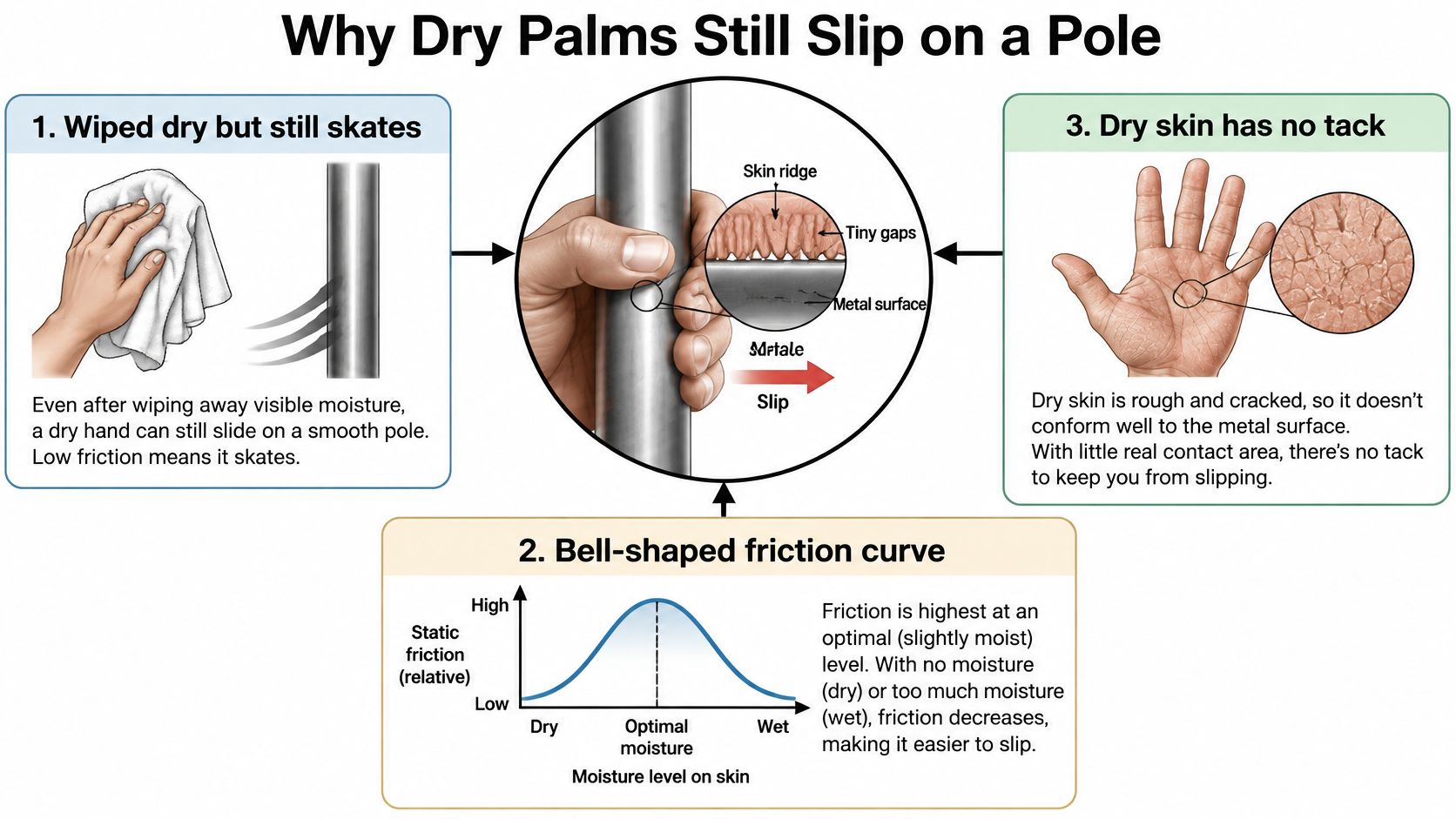
Paper on a polished steel rail behaves the same way. Bone-dry paper skates, slightly tacky paper catches, and soaked paper slides again. A palm that feels crisp and papery is the skin equivalent of that first sheet.
The contact patch is small and the load is not
A hold sends body weight and rotation through a narrow strip of palm or finger pads. For that contact to survive a spin, the skin has to deform slightly into the metal and stay seated against it. Smooth, stiff, glassy skin can't conform to the surface, so it skates across the pole instead of locking on.
Skin condition changes the measured numbers as well as the feel. A review of skin-friction research reports that wet skin produced friction coefficients more than twice those of natural skin in some material-contact tests, and that the palm averaged about 25% higher friction than the forearm, partly because of greater roughness and sweat-gland activity. High friction in a lab test still doesn't guarantee a reliable hold, because sweat softens the outer skin layer and can trigger a sudden slip once tangential force outruns adhesion.
Why a brief touch lies to you
The timing catches dancers out. A hand pressed against the pole seals moisture under the skin where it can't evaporate, so friction keeps climbing through the hold itself. A quick press feels secure. The same hand, deep into a sustained spin, is a different surface.
Test it the way you train. A fingertip tap proves nothing. Set the hold, hang your weight off it, and keep it loaded for the full length of a held pose. If the contact feels secure at takeoff and greasy by the end, trapped moisture changed the friction mid-hold, and a drier start won't fix that.
Strong hands don't settle the question either. A 2024 review of pole-dance research found pole athletes had significantly greater hand-grip strength than female weightlifters, volleyball players, swimmers and untrained women, while non-contact injuries made up 57.3% of reported injuries and the shoulder and wrist were the most frequently injured joints. Grip strength and grip contact are separate variables, and squeezing harder only trains one of them. The other lives in the thin film of moisture sitting between skin and metal.
Match Your Hand Type Before Class
Read the table once, find your row for today, and ignore the other three. Hands change with weather, hydration, nerves and what you washed them with that morning, so your row can move between classes. The row you land on today is the only one that matters for this class.
| Hand type | What you feel | Do this | Avoid this |
|---|---|---|---|
| Over-dry | Smooth, stiff skin that skates with no visible sweat | Clean off residue, restore flexibility, then a small tack film | More alcohol, antiperspirant or repeated drying |
| Sweaty | Slick palms during a sustained hold or spin | Wipe visible sweat, one thin even coat, reapply only when slick | Heavy wet layers and stacked product |
| Oily | Shiny palms from lotion, sunscreen or old residue | Wash before class and keep oils many hours from contact | Moisturizer in the minutes before gripping |
| Cold | Pale, stiff hands in a cool or arid studio | Warm hands first, then a thin coat on flexible skin | Assuming cold skin is already grip-ready |
The over-dry row deserves its own heading
The standard fix for slipping hands is a stronger drying product, and on this row that instinct does real damage. Very dry skin turns smooth and stiff, losing the flexibility that lets a palm wrap and conform to the pole's curve. A stiff palm behaves like an old rubber band dragged across glass: the hardened surface skates where a supple one would grab.
The order of operations that works runs opposite to the drying instinct. Clear oil and old residue off the skin first, keep lotion away from the window before contact, then lay a small amount of a tack-enhancing aid on flexible skin. Adding another round of drying at that point treats a moisture problem the hands don't have.
There's a point where repeated drying stops helping entirely. Alcohol-heavy products used session after session can leave palms cracked, peeling, red or sore, and a damaged surface grips worse than a dry one ever did.
Sweaty, oily and cold hands behave differently
Wet palms have real moisture, and a thin drying film plus a wipe handles it. This row can also be more crowded than it looks. Clinical reviews of hyperhidrosis, the medical term for excessive sweating, describe it as a recognized condition affecting a measurable share of adults, so a slick-handed classmate may be managing physiology.
Oily palms are a residue problem. Hand cream, sunscreen, massage oil and yesterday's product all leave a film that no grip aid can cut through, and the fix is a wash rather than another layer. Cold hands are a circulation and flexibility problem first. Warm them, move them, get blood into the fingers, and only then decide what goes on the skin.
The class-day sequence
- Wash with a plain soap to strip oil, sunscreen and the remains of the last session, then rinse thoroughly so no soap film of your own is left behind.
- Dry completely, including between the fingers and around the nails, before anything touches a grip product.
- Moisturize on your own time, meaning after training or many hours before it, never in the minutes before you grip.
- Patch test new products on a small patch of palm before a full class, and stop if the skin stings or reddens.
Stop signal: if palms crack, peel, stay red or feel sore between sessions, pause the alcohol-heavy dryers and antiperspirants for a week or two. Persistent skin trouble belongs with a clinician, not with a stronger grip product.
One more distinction saves a lot of confusion. Body grip products and hand grip products sit in different categories, and something formulated for thighs and knees may not be intended for palms at all. Keep them separate unless the label and a patch test both say otherwise.
For a symptom-by-symptom walkthrough, this dry grip routine for hands covers the same decision tree in more detail.
How to Set a Thin Liquid Chalk Film
Once the row is settled, the mechanics are short. A liquid magnesium-carbonate film works as a controlled tack layer, not as a coating you build up until the pole feels sticky.
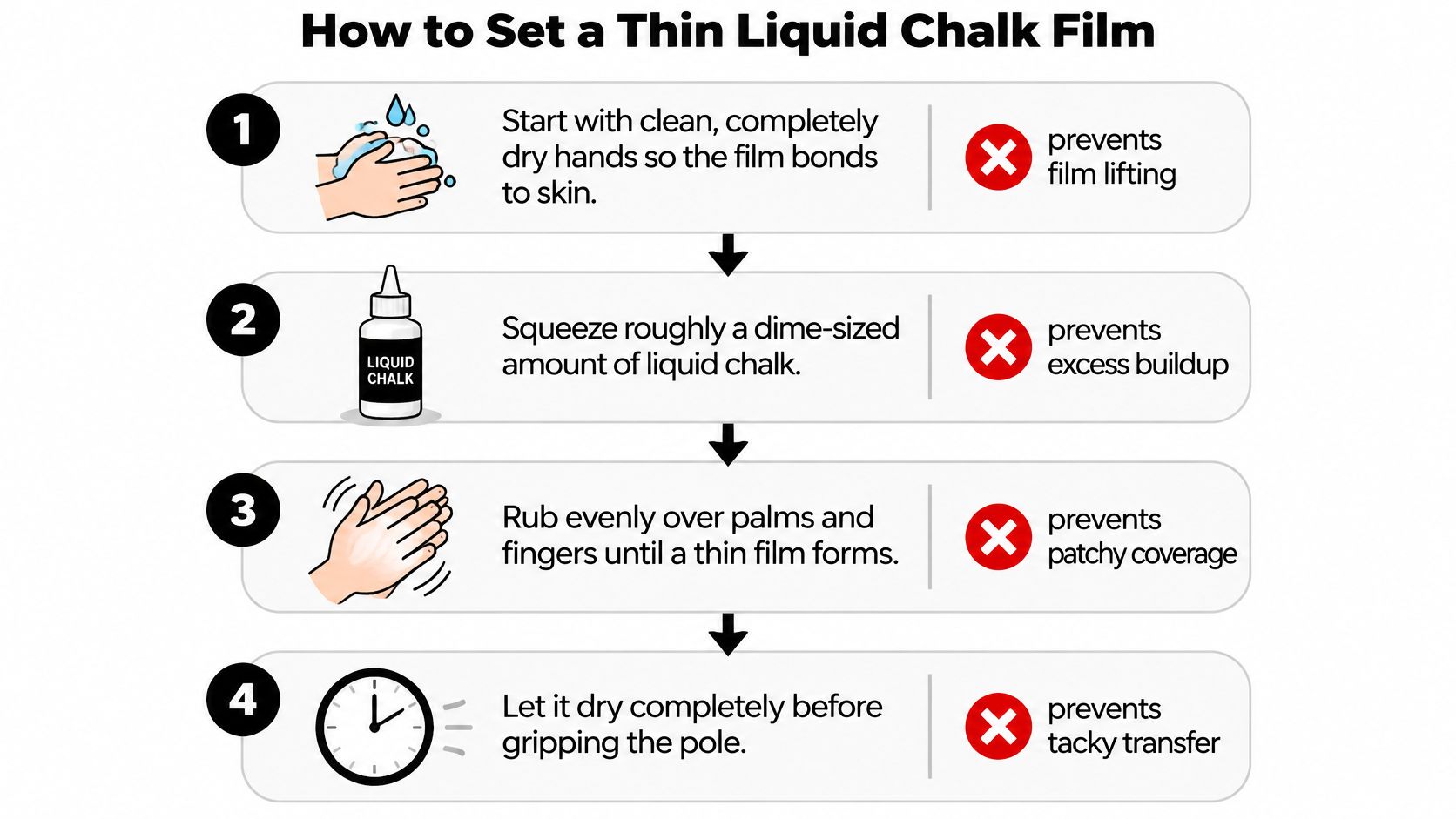
- Start with clean, completely dry hands. A film laid over residue lifts in patches instead of bonding to the skin, and those patches are exactly where the slip starts.
- Squeeze roughly a dime-sized amount into one palm. More than that builds a paste that never sets evenly, and the excess ends up on the pole rather than on you.
- Rub a thin, even coat across the palms and the fingers that meet the pole. Skip the backs of the hands. Patchy coverage creates alternating sticky and slick zones that feel unpredictable mid-spin.
- Wait until the layer is fully dry before gripping. Putting a wet coat on the pole smears product onto the apparatus instead of leaving it on your skin, which is both a grip failure and a cleanup problem.
- Test with a sustained hold like the one you'll train that day, not a quick tap. The friction curve shifts over the first half minute of contact, so the test has to last about as long as the planned sequence.
- Reapply a small amount only when contact goes slick. One set layer beats repeated heavy coats, which can change how the skin reads the metal and blur the feedback you rely on for control.
The application details matter as much as the product choice. Guidance on how liquid chalk differs from block chalk recommends clean, fully dry hands, roughly a dime-sized amount, a thin even coat, and a full dry before gripping, because a wet application transfers onto the apparatus.
For pole, lifting, climbing and gymnastics, EVMT Liquid Chalk is built as that fast-drying hand preparation step: apply sparingly, let the magnesium-carbonate layer set, test the hold, and keep the product off the pole itself. Whether it's permitted on your studio's equipment is a separate question, answered by the venue rather than the bottle.
Wipe and Wash Off Residue Safely
Cleanup on a liquid chalk is a wipe, not a deep clean. The film sits on skin, so the residue question is mostly about the few grams that transfer to the metal during contact. Four steps cover almost every case.
- Wipe the pole with a clean cloth after each athlete. Left alone, transferred film builds into a dull layer that behaves inconsistently from one section of the pole to the next.
- Wash hands with soap and water after training so no film carries into the next session, where it can react badly with a fresh application.
- Check that residue comes off inside the event's cleaning window. If it takes more scrubbing than that, the amount was too heavy or the product was wrong for that surface.
- Keep liquid chalk off bars, poles and shared mats. It goes on skin only. Skin is where the film belongs, and equipment surfaces are where it causes problems.
The contrast with loose powder is the dust. A set liquid film doesn't throw a cloud across the room, so cleanup is one damp cloth on one apparatus rather than a shared-space sweep. Home-gym owners who can't tolerate dust get the same benefit in a smaller room.
Timing explains most transfer complaints. A fully dried film stays put. A wet coat smears onto the metal the moment it touches it, which is why the drying step isn't optional.
Wash with something mild rather than a stripping bar, since hands that grip metal several times a week don't need to be scrubbed raw. This guide to mild surfactants in daily shower cleansers explains why gentle formulas clean without leaving skin tight and dry, and the same logic applies to what you use on your palms after class.
If a session ends with a visible haze on the pole, this walkthrough on removing liquid chalk residue covers the cloth-and-water method in order.
What Studios and Competitions Allow on Skin
Rules separate the athlete from the apparatus, and that distinction decides everything about how you use a grip aid on a pole. International pole sport rules allow grip products on the athlete's skin while keeping them off the pole itself. Transferred residue has to wipe off inside the event's cleaning window, and anything that stays put can cost points; a prohibited product can end the run entirely.
Read those rules together and the compliant method writes itself. Product goes on clean hands. It dries fully. The pole gets wiped afterward. Anything else puts points at risk.
Other sports police where chalk lands just as tightly. The chalk rules gymnastics applies to each apparatus keep magnesia off the vault table, allow it on a hand-placement mat only if the markings are gone by the end of the rotation, and keep it off the runway. Loose powder spreads across a room. A thin set film stays on the hand, which is exactly what these rules are checking for.
The audience for this is large. PoleCon 2024 drew approximately 1,425 attendees, exhibitors and workshop leaders across the weekend, and every athlete in that building trained under some venue's grip policy.
Confirm the rule before the session starts. A boutique studio can be stricter than a federation, and equipment finish matters too, since chrome, brass and powder-coated poles respond differently to the same film.
Practical check: if the dried film won't wipe off the pole inside the event's cleaning window, the amount was too heavy or the product was wrong for that event.
Decide on a Thin Hand Film
Over-drying is easy to mistake for readiness. Skin stripped of moisture can skate on chrome just as badly as sweaty skin, so the target is controlled moisture under a thin tack film. From there the decision collapses to two questions: does today's hand condition call for a tack layer, and does the venue allow hand-applied liquid chalk?
Say yes when the hand is over-dry or sweaty, the studio or event permits a magnesium-carbonate product on skin, and the athlete will keep the coat thin and let it dry completely. EVMT Liquid Chalk comes in 50 ml portable bottles and 250 ml high-volume sizes, dries in seconds, produces no dust and leaves minimal residue on equipment once dry, which suits pole athletes, gym lifters and home-gym owners who can't have powder in the air.
Three cases rule it out. A venue that bans all chalk gets a clean-hands session, with no case argued on the day. Oily hands need a wash and better moisturizer timing rather than another layer on top. A studio that bans liquid chalk on skin specifically sets the product list, and whatever that studio approves is what goes in the bag.
Reviews suggest the thin-film approach reads well on skin too. One reviewer noted the chalk "doesn't dry out my hands after use", and another said it lasted through a full dance routine without drying their hands out. Both comments point at the same quality: a set film that holds the skin at working moisture instead of stripping it further.
Before class, run the short version:
- Pick today's row from the four hand types and act on that one.
- Confirm the studio or event rule on hand-applied chalk.
- Apply only to skin, never to the pole or a shared surface.
- Wipe the pole after use, inside whatever window the venue sets.
- Patch test anything new on a small patch of palm first.
Evermost LLC makes EVMT Liquid Chalk, a magnesium-carbonate liquid chalk for pole athletes, lifters, climbers, gymnasts and anyone whose hands sweat or skate through a session. It dries in seconds, leaves no dust in the room, and leaves minimal residue on equipment and apparel once dry, which fits studios and home gyms that restrict powder. Visit Evermost LLC to compare the 50 ml and 250 ml sizes before your next class.