


Latex Free Athletic Tape: What to Know Before You Buy
An athlete tapes an ankle before training, gets through the session, then notices an itchy red patch hours later. It's easy to blame latex, but the tape's adhesive, trapped sweat, friction, or removal can also irritate skin. Knowing what the label does and doesn't promise helps athletes choose more carefully and respond safely if a rash appears.
Latex-free tape addresses one specific concern: contact with natural-rubber latex. It doesn't guarantee that every ingredient will suit every athlete. For people who tape repeatedly, checking the adhesive and backing matters alongside checking for latex.
Table of Contents
- Why Latex Free Athletic Tape Matters
- What Latex Free Really Means
- Common Materials in Latex Free Tape
- How to Choose the Right Latex Free Tape
- How to Apply Latex Free Athletic Tape Correctly
- Latex Allergy vs Adhesive Irritation
- Final Checklist for Sensitive Athletes
Why Latex Free Athletic Tape Matters
A reaction after taping can be unsettling, especially when the tape seemed fine during training. Natural-rubber-latex exposure can cause contact dermatitis and, in some people, a severe allergic reaction called anaphylaxis. The risk is relevant beyond medical settings: athletes, coaches, trainers, and gym staff may handle or wear tape repeatedly across training, competition, and rehabilitation.
A medical review reported that about 1% of the general population reports latex sensitivity, while blood-donor studies measuring anti-latex IgE antibodies suggested prevalence as high as 6%. Reported sensitivity among healthcare workers has ranged from 10% to 17%, and a separate review found immediate-type sensitivity in healthcare workers ranging from 2.9% to 12.1%. For people with extensive medical exposure, risk can be higher: reported prevalence among individuals with spina bifida has reached 68%. These figures come from a medical summary of latex sensitivity and exposure; they help explain why repeated contact deserves attention, even though they don't predict any one athlete's response (FDA guidance on natural-rubber latex labeling).
The FDA notes that people sensitive to natural-latex proteins may experience severe anaphylactic reactions. That's why latex labeling is a safety matter, not a product preference. A coach stocking tape for a team, or a trainer applying it to different athletes, should take the same care as someone choosing tape for personal use.
Practical rule: A latex-free claim can help someone avoid natural-rubber latex, but it can't tell them whether the adhesive or another ingredient will agree with their skin.
Athletes who've had a confirmed latex reaction should check the product specification before use, rather than guessing from the tape's color, feel, or intended sport. Anyone with a history of severe allergy should follow their clinician's advice when evaluating products that contact skin.
What Latex Free Really Means
The words on the front of a package don't always describe every material in the product. In the United States, the FDA established a labeling requirement in 1997 for medical devices and packaging containing natural rubber latex that contacts humans. The required warning is: “Caution: This Product Contains Natural Rubber Latex Which May Cause Allergic Reactions.” The rule covers the device and relevant packaging or components, and its definition includes natural-rubber latex, dry natural rubber, and synthetic latex or synthetic rubber formulated with natural rubber (FDA labeling guidance).
That history matters because “latex-free” can sound broader and more certain than a manufacturer can prove. In 2014, the FDA advised manufacturers to use “Not made with natural rubber latex” rather than unqualified claims such as “latex-free” or “does not contain latex.” The concern is that an overly broad claim could give someone with an allergy a false sense of security. For a useful product specification, the manufacturer should clarify whether the tape, adhesive, backing, and packaging were made without natural rubber latex.
Read beyond the front label
“Hypoallergenic” isn't a substitute for clear material information. It doesn't mean allergy-proof, and it doesn't identify which adhesives or other ingredients a product contains. A tape can be made without natural rubber latex and still cause irritation or an allergic contact reaction for a particular person.
For athletes and facilities, the practical question is not only whether the package says “latex-free.” It's whether the supplier's specification covers the parts that touch skin, including the adhesive and backing, and whether the answer is clear enough to guide a purchase. If the information is incomplete, asking the manufacturer is safer than assuming that a broad label covers every component.
Common Materials in Latex Free Tape
Latex-free tapes can use different backings and adhesives, and those choices affect stretch, hold, and skin contact. The backing is the material the athlete sees and handles, but the adhesive is often just as important when a reaction occurs. Neither a latex-free claim nor a particular backing material guarantees skin tolerance.
A 2025 survey of 80 athletic tapes found that rubber chemicals were the most frequently declared allergen category, appearing in 42.5% of products. Zinc oxide was declared in 18.8%, colophony or abietic-resin derivatives in 12.5%, and acrylates in 7.5%. Those figures describe declared ingredients in the surveyed products, not the chance that an individual will react (2025 athletic-tape allergen survey).
A separate analysis of 43,722 patch-tested patients identified 313 cases of medical-adhesive allergy. Among those cases, colophony produced positive reactions in 80.7%; carba mix and 2-hydroxyethyl methacrylate each accounted for 2.7%. This is a result among identified allergy cases, not a measure of risk for all tape users. It does, however, show why checking the adhesive's disclosed constituents can matter as much as checking the backing.
Compare performance separately from allergy claims
Material and mechanical specifications answer different questions. A documented latex-free cotton athletic tape specification reports tensile strength of 34 lbf/in (151 N/25 mm) under ASTM D1000 testing. A separately documented synthetic-rubber latex-free tape lists 43 lbf/in longitudinal tensile strength, 29 oz/in adhesion to stainless steel, and 10 mil total thickness; those latter values are manufacturer-provided and weren't independently verified (documented latex-free tape specification).
| Material or specification | Tensile strength | Adhesion | Best suited to |
|---|---|---|---|
| Cotton tape specification | 34 lbf/in (151 N/25 mm) | Not stated in the cited specification | Applications where a cotton carrier meets the support need |
| Synthetic-rubber tape specification | 43 lbf/in longitudinally | 29 oz/in to stainless steel | Comparing a listed synthetic-rubber specification with the required task |
| Acrylic adhesive | Not stated | Depends on the product | Assess only from the full product specification |
| Zinc oxide adhesive | Not stated | Depends on the product | Assess only from the full product specification |
Tensile strength measures resistance to pulling along the tape. It doesn't show whether tape will stay secure on sweaty skin during movement. Adhesion, skin moisture, surface cleanliness, wrap tension, and the direction of force all affect real-world fixation. Stronger adhesion may also make removal rougher on skin, so a higher number isn't automatically the better choice.
How to Choose the Right Latex Free Tape
A useful selection starts with the athlete, not the sport printed on the package. Someone with a known latex sensitivity needs clear confirmation about the materials; someone who has reacted to several tapes may need help identifying whether the adhesive, sweat, or another factor is involved. The same roll won't suit every skin type or every taping job.
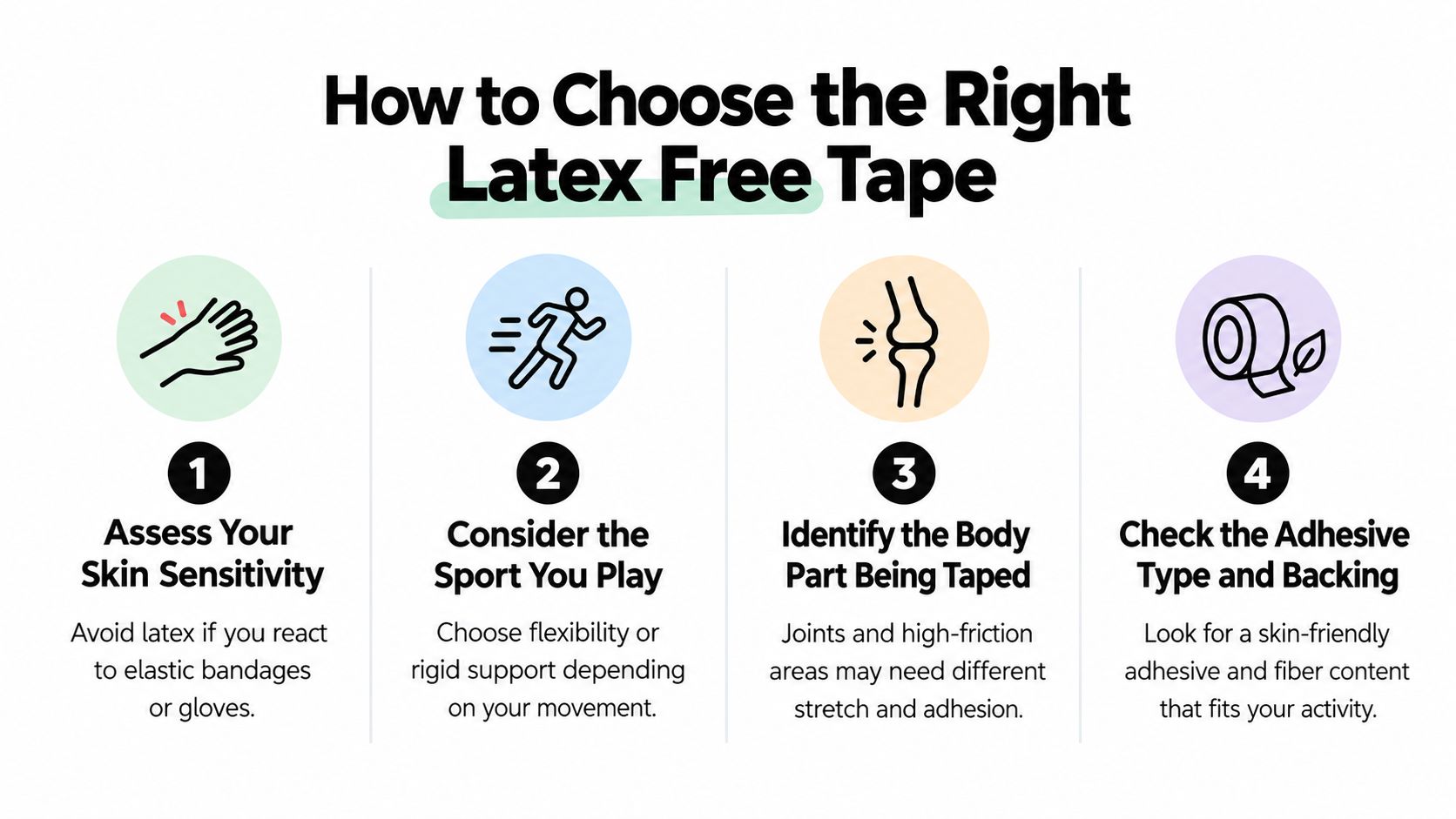
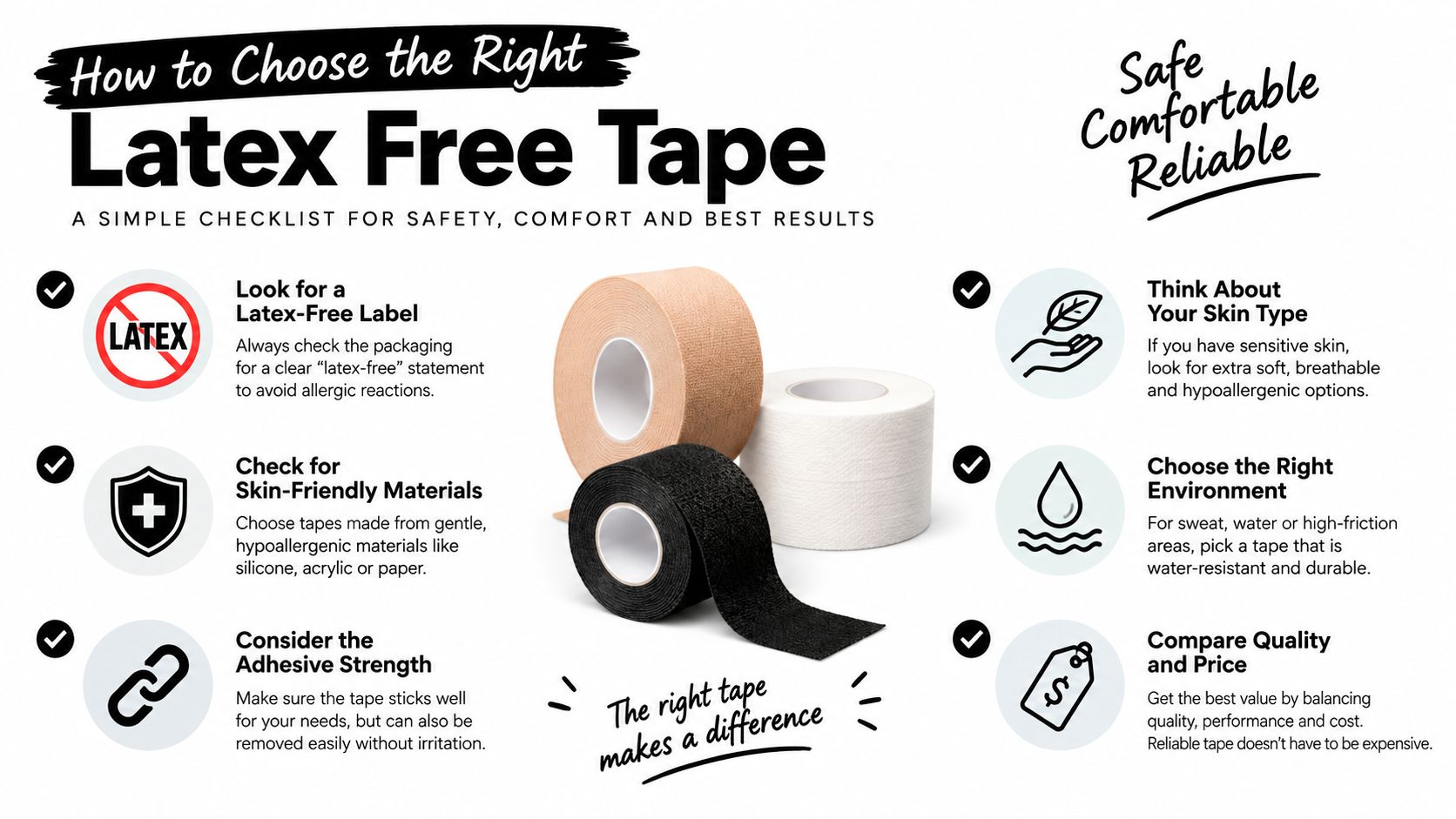
- Start with the skin history. Note any previous reactions to tape, adhesives, elastic bandages, or gloves. If a clinician has confirmed latex allergy, look for a manufacturer specification that says the product was not made with natural rubber latex and ask about any unclear components.
- Match the tape to the activity and body part. A moving joint and a high-friction area may call for different stretch and adhesion than a less mobile area. Consider how long the tape will be worn, whether the athlete will sweat heavily, and whether a clinician has recommended a particular support method.
- Read the adhesive and backing details. A latex-free statement doesn't identify every possible sensitizer. Check whether the manufacturer discloses adhesive constituents, and don't treat “hypoallergenic” as a guarantee of tolerance.
- Test cautiously before relying on it. If appropriate, place a small strip on intact skin and monitor it for 24–48 hours before wider use. Don't apply tape over broken or already irritated skin. Stop using it if burning, progressive redness, swelling, or blisters develop.
The right purchase also depends on the movement and equipment involved. For a sport-specific example of how athletes compare thumb tape by application, best bowling thumb tape options offers a focused reference. For broader context on good athletic tape, the key is to match the product's materials and support characteristics to the task rather than choosing from the label alone.
Tape isn't the right tool for every grip problem. For sweaty hands during weightlifting, climbing, gymnastics, or sport, EVMT Liquid Chalk is a magnesium-carbonate grip aid described for those activities; it addresses hand grip rather than providing joint support.
How to Apply Latex Free Athletic Tape Correctly
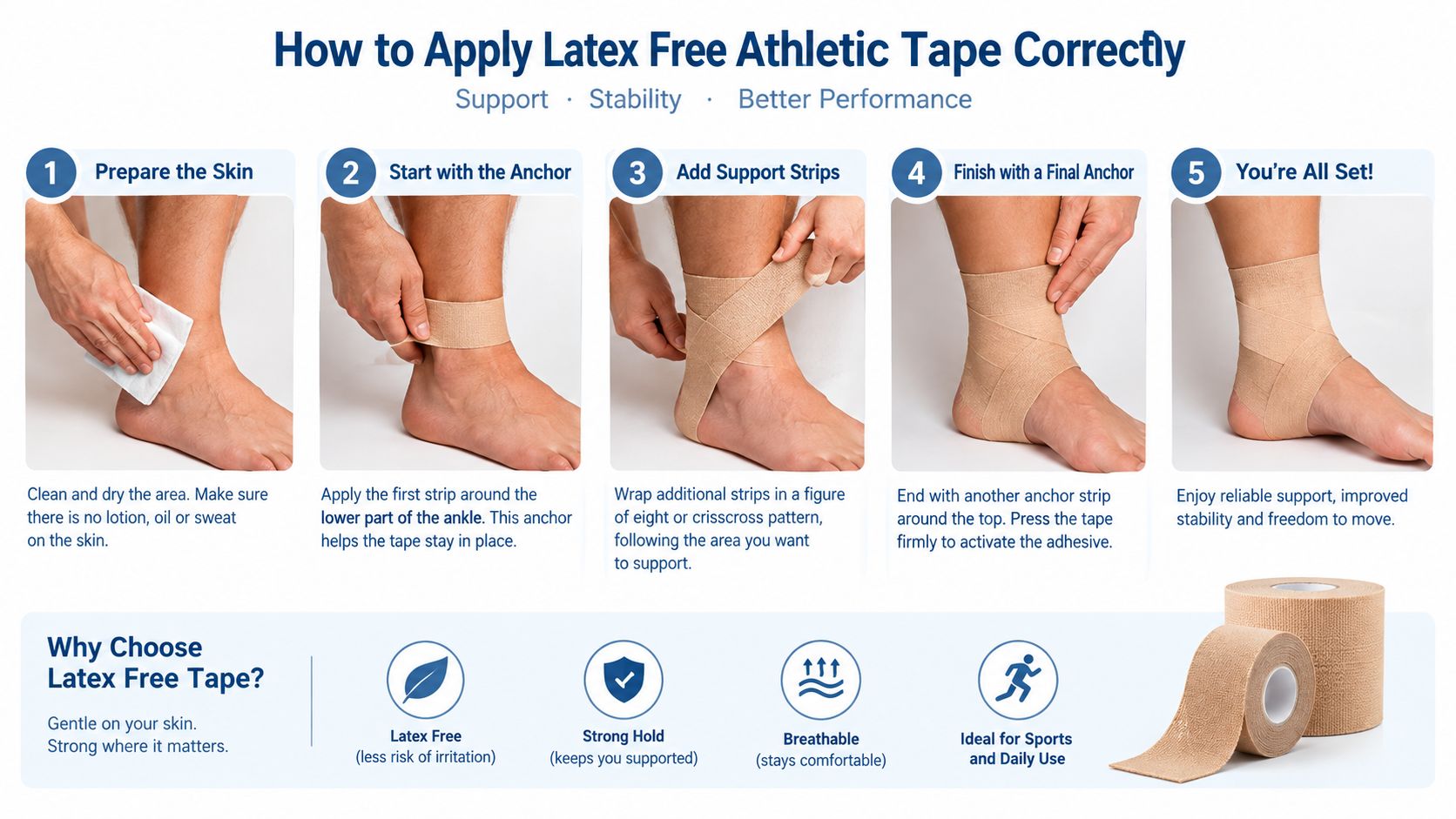
Good application can help tape hold as intended without adding unnecessary stress to the skin. Before taping, clean the area and let it dry fully. Lotion and oil can interfere with adhesion, while sweat left on the skin can make the result less predictable.
Apply with steady, moderate tension
Begin with an anchor that sits securely without pulling the skin tight. Lay the tape in a consistent direction and overlap each pass evenly, rather than stretching it hard to force a tighter hold. Excessive tension can create pressure and friction, especially around a limb.
When tape wraps all the way around an arm, leg, or digit, avoid making the wrap constrictive. After application, check the skin beyond the taped area for normal color and warmth, and ask the athlete whether sensation feels normal. Remove or loosen the tape if circulation, sensation, or skin color changes.
Application check: The tape should feel secure, not numb, painful, or increasingly tight.
A clean, dry surface and moderate tension won't prevent every skin reaction, but they reduce avoidable sources of irritation. Don't tape over damaged skin, and remove the tape if burning, spreading redness, swelling, or blistering appears. For additional context on tape and hand comfort, see this guide to athletic tape for hands.
Latex Allergy vs Adhesive Irritation
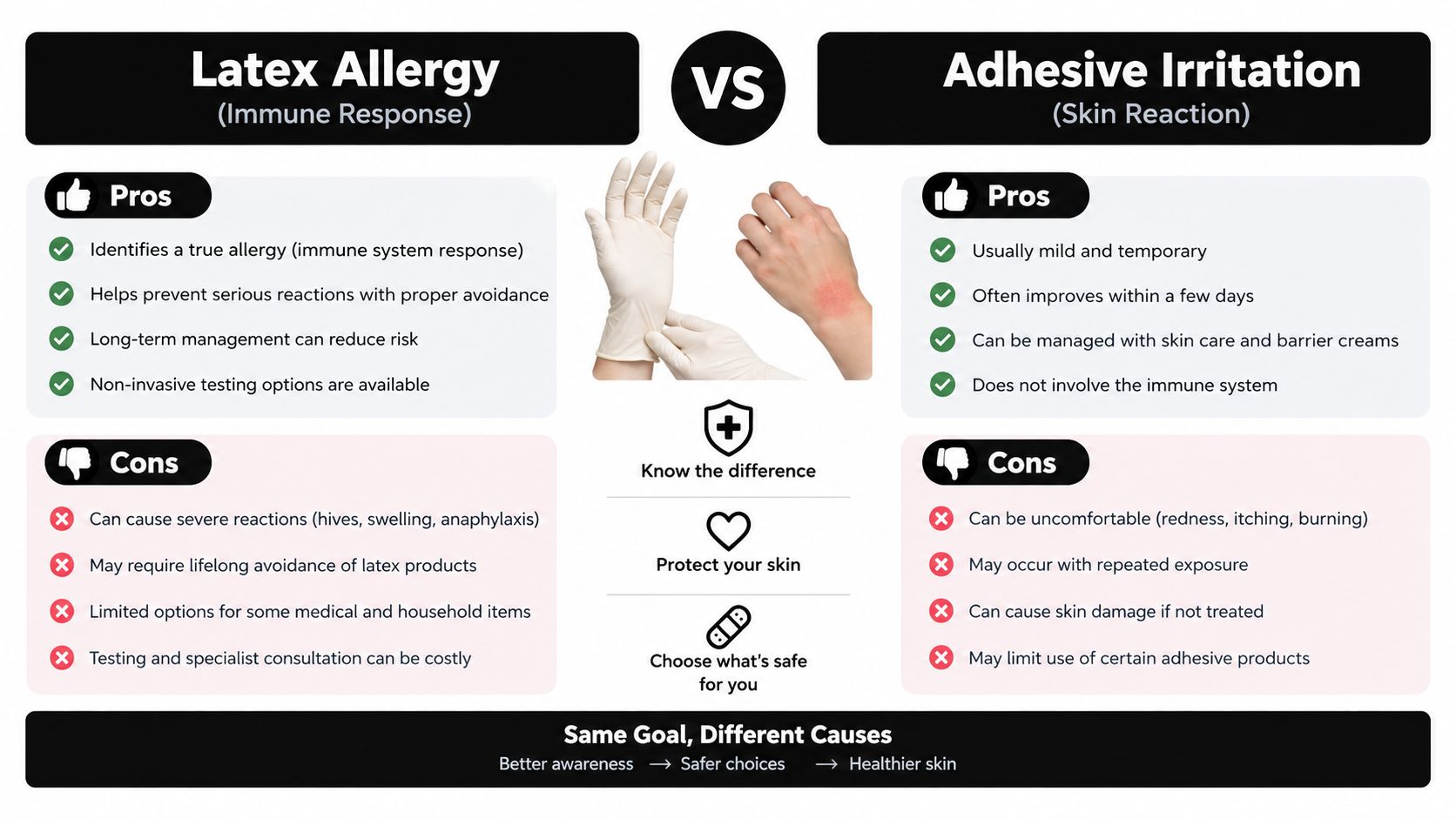
A rash under tape doesn't automatically mean the athlete has a latex allergy. A true immediate allergic reaction and delayed contact dermatitis are different patterns, and irritation from sweat, friction, pressure, or trapped moisture can look similar at first. The adhesive may be involved even when the product was made without natural rubber latex.
Delayed allergic or irritant contact dermatitis can appear 12–48 hours after exposure. It may cause localized redness, itching, bumps, or blisters. By contrast, breathing difficulty or facial swelling after exposure can signal a severe reaction and needs emergency care. Anyone with symptoms that could indicate anaphylaxis should seek emergency help rather than waiting to see whether a skin rash changes.
Look for the pattern, then stop exposure
For a localized rash, remove the tape and avoid reapplying that product until the likely cause has been considered. Record the tape brand, adhesive and backing details, how long it was worn, sweat exposure, and any cleansing products used. That information can help a clinician assess whether the reaction may relate to an ingredient, moisture, friction, or another factor.
A “hypoallergenic” label doesn't guarantee that an individual will tolerate the product. A clinician can advise whether formal patch testing is appropriate, particularly for reactions that keep returning. For general reading about skin irritation under compression, this sleeve rash advice may help readers compare possible causes, though it doesn't replace clinical advice about a tape reaction.
The key distinction is practical: emergency symptoms call for emergency care; a localized delayed rash calls for stopping exposure and seeking clinical advice if it persists, recurs, or worsens. A guide to blister prevention can also help athletes think through friction and skin care during training, but it can't diagnose an allergy.
Final Checklist for Sensitive Athletes
“Latex-free” doesn't mean “allergen-free.” Adhesives, rubber-processing chemicals, sweat, friction, and occlusion can still contribute to a reaction, so check more than the front label.
- Verify the claim: Confirm that the tape, adhesive, backing, and relevant packaging were made without natural rubber latex.
- Check the ingredients: Look for disclosed adhesive materials and other potential sensitizers.
- Test thoughtfully: Use a small test strip on intact skin when appropriate, and follow manufacturer or clinician guidance.
- Apply carefully: Start with clean, dry skin and use moderate tension.
- Track and respond: Record the product and wear conditions. Stop use if symptoms develop, and seek clinical advice for persistent or recurring reactions. Breathing difficulty or facial swelling requires emergency care.
Evermost LLC offers EVMT Liquid Chalk for athletes who need grip support for activities such as weightlifting, climbing, and gymnastics, rather than tape-based joint support. For product information and options, visit Evermost LLC.