


Climbing Chalk Reviews for Holds, Sweat, and Rules
A climbing chalk review that names a single winner without saying what the climber tested may be ranking feel, not grip. Rock type, hand moisture, hold cleanliness, and the outcome measured all change what a result means. For climbers who already carry powder, the practical question isn't whether to replace it, but whether a liquid base layer or a contained format better fits the session and the venue.
| Review question | Why it changes the decision |
|---|---|
| What was the hold made of? | Chalk's friction effect can differ across rock surfaces. |
| Were fingertips dry or sweaty? | Results under dry conditions don't automatically apply to sweaty hands. |
| Were holds clean or chalk-loaded? | Accumulated chalk can alter contact with the surface. |
| What did the test measure? | Friction, hang time, and subjective security aren't interchangeable. |
| What does the venue permit? | Loose powder may be prohibited even when contained or liquid formats are allowed. |
Table of Contents
- What Climbing Chalk Reviews Get Wrong
- Compare Liquid Block and Chalk Ball Formats
- Read Friction Results Against Real Hangs
- Use Liquid Chalk as a Climbing Base Layer
- Match Chalk to Gym Rules and Sweaty Hands
- Weigh Skin Dust and Cleanup Tradeoffs
- Pick EVMT Liquid Chalk for Your Next Session
What Climbing Chalk Reviews Get Wrong
The most common review shortcut is to treat dryness, texture, and a climber's impression of security as one score called grip. That score can't tell a reader whether chalk increased friction on a particular rock, helped preserve grip as sweat built, or just felt reassuring. Research across different surfaces and moisture conditions shows that chalk can help in some tests and hinder in others, so a universal ranking leaves out the conditions that matter.
A useful review identifies the rock or hold material, whether fingertips were dry or sweaty, whether the holds were clean, and whether the result came from a friction measurement or time on the wall. Without those details, a “best chalk” verdict can't be reliably carried from one climber's session to another. Even a measured friction result doesn't answer every practical question about how long a climber can maintain a usable hold.
A review without test conditions is a personal impression, not a portable buying rule.
This distinction matters because climbers often already own powder chalk. They aren't necessarily choosing a replacement. They're deciding which format fits a given session, whether a liquid layer makes sense under their usual powder, and what will be accepted in a gym that restricts loose chalk.
Reviews of gyms also benefit from explaining rules and policies in a way members can use. For a useful example of how feedback can be shaped into clear, actionable information, see this guide on turning member feedback into signups.
The buying path is practical: first compare formats, then interpret the friction evidence, then decide whether to layer, check the venue's rules, and account for skin and cleanup. Liquid chalk belongs in that decision as a controlled base layer, not a universal winner.
Compare Liquid Block and Chalk Ball Formats
The format changes how chalk reaches the hand and how much loose powder enters the air. Block chalk is broken into a bag for application; a chalk ball or sock releases contained powder through fabric; liquid chalk is spread on the skin and left to dry.
| Format | How it's used | Where it fits |
|---|---|---|
| Liquid chalk | Apply to the skin and let it dry. | A no-dust application option or a base beneath powder. |
| Block chalk | Break or crumble it for use from a chalk bag. | Keeps powder available for re-chalking during a session. |
| Chalk ball or sock | Apply powder through a fabric container. | May suit gyms that allow contained chalk but restrict loose powder. |
Block chalk and chalk balls keep powder on hand for re-chalking. Liquid chalk changes the application method, but it does not replace powder for climbers who want to re-chalk during a session. Whether a format is allowed depends on the facility's rules.
EVMT Liquid Chalk is a magnesium-carbonate liquid sold in portable 50 ml bottles and higher-volume 250 ml bottles. Some portable options have a carabiner ring, and listed formulas include Classic, Weightlifting, and Rock Climbing. These are format details, not evidence of better grip across different holds.
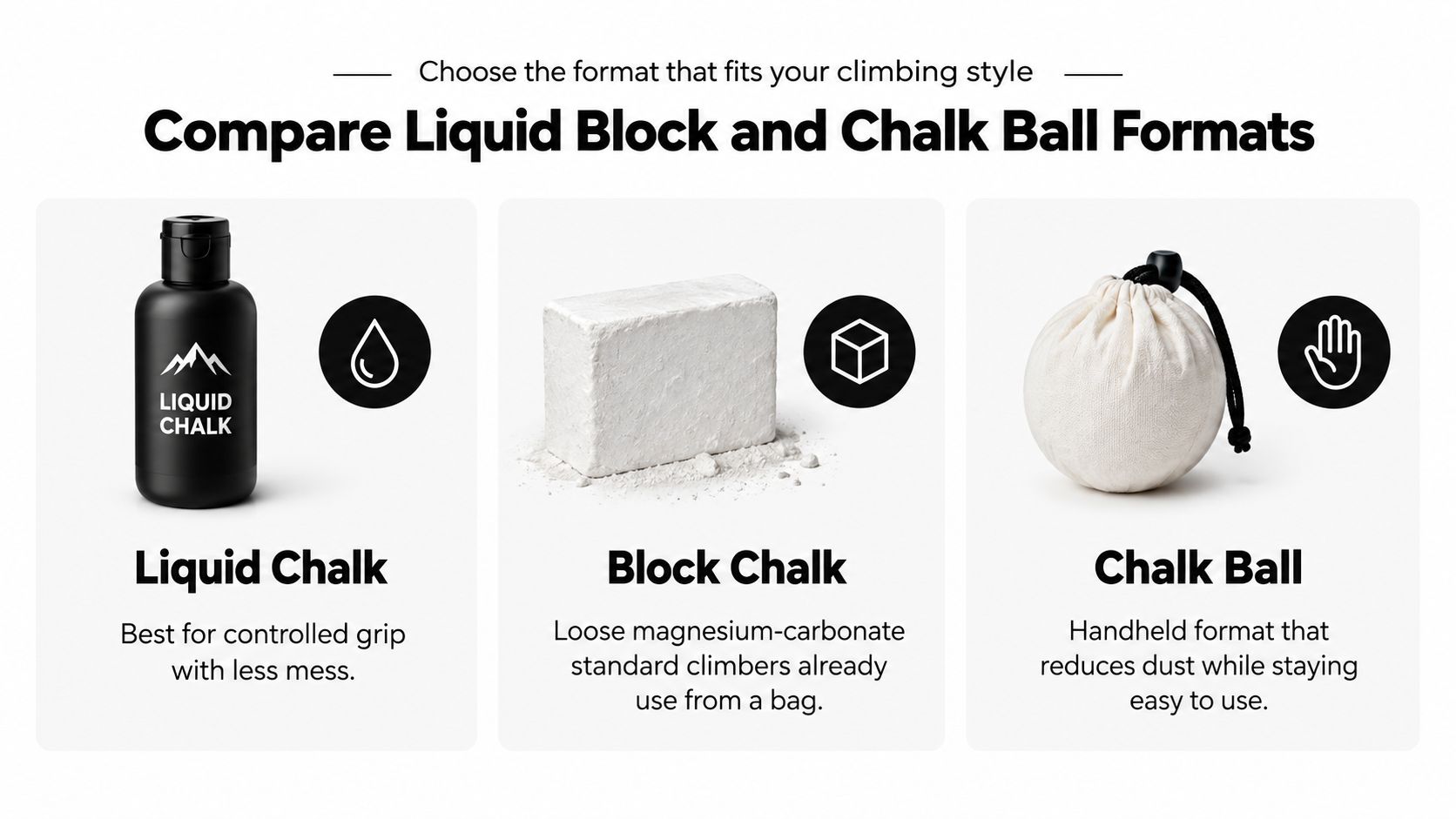
Contained powder offers an alternative to handling loose block chalk. This guide to chalk balls for climbing explains the format; check the gym's policy and consider how often you re-chalk before choosing.
Read Friction Results Against Real Hangs
A friction test and a climbing endurance test answer different questions. Friction measures contact under stated test conditions; hang time reflects how long a person maintains a hold. A review that treats those outcomes as interchangeable can make a product seem more universally effective than the evidence supports.
A 2024 study measured static friction on sandstone, granite, dark limestone, and light limestone, with dry and simulated-sweaty fingertips and normal forces of 5, 10, and 15 N. Chalk on dry fingertips generally produced a more positive friction effect than chalk under sweaty conditions, and it made friction more consistent across most test conditions. The surface mattered: the effect was most beneficial on light limestone when dry and most detrimental on dark limestone when wet. (2024 study of chalk on rock surfaces)
Earlier findings also resist a one-line verdict. In a study of 15 participants testing sandstone, granite, and slate, chalk reduced the coefficient of friction, possibly because dried skin and loose chalk formed a granular layer. In a separate performance study, weighted pull-up repetitions increased from 19.7 to 22.8 in open-handed grip tests and from 9.1 to 14.4 in pinch-grip tests. These are different tasks and outcomes, so the pull-up results don't prove that chalk raises friction on every climbing hold. (Review of climbers' perceptions and friction research)
| Evidence | Conditions | What changed | Review takeaway |
|---|---|---|---|
| 2024 rock-friction study | Four rock types, dry and simulated-sweaty fingertips, and normal forces of 5, 10, and 15 N | Effects differed by rock and moisture condition. | Name the surface and hand condition; don't generalize from one hold. |
| Earlier participant study | 15 participants testing sandstone, granite, and slate | Chalk reduced measured friction. | More chalk isn't automatically better. |
| Weighted pull-up study | Open-handed and pinch-grip tests | Repetitions rose from 19.7 to 22.8 and from 9.1 to 14.4, respectively. | Performance results aren't the same as friction measurements. |
| Experienced-climber hang study | 19 recreational climbers | Hang time rose from 49.3 ± 25.2 to 62.9 ± 36.7 seconds; measured friction, force distribution, and muscular activity didn't significantly change. | Assess endurance separately from friction. |
The hang-time finding suggests chalk's practical value may lie in preserving usable grip during a sustained effort, not raising measured friction in every setting. (Study of chalk and hang time in experienced recreational climbers)
For reviewers, the useful questions are whether a test tracked hang time, slip frequency, or friction under controlled moisture, and whether it reported how much chalk was applied. A thin coat or wiping away excess may be more informative than piling chalk on; “drier is always better” doesn't follow from these results.
Use Liquid Chalk as a Climbing Base Layer
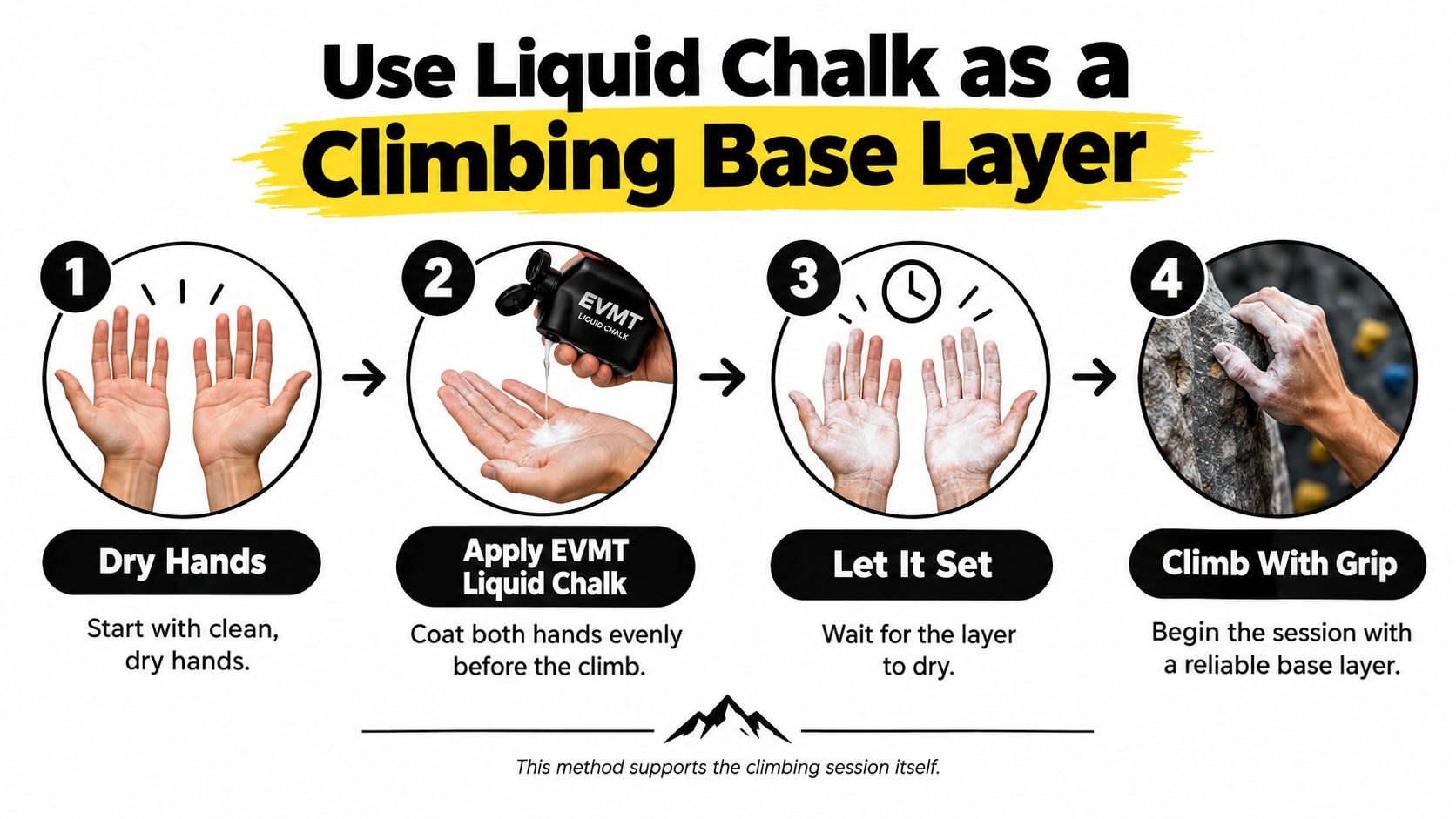
Climbers who already use powder can keep it. The base-layer method adds liquid chalk to the start of the session, then leaves the familiar powder in place for normal re-chalking. Its purpose is not to claim a universal friction increase; it's a practical way to add a coat before the route begins.
- Start with dry hands. Apply the liquid layer before climbing, not over damp or sweaty fingertips.
- Coat both hands evenly. Use enough to cover the contact skin without building up excess.
- Let it dry fully. The product is described as drying in seconds, but the hands should be dry before powder goes on.
- Use powder as usual. Keep the climber's regular powder and re-chalk when the session calls for it.
The proposed benefit is a longer-lasting combined coat, which may mean fewer trips to the bag before re-chalking. Sweat has to work through two layers instead of one. This approach is more relevant on long sport routes, multi-pitch climbs, or in humid gyms than on short boulder problems, where climbers may re-chalk frequently anyway. No particular number of moves or duration can be promised.
Liquid chalk is a primer, not a replacement for powder.
That practical distinction fits the hang-time evidence: a useful benefit can be maintaining usable grip as sweat builds, even when friction measurements don't rise. It also leaves room for the surface and conditions to change the result.
Competition rules are another part of the decision. USA Climbing's 2025–2026 rulebook permits commercially available dry or liquid climbing chalk on competitors' hands, while prohibiting substances or equipment that modify the holds or climbing surface. Ordinary chalk transfer from the hands isn't treated as a violation, but competitors still need to follow the specific event and venue rules. (USA Climbing 2025–2026 rulebook)
Match Chalk to Gym Rules and Sweaty Hands
A posted sign can settle the format choice before a climber considers texture or feel. At Dartmouth's climbing gym, loose chalk isn't permitted, while chalk socks and liquid chalk are provided. The policy cites healthy air quality and minimizing dust, and allows chalk balls, chalk socks, or liquid chalk. (Dartmouth climbing-gym rules)
BCIT's bouldering guidelines draw a similar line: climbers may use chalk balls or socks contained in a chalk bag, or liquid chalk, while loose chalk is prohibited. That rule makes containment the deciding factor for powder. A climber looking for another example of a bouldering-specific chalk policy can consult the guide to bouldering chalk, then confirm the rules at their own facility. (BCIT bouldering-gym guidelines)
For a climber with sweaty hands, liquid chalk gives a directly applied coating without requiring a loose-powder cloud. The same format can suit lifters, gymnasts, and pole athletes when moisture and a dust restriction are both concerns. A small amount, allowed to dry, is a format choice; it isn't proof of stronger friction on every surface.
The best usable format is the one the venue permits and the athlete can apply consistently.
USA Climbing's medical guidance gives another reason facilities may prefer liquid chalk or contained powder. It describes loose chalk as an irritant to the respiratory tract and says it can increase eye-rubbing and mask-touching behaviors that may raise viral-infection risk. The guidance strongly encourages liquid chalk or chalk balls, and notes that alcohol-based liquid chalk may help decrease hand contamination with infectious particles. (USA Climbing return-to-sport medical guidance)
A venue's own written policy still controls. Where both formats are permitted, a climber can use liquid chalk as a base under powder; where loose powder is prohibited, a liquid format or an accepted contained option may be the practical choice.
Weigh Skin Dust and Cleanup Tradeoffs
A grip review can stop at the end of a route, but a climber still has to consider how hands and the space feel afterward. Chalk can dry skin, and some liquid formulas may contain alcohol or fragrance that irritates some users. Climbers with eczema, sensitive skin, or hyperhidrosis should pay attention to ingredient information and whether hands feel comfortable after repeated sessions.
Air quality also needs careful attribution. Research from the University of Vienna and EPFL found potentially harmful chemicals from climbing-shoe rubber in bouldering-gym air, in some cases at concentrations higher than beside a busy street. That finding doesn't mean chalk dust is harmless; it means an air-quality complaint shouldn't automatically be blamed on chalk alone.
Outdoor use brings a different cleanup question. Conservation research summarized in the same review reports that chalk can affect moss and fern germination and survival in laboratory settings, and that cleaned rock can retain pH-changing chemical trails. Local climbing areas may therefore restrict or discourage chalk, so climbers should check and follow local guidance.
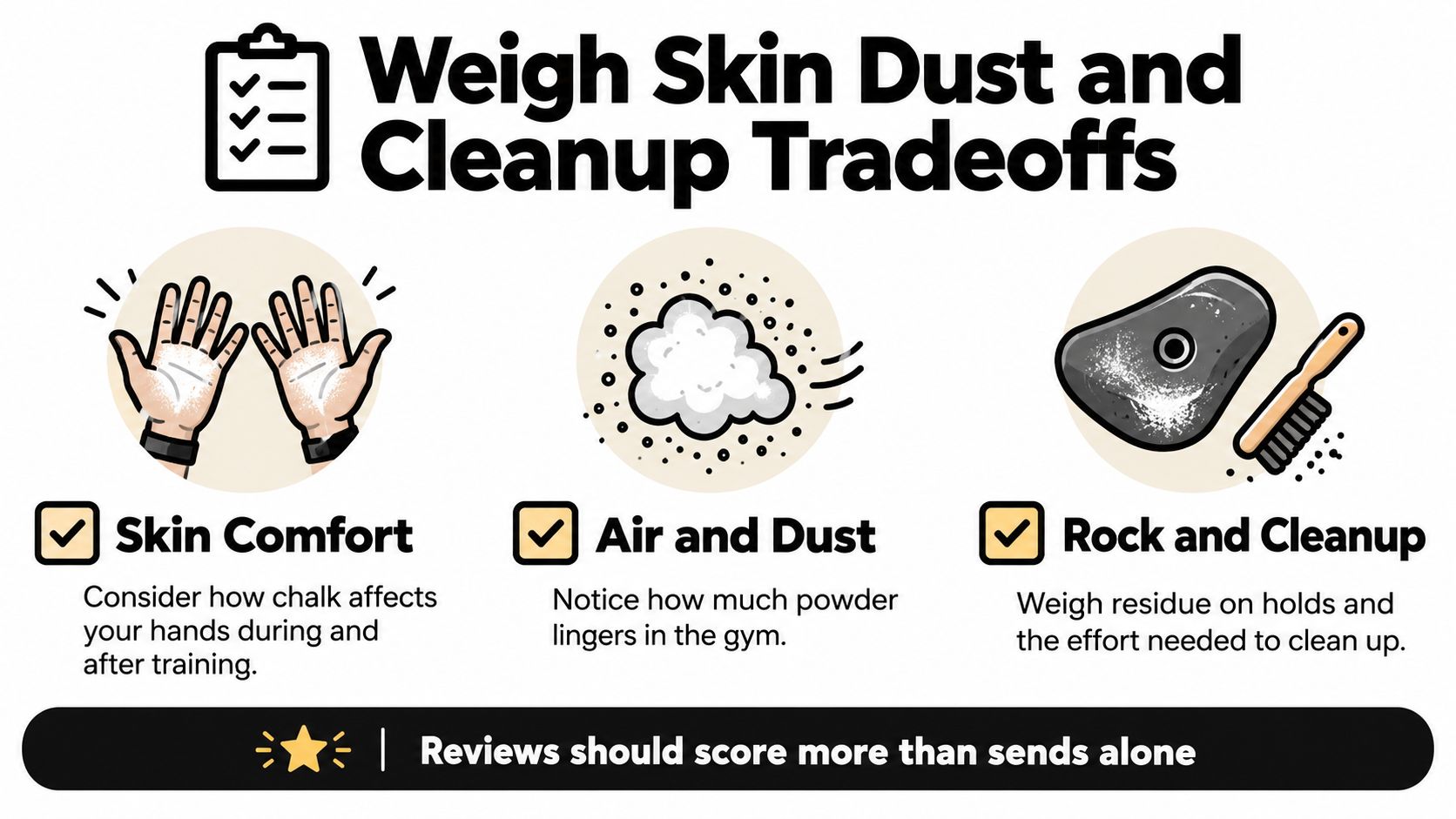
For equipment and apparel, EVMT is described as dermatologist tested, producing no dust clouds and leaving minimal residue once dry. After a session, soap and water provide a straightforward way to wash chalk from hands. Applying only enough to cover contact skin also avoids excess material that could form the granular layer discussed in friction research.
A useful review checks the morning after: skin comfort, residue, and cleanup matter alongside performance.
Facility managers assessing dust and maintenance can also consider practical routines such as these cleaning schedules for rubber floors. For climbers with dried liquid chalk on their hands or equipment, these instructions on removing liquid chalk offer another cleanup reference.
Pick EVMT Liquid Chalk for Your Next Session
Treat liquid chalk as a context test. Gym rules, hand moisture, hold cleanliness, and rock type can all affect whether a chalk routine suits a session. If a venue restricts loose powder, check which formats it permits before choosing what to apply.
For climbers who already use powder, liquid chalk can serve as a dry-hand base, not a replacement. Apply a thin layer to dry hands, let it dry fully, then add the usual powder. The result may vary with hand condition and hold surface, so compare like with like.
For a first test, apply a liquid base to dry hands, let it dry fully, add your usual powder, and record hang security, re-chalking frequency, skin comfort, and residue. Keep the hold surface, hand condition, and venue rules visible because each can change the result.
A useful test changes one factor at a time, so the session can show whether the base layer suits your routine.
In competition, use only chalk permitted by the rules, and do not apply anything to alter the holds.
Evermost LLC offers liquid chalk for climbing and other grip-intensive training. For a climbing base layer used with powder, visit Evermost LLC and choose a format for your next session.