


Bumper Rubber Plates: 2026 Buying Guide for Gyms
True competition bumper rubber plates use a standardized 450 mm diameter, roughly ±10–15 g tolerance for a 20 kg plate, and minimal bounce. Standard training plates prioritize cost and general durability, accepting broader tolerances and more rebound.
A lifter usually notices the difference after the first missed snatch. The bar drops, one plate rebounds harder than the other, the platform shudders, and the next attempt starts with less confidence. In a home gym, the same impact can travel through a wood-framed floor or wake the neighbors. The right bumper rubber plates solve part of that problem, but they don't make every surface or building safe for repeated drops.
The practical question isn't just which plate is thickest. It's whether the plate's grip environment, bounce behavior, calibration, rubber hardness, and floor setup match the way athletes train. Grip matters before the bar ever leaves the floor, especially for athletes whose hands sweat through high-repetition lifting. A clean, dry grip can prevent a failed lift, while the right impact system keeps that failure from becoming equipment or building damage.
Table of Contents
- Why Grip, Bounce, and Floor Protection Matter
- Competition Versus Training Bumper Plates
- Diameter, Calibration, and Rubber Hardness Explained
- Noise, Impact, and Real Floor Protection
- How to Choose Bumper Plates for Your Athletes and Gym
- Price Ranges and Durability Signals
- Final Recommendations and Next Steps
Why Grip, Bounce, and Floor Protection Matter
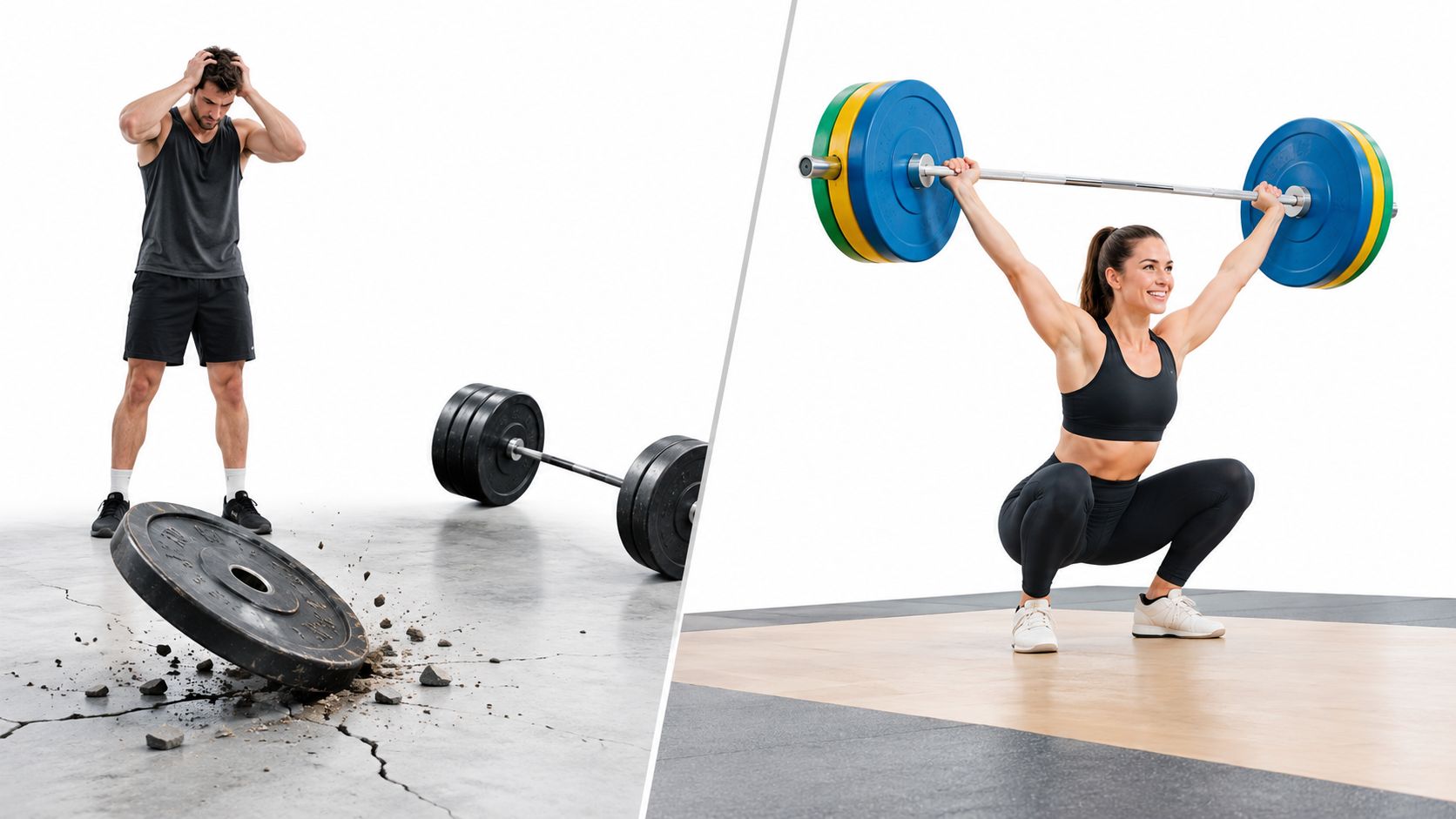
A missed snatch often starts with a hand that shifts slightly on the bar. The lifter corrects late, releases the bar, and the bumper rubber plates hit the platform at different angles. A plate with pronounced rebound sends the bar rolling or hopping, while a hard floor receives more impact than the buyer expected.
Bumper plates became important in Olympic weightlifting because athletes need to release loaded bars from overhead. Traditional cast-iron plates aren't designed for repeated drops from that height. Rubber plates absorb and distribute impact more effectively, reducing stress on the bar, plates, platform, and surrounding room. Historical equipment records describe France producing its first rubber weight set in the early 1960s, rubber plates appearing in Canada at the 1967 Pan-American Games in Winnipeg, and Schnell rubber plates being used prominently at the 1972 Olympic Games under International Weightlifting Federation rules. The documented equipment history shows how rubber moved from experimental equipment into accepted competition practice.
The plate solves only one part of the impact
A resilient plate can lower sharp impact noise and protect its own structure, but it can't cancel every force reaching the room. A commercial platform over suitable flooring handles drops differently from bare tile, polished concrete, plywood, or a floating residential floor.
Noise also has more than one form. Rubber can reduce the clank of metal-on-metal contact, yet a dropped bar may still create a sharp airborne sound and a low vibration through the subfloor. That difference matters in apartments, upstairs rooms, boutique gyms, and facilities sharing walls with offices.
Practical rule: “Safe to drop” describes the intended use of the plate. It doesn't guarantee that the building, floor finish, or neighbors can tolerate repeated overhead impacts.
Grip belongs in the same decision. A slipping hand can cause an uncontrolled drop, while powder chalk may create dust across bars and floors. EVMT Liquid Chalk gives weightlifters, powerlifters, and other athletes a magnesium-carbonate grip layer that dries in seconds without the airborne spread associated with loose chalk. It's a sensible option where sweaty hands are the immediate problem and the venue restricts powder.
Competition Versus Training Bumper Plates
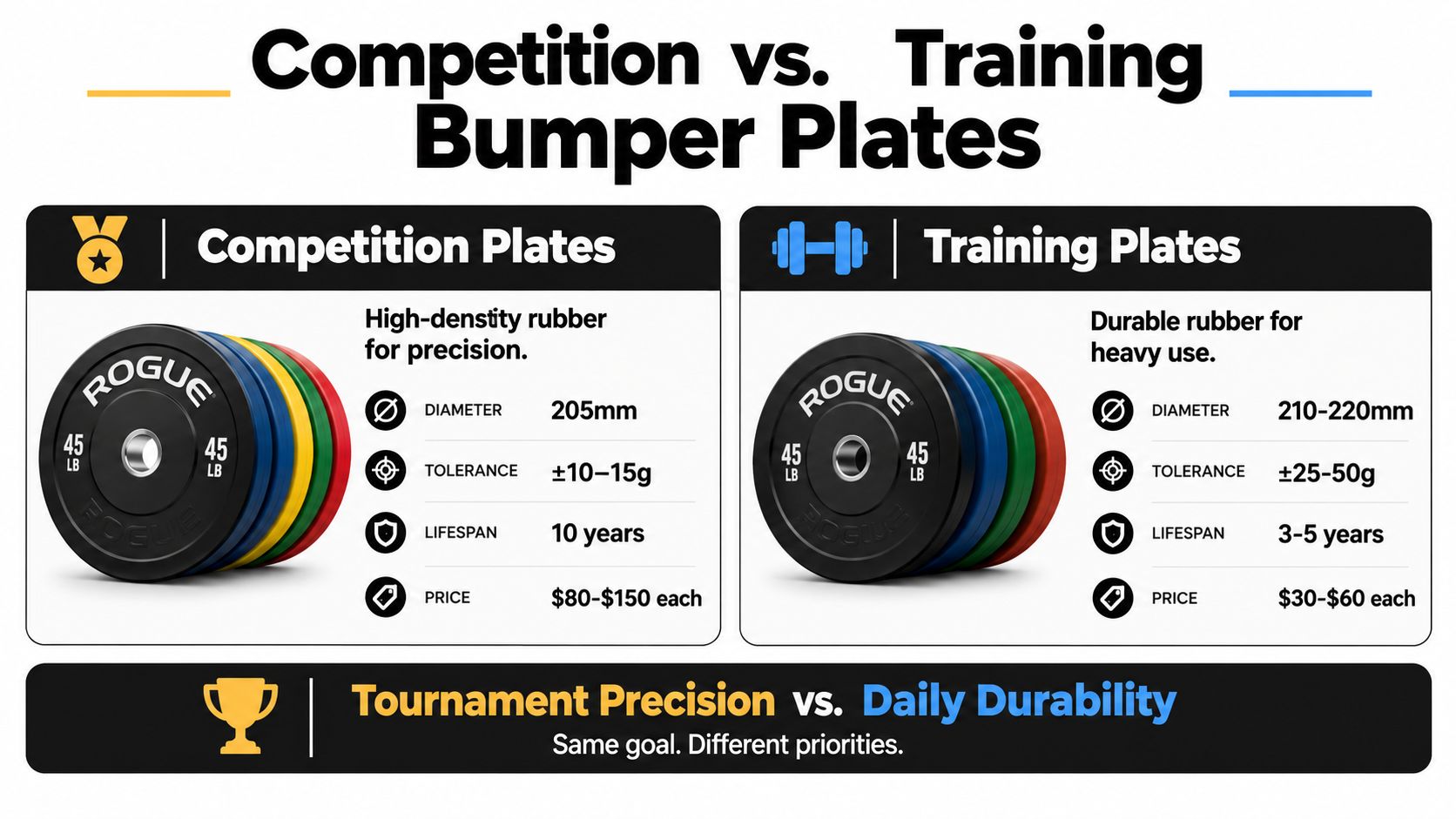
Competition and training plates share the same basic purpose, but they make different compromises. Competition plates use denser rubber and precision-machined steel inserts. Representative specifications place a 20 kg competition plate at approximately ±10–15 g, with a thickness of 28–34 mm and minimal “dead bounce” according to this bumper plate buying guide.
Standard molded-rubber training plates commonly use SBR or virgin rubber around a steel insert. Their typical tolerance is approximately ±1–3%, and they generally rebound more after a drop. That doesn't make them unsuitable. It makes them a better fit for high-volume general training where exact calibration and maximum sleeve capacity matter less.
A practical comparison
| Feature | Competition Plates | Training Plates |
|---|---|---|
| Primary use | Competition preparation and precise Olympic lifting | General lifting, CrossFit-style conditioning, and high-volume sessions |
| Weight control | Approximately ±10–15 g for a representative 20 kg plate | Approximately ±1–3% |
| Construction | Dense rubber and precision-machined steel insert | SBR or virgin rubber with a steel insert |
| Bounce | Minimal or controlled | Moderate to high, depending on compound and design |
| Thickness | Approximately 28–34 mm in representative specifications | Usually broader, depending on weight and manufacturer |
| Sleeve capacity | More load fits on the bar | Less load fits when thick plates fill the sleeve |
| Budget logic | Pay for calibration, density, and control | Pay for economical impact protection and volume use |
| Expected lifespan | Depends on use, flooring, insert, and care | Depends on use, flooring, insert, and care |
The important point is that a training plate's broader tolerance rarely changes a normal conditioning session. It becomes more consequential when an athlete tracks small load changes, prepares for calibrated competition equipment, or needs several heavy plates on a limited sleeve.
For more background on construction and use, the guide to what bumper plates are explains the category without treating every rubber plate as interchangeable. Athletes should also keep grip separate from plate choice. EVMT Liquid Chalk is a magnesium-carbonate liquid chalk option for weightlifting and other grip-dependent sports, but it doesn't change a plate's tolerance or rebound.
Who should buy which type
A competition-focused weightlifter benefits from calibrated plates that sit close to the platform and preserve sleeve space. A busy general gym may get better value from standard training plates, especially when members perform varied work and the facility replaces equipment in volume. A home-gym buyer should decide based on drop frequency, floor construction, and whether the plates need to support precise competition preparation.
Diameter, Calibration, and Rubber Hardness Explained
A spec sheet becomes much easier to judge once three details are separated: diameter, calibration, and hardness. Buyers who focus only on the printed weight can miss the characteristics that control bar height, rebound, and long-term stress.
Diameter keeps the bar at a repeatable height
Modern competition bumper plates use a 450 mm outside diameter, with an International Weightlifting Federation specification allowing approximately plus or minus 1 mm. That standard, equivalent to about 17.72 inches, keeps the bar at a consistent starting height across principal plate denominations such as 10, 15, 20, and 25 kg. The weight plate reference describes why this geometry distinguishes Olympic-style plates from ordinary iron plates with only a thin rubber coating.
Consistent diameter matters for deadlifts, cleans, and snatches. If a lighter plate is materially smaller, the bar begins closer to the floor and the athlete changes the pull before the load changes. True bumper rubber plates avoid that problem by keeping the outside dimension consistent.
Calibration controls what the load really means
A tolerance of ±10–15 g is a precision feature, not a visual detail. It lets coaches and athletes trust that a programmed load is close to the intended load, while a broader ±1–3% training tolerance is usually acceptable for general work where the objective is volume rather than calibrated competition practice.
Rubber hardness adds another trade-off. Technical guidance places common bumper compounds around 75–90 Shore A, with softer compounds absorbing more impact but tending to deform more, and harder compounds reducing bounce while transferring more force into the bar and floor. A representative competition product specifies 94 Shore A, ±1% weight tolerance, and ±1 mm dimensional tolerance, showing the tighter control associated with competition-oriented equipment. These specifications are summarized in this technical guide to bumper plates.
Read the entire specification
Hardness alone doesn't predict service life. Temperature, drop frequency, flooring, insert construction, and storage all influence how a plate behaves. A buyer should check the manufacturer's stated durometer, outside diameter, dimensional tolerance, weight tolerance, and required drop surface before treating a low-bounce claim as proof of durability.
Noise, Impact, and Real Floor Protection
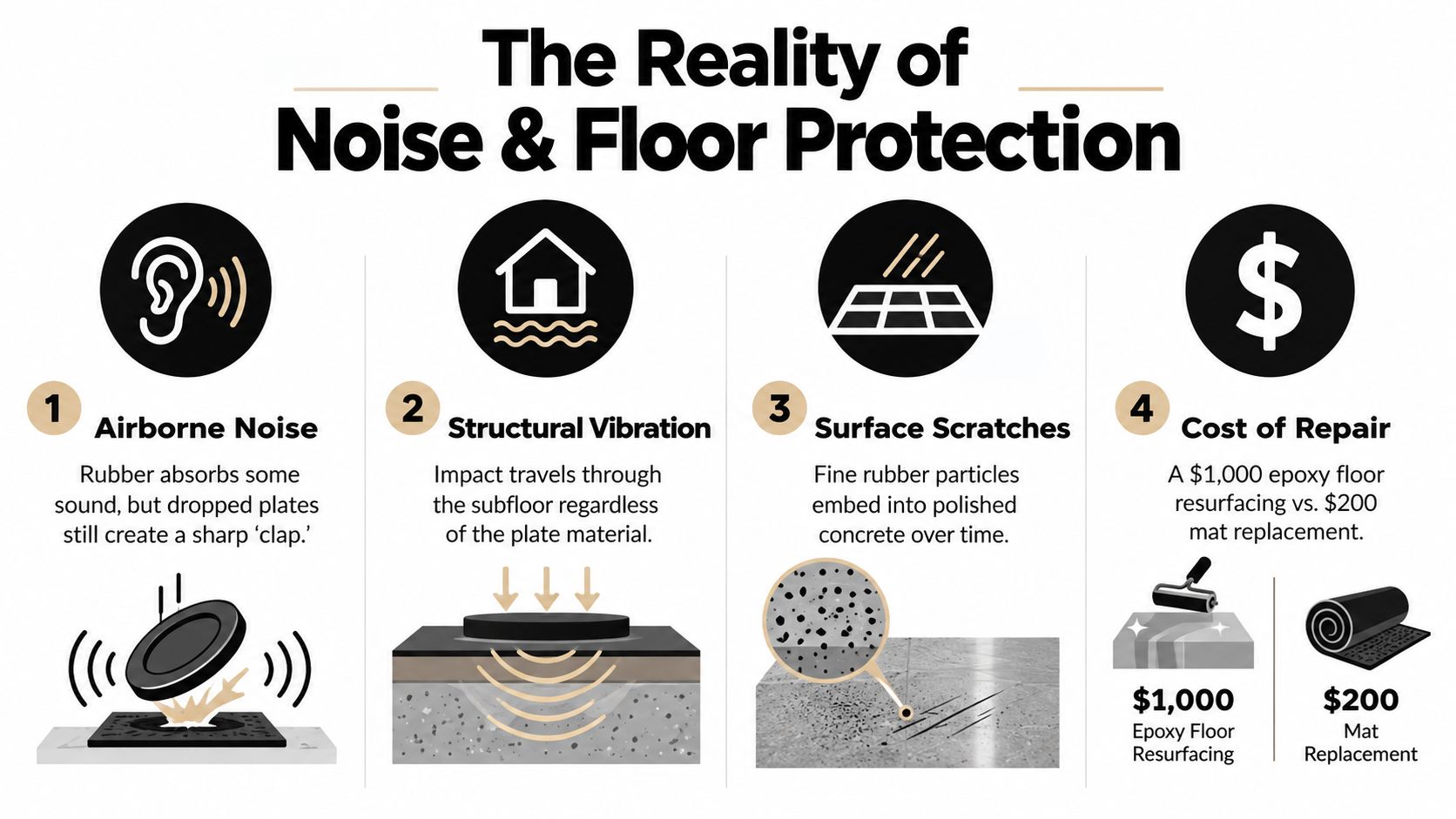
Bumper plates are quieter than bare iron in many situations, but “quiet” is too vague to guide a residential purchase. Three separate problems need attention: airborne noise, structural vibration, and cosmetic surface damage. A plate can reduce one while leaving the others largely unchanged.
A dropped bar still creates a sharp sound when it lands. The rubber body absorbs some of the impact, yet the force travels through the platform and subfloor. Concrete, a purpose-built lifting platform, plywood, and a joisted wood floor don't respond in the same way. The same bumper rubber plates may work well in a commercial lifting area and be a poor choice on an unprotected upstairs floor.
Match protection to the building
Repeated drops over plywood or joisted floors may call for at least two layers of 3/4-inch mats, especially when overhead drops are routine. That guidance appears in this discussion of floor protection, which also makes the important distinction between plate durability and building protection.
The practical decision matrix is straightforward:
- Apartment or upstairs room: If neighbors are close and drops aren't essential, controlled resets are safer for the building than repeated overhead releases. Bumper plates alone won't remove structural vibration.
- Garage on concrete: Rubber plates still benefit from suitable mats or a platform. The goal is to protect the finish, control rebound, and keep the bar from damaging the slab or plate edges.
- Commercial lifting area: A dedicated platform and appropriate mats can make frequent drops manageable, but staff should still inspect seams, inserts, and surface wear.
- Boutique or shared facility: Choose the plate and surface together. Noise complaints often come from impact transmission, not only from the sound of metal.
For a deeper flooring perspective, choosing the right floor protection can help facility owners evaluate the surface beneath the equipment rather than relying on the plate label alone.
A bumper plate protects the plate. The platform protects the floor. The building still needs a separate assessment.
How to Choose Bumper Plates for Your Athletes and Gym
The best plate depends on who drops it, how often, and where the impact lands. A competition lifter, a CrossFit athlete, and a commercial-gym manager may all need bumper rubber plates, but they shouldn't buy the same construction by default.
Start with the athlete
Weightlifters should prioritize 450 mm diameter, tight calibration, controlled bounce, and sufficient sleeve capacity. Those details support repeatable starts and make competition preparation more reliable.
Powerlifters may not need competition bumpers for every session if the bar is rarely dropped. If deadlifts are reset under control, a training plate can provide impact protection without paying for calibration that the program doesn't use.
CrossFit athletes generally need plates that tolerate frequent drops, rapid transitions, and mixed loading. Moderate rebound may be acceptable during high-volume work, but excessive movement creates cleanup and safety problems in a crowded training area.
Commercial gyms need a balanced purchase. Member misuse, varied skill levels, and replacement logistics often matter more than achieving the smallest possible tolerance. A sturdy insert and appropriate flooring may deliver more practical value than a competition specification that most members won't use.
Then inspect the facility
A performance center with a dedicated platform can take advantage of low-bounce competition plates. A home gym with limited drop space may need a conservative setup where athletes avoid unnecessary releases, regardless of plate type. The floor construction and neighbor sensitivity should be considered before the order is placed.
Use this purchase sequence:
- Confirm the outside diameter. Olympic-style bumper plates from 10 kg upward are generally built around 450 mm, but the manufacturer should state the actual dimension and tolerance.
- Match tolerance to programming. Choose calibrated plates for competition preparation and precise progression. Accept broader tolerance when the work is high-repetition conditioning.
- Check sleeve capacity. Thick training plates can fill a bar sooner, while thinner competition plates leave room for heavier loading.
- Ask for hardness and insert details. Durometer, steel-insert construction, and bonding quality reveal more than a generic “durable rubber” label.
- Verify the drop surface. A manufacturer's drop-surface requirements are part of the product specification, not an optional accessory note.
Sweaty hands can also make an otherwise sound setup less predictable. Athletes training with a bar, rings, or other grip-dependent equipment may apply liquid chalk before the session so the hand doesn't become the weak link in an overhead lift.
Price Ranges and Durability Signals
The cheapest bumper plate isn't always the lowest-cost choice. Low pricing can reflect broader weight tolerances, more rebound, a less secure insert, or rubber that shows degradation sooner under repeated impact. None of those traits automatically disqualifies a plate, but each should be visible in the specification.
A better quote comparison separates the purchase into performance signals:
- Calibration: Is the tolerance stated, or does the listing only show the nominal weight?
- Geometry: Is the 450 mm diameter confirmed, including dimensional tolerance?
- Impact behavior: Does the manufacturer describe rebound, hardness, or drop requirements?
- Insert security: Is the hub precision-machined, securely bonded, or left unexplained?
- Facility fit: Does the quote account for mats, platform space, storage, and replacement needs?
Choose precision only where it earns its place
Competition-grade plates make sense when athletes need calibrated loading, minimal bounce, thinner profiles, and a close match to formal equipment. Training-grade sets make sense when a gym needs durable impact protection across general sessions and can accept broader tolerances.
A commercial buyer should compare total ownership rather than unit cost. A plate that costs less but moves unpredictably, occupies more sleeve space, or fails around the insert can create replacement and floor-management costs. Bulk purchasing may improve consistency across a facility, while subscription-style replenishment can help a gym plan recurring consumables, but neither approach fixes a poor specification.
For a separate look at how equipment claims should be tested, the durability testing guide offers a useful framework for evaluating performance beyond marketing language. The same discipline applies to chalk: a grip product should be judged by how it behaves on sweaty hands and whether the venue permits it, not by packaging alone.
Final Recommendations and Next Steps
A sound bumper rubber plates purchase comes down to a clear trade-off. Competition plates buy precision, controlled rebound, and sleeve efficiency. Training plates buy economical impact protection for repeated general use. Neither category makes an unsuitable floor safe.
Before ordering, a buyer should confirm:
- Diameter consistency: Look for the 450 mm standard and the stated dimensional tolerance.
- Weight tolerance: Choose calibrated specifications when small load differences matter.
- Hardness and rebound: Softer rubber can absorb more impact, while harder rubber may settle faster but transmit more force.
- Insert construction: Check how the hub is made and secured.
- Drop-surface requirements: Match the plates to mats, platforms, concrete, wood, or other flooring.
- Return terms: A return policy matters if the plates arrive with excessive bounce, odor, dimensional variation, or insert movement.
A gym that stores plates properly and uses an appropriate platform will get more value from either category. Buyers should compare supplier spec sheets, competition standards, and return conditions rather than selecting solely by the lowest quote. Storage also matters, so a dedicated bumper plate rack can help keep plates off damp or uneven surfaces when the facility has room for one.
The final check is practical: if sweaty hands can make the bar slip, add a venue-approved grip solution to the setup. A magnesium-carbonate liquid chalk that dries quickly and doesn't spread loose dust can support cleaner sessions for lifters training around shared equipment.
Evermost LLC offers EVMT Liquid Chalk in single bottles and multi-packs for athletes who need a clean magnesium-carbonate grip aid without powder dust. Visit Evermost LLC to choose a liquid chalk option for lifting, climbing, gymnastics, or other grip-intensive training.