


Weightlifting Accessories: Which Grip Aids Are Worth It
Your hands are already damp when you walk to the bar. You chalk up, set your grip, and pull. Two reps in, the bar rolls a quarter inch in your palm, your fingers peel open, and the set ends early. Nothing failed except the contact between skin and steel.
Then the second problem appears. You reach for the powder block and remember the sign taped beside the front desk, the one about dust on the turf and fingerprints on the mirrors. Plenty of commercial gyms now treat loose chalk as a nuisance item, and that rule rarely says anything about liquid products either way.
That's the decision behind grip-focused weightlifting accessories. It isn't which aid is strongest. It's which one solves the problem in front of you, whether that problem is sweat, dust, a venue policy, or a route long enough that stopping to re-chalk costs you the send.
Table of Contents
- Liquid Chalk vs Powder vs Chalk Balls at a Glance
- Why Liquid Chalk Holds Grip Longer
- Gyms That Ban Chalk and How to Check the Rules
- How to Apply Liquid Chalk and Wash It Off
- Layering Liquid Under Powder Chalk for Climbing
- Liquid Chalk for Pole and Gymnastics Grip
- Match Each Grip Problem to the Right Fix
- Choose Your Grip Aid and Test It Next Session
Liquid Chalk vs Powder vs Chalk Balls at a Glance
Lockout is where the format choice shows itself. By the time the bar reaches the hips, the knurling can feel polished instead of sharp, and the coat you applied at the start of the pull is either still gripping or already gone.
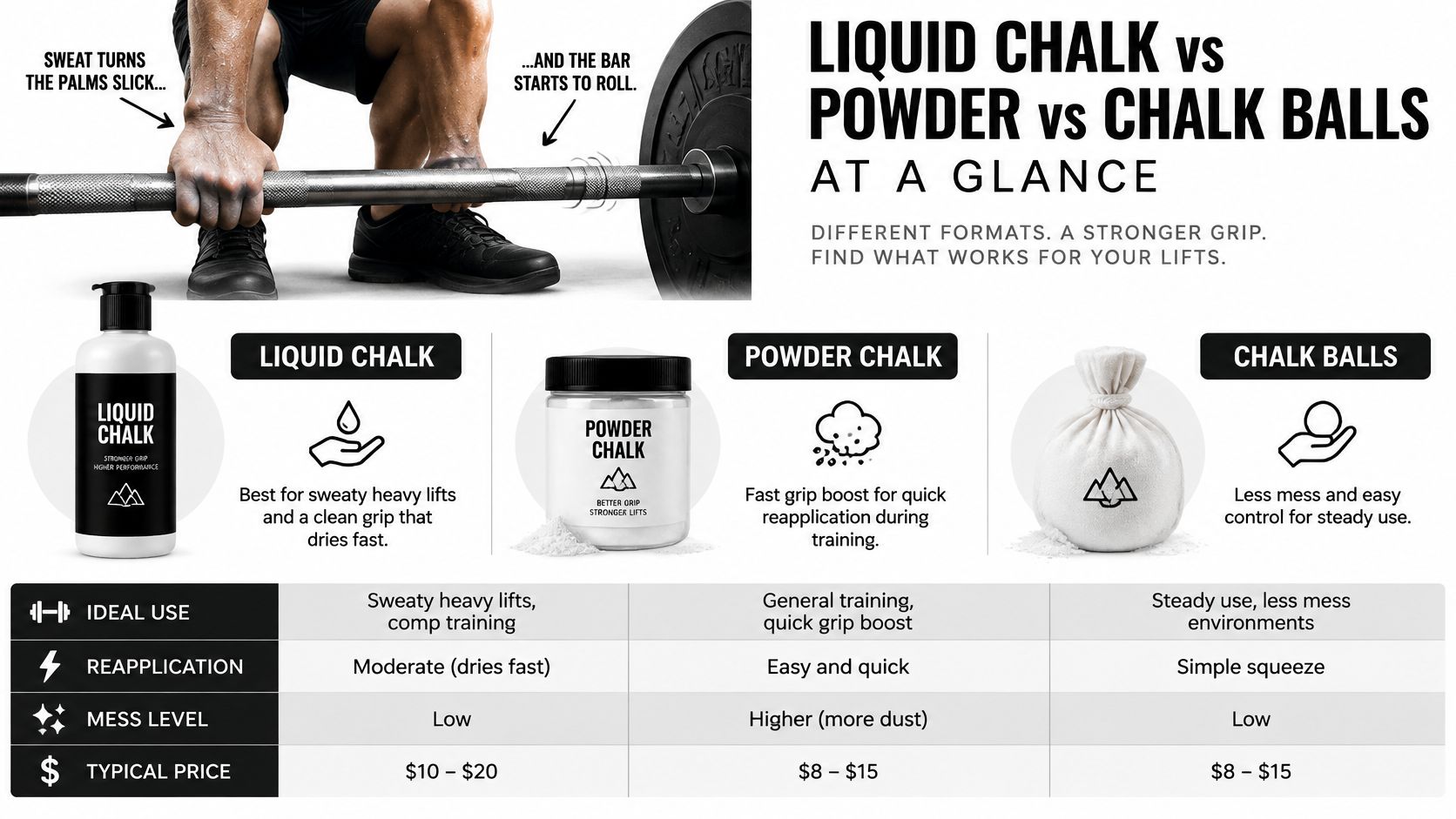
Here is the short version, sorted by where each format fits rather than by who markets it hardest.
| Chalk format | Best for | Dust | Typical gym acceptance |
|---|---|---|---|
| Liquid chalk (magnesium carbonate) | Sweaty hands during heavy lifts and long sets | None once dry | Often allowed where loose chalk is banned |
| Loose powder chalk | Open gyms and bouldering with a chalk bag | High, settles on bars and equipment | Frequently banned in commercial gyms |
| Chalk ball | Quick top-ups between sets in open gyms | Moderate, dust escapes through the mesh | Often restricted alongside loose powder |
Six criteria sit behind those rows: sweat absorption, airborne dust, dry time, residue left on bars and poles, how the format packs into a gym bag, and whether the venue will let you use it at all. The pattern is consistent: a lifter compares formats on grip feel, buys a block, then reads the no-chalk sign at the front desk on the first visit. Check the last column before the first one.
What actually separates the three formats
The bar itself is the fixed part of the equation. A men's competition bar weighs 20 kilograms, measures 2.2 meters and carries a 28-millimeter shaft, while a women's bar is 15 kilograms, 2.01 meters and a 25-millimeter shaft, as the Olympic weightlifting equipment standards describe. Standard steel means the variable is almost always your hand, and what changes between formats is how each one sits on it.
- Dry time: a liquid film needs a few seconds to set before you touch a bar, while powder and ball chalk work on contact and then migrate everywhere.
- Residue: a thick powder layer leaves white prints on knurling and collars, and a badly applied liquid coat leaves a tacky patch that the next member inherits.
- Packing: a bottle survives a gym bag and a competition kit without bursting, a block crumbles, and a ball leaks through its mesh over a season.
- Sweat control: all three rely on magnesium carbonate to absorb moisture, so the difference is how long the layer survives friction and how evenly it covers.
Sort the decision by situation instead of by product. Venue rules first, because they decide what you may carry through the door. Then dry time and residue, then how the format packs, then how evenly it covers a sweating palm.
Why Liquid Chalk Holds Grip Longer
Sweat is the whole problem. Between your palm and the knurling sits a film of moisture, and as that film thickens the hand stops locking to the bar and starts sliding across it. Contact gives out before the muscles do.
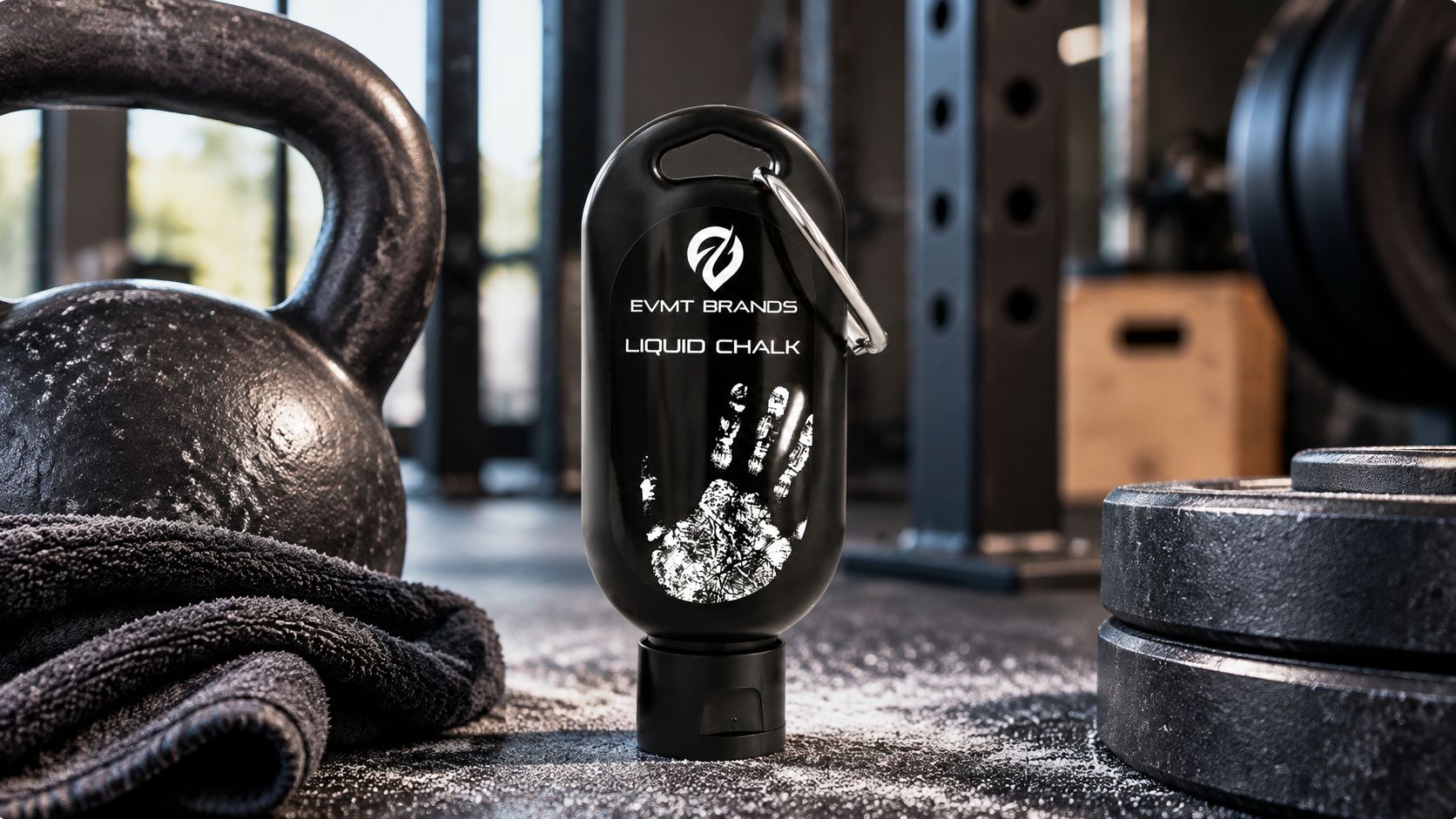
Liquid chalk delivers magnesium carbonate as a thin film that dries in seconds and stays where you put it, instead of a cloud that lands on the bar, your shins, and the floor between the racks. Same active ingredient, different delivery. The delivery is what decides whether a venue tolerates it, and it also decides how long a coat lasts: loose powder sits on top of the skin and gets scrubbed off by the knurling rep after rep, while a dried film bonds to the hand and wears away slowly. That is why one application often outlasts a set that would chew through a fresh dusting.
What the climbing study measured
The clearest published test of the ingredient comes from climbing, not lifting. In the study of chalk and grip endurance, recreational climbers doing repeated weight-assisted pull-ups lasted significantly longer with magnesium carbonate chalk: open-handed performance rose from 19.7 ± 4.39 repetitions without chalk to 22.8 ± 4.53 with it (p = 0.006), and pinch-grip performance rose from 9.1 ± 4.83 to 14.4 ± 4.47 repetitions (p = 0.007).
Calculated from those means, the relative gains work out to roughly 16% for open-handed work and roughly 58% for pinch grip. When the thumb and fingertips have to hold precise contact rather than wrap a bar, chalk appears to matter more. That lines up with what happens on a slick barbell at lockout, where the thumb is doing quiet, constant work.
Timing rule: apply chalk before grip degrades, not after the first slip. A complete, thin coat on the contact surfaces beats a heavy layer smeared on mid-set.
Where chalk stops helping
The study tested magnesium carbonate in powder form, not liquid. The result supports the ingredient's effect on sweat and friction, and applying those numbers to a liquid film is a reasoned extension rather than a measured outcome. Treat it as a strong indication, not a guarantee.
Chalk buys endurance and consistency. It does not build forearm strength, finger-flexor capacity, or thumb stability, and piling on more of it adds nothing once the contact surface is covered. The athletes who get the most from it train grip separately and use chalk to stop sweat from taxing a set they've already earned.
Gyms That Ban Chalk and How to Check the Rules
Walk into a commercial gym and look at where the plates are stacked. Strength training now dominates the floor. Modern fitness facilities allocate 42% of their floor space to strength training, compared with 20% in traditional layouts, according to a 2025 Health Club Management report. More lifters in more square footage means more chalk dust landing on more equipment.
That's the reason behind most bans. Airborne powder settles on bars, benches, cable stacks, mats and mirrors, drifts into ventilation, and turns into cleaning work for staff who didn't budget for it. A ban written to stop dust clouds often says nothing specific about a liquid product, which leaves the lifter guessing.
The layers of rules, in order
The governing federation sets the baseline. USA Weightlifting directs athletes and meet organizers to follow the International Weightlifting Federation Technical and Competition Rules, as set out in the USA Weightlifting governance and technical rules, which makes those equipment provisions the relevant standard when a lifter picks a grip aid. Local and national events then add their own procedures, so a meet director's instruction can differ from what the host facility allows on a normal Tuesday.
The rulebook identifies the framework, not a universal liquid-versus-powder verdict. Local confirmation is the only reliable answer, and it costs one message.
- Ask in writing. Send the question to the gym's contact address and keep the reply. An answer overheard at the front desk doesn't survive a change of shift.
- For a meet, ask the meet director. Not the host gym, and not a training partner who competed somewhere else last season.
- Have the product details ready. Name the active ingredient and note that the coat produces no airborne dust once dry, so staff can judge it on facts.
- Never generalize. One venue's approval says nothing about the gym across town, and nothing at all about a competition floor.
How to Apply Liquid Chalk and Wash It Off
A liquid coat fails for three predictable reasons: it went on damp skin, it went on too thick, or it never got cleaned off the equipment. The routine below removes all three.
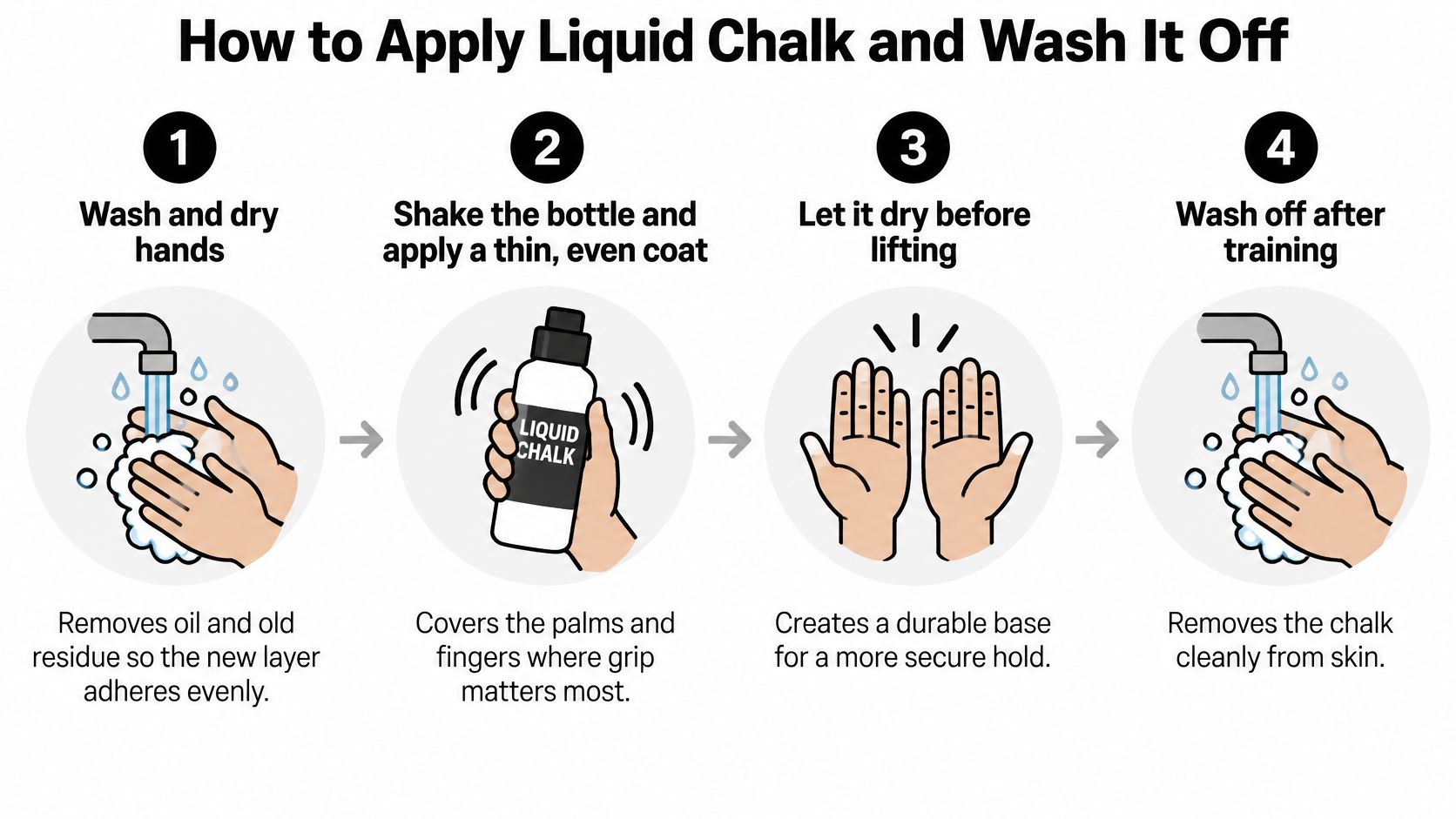
The six steps
- Wash and dry your hands. Oil, hand cream and old residue sit under the new layer and stop it bonding. Dry properly, including between the fingers, because a damp palm dilutes the film.
- Shake the bottle and apply a thin, even coat. Cover the palms and the finger pads, the areas that meet the bar. A coin-sized amount per hand is usually enough for a full session.
- Let it dry completely. A thin coat sets in seconds. Gripping while the film is still wet smears it, wastes product, and leaves a slick patch instead of a tacky one.
- Test the contact before the working set. Take the bar and check the palm. If it feels slick rather than tacky, the coat was too thick or still wet, so wipe and start again rather than adding more.
- Re-coat between heavy sets instead of stacking layers. Additional layers add little grip and plenty of residue. One thin top-up on the finger pads does more than a second full application.
- Wash off after training. Soap and water remove the film completely. If you've been pulling heavy, wipe the bar or pole with a damp cloth so the next person doesn't inherit a sticky surface.
Skipping step six is the mistake that gets products banned. A tacky bar collects dust, feels unclean, and gives staff a reason to add another line to the sign. The full method for getting the film off skin and equipment is covered in this guide to removing liquid chalk from hands and gear.
Signs of a good coat: the hand feels tacky but dry, the bar stops rotating in the palm, and the knurling looks the same after the set as it did before it.
If the hands feel wet, the coat was too thin or applied to damp skin. If they feel thick and cakey, it was too generous. Both are fixable in one session.
Layering Liquid Under Powder Chalk for Climbing
Climbers already own powder chalk and don't need to replace it. The useful move is to add a base layer underneath it: a coat of liquid chalk on dry hands before the session, left to dry fully, then powder chalk on top as normal. The liquid layer adds another layer of grip, so the coat holds through more moves before re-chalking, and sweat has to work through two layers instead of one.
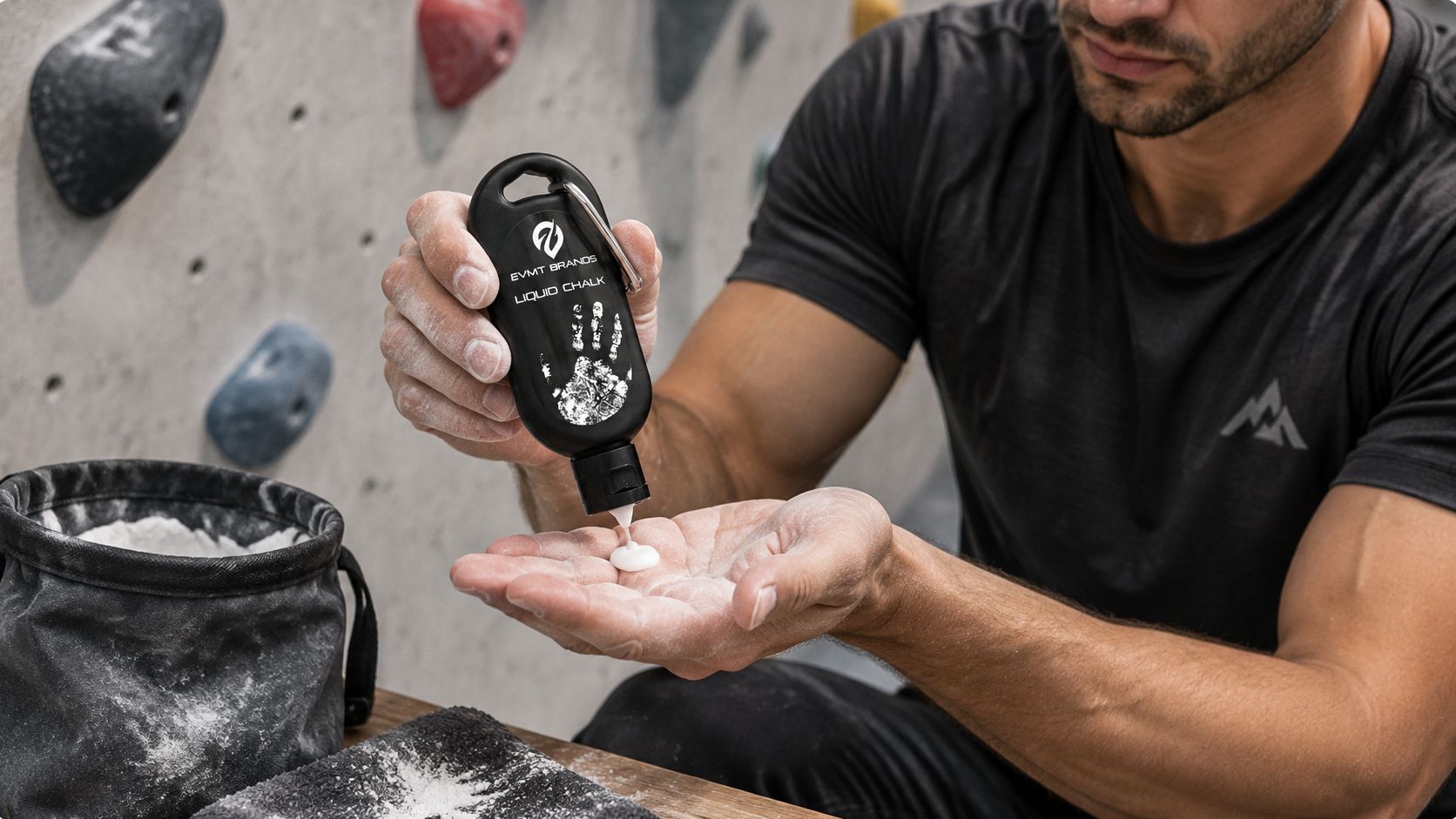
That pays off differently depending on what you're climbing. On a short boulder problem you're on the wall for seconds and the extra layer barely registers. On a long sport route, a multi-pitch line, or a humid gym where the holds never quite dry, fewer trips to the bag mid-route changes how the climb feels.
Session by session
| Session type | Liquid base | Powder on top | Why |
|---|---|---|---|
| Short boulder problems | Optional | Yes | Brief climbs rarely need a second grip layer |
| Long sport route | Yes, dry fully first | Yes | The extra layer lasts through more moves before re-chalking |
| Multi-pitch climb | Yes, dry fully first | Yes, light coat at belays | Fewer trips to the bag while hanging |
| Humid gym | Yes, dry fully first | Yes | Sweat has to get through two layers instead of one |
Two rules keep the layering from backfiring. Let the liquid layer dry fully before powder goes anywhere near your hands, because a wet film plus powder turns into a slick cake that's worse than either product alone. Then keep the powder coat light, dusted on rather than loaded.
Practical rule: the liquid layer is the base, not the finish. If you can see a thick white crust on your palms, you've overdone the top layer and lost the friction you were trying to build.
The benefit worth promising yourself is a longer-lasting coat and fewer re-chalks. Nothing more specific than that, because how long a coat lasts depends on the rock, the humidity and how much you sweat.
Liquid Chalk for Pole and Gymnastics Grip
Pole and gymnastics athletes meet the same sweat problem on smooth, fixed surfaces, where a slip is more dangerous and residue is far easier to see. A pole athlete holds a metal pole through spins and inverts, so the coat has to survive long sequences on the same contact patch. A gymnast needs dry hands on bars, beams and stunt surfaces without a cloud of powder drifting across a shared studio floor.
Apply a thin coat to the palms and the inner arms where they meet the pole, let it dry fully, then take the grip. Keep the layer thin enough that the hand feels tacky rather than slick, since a heavy coat on smooth metal is worse than none at all.
- Test before you commit. Run the coat through a light grip or a single sequence before a full session, so a bad application doesn't cost you a skill.
- Keep the coat thin. Reapply lightly between sequences instead of building up, because buildup is what transfers onto the pole and shows up as grey smears.
- Wipe the equipment after training. A damp cloth on the pole or bar takes ten seconds and keeps the next athlete from meeting a sticky surface.
Studio policies on chalk differ from gym to gym, so ask before the first session whether a liquid product is allowed. A short routine for building and maintaining that grip is set out in this gymnastics grip guide, and it's worth reading before a competition cycle rather than during one.
Match Each Grip Problem to the Right Fix
A bar that slips at lockout is the failure lifters feel first, and it usually traces to sweat or residue on the contact area, not to strength. Check the hand surface before you touch the training program.
| Symptom | Likely cause | Fix |
|---|---|---|
| Bar slips at lockout | Sweat or dry skin missed on the contact area | Apply a thin coat, let it dry fully, retest the grip |
| Chalk comes off in the first sets | Hands were still wet or oily | Wash hands, dry them, reapply a thin layer |
| Dust complaints or a venue warning | Loose powder in use | Check venue rules, then switch to liquid chalk if permitted |
| Residue on bars or poles | Thick buildup or missed cleanup | Use a thinner coat and wipe with a damp cloth after training |
| Grip fails before target muscles tire | Grip is the limiter for that set | Build grip with unassisted work; use a thin liquid coat on sweat-limited sets |
Two of these fixes take a single session: a thinner coat and a fully dried one. The last row takes weeks, because grip capacity is built with bare-hand holds, loaded carries and unassisted pulls, not with a better product. The venue row deserves attention before you buy anything, since the same slipping bar calls for liquid chalk in a gym that bans powder and for loose chalk in a garage where nobody complains about dust.
When the problem isn't chalk at all
A bodybuilder chasing back thickness wants the lats or hamstrings to reach failure before the forearms do. A powerlifter or a climber needs grip capacity itself, because grip is the thing being tested. Same accessory shelf, opposite goals.
Straps sit in that gap, and they change mechanics as well as load retention. Using a belt and straps together reduced knee-flexion angle during setup (P < 0.001), shortened deadlift completion time (P = 0.008) and lowered perceived exertion (P < 0.001), while straps alone produced greater thoracic kyphosis at lockout than a belt-only condition (P < 0.001) with cervical and lumbar lordosis unchanged, in a biomechanics study of belts and straps in the deadlift.
The takeaway is practical: straps remove the grip limit and speed a set up, but they can shift upper-back position when pulling mechanics aren't controlled. Reserve them for heavy pulling volume, back hypertrophy work or sets where grip fatigue would cut the target muscle short. Keep unassisted work in the program for grip development, and watch thoracic position at lockout rather than assuming faster means better. The full trade-off between the two aids is covered in this guide to wrist straps and how they compare with wraps.
Wrist wraps do a different job entirely. They support the wrist during pressing and overhead work, and they interfere on pulls, where they block the strap position you need.
Order of operations: develop grip with bare-hand and chalked work first, reach for a liquid coat when sweat is the limiter, and add straps only on the sets where grip would steal the stimulus from the muscle you're training.
Choose Your Grip Aid and Test It Next Session
The decision path is short. If the venue allows liquid chalk and sweat is your limiter, liquid is the first purchase. If loose powder is permitted and dust isn't a problem, powder stays the simplest option. Climbers keep the powder they own and add a liquid base underneath it. Where you train settles the choice as much as how strong your grip is.
Then run one test session instead of guessing. Confirm the venue policy in writing, pick the format that matches the session you're about to train, and apply a thin coat following the steps above. Judge the result on three checks:
- The grip holds through your working sets, not just the warm-ups.
- The hands feel dry and tacky, not wet underneath or thick on top.
- The bar or apparatus is clean afterward, with no tacky film left for the next user.
If all three pass, you've found your format. If any one fails, change the application before changing the product. A thinner coat, a longer dry time or a second pass on sweaty palms fixes most misses.
EVMT's Classic Liquid Chalk fits that test for general training: it is built for gym, CrossFit, gymnastics, dance and sports use, reduces hand sweat and improves grip instantly, and washes off easily with soap and water. The bottles are compact and durable, sold in 50 ml portable and 250 ml high-volume sizes, with a carabiner clip included on select sizes for easy carry. Match the size to your training volume on the EVMT Liquid Chalk product page.
Evermost LLC makes EVMT Liquid Chalk for lifters, climbers, gymnasts and dancers who want grip that dries in seconds and leaves no dust cloud behind. If sweat is costing you reps at lockout or sending you back to the chalk bag mid-route, a bottle in your gym bag solves the problem cleanly. Visit Evermost LLC to pick the bottle size that matches how often you train.