


Straight Barbell Weight: Real Specs for 2026
Straight barbell weight is often answered with “45 pounds.” That answer works only when you're holding a particular men's Olympic-style bar, and even then it rounds a 20 kg competition standard into a U.S. gym label. Pick up a women's Olympic bar, a technique bar, a power bar, or a standard 1-inch bar, and the answer changes.
The empty bar affects every number you load, but weight alone doesn't explain how the bar behaves. Shaft diameter, sleeve construction, length, knurling, and tensile strength determine whether the bar feels quick in a snatch, rigid in a deadlift, or awkward in a rack. Treat the bar as a piece of equipment with a specification, not as a generic steel rod.
Why Your Straight Barbell Weight Is More Complicated Than 45 Pounds
A straight barbell does not have one default weight. The familiar 45 lb label usually describes a commercial men's Olympic-style bar, while a standard 1-inch bar may weigh roughly 15 to 25 lb. Specialty bars can range from about 7 kg to over 30 kg, depending on their purpose and construction, as shown in this breakdown of actual barbell weights. The 45 lb figure comes from rounding 20 kg, or 44.1 lb, into a convenient U.S. gym number.
That difference changes more than the number written in your log. A women's Olympic bar weighs 15 kg, or 33 lb, so loading it with the same plates as a 20 kg bar produces a different total. The gap is about 11 lb, which can affect progressive overload, warm-up jumps, and how you compare sessions performed on different bars (IWF equipment standards).
The bar's mass reflects several design choices:
- Shaft dimensions: A longer or thicker shaft uses more steel and changes stiffness, flex, and hand position.
- Sleeve construction: Olympic sleeves accept 50 mm plates and rotate, adding both mass and mechanical complexity.
- Overall length: A full-size competition bar contains more material than a short technique bar.
- Intended lift: Weightlifting bars allow controlled whip, while powerlifting bars favor stiffness and predictable positioning.
Those specifications change the bar's behavior in your hands. A flexible weightlifting bar can help a fast lift move smoothly through turnover, while a stiffer power bar gives a squat or bench press a more fixed platform. A short training bar may feel lighter to handle even when its scale weight is similar, because its length and sleeve design change the balance.
| Bar Type | Typical Weight | Common Use |
|---|---|---|
| Standard 1-inch straight bar | Roughly 15 to 25 lb | General home-gym training |
| Technique or specialty bar | About 7 kg to over 30 kg across specialty designs | Skill practice or lift-specific training |
| Women's Olympic bar | 15 kg, 33 lb | Olympic weightlifting |
| Men's Olympic bar | 20 kg, 44.1 lb | Olympic weightlifting and general strength |
| Powerlifting bar | Commonly 20 kg in competition settings | Squat, bench press, and deadlift |
A printed end-cap weight or manufacturer specification is more reliable than a familiar label. If neither is available, treat “45 lb” as an assumption, not a measurement. Check the empty weight first, then the shaft diameter, sleeve plate standard, and discipline the bar was designed for. Together, those details explain how the bar will feel before you add a single plate.
Anatomy of a Straight Barbell From Sleeve to Knurl
A straight barbell's weight is only one part of its behavior. The parts you touch and load determine how that weight moves. At the outside, the sleeves hold the plates. The shaft carries the load through the center. The knurl provides friction for your hands, while the inner collars mark the boundary between gripping and loading areas. A bar can show the expected mass on a scale yet feel entirely different because these zones are built differently.
Olympic sleeves are about 50 mm in diameter, matching Olympic plates, and use bearings or bushings so the sleeves can rotate (barbell guide from Wolverson Fitness). During cleans and snatches, the plates can turn without forcing the shaft to twist with them. Your hands and arms therefore resist less rotational pull, especially as the bar changes direction quickly.
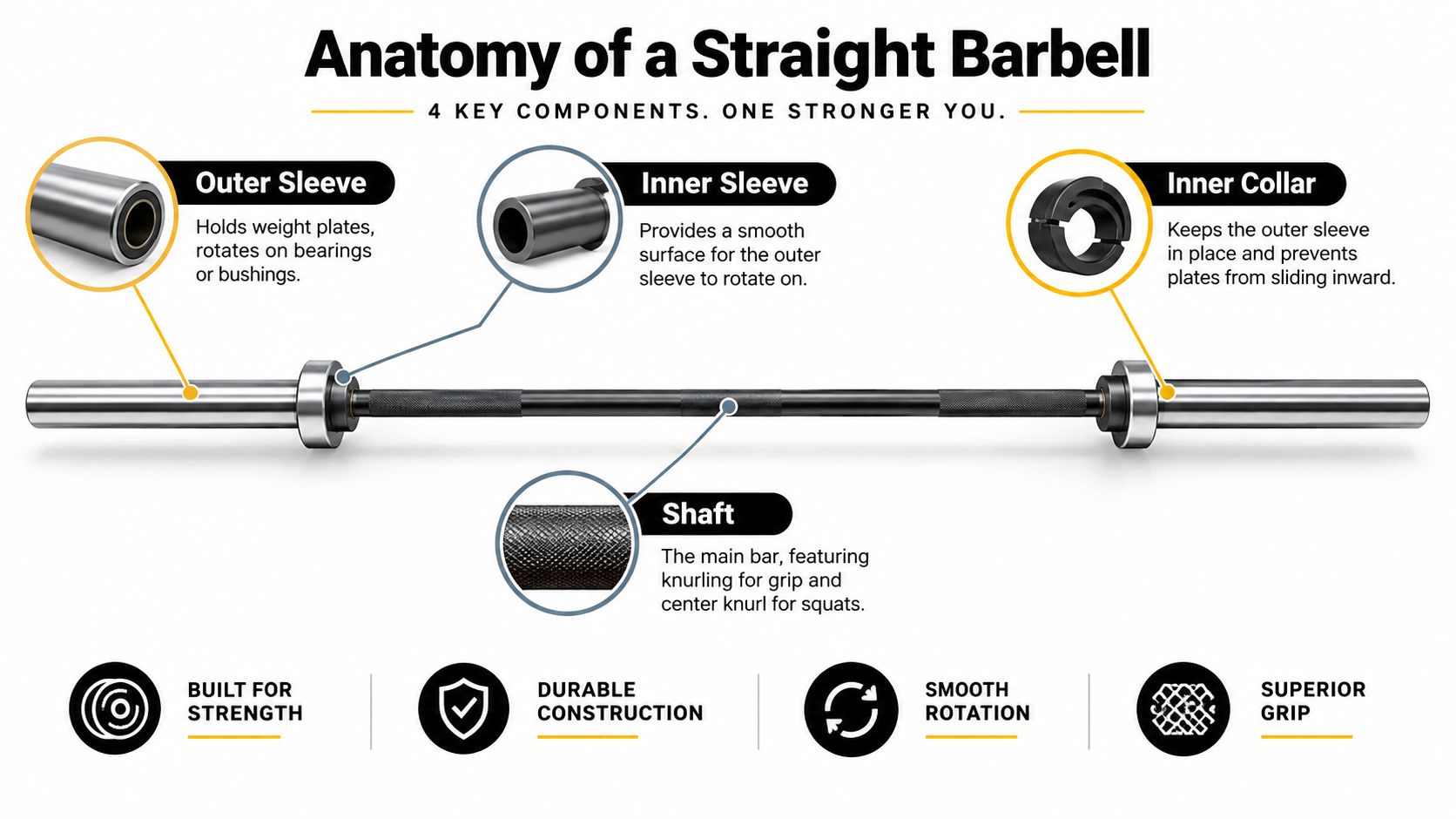
Locate the parts you actually feel
The shaft diameter changes how securely the bar sits in your hand and how much it flexes. Women's Olympic bars generally use a 25 mm shaft, men's Olympic bars about 28 mm, and powerlifting bars commonly around 29 mm (official Olympic bar specifications). A thinner shaft can suit a smaller hand and make a hook grip easier to close. A thicker shaft gives the hand more surface to wrap around and often feels firmer during pressing or pulling.
Sleeve length controls both loading space and balance. Full Olympic sleeves provide substantially more room than the short sleeves on many standard 1-inch bars. On heavy deadlifts, a short sleeve can limit the plates you fit before the bar's shaft capacity becomes the issue.
Knurling is the final contact point. A center knurl can help keep the bar from sliding during a squat, while sharper knurling can make heavy pulls feel more secure. Skin tolerance, grip strength, lift choice, and chalk all affect which texture feels appropriate.
For pressing setup and bar dimensions, use this guide to bench press bar dimensions and weight. Before judging a bar, hold the shaft, inspect the knurl, spin the sleeves, and read the collar markings. Those checks reveal more than the familiar “45 lb” label alone.
Olympic Straight Barbell Standards for Men and Women
A straight bar's label can be misleading. “45 lb” often describes a rounded gym convention, while Olympic standards distinguish the bar by mass, length, shaft diameter, and intended movement. Those details change how the bar sits in the hands and how it behaves during a pull, catch, squat, or press.
The International Weightlifting Federation sets the men's bar at 20 kg and the women's bar at 15 kg (IWF equipment requirements). Fixed empty-bar weights let athletes compare training loads across sanctioned competition environments.
A men's Olympic bar is typically 2.2 m long, with a 28 mm shaft and 50 mm sleeves. A women's bar is about 2.01 to 2.10 m long, with a 25 mm shaft and the same 50 mm sleeve diameter. The shorter body and thinner shaft affect hand placement, flex, and the bar's contact with the lifter during the pull.
The 45 lb label is a conversion shortcut
A 20 kg bar is approximately 44.1 lb, which explains the familiar 45 lb label in U.S. gyms. A true 45 lb bar equals 20.41 kg, so the two descriptions are close rather than identical. Rounding rarely changes a routine gym session, but accurate records matter for competition preparation and careful load tracking.
| Specification | Men's 20 kg Bar | Women's 15 kg Bar |
|---|---|---|
| Empty-bar weight | 20 kg, 44.1 lb | 15 kg, 33 lb |
| Typical length | 2.2 m, 2,200 mm | About 2.01 to 2.10 m, 2,010 mm |
| Shaft diameter | 28 mm | 25 mm |
| Sleeve diameter | 50 mm | 50 mm |
| Primary design goal | Dynamic Olympic lifts | Dynamic Olympic lifts with a smaller grip |
Powerlifting uses a different bar feel even when its competition bar also weighs 20 kg. IPF rules specify a straight bar no longer than 2.2 m, with a shaft diameter between 28 and 29 mm, sleeve diameter between 50 and 52 mm, and a total bar-and-collars weight of 25 kg (IPF technical rules). Its stiffer construction, knurl pattern, and diameter markings, including marks spaced 81 cm apart, support repeatable squat, bench, and deadlift setup.
A training bar may follow the same general dimensions without carrying the same competition designation. Check the end-cap marking and weigh the unloaded bar when the exact starting load matters.
How Shaft Diameter and Tensile Strength Change the Feel
Bar weight is only part of what reaches your hands. A 28 mm Olympic bar can flex and settle as plates leave the floor, while a stiffer 29 mm powerlifting bar feels more planted. That flex changes how quickly tension travels through the bar to the plates, so the first part of a deadlift can feel either responsive or deliberate.
You may notice the difference even more in a clean. Olympic bars are designed with more whip than thicker power bars, and that controlled movement can suit a fast turnover. A stiffer bar often feels calmer in a heavy squat or deadlift, yet less responsive when the bar must move quickly around the body (Olympic and power bar comparison).
Diameter changes your hand position
Shaft diameter changes the way your fingers close around the bar. A thinner shaft sits more securely in many hands, which helps explain why a 25 mm women's bar suits the grip demands of Olympic lifting. A 28 mm Olympic shaft balances grip comfort with flex. A 29 mm power bar gives up some of that liveliness for stiffness and a firm, repeatable hold.
Tensile strength describes how much stress the steel can withstand before it permanently deforms. Barbell specification guidance places strong-lifter benchmarks above 180,000 PSI, with around 200,000 PSI often cited for powerlifting bars (barbell tensile-strength guidance). That figure helps compare materials, but it cannot predict the entire experience in your hands. Diameter, heat treatment, sleeve construction, and whip also shape how the bar behaves.
| Bar Type | Shaft Diameter | Tensile Strength | Typical Feel |
|---|---|---|---|
| Women's Olympic bar | 25 mm | Varies by manufacturer | Fast, lighter grip, controlled whip |
| Men's Olympic bar | 28 mm | Strong-lifter benchmarks can exceed 180,000 PSI | Flexible and responsive |
| Powerlifting bar | 28 to 29 mm | Around 200,000 PSI often cited | Stiffer and more predictable |
| General training bar | Varies | Varies | Depends heavily on construction |
A bar that feels lively and helpful in a clean can feel unsettled during a heavy bench press. Match the bar's movement to the lift. Compare the shaft diameter and tensile-strength rating together, rather than treating one specification as a complete quality score.
Straight Bar vs EZ Curl, Trap, and Specialty Bars
The straight bar remains the default because it asks the lifter to control a fixed hand position across squats, presses, rows, deadlifts, and Olympic lifts. It also offers long sleeves and broad compatibility with Olympic plates when the bar uses the 50 mm sleeve standard. That versatility comes with a cost: your wrists and shoulders must accommodate the position the shaft creates.
An EZ curl bar changes the angle through its cambered grip. That can reduce wrist stress for curls and certain extensions, but the shorter sleeves usually give you less room for loading. A trap bar places the handles beside the body and centers the load around the lifter, which can make deadlift setup feel more ergonomic. It doesn't replace the unilateral loading demands and fixed bar path of a straight bar.
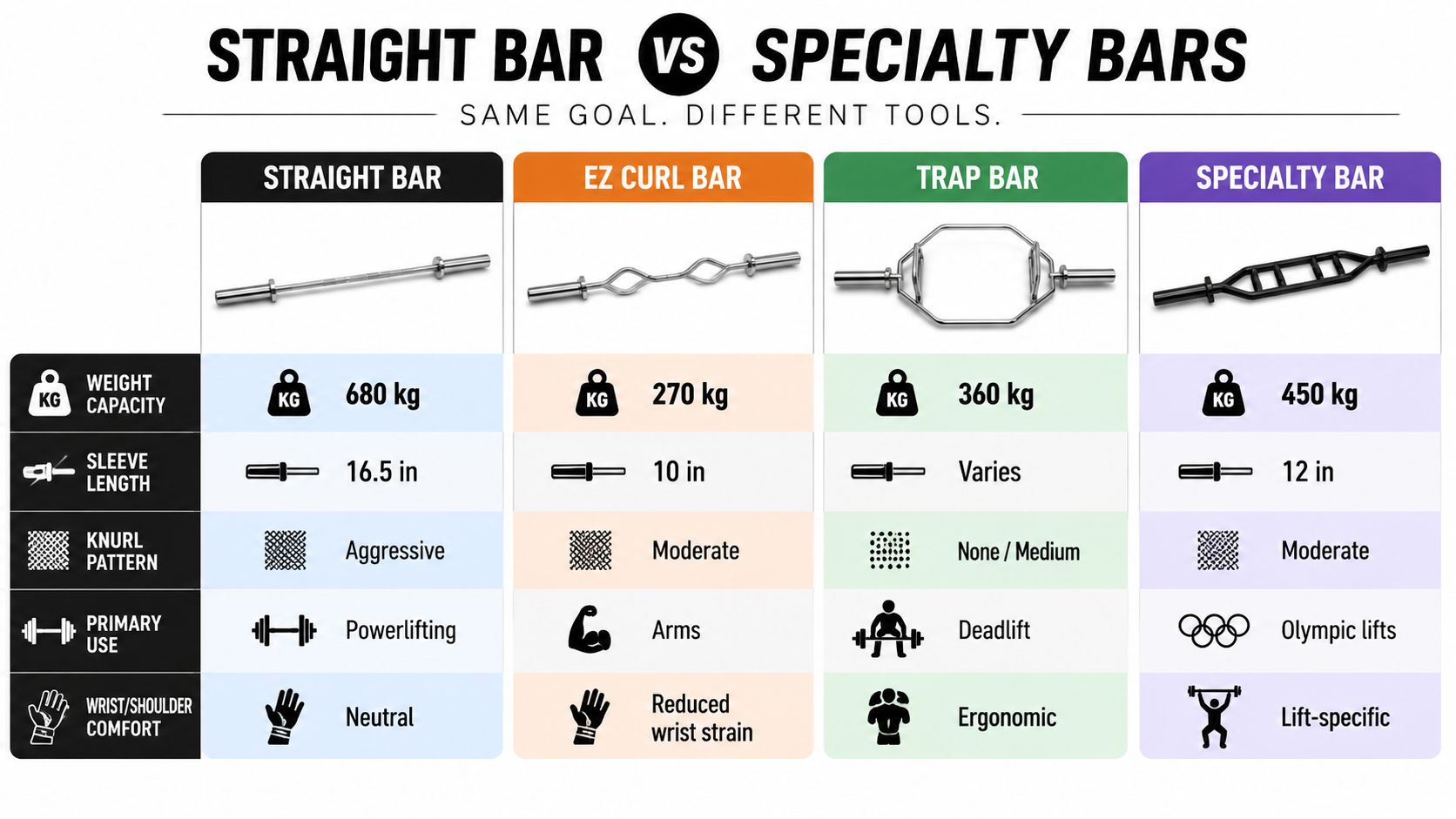
Choose the tool for the limitation
- Straight bar: Best for broad programming, competition-specific practice, and lifts that require a centered shaft.
- EZ curl bar: Useful when a fixed straight grip makes arm work uncomfortable or limits consistent technique.
- Trap bar: Suits deadlift variations where neutral handles and a centered load are priorities.
- Specialty bars: Swiss, cambered, and safety squat bars address specific positions, joint demands, or weak points.
Specialty bars can be valuable supplements, not universal replacements. A safety squat bar may help a lifter train around a difficult shoulder position, while a cambered bar can challenge upper-back control. The equipment works because it changes the problem. That also means it may not reproduce the exact demands of a straight-bar competition lift.
For a broader equipment overview, use this barbell type comparison when you're deciding which tools belong in a home gym.
The video below adds a visual look at how different bar designs influence lifting applications.
Choosing the Right Straight Barbell for Your Training
A straight barbell is not automatically a 20 kg or 45 lb purchase. The right choice depends on the lifts you perform, how the shaft moves under load, the plates you own, and whether the bar physically fits your rack. Choose those details before comparing coatings or cosmetic finishes.
Match the bar to your main lifts
Powerlifting-focused training usually suits a stiff bar with a 28 to 29 mm shaft, clear powerlifting markings, and center knurling to help the bar stay secure during squats. The IPF technical standards provide a useful reference for competition-style dimensions.
Olympic lifting calls for a different feel. A bar with a 25 to 28 mm shaft, rotating sleeves, and more whip can move with cleans and snatches rather than resisting every change of position. The Olympic bar guide explains these design differences. A power bar feels like a rigid steel beam, while an Olympic bar gives slightly under a fast, heavy pull.
General strength trainees can choose a men's or women's Olympic bar according to body size, grip preference, and the loading standard they want to track. A lighter training bar may help a beginner practise technique, but check its stated mass instead of trusting the category name.
Check the practical fit
Use this checklist at the rack or retailer:
- Primary lifts: Decide whether stiffness, whip, knurling, or sleeve rotation matters most.
- Empty-bar mass: Confirm whether the bar is 20 kg, 15 kg, or another stated weight.
- Plate compatibility: Check whether the sleeves accept 50 mm Olympic plates or standard 1-inch plates.
- Rack and floor space: Confirm overall length, sleeve clearance, and storage position.
- Construction details: Review tensile strength, sleeve mechanism, finish, and warranty.
- Training frequency: Give durability and service support more weight if the bar will handle frequent heavy sessions.
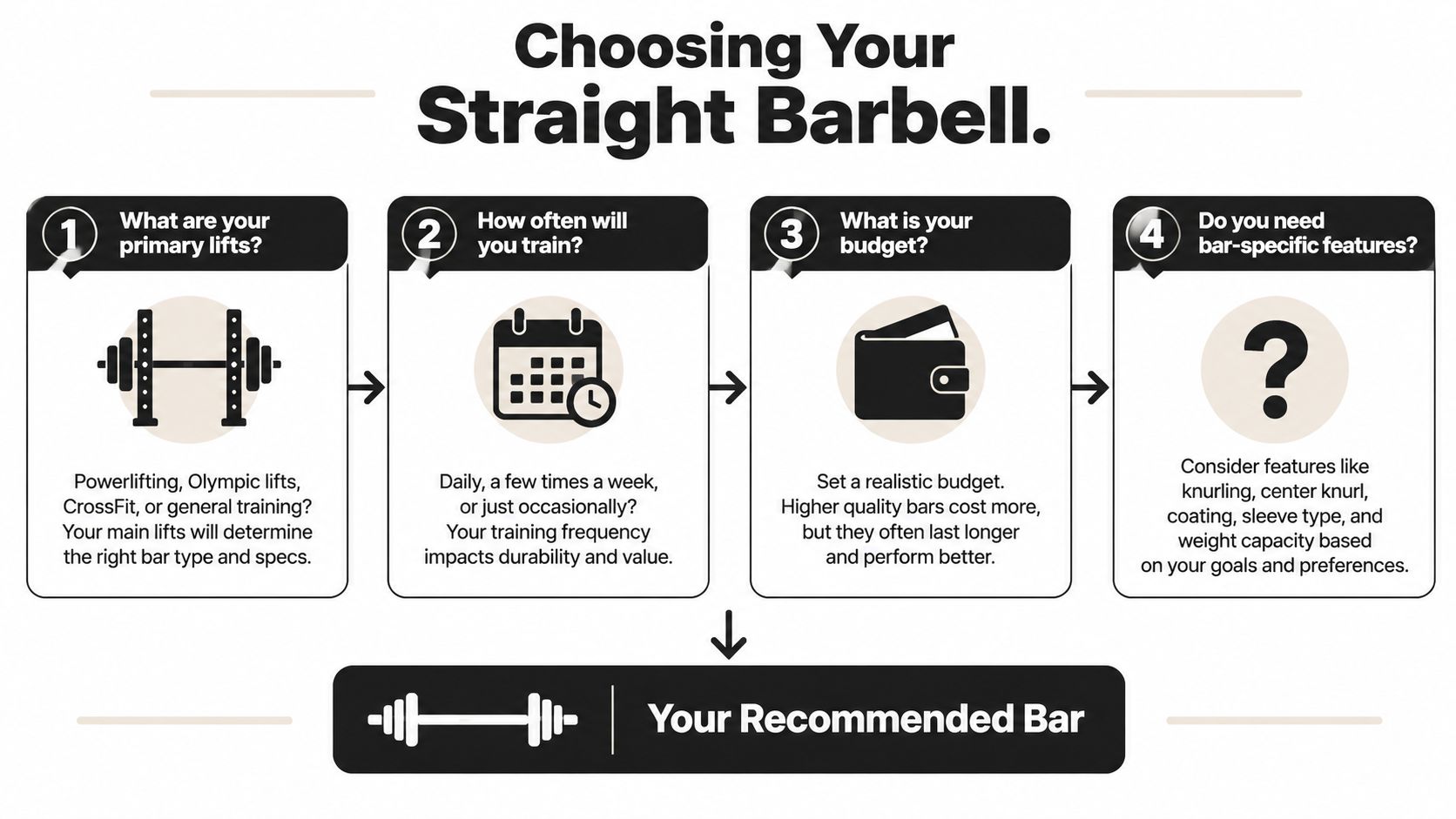
An Olympic lifter should not choose a stiff power bar because its load rating looks impressive. A home-gym owner who mainly squats, benches, and deadlifts may not need rapid sleeve rotation. Match the bar to the program, then pay for features your hands and lifts will use.
Maintenance, Safety, and Grip Practices That Protect the Bar
A barbell's service life depends more on routine care than on occasional deep cleaning. Chalk, sweat, moisture, and careless plate handling collect around the knurl and sleeves. A short post-session check helps preserve grip texture, sleeve movement, and the shaft's straightness.
Start with three simple actions:
- Wipe the shaft: Use a suitable light oil after training when the finish and manufacturer guidance allow it.
- Brush the knurl: Work a nylon or appropriate barbell brush through the grooves to remove chalk buildup.
- Store it correctly: Keep the bar horizontally supported in a dry area, rather than leaving it where moisture can sit against the steel.
Protect the moving parts
Olympic sleeves should rotate smoothly. Don't yank plates off at an angle, because abrupt plate removal can stress the sleeve assembly and the plate edges. Support the bar while changing plates, and investigate grinding, binding, or unusual side-to-side movement instead of continuing to load a questionable sleeve.
A straight bar should also stay straight. Store it on a rack or floor cradle that supports it properly, and avoid using the shaft as a lever or leaving it under an uneven load. For facility owners, this preventive maintenance checklist from Facility Management Insights offers a useful framework for documenting routine equipment checks.
Treat grip as part of bar control
Sweaty hands reduce friction. Clean, dry knurling and sensible chalk use help the lifter maintain contact without squeezing the bar unnecessarily hard. Keep calluses smooth, avoid tearing damaged skin, and wipe excess chalk from the shaft after training so the next lifter gets a usable grip surface.
For a practical cleaning routine, follow this barbell cleaning guide. A 30-second finish works well: brush the knurl, wipe the shaft, spin each sleeve by hand, and return the bar to dry storage. That small routine protects both the equipment and the next lift.
Common Bar Weight Mistakes and a Quick Verification Checklist
The most expensive mistake is trusting a label without checking the bar in your hands. A commercial gym may call a 20 kg Olympic bar “45 lb,” while another bar may be a standard 1-inch model with a different empty weight. The lifter who records every session as if the bars were identical loses accuracy before the first working set begins.
Other errors are more physical. Lifters sometimes mix 1-inch and 2-inch bars and plates, overlook short sleeves that limit loading, or assume a women's bar and men's bar behave identically because both are straight. A damaged or poorly maintained bar can also develop sleeve or shaft problems that change how it handles, even when the printed label remains unchanged.
Verify the bar before you program around it
Use this checklist when you buy a bar or encounter an unfamiliar one:
- Weigh the unloaded bar: Use a calibrated scale, luggage scale, or bathroom scale method when the manufacturer hasn't clearly stated the mass (bar-weight verification guidance).
- Measure the shaft and sleeves: Calipers can distinguish a 25 mm, 28 mm, or 29 mm shaft and confirm whether the sleeves match the plates you own.
- Confirm tensile strength: Compare the stated rating with the loads and lifts you plan to perform. A higher rating doesn't replace correct diameter, sleeve, or knurl selection.
- Inspect the knurl: Check its depth, center section, and condition. A squat-focused bar and an Olympic bar may present very different contact points.
- Record the bar details: Keep the manufacturer, serial information, and purchase documentation available for warranty or equipment records.
Numbers beat labels every time.
Measure first, then enter the actual empty-bar weight in your training log. If you're building a gym around reliable bar control, Evermost LLC offers EVMT Liquid Chalk, a fast-drying, sweat-resistant grip option for barbell training that's available in portable and higher-volume formats. Use it alongside sound bar selection, accurate load tracking, and a consistent maintenance routine.