


Ring Size 10: The Ultimate Guide to US, UK & EU Conversion
You've ordered a ring online, opened the box, and found that the band either stops at the knuckle or spins around your finger. The label says size 10, yet that number alone hasn't told you enough about the actual fit.
Ring size 10 has a precise millimeter meaning, but regional charts, band width, knuckle shape, temperature, and setting design can all change how it feels. A broad band or low-profile bezel may need more careful fitting than a narrow, rounded ring, even when both carry the same nominal size.
Introduction to Ring Size 10
A ring marked size 10 can fit comfortably in one design and feel restrictive in another. A shopper may compare a familiar ring with a new wide band or low-profile bezel, expecting the same fit, then find that the second ring pinches or sits less securely. The label stays the same, while the interior shape, band width, and edge profile change how the finger settles.
A slim, rounded band may feel more forgiving. A broad band covers more of the finger, and a low-profile bezel can leave less room around its setting. These styles make fit depend on more than the number stamped inside the ring.
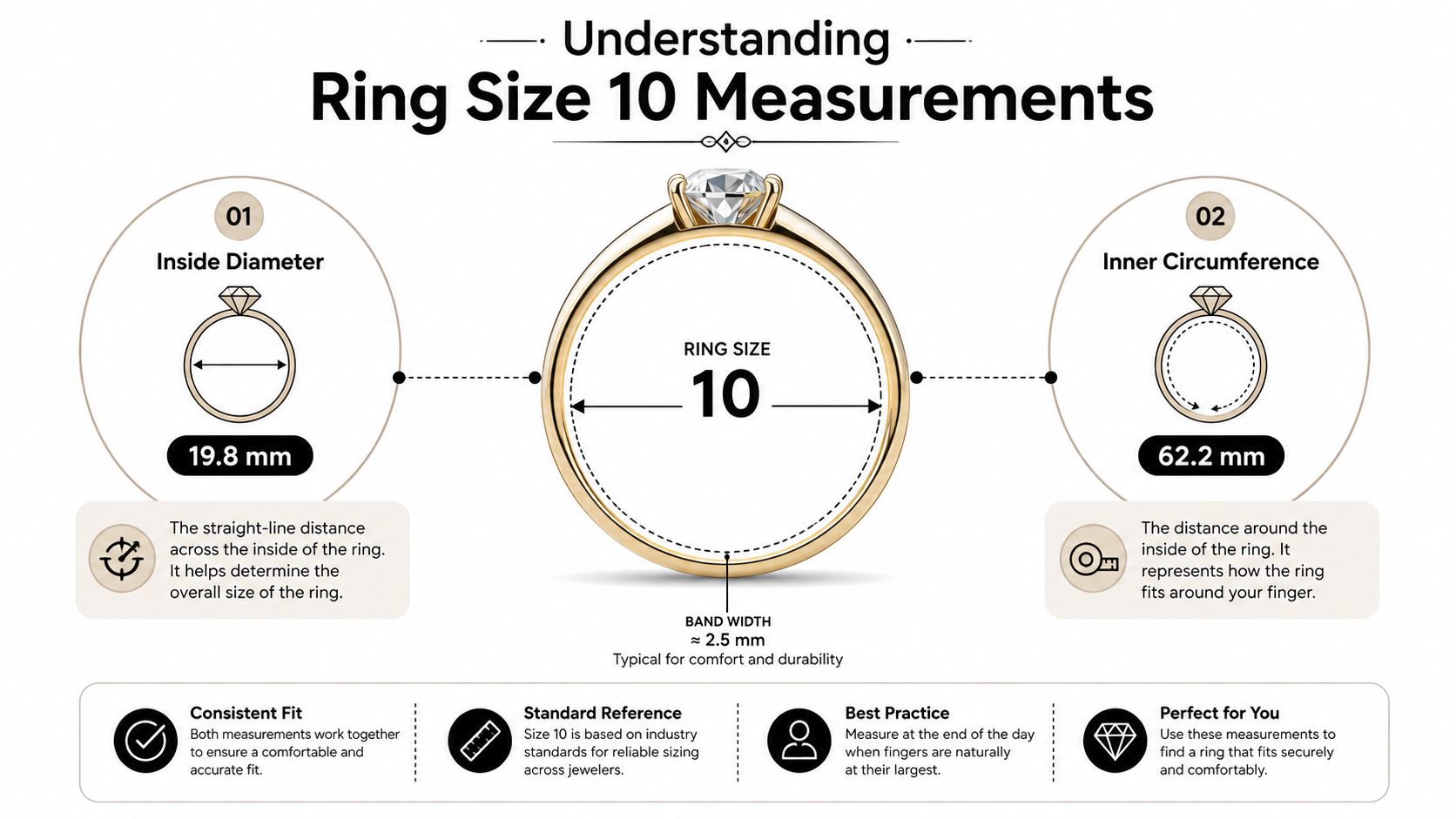
Start with measurement rather than the label alone. A size chart supplies a nominal reference, while the inside diameter and inner circumference describe the space your finger occupies. North American charts place size 10 near 19.8 mm in inside diameter and about 62.1 to 62.2 mm in inside circumference (Larson Jewelers' U.S. ring sizing chart).
That number is only the beginning of the fit story. The sections ahead explain how to read these measurements, compare international labels, measure your finger, judge modern ring styles, and buy with fewer surprises.
Understanding Ring Size 10 Measurements
Ring size 10 describes the space inside the ring. It does not describe the metal's outer diameter or the band's total width. Inside diameter runs straight across the opening, while inner circumference follows the inside wall around the finger.
For U.S., Canadian, and Mexican sizing systems, whole size 10 measures about 19.8 mm in inside diameter, or 0.778 to 0.781 inches, with an inside circumference of about 62.1 to 62.2 mm, or 2.44 inches. These figures provide a physical reference for comparing a retailer's chart and a ring's construction.
Why millimeters matter
Small changes on a chart can affect comfort. Around size 10, quarter-size increments shift the diameter by roughly 0.16 to 0.20 mm. Size 10¼ is roughly 20.0 mm, while size 10½ is roughly 20.2 mm.
Your finger has a continuous shape, but ring labels advance in set steps. A measurement between labels may therefore need a jeweler's judgment, particularly if the ring has a wide shank or an unusual interior contour. A wide band covers more of the finger and can feel tighter than a slim band with the same nominal size. A low-profile bezel may also leave less room around the setting, changing how the ring settles and how securely it stays in place.
Practical rule: Treat the measured millimeters as the fit specification; the size number is only its shorthand.
Inner circumference is especially useful because it follows the surface that touches your finger. If a retailer lists only “size 10,” ask for the internal measurements and consult that brand's own chart. For shoppers comparing gemstone designs, an Ametrine ring for gemstone enthusiasts shows how a stone setting and band construction can influence the ring's proportions, even when its listed size differs.
Diameter and circumference are related, not interchangeable
Inside diameter gives a quick cross-sectional reference. Circumference indicates the total room around the finger. They describe the same opening from different directions, yet comfort can vary because fingers are not perfect cylinders.
A rounded inner profile may pass over the knuckle more comfortably than a flat interior. A square-edged band may feel more restrictive at the same nominal size. For a dependable choice, compare the physical measurements with the ring's width, inner profile, and setting design.
Converting Ring Size 10 Globally
A U.S. size 10 doesn't translate into one universally agreed international label. Retail conversion charts commonly place it around UK T or T½, European 61½ to 62, and Japanese 20 (Goldsmiths' ring sizing guidance).
| Region | Label | Diameter (mm) | Circumference (mm) |
|---|---|---|---|
| United States | 10 | About 19.8 | About 62.1 to 62.5 |
| United Kingdom | T or T½ | Comparable sizing band | Comparable sizing band |
| Europe | 61½ or 62 | Comparable sizing band | About 62 |
| Japan | 20 | Conversion equivalent | Conversion equivalent |
The table is useful for orientation, but it shouldn't replace the seller's own chart. One retailer may map U.S. 10 to UK T and Continental 62, while another may use UK T½. Another chart places U.S. 10 at 19.8 mm diameter and 62 mm circumference, with UK T½ as the nearest U.K. label (Solvar's ring size guide).
Why labels disagree
International systems don't use a single shared naming convention. Some labels represent a measured circumference, while others use a numbered sequence or a regional scale. Rounding practices also differ, and brands may assign a nearest equivalent rather than an exact physical match.
For an online order, compare the physical dimensions first. Kay's guide places U.S. size 10 at about 19.8 mm inside diameter and 62.1 to 62.5 mm inside circumference, within the same general band as UK T or T½ and European 62 (Kay Jewelers' ring size guide).
A retailer serving multiple markets should publish both measurements beside the regional label. That approach gives an international customer something concrete to compare with a ring that already fits, and it reduces the risk of treating a familiar number as a universal standard.
Measuring Your Finger for Ring Size 10
A ring measurement and a finger measurement answer related but different questions. Measuring an existing ring tells you the size of its opening, while measuring your finger tells you how much space your finger needs. For either method, aim for a snug result without compressing the skin.
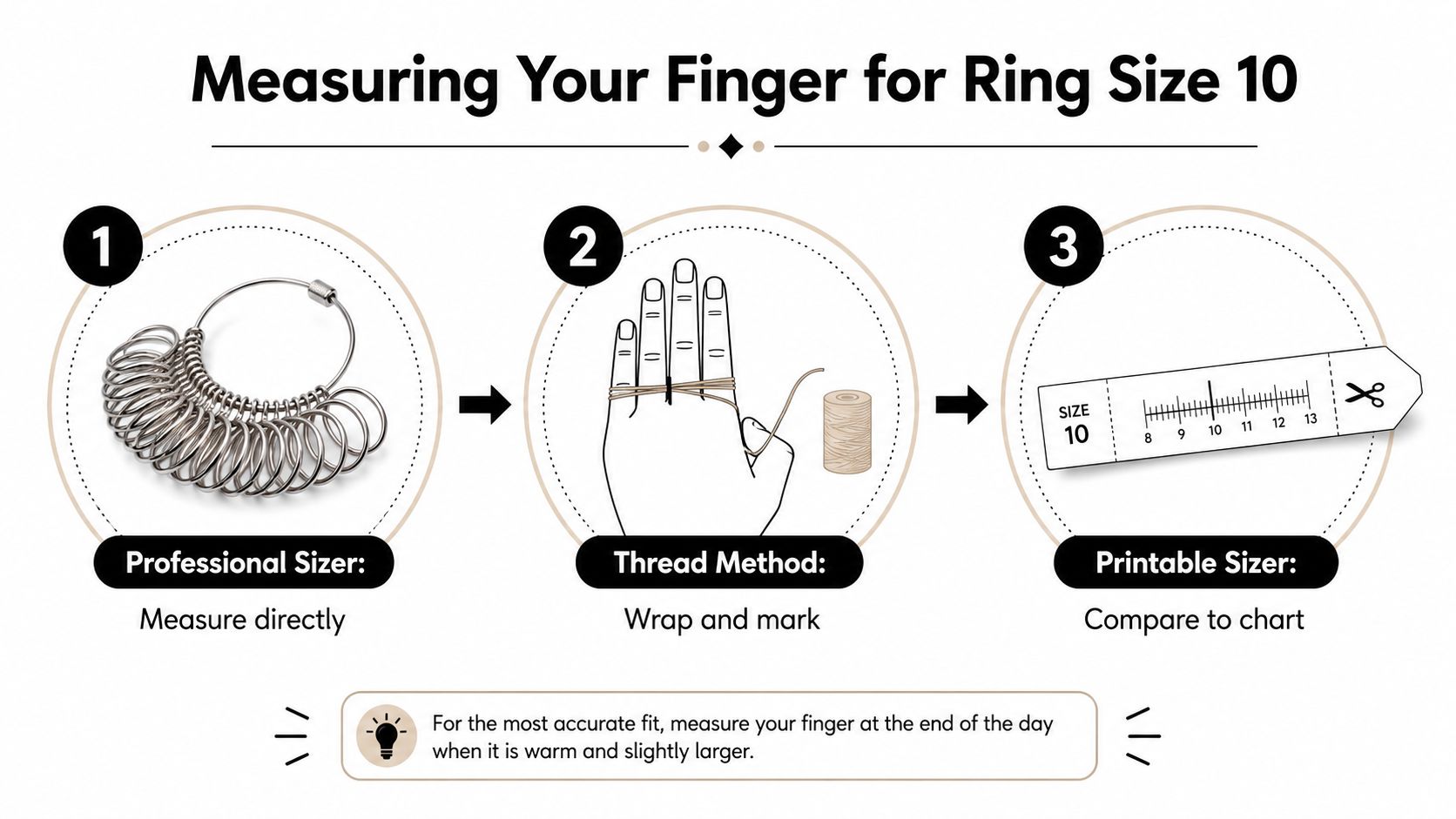
Method one, use a professional ring sizer
A metal or plastic ring sizer is the clearest home tool.
- Slide the individual sizer onto the intended finger.
- Check that it passes over the widest part of your knuckle.
- Tighten or loosen the sizer until it sits securely without pinching.
- Read the marked size, then compare it with the seller's millimeter chart.
- Repeat the check while your hand is relaxed.
A jeweler can also compare the knuckle and finger base directly. This matters when the knuckle is substantially wider than the area where the ring rests.
Method two, use thread carefully
Thread can provide a rough circumference estimate, but it's easy to distort.
- Wrap a non-stretch thread around the finger where the ring will sit.
- Keep it comfortably snug, not tight enough to indent the skin.
- Mark the overlap.
- Lay the thread flat against a ruler and record the length.
- Repeat the measurement and compare the result with a ring chart.
Don't pull the thread taut. Stretching it produces a falsely small reading, while leaving it loose produces a falsely large one. Avoid using elastic material, and take care with paper strips that can bend or change shape.
For a fuller walkthrough, use this guide to measure ring size at home. If you're considering tape as part of a hand-measurement routine, this explainer on tape for fingers provides useful context about material behavior and placement.
Method three, compare with a printable sizer
A printable guide can work when it's printed at the correct scale.
- Confirm scale: Check the printed guide against its stated reference measurement.
- Cut accurately: Follow the outline rather than estimating with a screen.
- Test the fit: Wrap the strip around the finger and compare the overlap with the chart.
- Record the result: Write down the measured circumference, not only the suggested size.
Measure when your hands are at a normal, comfortable temperature. Fingers can feel different at different times of day, so repeat the check rather than treating one reading as definitive.
A visual demonstration can make placement easier:
Evaluating Ring Fit Beyond Numbers
A ring can match the chart and still feel wrong. Your finger includes a knuckle, soft tissue, temperature changes, and an uneven shape that a sizing chart reduces to a circle.
Begin with the narrowest point the ring must cross. If your knuckle is wider than the finger base, a ring that fits the base may become difficult to remove. Sizing only for the knuckle can leave the ring rotating or feeling loose during everyday wear. The right fit balances both points, like a door that must clear its frame but should not swing freely once closed.
Band width changes the experience
A narrow band leaves more skin visible above and below the ring. A wide band covers more of the finger, so it often feels tighter even with the same inside diameter. Thick shoulders, a flat interior, or a bezel extending across the finger can create similar pressure.
Size 10 is often presented as a men's starting point, but that label does not settle the fit of a broad modern band. Thicker bands, bezel and burnish settings, low-profile designs, and personalized construction all make style-specific fitting more important (Element 79's men's ring sizing guide).
Do not add a quarter size automatically. Test the exact width and interior profile whenever possible. A quarter-size adjustment may suit some wider designs, but the choice depends on your finger, the ring's geometry, and whether the band must pass over a prominent knuckle.
Temperature and daily movement
Hands can feel different after exercise, in cold surroundings, or following prolonged heat exposure. A ring that feels comfortable on cool fingers may become restrictive later. A loose ring can also rotate more when the finger contracts.
Fit check: A well-fitting ring should pass the knuckle with controlled resistance, sit securely at the base, and come off without force or discomfort.
Wear the ring long enough to notice rotation, edge pressure, and swelling during normal hand use. If you lift, climb, or perform manual work, remove it before an activity that could trap your finger or damage the piece. Guidance on preventing calluses from lifting may also help you separate skin irritation from an incorrect size.
Sleeve-style and hinged rings need a different removal check. Their opening may clear a large knuckle more easily than a solid band, yet the hinge or sleeve can press against the finger during movement. Open and close the mechanism repeatedly, then confirm that it stays secure at the base without pinching. A low-profile bezel may feel comfortable at rest but press against nearby fingers when your hand closes, so test the ring in a natural fist as well as with relaxed fingers.
Buying Tips for Ring Size 10
Start with a retailer that publishes inside diameter and circumference, not just a regional size number. Those measurements let you compare the listing with a ring you already wear and expose differences between brand charts.
Next, examine the design details. Ask whether the band is narrow, wide, flat inside, rounded inside, bezel-set, or heavily ornamented. A jeweler should explain whether the piece can be resized, whether an insert is possible, and how the setting limits adjustment.
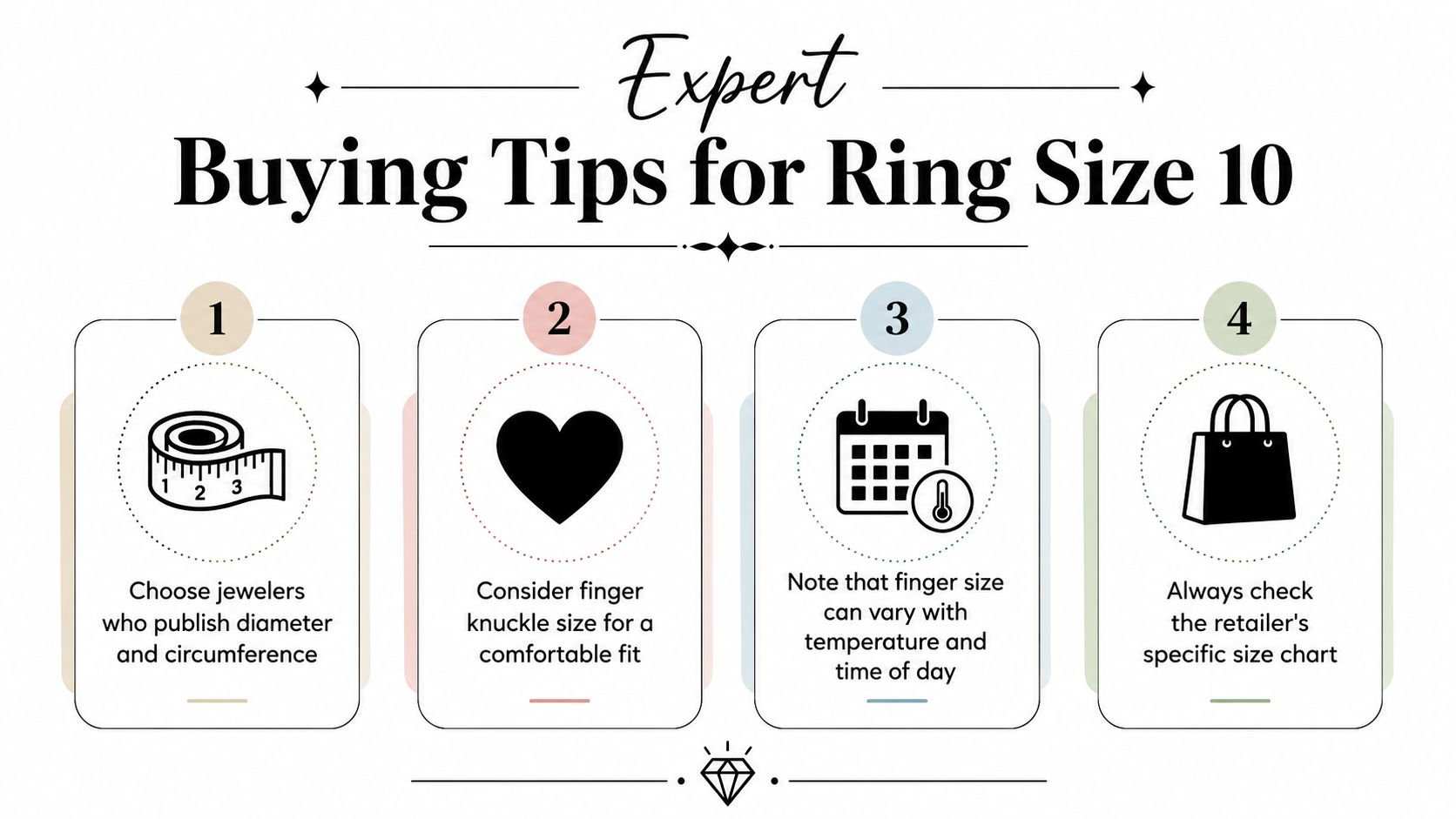
Use this quick buying screen:
- Verify measurements: Match the listing's millimeter values with your measured finger or a ring that fits.
- Check the style: Treat wide bands and architectural settings as separate fit decisions, not automatic size 10 purchases.
- Review stock carefully: A common reference size may not be the best stock choice for every contemporary or custom design.
- Read the policy: Confirm return, exchange, resizing, and engraving conditions before ordering.
Pricing can also vary with materials, labor, construction, and customization. Readers comparing handmade or personalized pieces may find these market insights on jewelry pricing useful when evaluating why two similarly sized rings have different prices.
If you train with weights or use your hands intensively, account for when the ring will be worn. A comfortable everyday fit may not be appropriate during barbell work, climbing, gymnastics, or other grip-heavy sessions. Skin comfort matters too, so a practical industrial-strength hand healer can be part of a broader hand-care routine, but it won't correct an incorrectly sized ring.
Evermost LLC offers clean, high-performance liquid chalk for lifting, climbing, gymnastics, dance, and other grip-intensive training, helping athletes manage sweat without loose chalk clouds. Visit Evermost LLC to explore its gym-approved formulas and choose a grip solution that fits your training environment.