


Pure Grip Liquid Chalk: What It Is and How to Use It
Sweat ruins grip in a very specific way. The hand feels strong, the back or fingers are ready, and then the bar starts to turn, the hold feels slick, or the pole stops feeling secure. The problem isn't always strength. Often, it's moisture sitting between skin and surface.
That's where Pure Grip liquid chalk makes sense. It gives sweaty-handed athletes a fast-drying layer of magnesium carbonate without the dust cloud that comes with loose chalk. For some people, that layer is enough on its own. For climbers, it often works better as a base layer under regular powder chalk, especially on longer routes and in humid gyms.
Table of Contents
- When Sweat Steals the Lift
- What Liquid Chalk Actually Is
- Liquid Chalk vs Powder, Chalk Balls, and Gloves
- Who Pure Grip Liquid Chalk Is Built For
- The Climber's Base Layer Move
- How to Apply, Layer, and Wash It Off
- Skin Safety and Sensitive Hands
- Buying Checklist Before You Commit
When Sweat Steals the Lift
A deadlift can be lost at lockout because the palm gets damp before the legs give out. A crux move can fall apart because fingertips feel greasy halfway through the sequence. A pole athlete can feel the loss of contact at the worst possible moment, right when timing matters most.
That's the job of Pure Grip liquid chalk. It isn't magic and it doesn't replace training. It deals with a narrower problem. It helps when sweat becomes the layer that breaks contact.
What changes when sweat is the issue
Liquid chalk is typically magnesium carbonate suspended in alcohol. Climbing and sports guidance consistently describes that setup the same way: the alcohol flashes off quickly and leaves a dry coating behind, which cuts dust and residue compared with loose chalk, especially indoors.
In practical terms, that means the athlete doesn't need a chalk cloud around the platform, the pull-up rig, or the climbing wall. That matters in shared spaces, at home, and in public events where clean operation matters. For gyms, schools, and event organizers using temporary climbing setups, an event rock climbing wall rental is one example of an environment where low-mess grip options make more sense than loose powder.
Practical rule: If the hand slips because it's wet, a drying grip aid is usually more useful than simply squeezing harder.
Sweaty palms are common enough that many athletes start by solving that issue before changing anything else. A short breakdown on how to stop sweaty palms can help separate grip problems caused by sweat from grip problems caused by skin damage or fatigue.
Where people get confused
A lot of confusion starts with the word “chalk.” People hear it and assume every format works the same. It doesn't. Powder sits on the skin differently. Liquid dries into a thin film. That difference changes how each one behaves on a bar, a hold, or a pole.
Pure Grip liquid chalk earns its place when the athlete wants cleaner application, fast drying, and less airborne mess. It also earns its place when powder chalk isn't allowed.
What Liquid Chalk Actually Is
Liquid chalk sounds more technical than it is. It's still chalk. The difference is the delivery system.
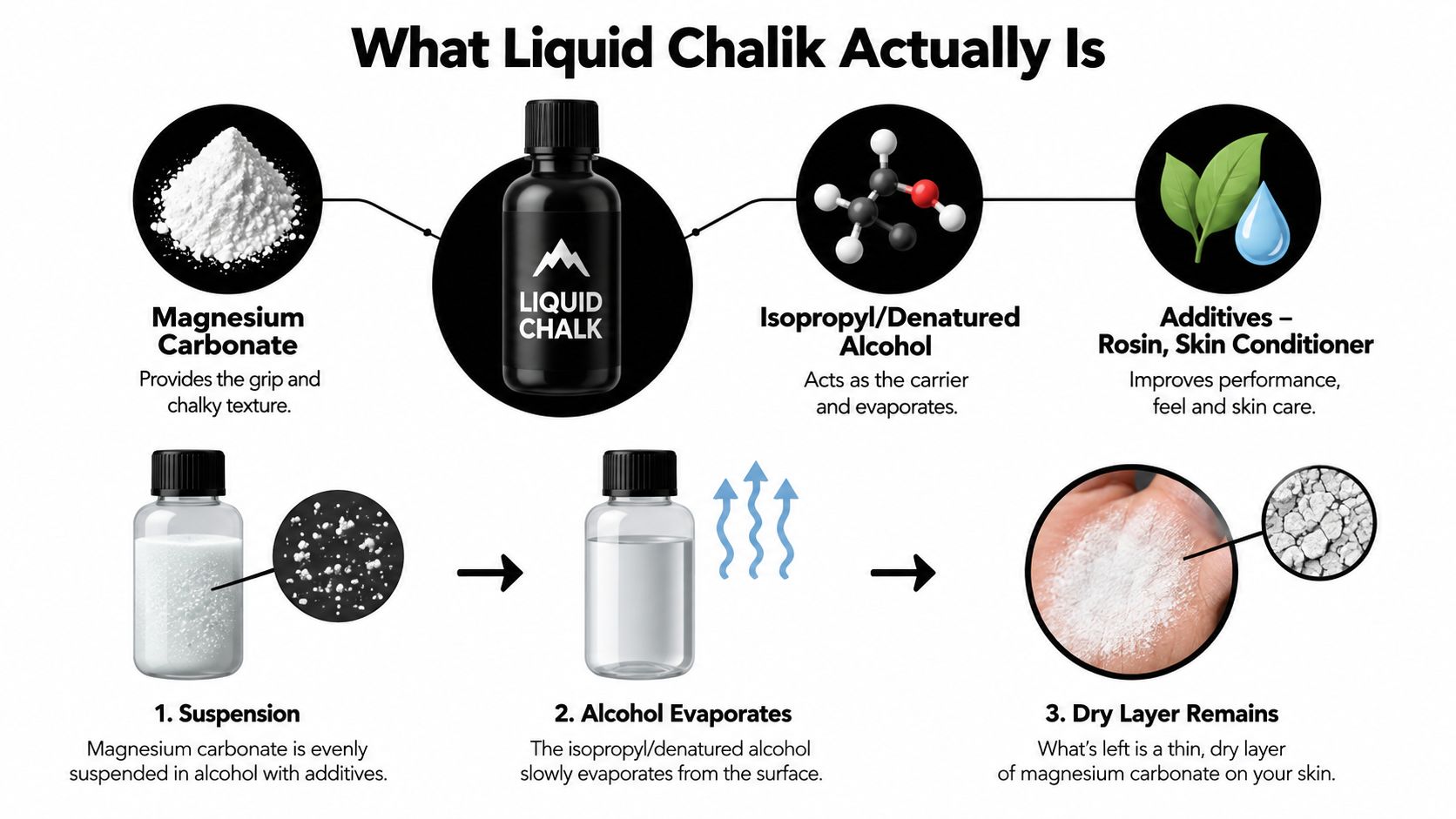
Most guidance describes liquid chalk as magnesium carbonate in an alcohol-based carrier. Once it's rubbed onto the hands, the alcohol evaporates and leaves behind a thin, even layer of chalk. Climbing reviews also note that this layer is low-dust and more durable than loose chalk, which is why it's often favored in indoor spaces and by athletes with sweaty hands.
What the alcohol actually does
The alcohol isn't there for grip by itself. Its job is to spread the chalk across the hand, then disappear. A science summary on climbing chalk notes that the alcohol evaporates within seconds and can leave a thin film roughly 50 to 100 micrometers thick, which helps explain why liquid chalk feels more uniform than a handful of powder (surface and thickness explanation).
That thinness matters. Too much product can feel pasty. A thin coat usually feels more tactile and lets the athlete still sense the bar knurl, hold texture, or pole finish.
Why it behaves differently from powder
Loose chalk can work very well, but it doesn't always spread evenly on damp hands. It can clump in some spots and miss others. Liquid chalk tends to cover creases, fingertips, and palm lines more evenly because it starts wet and dries in place.
That's the practical reason some athletes keep it around even when they also use powder. A bottle like EVMT LIQUID CHALK fits that role. It's a liquid chalk product for weightlifting, gymnastics, rock climbing, and other grip-heavy sports.
A thin coat usually works better than a heavy one. More product doesn't always mean more friction.
Liquid Chalk vs Powder, Chalk Balls, and Gloves
No grip aid wins every situation. The right choice depends on three things: how much the hands sweat, what the venue allows, and what kind of contact the sport demands.
Liquid chalk usually wins on cleanliness and convenience. Loose powder often wins when an athlete wants quick top-ups and that dry, dusty feel. Chalk balls sit in the middle. Gloves solve a different problem entirely.
Side-by-side decision table
| Attribute | Liquid Chalk | Loose Powder | Chalk Ball | Grip Gloves |
|---|---|---|---|---|
| Sweat resistance | Strong choice for sweaty hands because it dries into a film | Works well, but can break down faster on very damp hands | Similar chalk effect with less loose spread | Helps some users, but doesn't absorb moisture the way chalk does |
| Mess and residue | Low dust, low airborne mess | Highest mess and most visible spread | Lower mess than loose powder | No chalk mess, but gloves can trap heat and sweat |
| Drying time | Needs a short dry-down before use | Ready immediately | Ready immediately | Ready immediately |
| Gym and venue rules | Often allowed where powder is banned because it creates essentially no dust cloud and commonly dries in about 10 to 30 seconds (gym policy explanation) | Most likely to be restricted | More acceptable than loose powder in some spaces | Useful when all chalk is banned |
| Sport suitability | Strong for lifting, CrossFit, gymnastics, pole, and as a climbing base layer | Strong for climbing and heavy barbell sessions where re-chalking is part of the rhythm | Useful in shared gyms that want less dust | Better for hand coverage or callus comfort than pure friction |
The clean verdict
For commercial gyms, liquid chalk is often the easiest answer. One industry source reports that roughly 80% of the 50 largest U.S. commercial gym chains allow liquid chalk, while 30% allow powder chalk and 20% ban all chalk products entirely.
For climbing, powder still has a clear place. Climbers often need quick touch-ups and already carry chalk. That's why liquid chalk makes more sense as a primer than as a total replacement.
For athletes who can't use chalk at all, gloves are a rule-compliance tool, not a true chalk substitute.
Who Pure Grip Liquid Chalk Is Built For
Some athletes get immediate value from liquid chalk. Others don't need it often enough to justify making it a staple.
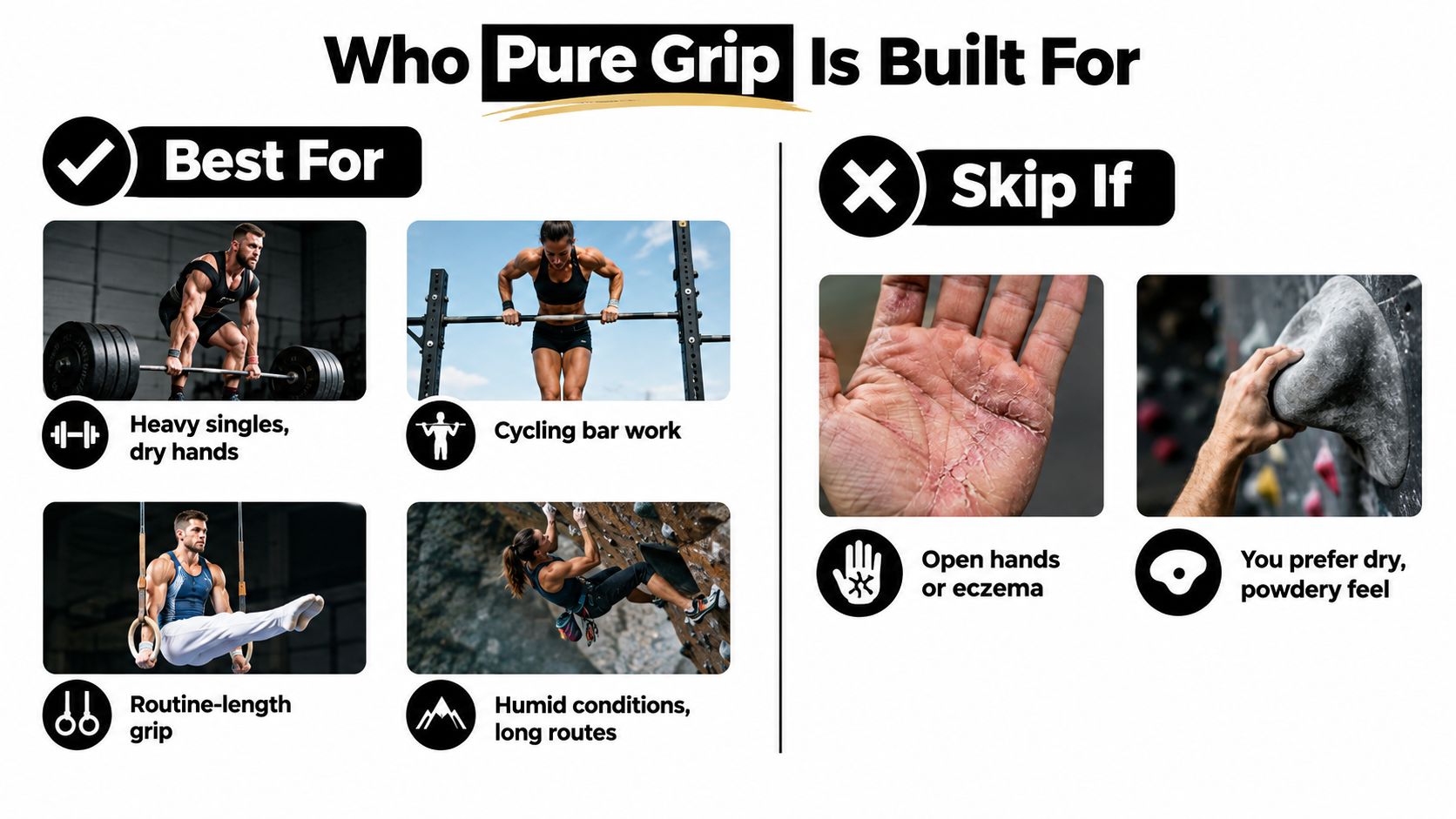
The best fit is the person whose hands are the weak link because they get wet fast. That includes lifters pulling heavy singles, CrossFit athletes cycling through repeated bar work, gymnasts working bars or rings, and pole athletes who need grip without powder drifting around the studio.
Athletes who usually benefit most
- Sweaty-handed lifters: They need a dry hand-to-bar connection more than a thick chalk coating.
- Indoor trainees: Low dust matters more when the room is shared, small, or tightly managed.
- Home-gym owners: They often want grip help without white footprints, powder on floors, or chalk settling on equipment.
- Athletes under gym restrictions: Liquid chalk is designed for exactly that situation. Multiple gym-industry sources describe it as a fast-drying film that replaces airborne powder with a cleaner layer, which is why many powder-banning gyms still allow it (restriction-friendly format).
Athletes who may want something else
Not everyone needs Pure Grip liquid chalk.
A dry-handed casual lifter may be fine with bare hands for most training. A climber who loves frequent powder top-ups on short boulders may not gain much from liquid except in humid sessions. Anyone whose gym bans all chalk products should check the rules before buying anything.
If a venue says “no chalk,” that may include liquid chalk. The bottle doesn't override the sign.
It also won't solve problems caused by torn skin, poor recovery between attempts, or forearm endurance that gives out before the target muscles do. Liquid chalk fixes moisture. It doesn't fix everything that feels like grip.
The Climber's Base Layer Move
Climbers are the group most likely to misunderstand liquid chalk at first. They already own powder chalk. They aren't looking for a replacement. They're looking for a way to make the chalk they already trust last longer.
That's where the base-layer approach makes sense.
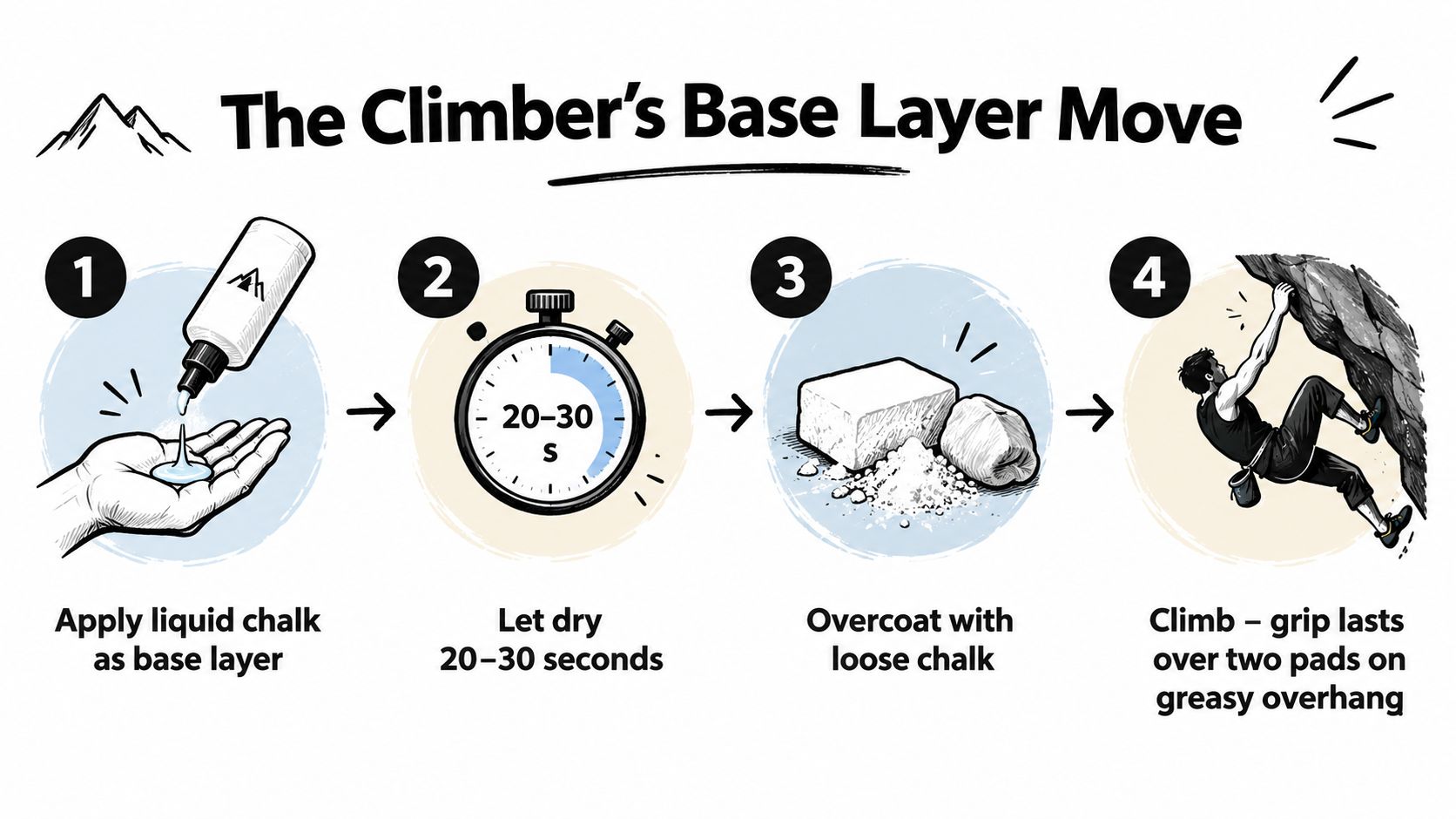
A humid gym session is the classic example. Powder goes on well at the start, then sweat pushes through, the fingers feel slick, and the climber reaches for the chalk bag again after only a few moves. On a longer route or a sustained overhang, those extra re-chalk moments add up.
The four-step sequence
- Start with dry hands. Lotion, fresh sweat, or damp skin gets in the way.
- Apply a thin coat of liquid chalk. Thin is the key word.
- Let it dry fully. A matte, chalk-dry feel matters more than rushing.
- Add a light powder layer on top. Then climb as usual.
This works because the dried liquid layer bonds to the skin first, then the powder sits on that surface instead of landing directly on a sweaty palm. Climbing-focused guidance also notes that liquid chalk leaves a bonded magnesium-carbonate layer after the alcohol evaporates, helping reduce residue on holds and rock while still supporting fingertip moisture control.
When this move makes the most sense
The layered approach is more useful on:
- Long sport routes
- Multi-pitch climbing
- Humid indoor gyms
- Endurance-heavy climbing sessions
It matters less on short boulders where re-chalking is easy and fast.
A related detail often gets missed. Chalk's grip benefit is highly context-dependent. A 2024 study found that chalk generally improved the static coefficient of friction on dry fingertips, but the result varied with roughness and moisture, with better results on dry contacts than on simulated sweaty conditions. The same science summary also notes friction increases of 18.7% on limestone and 21.6% on sandstone, supporting the idea that chalk works best by managing moisture rather than adding stickiness (friction and surface context).
That's why the base layer helps. It gives powder a drier place to sit.
How to Apply, Layer, and Wash It Off
Good application fixes half the complaints people have about liquid chalk. Most “it felt weird” or “it didn't last” stories trace back to too much product, wet hands, or touching the bar too soon.
The basic application sequence
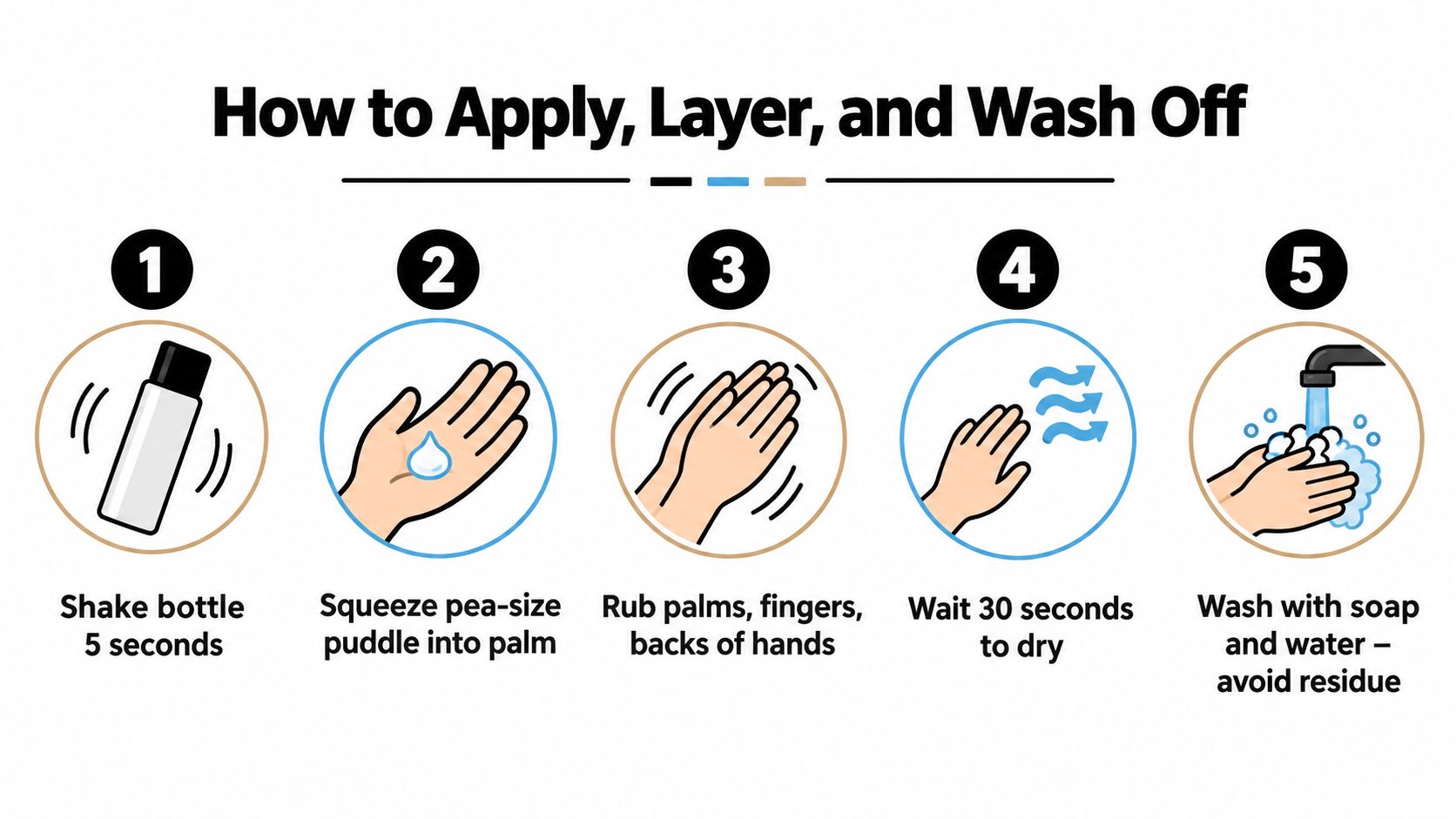
A simple routine works best:
- Shake the bottle briefly. Chalk settles when it sits.
- Put a small amount in the palm. Starting in the palm reduces waste.
- Rub across palms, fingers, and thumbs. Coverage matters more than thickness.
- Wait until fully dry before touching equipment. That's the step people rush.
A climbing guide recommends a thin, fully dried base layer rather than repeated heavy coats, especially because alcohol-based formulas can be drying on sensitive skin.
Layering rules that keep it useful
- One coat is enough for most starts: Add more only if the first coat has dried and the hands need it.
- Never apply over wet hands: The film won't set well on sweat.
- For climbers, top with powder only when needed: Indoors, liquid alone may be enough on some sessions.
- For bars and poles, less is cleaner: Heavy coats are more likely to leave visible buildup.
Coaching note: The best liquid chalk application is usually the one that almost looks too light.
Washing it off properly
Removal doesn't need anything fancy. Lukewarm water and soap usually handle it. If the product has built up around calluses or creases, a second wash may help.
Athletes who want a more detailed cleanup routine can use this guide on how to remove liquid chalk. After washing, moisturizer helps because alcohol and chalk both leave the skin drier than it started.
Equipment cleanup is simple too. Bars can be wiped down after use. Poles and specialty surfaces should be cleaned in line with the manufacturer's care guidance so the finish stays consistent.
Skin Safety and Sensitive Hands
A common assumption says liquid chalk must be gentler because it's tidy. That assumption doesn't always hold up.
The same alcohol that helps liquid chalk dry fast can also dry out the skin fast. Independent guidance notes that the alcohol base can irritate compromised skin, and it advises avoiding use on open splits and moisturizing after sessions. The same guidance also says there aren't many large clinical trials tracking long-term commercial liquid chalk use and dermatitis outcomes over months.
When liquid chalk may bother the skin
The higher-risk situations are usually obvious:
- Open rips or splits: Alcohol stings and may worsen irritation.
- Eczema or dermatitis-prone skin: Drying formulas can aggravate already stressed skin.
- Frequent long sessions: Repeated drying adds up.
- Hyperhidrosis: Some athletes do well with liquid chalk, while others find the skin gets irritated enough that the tradeoff isn't worth it.
That doesn't mean sensitive-handed athletes must avoid it forever. It means caution matters.
A safer way to test it
A patch test is the smart starting point. Apply a small amount to one area, let it dry, train lightly, then wash it off and watch the skin later that day and the next.
Hand care matters more than people think. Moisturizing after training helps restore the oils that alcohol strips away. For athletes already working through sensitivity, a gentle skincare routine matters as much as the grip product itself. A practical starting point is this guide by Ella & Eden, especially for anyone managing dry or reactive skin outside the gym as well.
People who are also thinking about formula safety often ask broader questions about ingredients and contact exposure. A short explainer on whether chalk is non-toxic can help with that part of the decision.
Stop using liquid chalk on skin that's already cracking. Grip should never come at the cost of healing.
Buying Checklist Before You Commit
Buying the right chalk gets simpler when the decision stays tied to real use. Sport comes first. Sweat level comes second. Venue rules come third.
Start with the actual use case
A powerlifter training in a commercial gym needs something different from a sport climber on long routes.
- For lifting in shared gyms: Liquid chalk makes sense when powder is restricted and the athlete wants cleaner hands and less mess.
- For climbing: Liquid works best as a base layer under powder, not as an automatic replacement.
- For home gyms: The cleaner format is often the deciding factor.
- For pole, gymnastics, and bar work: Residue control matters almost as much as friction.
Check the formula and the skin tradeoff
The core function comes from magnesium carbonate and an alcohol carrier. Extra ingredients may change feel, scent, or skin response, but they don't automatically make the product better for every athlete.
The main buying question is simple. Does the formula dry quickly, spread evenly, and match the user's skin tolerance?
If skin is sensitive, patch testing matters more than flashy add-ons.
Match the format to how often it will be used
A smaller bottle suits athletes who only need liquid chalk for selected sessions, travel, or as a climbing primer. Larger bottles make more sense when the product gets used regularly in a home gym or by multiple people in the same training space.
Gym policy matters too. Many facilities allow liquid because it doesn't create a dust cloud, but some still care about visible residue. It's worth checking the rule before buying, not after.
One last reality check helps. Liquid chalk is not always the answer for true max-effort barbell work. Independent reviews still describe that area as under-measured, and some roundup coverage says liquid chalk can be roughly 90% as effective as block chalk for true max deadlifts and Olympic lifts, while some users still need to reapply often. That doesn't make liquid chalk bad. It just means powder can still win when the athlete wants the rawest possible chalk feel and the venue allows it.
The cleanest conclusion is this. Pure Grip liquid chalk is strongest when sweat, mess, and chalk rules are the main problems. Powder still has the edge when an athlete wants quick top-ups and the most traditional feel, especially in climbing and heavy lifting.
Evermost LLC offers EVMT Liquid Chalk in single bottles and multi-packs for athletes who need fast-drying, low-mess grip for lifting, climbing, gymnastics, pole, and other sweaty-hand training. It fits the use cases that matter most in this topic, especially commercial gyms, home gyms, and climbing sessions where a clean base layer helps. Explore the options at Evermost LLC.