


Power Bar Barbell Grip: Liquid Chalk for Sweaty Hands
The bar reaches the top of a heavy pull, but the fingers start opening before the lift feels finished. The knurl feels sharp enough, yet sweaty palms let the shaft move. Buying a more aggressive power bar barbell might make the hands sore without fixing the moisture problem.
Liquid chalk is the practical starting point when sweat, rather than damaged skin or unsuitable bar texture, causes slipping. The useful decisions are straightforward: identify the bar's grip dimensions, match its knurl to the session, confirm the gym's rules, and apply a thin coat that dries completely before lifting.
Table of Contents
- Power Bar Specifications at a Glance
- Matching Knurl and Grip Setup to Your Lift
- Gyms That Ban Chalk and What to Do
- Liquid, Powder and Chalk Ball Compared for Bar Grip
- How to Apply and Remove Liquid Chalk on a Barbell
- Check Your Grip Setup Before Your Next Heavy Session
Power Bar Specifications at a Glance
A power bar is a straight, well-knurled barbell built around powerlifting requirements, and its grip-related dimensions determine how the hands wrap around and line up on the shaft.
Power bar and Olympic bar reference specifications
The IPF technical rulebook sets the powerlifting dimensions below, while the IWF technical and competition rules provide the Olympic-bar reference dimensions.
| Specification | IPF powerlifting bar | IWF men's Olympic bar |
|---|---|---|
| Maximum length | 2.20 m | 2.20 m |
| Shaft diameter | 28–29 mm | 25 mm in the cited specification |
| Distance between collar inner faces | 1.31–1.32 m | 131 cm grip section |
| Weight | 25 kg including collars | 20 kg bar |
| Reference mark spacing | 81 cm | Prescribed grip areas spaced 42 cm apart |
| Sleeve diameter | Check the approved bar specification | 5 cm |
| Sleeve length | Check the approved bar specification | 32 cm |
| Grip section length | Defined by collar-face spacing | 131 cm |
| Competition weight increments | Multiples of 2.5 kg | Governed by IWF loading rules |
Which dimensions affect the hands?
Shaft diameter matters more to grip than overall length. A thicker shaft changes finger overlap and the amount of hand contact available around the bar. Chalk can manage moisture at that contact surface, but it can't make an unsuitable diameter smaller.
Reference marks provide repeatable landmarks. They help a lifter reproduce hand placement instead of estimating it from the sleeves, although the marks aren't a requirement to use the same grip width for every lift.
Overall length and collar spacing matter mainly for equipment clearance and compatibility. They deserve attention when choosing equipment, but they won't explain why an otherwise secure grip becomes slick halfway through a working set.
Buying check: A bar's advertised weight isn't enough to establish competition compatibility. The listing must distinguish the bar alone from the bar-and-collar assembly.
A listing review should cover shaft diameter, whether collars are included in the stated weight, and reference-mark spacing. The power bar selection guide offers additional buying context, but the immediate grip question remains simpler: can the lifter hold the shaft comfortably, with consistent hand placement, once sweat is controlled?
Matching Knurl and Grip Setup to Your Lift
The right grip setup starts with the lift's failure risk, the training venue, and the amount of repeated hand contact. A heavy single and a long circuit don't demand the same compromise between friction and skin comfort.
Grip setup by lift and training context
| Lift or session | Main grip risk | Suggested setup |
|---|---|---|
| Heavy deadlift singles | Slipping at lockout | Thin liquid coat with aggressive knurl suited to heavy pulls |
| High-volume deadlifts or CrossFit circuits | Hand damage over a long session | Medium knurl, liquid coat, skin checks between sessions |
| Bench press with heavy sweat | Slipping on the press | Dry hands and a thin liquid coat before each set when needed |
| Olympic lifts with quick pulls | Uneven coating during fast movement | Thin, even liquid film applied before the session |
| Bodybuilding high-rep work | Comfort and cleanliness in shared gyms | Liquid chalk where allowed and a bar wipe-down afterward |
| Any lift in a commercial gym | Residue and venue rules | Permitted liquid chalk, followed by equipment cleaning |
Knurling supplies texture; chalk manages moisture. The discussion of sports science in equipment design describes the trade-off between stronger mechanical grip and greater skin abrasion from aggressive patterns.
That distinction matters when choosing a remedy. More texture can help a dry hand hold a bar, but adding sharpness to already irritated palms can make repeated lifting less tolerable.
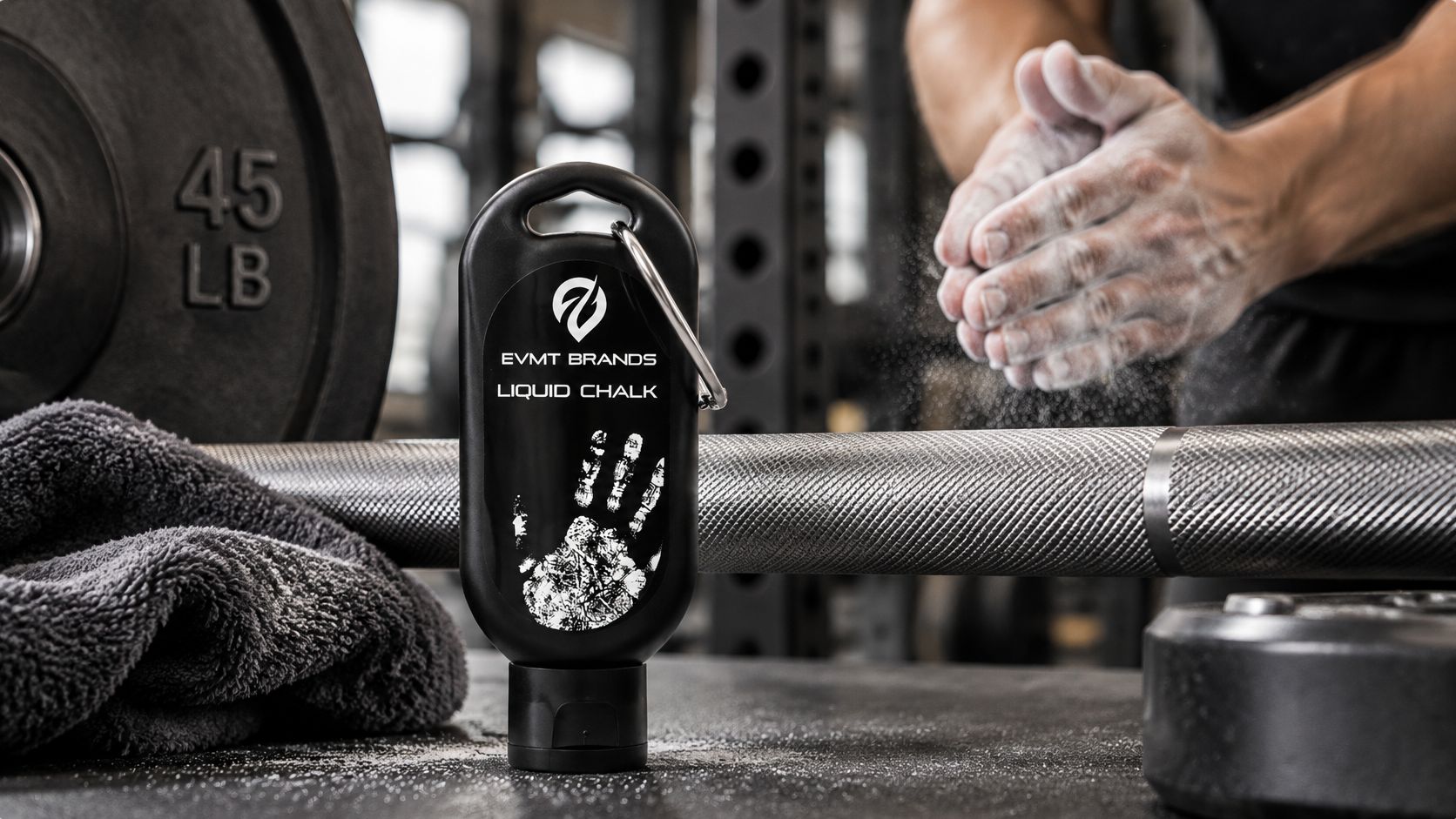
EVMT LIQUID CHALK is a magnesium-carbonate liquid option that dries in seconds without creating dust or leaving white residue on bars, poles, or apparel once dry. Its Weightlifting Liquid Chalk has an extra-thick consistency for coverage and is designed for powerlifting, Olympic lifts, and bodybuilding to prevent bar slippage and callus tears; thick consistency still calls for a thin application, not a heavy coating.
Tests that separate slipping from skin damage
- Dry-hand hold: During a manageable warm-up, assess whether the bar moves despite dry palms. Persistent movement warrants a check of texture, hand placement, and load rather than more chalk alone.
- Post-session skin check: Look for tender ridges, torn calluses, or abrasion where the shaft contacts the fingers. Chalk doesn't repair those areas.
- Between-session recovery: Notice whether hand soreness, rather than muscular recovery, prevents normal training. That points toward a contact problem that deserves attention.
Consider a lifter whose final pull becomes slippery only after sweating. A fully dried coat before the working set addresses that specific problem. A lifter who repeatedly tears calluses needs to address skin condition and bar texture before adding more grip aid.
A commercial gym's policy can rule out an otherwise useful format, and competition rules can narrow the choices further. Pain changes the decision entirely: increasing friction isn't an appropriate response to damaged skin.
For broader context on how lifters build strength with barbell training, Maximum Health Products provides a useful training resource. Grip preparation should support that work, not become the reason sessions are missed.
Maximum knurl aggression isn't the goal. The useful texture is the one that secures the lift without making hand recovery the limiting factor.
Gyms That Ban Chalk and What to Do
Loose chalk becomes a venue problem when airborne powder spreads beyond the athlete's hands. It settles around equipment and creates cleanup work, while airborne dust can irritate the respiratory tract.
USA Climbing's return-to-sport guidance encouraged liquid chalk or chalk balls and explained that contained chalk reduces dust and debris dispersal. That guidance addresses a specific venue concern, not a universal promise that every gym must permit chalk.
Getting a clear answer at the front desk
- Read the written policy. A powder-only restriction leaves a different decision from a ban on all chalk products.
- Ask about liquid specifically. Many gyms ban loose chalk but allow liquid chalk, so the distinction matters.
- Offer a controlled demonstration. With staff permission, a small application can show how a dust-free format dries without spreading powder.
- Keep application personal. Apply chalk to the hands, not directly onto shared equipment, and wipe the bar afterward.
- Respect a refusal. A dry towel, clean bar, and conservative loading provide a workable session plan when no chalk is allowed.
A home gym removes the front-desk discussion, but not the mess concern. Shared rooms, stored belongings, and nearby equipment make controlled application useful even when no formal policy applies.
Competition travel requires a separate check. The USA Climbing competition rulebook permits a small container of commercially available liquid chalk on the field of play and requires liquids to be in sealable, leak-proof containers. That climbing provision doesn't establish permission at a powerlifting event; the relevant organizer's rules still control.
A clear front-desk request avoids arguments about terminology:
Would the gym allow a liquid chalk that dries in seconds and leaves no dust on the bars?
Liquid, Powder and Chalk Ball Compared for Bar Grip
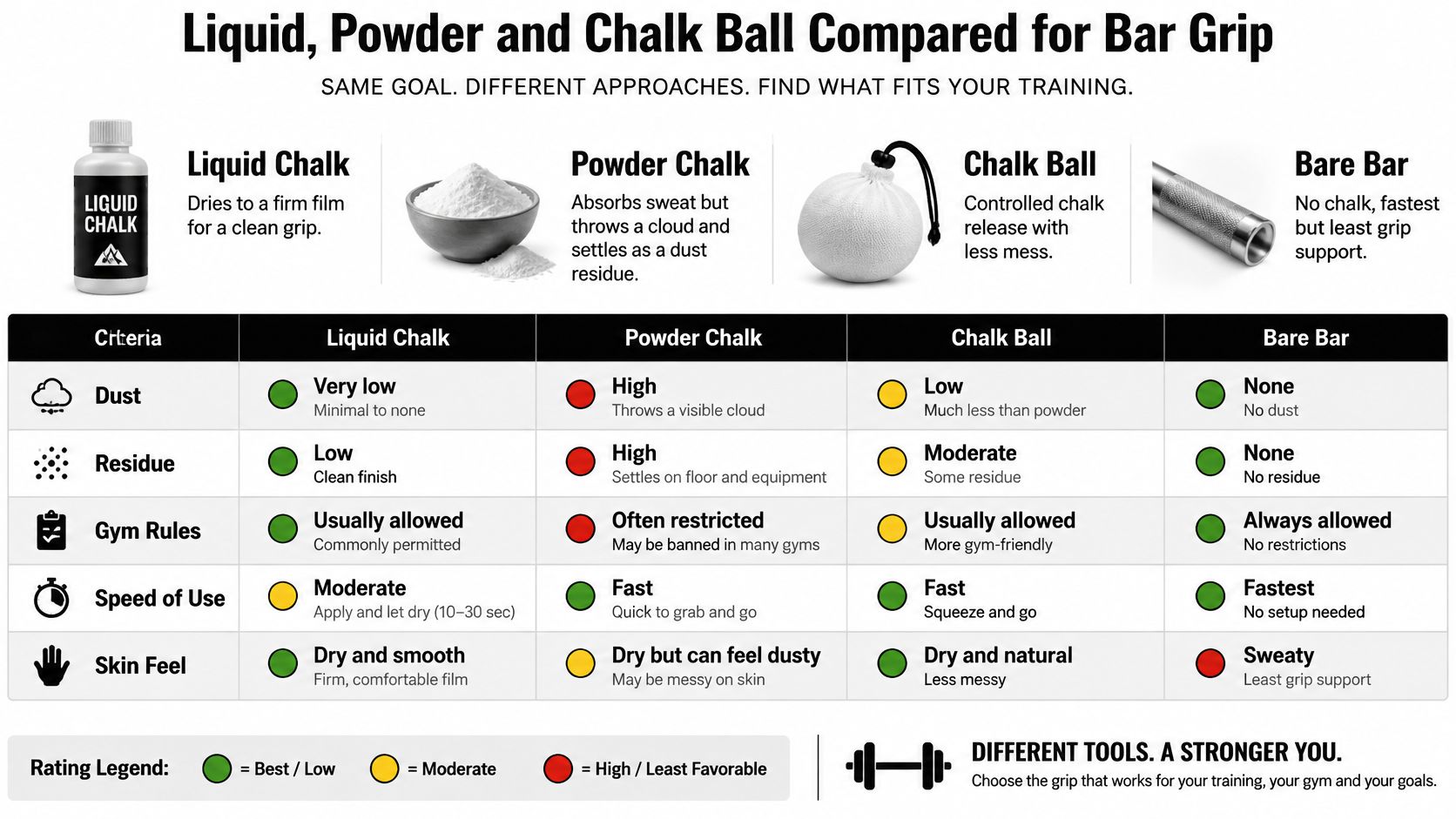
Grip formats for a power bar compared
| Format | Application | Dust in the room | Residue on bar | Gym policy | Best for |
|---|---|---|---|---|---|
| Powder chalk | Dip or rub from a bowl or block | High potential for airborne spread | Visible white film | Often restricted | Short, dry sets in venues that permit powder |
| Liquid chalk | Spread a thin coat and allow it to dry | No dust during controlled application | Product-specific; the liquid option described here leaves no white residue once dry | Often allowed where loose chalk is banned | Sweaty hands, shared gyms, heavy pulls |
| Chalk ball | Dab or roll powder through mesh | Lower spread, but powder can escape | Light powder transfer | Requires venue approval | Quick top-ups mid-session |
| Grip gloves | Wear over the hands | None from chalk | No chalk residue | Subject to venue and event rules | Hand protection rather than direct moisture control |
Permission comes before preference. A format that feels excellent but violates the venue's policy isn't a usable choice for that session. After permission is settled, sweat level, application speed, and skin comfort become the deciding factors.
Powder is easy to top up, but its convenience comes with loose material around the lifting area. A chalk ball controls the release rather than eliminating powder altogether; the gym chalk ball comparison helps distinguish contained powder from a dust-free application.
Choosing for the actual training environment
For a home-gym owner who can't have dust, liquid chalk is the direct fit. It avoids an open powder source and allows application away from the loaded bar without leaving a cloud around nearby belongings.
For a commercial-gym lifter, the useful combination is permission, controlled application, and a fully dried film. A competitor who prefers rapid powder top-ups must confirm that powder is permitted and that the application area fits the event's procedures.
Gloves make a different trade-off. They place material between hand and shaft, changing contact and feel rather than just managing moisture on bare skin. They shouldn't be treated as an interchangeable version of chalk.
A bare bar remains reasonable when hands stay dry and the hold is secure. It offers no added moisture management, but unnecessary chalk isn't an improvement merely because it is available.
Climbers using liquid chalk have a different layering option: a dry liquid base beneath their usual powder. That approach supports a longer-lasting coat and less frequent re-chalking, particularly on long routes and in humid gyms, rather than requiring climbers to abandon powder.
How to Apply and Remove Liquid Chalk on a Barbell
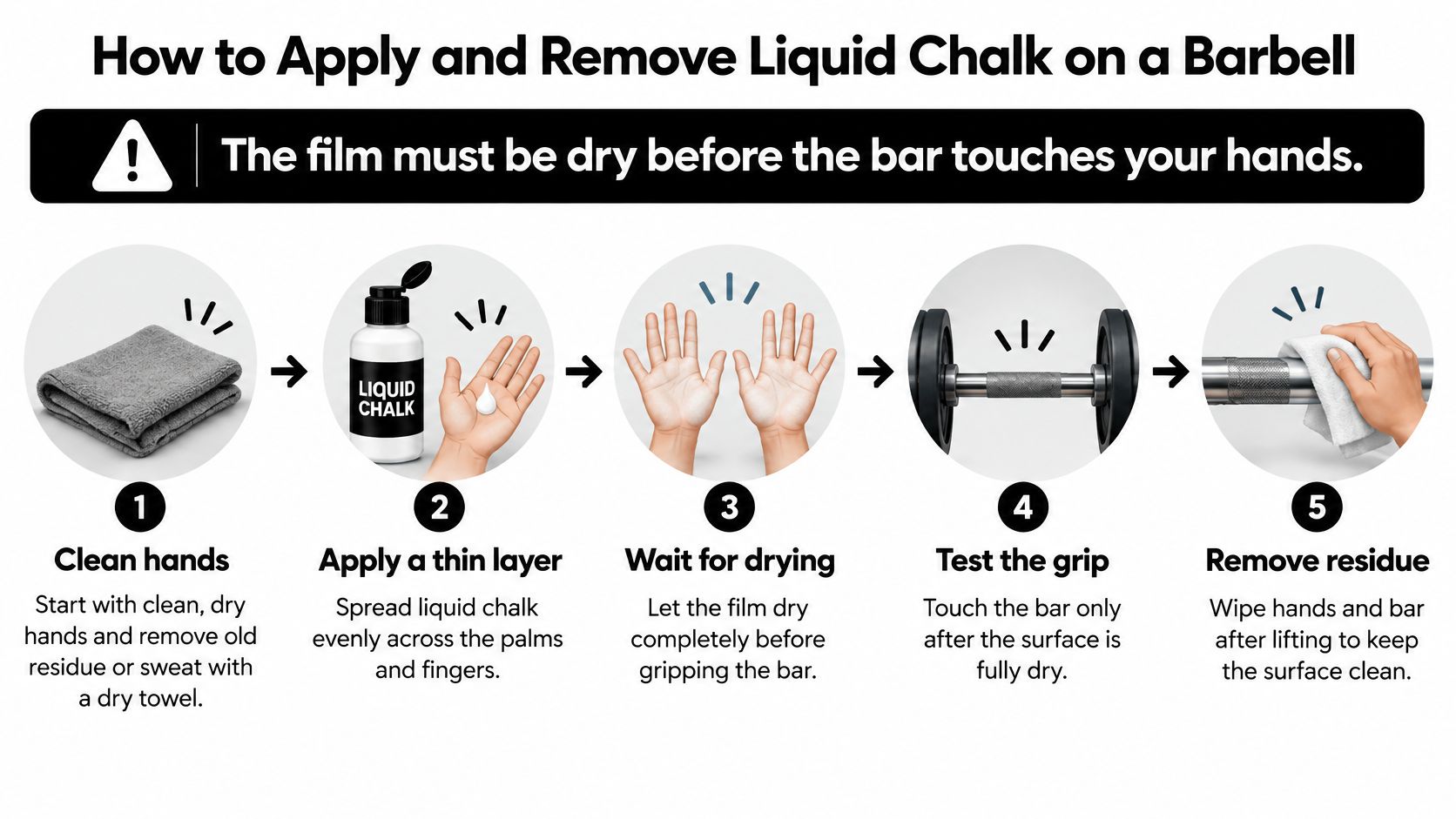
The film must be dry before the bar touches the hands. Wet application can transfer onto the knurl instead of creating the intended hand coating, so drying is part of grip preparation, not an optional pause.
A small, even application is easier to assess than a thick layer. Coverage belongs on the contact areas of the palms and fingers, not across unrelated skin to make the hands look uniformly white.
Application and cleanup sequence
- Start with clean, dry hands. Remove sweat and old loose material with a dry towel so the fresh coating reaches a stable surface.
- Spread a thin, even coat. Cover the palm and finger areas that contact the shaft, because excess material adds buildup without improving placement.
- Let the film dry completely. Drying takes seconds for the liquid option described here, and gripping too early can smear the application.
- Test the hold under a light load. A controlled warm-up reveals missed contact areas or remaining slickness before a demanding set.
- Re-coat only when needed. A fresh application belongs where the grip has become slick, not automatically over a coating that still works.
- Wash with soap and water after training. Washing removes the hand film rather than leaving old layers in place for the next session.
- Wipe shared contact surfaces. Use a clean, dry cloth on the bar and any contacted pole or apparel, then follow the facility's approved cleaning procedure where necessary.
Correcting the common application mistakes
A coat that stays tacky or smears onto equipment needs more drying time, not another layer. Excess application should be removed before starting again with less product.
Repeated top-ups can also hide the underlying problem. If a dry coating remains on the hands but the bar still moves, the next check should be contact, texture, and load rather than automatic reapplication.
The liquid chalk removal guide provides additional cleanup guidance. Cleaning products used on a bar should suit its finish and the facility's equipment-care routine.
Successful application: The hands feel dry, the hold stays stable through the set, and the next user receives a clean bar.
Chalk isn't a substitute for shared-equipment hygiene. Even when a product leaves no visible white residue, sweat and ordinary contact still justify a wipe-down.
Check Your Grip Setup Before Your Next Heavy Session
A useful grip check changes a specific variable and observes the result. Changing the bar, chalk format, and loading all at once makes it harder to identify what helped.
- Verify the bar listing if buying. Confirm shaft diameter, collar inclusion, and the grip markings rather than relying on the power-bar label.
- Confirm the venue's chalk policy. Get a clear answer about liquid rather than assuming a powder ban covers every format.
- Choose for the session. Match the permitted format and hand-friendly texture to heavy singles, repeated pulls, or fast-moving lifts.
- Test during a warm-up. Apply a thin liquid coat, allow complete drying, and note whether the original slipping problem changes.
For load context, Wallaby Wellness can help a lifter find an estimated 1RM. An estimate isn't a reason to test grip at maximum effort; a manageable warm-up is the better place to assess preparation.
A single bottle suits an initial trial, while multi-packs suit frequent training or a home-gym supply. The purchasing decision should follow the grip test rather than replace it.
If slipping or skin wear continues after the trial session, repeat the dry-hand, skin-condition, and recovery checks. Persistent tearing calls for attention to contact and texture, not a thicker coating.
Evermost LLC offers EVMT Liquid Chalk in single bottles and multi-packs for lifters who need sweat-resistant grip without loose powder. Visit Evermost LLC to choose a bottle for a controlled warm-up trial, then assess grip security and hand comfort before the next heavy working set.