


Monohydrate vs Kre Alkalyn Which Creatine Wins
You're standing over a bar that felt fast last week, but today the final pull stalls, your grip starts to open, and the next set of power cleans loses its snap. It's easy to blame the supplement tub on your shelf, especially when the label promises a newer form of creatine that works at a smaller dose and causes less bloating.
The question behind monohydrate vs Kre-Alkalyn is simpler and more practical: does the buffered product produce better results once you account for muscle creatine saturation, dose equivalence, tolerance, convenience, and price? The answer matters during heavy deadlifts, Olympic lifting sessions, high-volume CrossFit workouts, and any training block where small drops in repeat power become obvious.
| Decision factor | Creatine monohydrate | Kre-Alkalyn |
|---|---|---|
| Evidence base | Deepest historical and scientific foundation | Smaller and mixed head-to-head evidence base |
| Muscle creatine content | Strongly established | No meaningful advantage shown in a controlled comparison |
| Typical protocol | Loading phase optional, followed by daily maintenance | Marketed at a lower daily dose, generally without loading |
| Buffering claim | Not buffered | Marketed as pH-buffered creatine |
| Best practical fit | Most athletes seeking proven value | Athletes prioritizing a smaller dose or testing tolerance |
Why Your Creatine Choice Matters for Performance
A powerlifter can have enough leg drive to complete a heavy squat and still miss the next attempt because the upper back and hands lose position. An Olympic lifter may catch the snatch cleanly in the first round, then see bar speed fade across repeated attempts. In a functional fitness session, the problem can appear as shorter sets, slower transitions, and a grip that fails before the target muscles do.
Creatine doesn't replace programming, food, sleep, or technical work. It supports the energy demands of repeated high-intensity efforts, so the useful outcome isn't a dramatic sensation after one serving. The useful outcome is more consistent work across the training week, provided the muscle stores become adequately saturated.
That makes product selection a practical decision rather than a branding contest. You need to know whether the form improves strength, muscle creatine content, body composition, or anaerobic capacity, whether the dose on the label represents a comparable amount of active creatine, and whether your stomach tolerates the routine. Your budget matters too, because a premium only makes sense if it buys a real benefit.
A lifter preparing for a powerlifting meet should also separate creatine-related questions from grip problems. Better muscle energy support won't stop a sweaty hand from sliding on a deadlift bar. Training details such as exercise order, volume, rest periods, and grip preparation still deserve attention, as outlined in this powerlifting training routine.
Practical rule: Choose the creatine form that lets you dose consistently and train normally. A theoretically advanced ingredient is irrelevant if you underdose it, skip it, or spend so much on it that you stop using it.
The balanced verdict is straightforward. Creatine monohydrate is the default choice for most athletes because its evidence base is deeper and its standard protocol is well established. Kre-Alkalyn may be reasonable when a lifter dislikes loading, prefers a low-dose format, or wants to test whether a buffered product feels better personally. Those are convenience and tolerance decisions, not proven reasons to expect superior performance.
Understanding Creatine Monohydrate and Kre-Alkalyn
Creatine monohydrate is creatine in its best-established supplemental form. The modern sports-nutrition foundation reaches back to 1912, when Otto Folin and Willey Glover Denis reported that oral creatine increased muscle creatine content, as documented in this history of creatine research. Decades later, a major 1992 study by Harris, Söderlund, and Hultman showed that oral creatine monohydrate could substantially raise total muscle creatine, with some participants reaching increases of up to 50% after repeated dosing from the same reference.
The mechanism is practical. Muscle cells store creatine and phosphocreatine, and the phosphocreatine system helps regenerate energy during short, intense efforts. Supplementation works by increasing the available pool over time, not by acting like an instant stimulant. Once stores rise, the athlete may be better positioned to repeat demanding efforts during resistance training or explosive work.
Kre-Alkalyn is marketed as a pH-buffered creatine monohydrate. Patent materials describe a buffering process intended to address creatine instability in lower-pH conditions and identify the product with a pH around 12, as described in the Kre-Alkalyn patent materials. The theory is that a more alkaline environment should protect the creatine compound from breakdown and allow a smaller amount to produce the same practical effect.
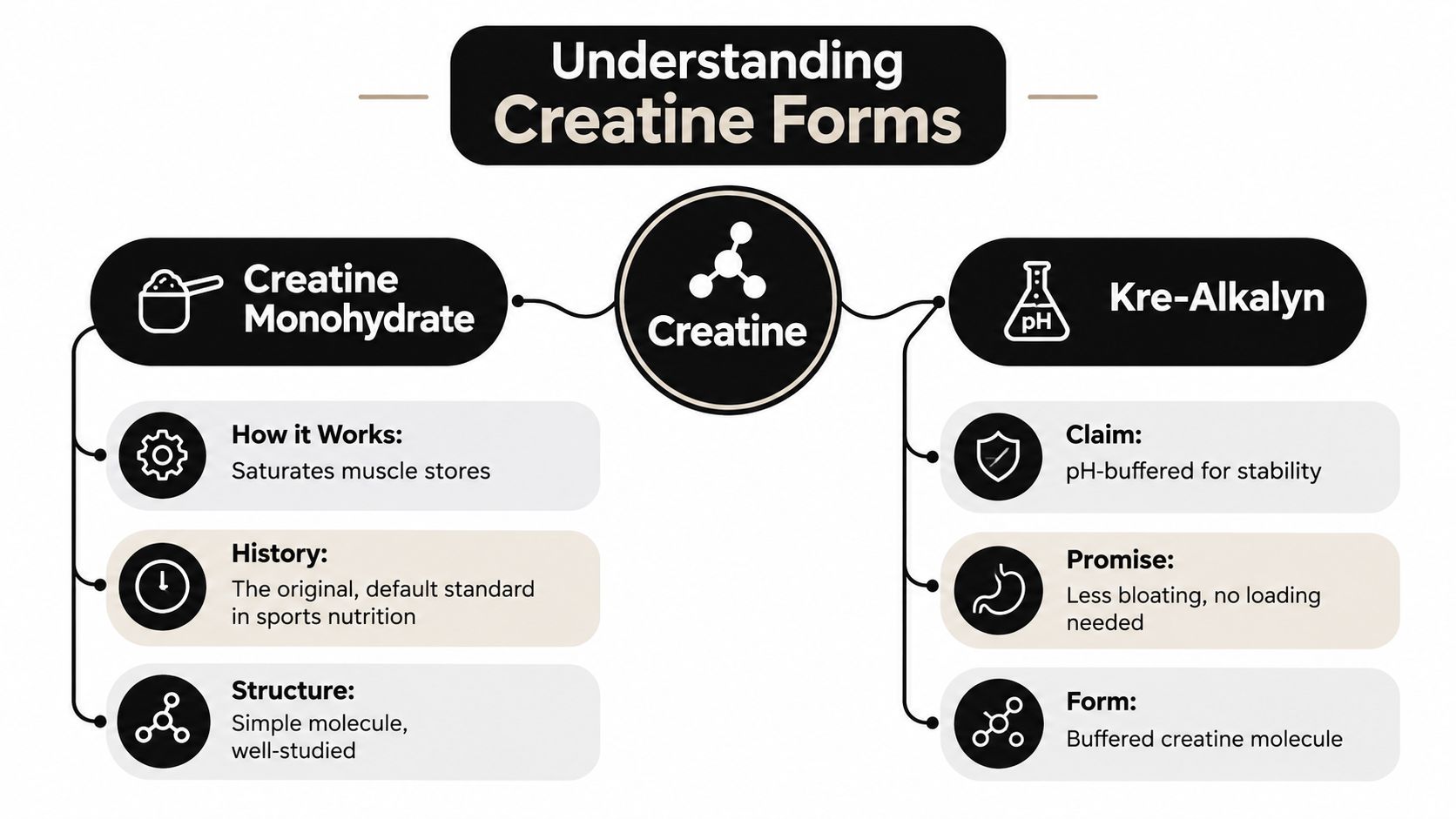
That theory needs to survive outcome testing. A claim about pH stability only matters to an athlete if it leads to better muscle creatine retention, strength, power, body composition, or tolerability under comparable conditions. A label that says “buffered creatine monohydrate” can also confuse buyers. It may sound like a separate ingredient, but the comparison still comes down to how much active creatine the athlete consumes and what that dose achieves.
For a broader overview of the available forms, this creatine types comparison can help clarify how monohydrate and buffered products fit within the wider supplement category. The useful mental model is simple: monohydrate has the longer record of demonstrated use, while Kre-Alkalyn adds a pH-buffering strategy that must be judged by real performance outcomes rather than chemical theory alone.
Head to Head Efficacy and Evidence Breakdown
The strongest independent comparison comes from a 2012 study of resistance-trained adults. Researchers divided 36 participants into three groups: a creatine monohydrate group using a loading-and-maintenance protocol, a Kre-Alkalyn group taking the manufacturer's recommended 1.5 grams per day, and a Kre-Alkalyn group using an equivalent loading dose. The study found no meaningful advantage for Kre-Alkalyn over monohydrate in muscle creatine content, body composition, strength, or anaerobic capacity, as reported in the peer-reviewed head-to-head trial.
That result directly challenges the idea that buffering automatically creates a superior product. Neither Kre-Alkalyn dosing strategy outperformed the conventional monohydrate protocol. A manufacturer-linked 2009 endurance study reported a 118.2% advantage for Kre-Alkalyn, but that finding conflicts with the later peer-reviewed comparison and deserves less weight when making broad purchasing decisions.
| Outcome | Creatine monohydrate | Kre-Alkalyn |
|---|---|---|
| Muscle creatine content | Increased effectively in the controlled comparison | No meaningful advantage over monohydrate |
| Strength | Performed comparably in the resistance-trained trial | No meaningful advantage in that trial |
| Body composition | No meaningful disadvantage shown | No meaningful advantage shown |
| Anaerobic capacity | Comparable outcome in the controlled comparison | No meaningful advantage shown |
| Evidence confidence | Stronger historical and research foundation | Smaller, mixed evidence base |
The picture becomes less uniform in elite Olympic lifting. A separate randomized, double-blind study followed 24 elite Olympic weightlifters for 60 days. The Kre-Alkalyn group improved average performance by 10.76% from baseline across the snatch, clean and jerk, high snatch, and back squat, compared with 8.39% in the monohydrate group. The report also stated that total lifts increased 28.25% more in the Kre-Alkalyn group, according to the Olympic weightlifter trial report.
The elite-lifter result is interesting, but a small, specific protocol shouldn't be converted into a universal buying claim.
That study creates a legitimate reason to keep the conclusion nuanced. One controlled trial found parity across several relevant outcomes, while another small study in elite lifters found a modest Kre-Alkalyn edge. The evidence doesn't support saying that Kre-Alkalyn never works. It does support rejecting the stronger claim that pH buffering has clearly established superiority for the wider lifting population.
Athletes comparing product categories may also benefit from separating this question from other alternatives, including the issues discussed in this creatine HCL versus Kre-Alkalyn comparison. The central coaching decision remains unchanged: judge the product by verified outcomes, usable dosing, and adherence rather than by the sophistication of the formulation story.
Dosing Protocols and Label Math That Actually Matters
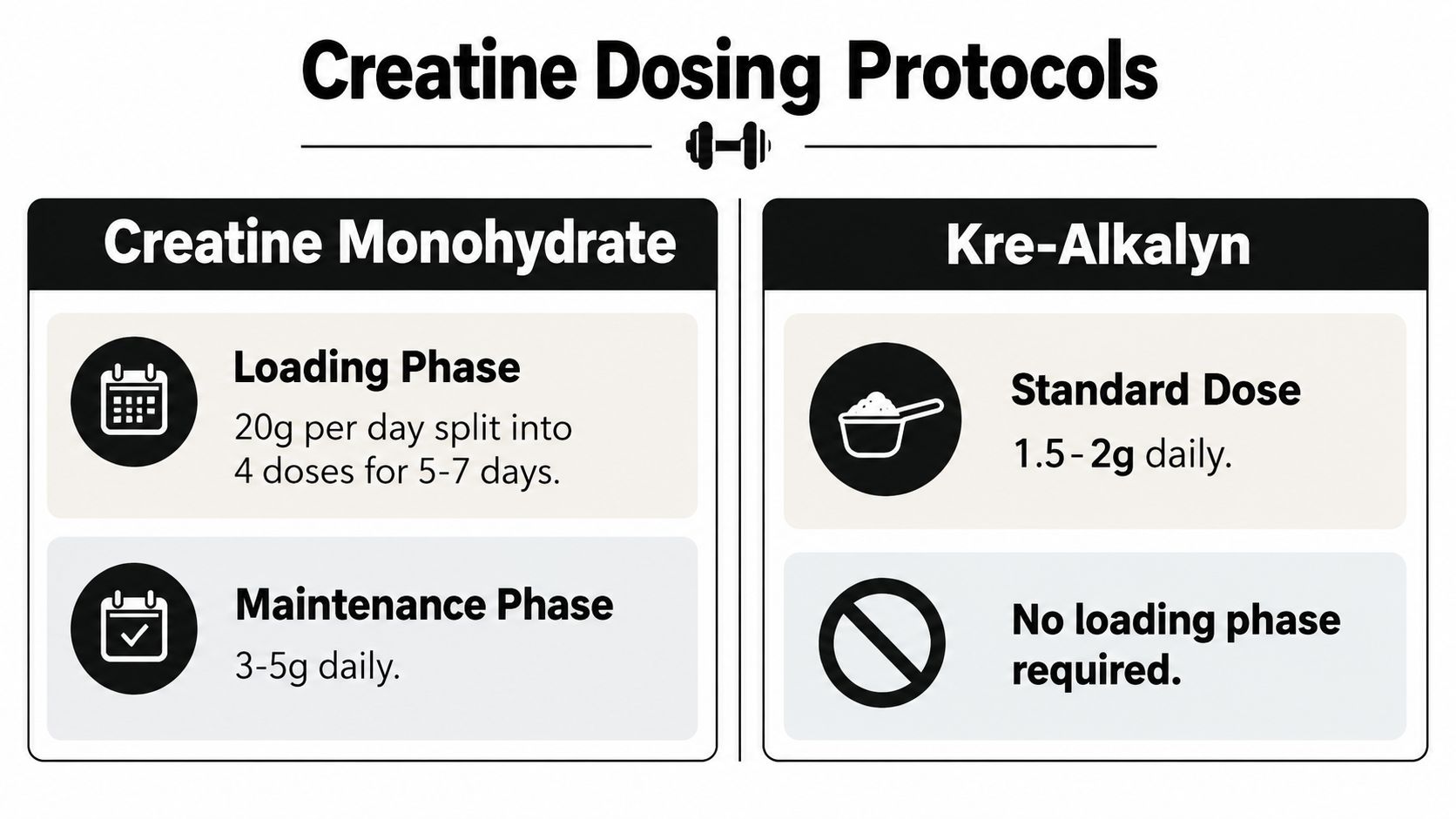
Dosing is where the comparison gets practical. A common monohydrate protocol uses 4 doses of 5 grams per day for 5 to 7 days, followed by 2 to 5 grams per day for ongoing maintenance, according to the review Creatine, A Review of Efficacy and Safety. The loading phase is designed to raise muscle stores quickly. It isn't a requirement for eventual use, but it is the conventional way to reach saturation sooner.
Kre-Alkalyn is often marketed around 1.5 grams per day, and some labels use a nearby low-dose range. The important question isn't whether the number on the front of the bottle looks smaller. It's whether that smaller quantity supplies an equivalent amount of active creatine and produces an equivalent increase in muscle stores.
How to read the label
Check the serving size, the amount of creatine per capsule or scoop, and whether the label clearly identifies the active ingredient. If a product lists Kre-Alkalyn as buffered creatine monohydrate, don't assume that the word “buffered” means you're receiving more creatine per gram. Ask whether the recommended dose has been tested against a matched monohydrate dose.
Independent summaries report that buffered creatine showed no advantage over monohydrate at matched doses, and that the pH-stability rationale hasn't translated into superior outcomes, as discussed in the Kre-Alkalyn product evidence summary. That makes label math essential. A lower serving may improve convenience, but it doesn't prove better efficiency.
How I'd implement the protocol
For a standard training block, use the established monohydrate approach if you want faster saturation, splitting the loading amount across the day instead of taking it in one large serving. After that, maintain daily intake within the established range. If you prefer to skip loading, consistent maintenance dosing remains a simpler route, though the saturation timeline won't be the same as a loading protocol.
For Kre-Alkalyn, follow the product label while recognizing that the marketed low-dose claim is the point being tested, not a settled fact. Track adherence, training performance, body weight changes, and stomach comfort. If the label doesn't make active creatine content clear, don't pay a premium based only on the pH number.
Side Effects Tolerance and Safety in Real Training
Creatine tolerance matters most when training already places stress on the stomach, hydration habits, and body weight. A collegiate lifter managing a weight-class target may dislike any unexpected scale movement. A climber may want a light stomach during a long session. A CrossFit athlete training twice daily may care more about repeatable digestion than about a clever label claim.
Monohydrate has an excellent safety profile across commonly used loading and maintenance protocols, including maintenance use described for 3 to 6 months or even up to 2 years in the safety review linked above. That doesn't mean every athlete experiences it identically. Some people report bloating or stomach discomfort, particularly when they take too much at once or change several supplements at the same time.

What to test before changing forms
Start by examining the routine rather than assuming the molecule is the problem. A large single serving can be harder to tolerate than divided servings. Taking creatine with a normal meal may also be more comfortable than swallowing it alongside a stack of empty-stomach products.
- Reduce serving size per sitting: Split the daily amount if your stomach reacts during a loading phase.
- Keep the timing consistent: A repeatable daily habit is easier to evaluate than random dosing.
- Use adequate fluids: Hydration supports normal training and makes it easier to distinguish supplement discomfort from a poor pre-session routine.
- Change one variable: Don't switch creatine, protein powder, pre-workout, and electrolyte products simultaneously.
Kre-Alkalyn may feel better for an individual who doesn't tolerate standard monohydrate, but the buffering claim shouldn't be treated as proof that gastrointestinal issues disappear. The controlled comparison did not establish a meaningful performance or tolerability advantage. A lower marketed dose may be easier for some athletes to handle.
Meet-day perspective: Don't trial a new creatine form immediately before competition. Test it during ordinary training, when a stomach issue or missed dose won't affect an attempt.
Water retention also needs precise language. Creatine increases stored creatine in muscle, and some athletes notice changes in how they feel or weigh. That response isn't automatically a negative, but an athlete in a weight-sensitive sport should evaluate it during a normal training block instead of guessing from marketing copy.
Best Use Cases for Each Creatine Type
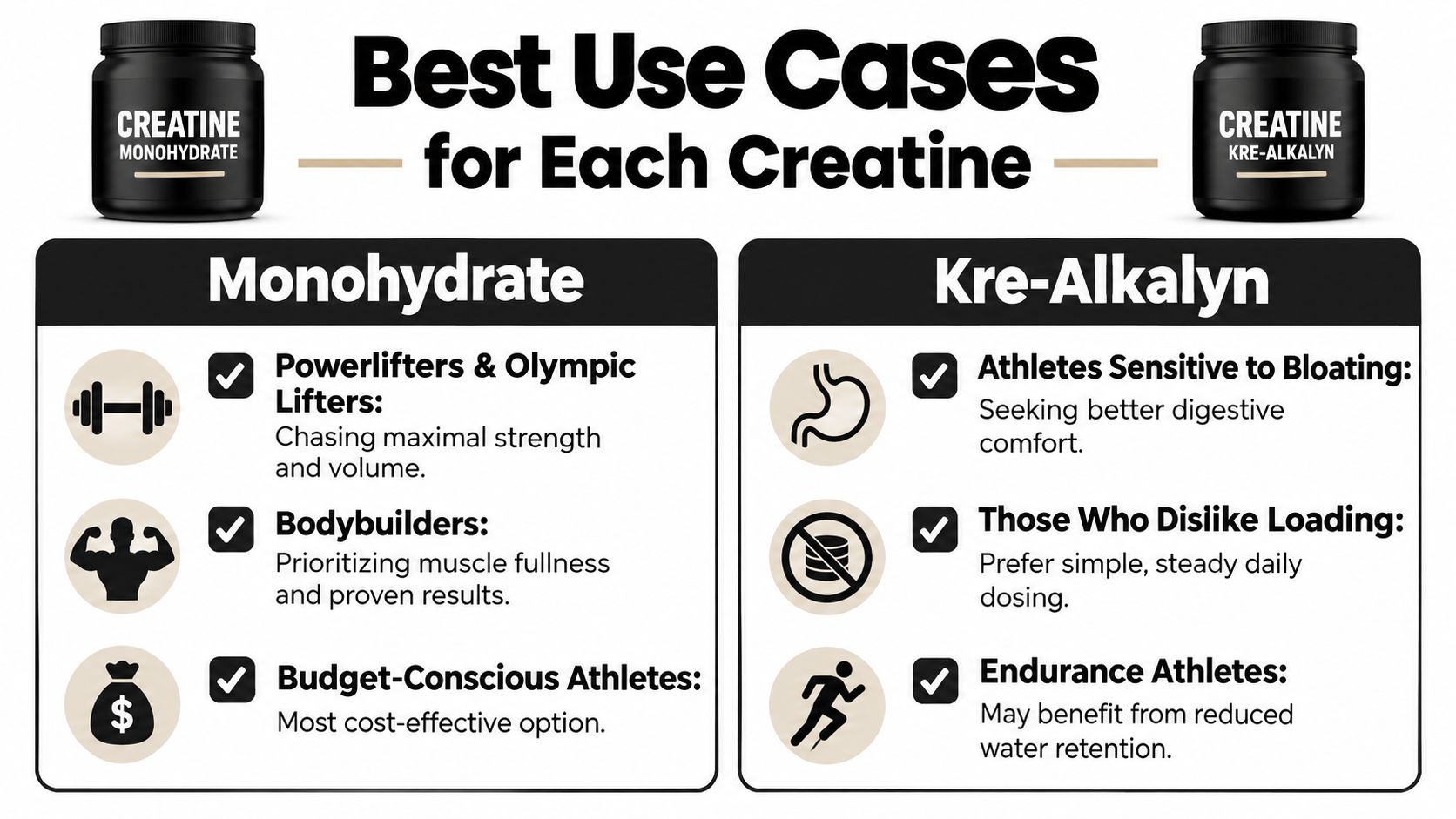
The best choice depends on what you value after the evidence is accounted for. For most strength athletes, monohydrate offers the cleanest decision because it combines the deepest research foundation with a familiar loading-and-maintenance system. It suits the lifter who wants to maximize saturation, keep the routine proven, and avoid paying for a benefit that hasn't been consistently demonstrated.
A powerlifter preparing for a high-volume block can use monohydrate and focus the budget on food, coaching, recovery, or competition expenses. The same applies to an Olympic lifter practicing frequent snatches and clean and jerks, where consistent training quality matters more than a novel pH system. A home gym owner who wants one dependable supplement also has a strong reason to choose the established form.
When Kre-Alkalyn may fit
Kre-Alkalyn can make sense as a personal experiment for an athlete who dislikes loading, struggles with the texture or routine of powdered monohydrate, or prefers capsules while traveling. It may also appeal to someone who experiences stomach discomfort with a standard protocol and has already tried smaller, divided servings.
That isn't the same as saying Kre-Alkalyn is better for endurance athletes or guarantees less water retention. Those ideas are part of the marketing conversation, but the available head-to-head evidence doesn't establish a broad advantage. If the product costs more, the athlete should be comfortable paying for convenience or personal tolerance rather than expecting a proven performance upgrade.
A useful decision matrix looks like this:
| Your priority | More sensible starting point |
|---|---|
| Strongest research foundation | Monohydrate |
| Faster saturation through a conventional loading protocol | Monohydrate |
| Simplest low-dose capsule routine | Kre-Alkalyn |
| Testing a possible tolerance preference | Kre-Alkalyn |
| Maximum value from a proven protocol | Monohydrate |
| Avoiding a loading phase | Kre-Alkalyn, with realistic expectations |
For programming context, athletes using creatine alongside high-frequency strength and hypertrophy work can also review this functional bodybuilding program. The supplement won't fix poorly managed fatigue, and neither form can compensate for inconsistent training.
Final Recommendation and How to Choose With Confidence
Start with creatine monohydrate unless you have a specific reason not to. It has the strongest historical foundation, a well-defined saturation protocol, and controlled evidence showing that Kre-Alkalyn doesn't provide a meaningful general advantage in muscle creatine content, body composition, strength, or anaerobic capacity.
Use this checklist before buying:
- Evidence: Does the product have outcome data beyond a pH or absorption claim?
- Dose: Does the label make active creatine content clear?
- Tolerance: Have you tested divided servings and consistent timing?
- Budget: Are you paying for a proven benefit or for convenience?
- Adherence: Will you take the product every day during the training block?
Run a simple personal test over 30 days, keeping your training, food, and other supplements as consistent as possible. Record daily adherence, key lifts, session quality, stomach comfort, and any body-weight changes that matter for your sport. If monohydrate works well, there's little reason to switch. If it doesn't suit your routine after sensible adjustments, Kre-Alkalyn becomes a reasonable convenience and tolerance trial, not a guaranteed upgrade.
Creatine supports the power side of performance. Grip support addresses the contact point between your hands and the bar, rings, rope, or climbing hold. In high-pressure training and competition environments, reliable bar contact can help you express the strength you've built, while a consistent creatine routine supports the repeated efforts behind that strength.
Evermost LLC offers EVMT Liquid Chalk, a clean, fast-drying grip solution for weightlifting, climbing, gymnastics, dance, and grip-intensive training. Visit Evermost LLC to find a formula and bottle size that fit your training setup, then pair dependable grip preparation with the creatine routine you can follow consistently.