


Men's Gymnastics Grips: The Complete Buyer's Guide
You're standing beside the high bar with a new pair of men's gymnastics grips in your kit bag. The leather feels stiff, the finger holes aren't sure where they belong, and your coach has warned you not to test them with a full routine. At the same time, the rings group is using grips that look noticeably different, leaving one question: why can't one pair work everywhere?
Men's gymnastics grips are event-specific equipment. Their leather shape, finger-hole layout, dowel, and wrist closure change how your hand meets the apparatus, how force travels through the palm, and how reliably the grip stays positioned during swings, catches, and strength work. A good purchase starts with mechanics, not appearance.
Why Men's Gymnastics Grips Are Not Just Hand Protection
During a high-bar release, the hand must stay connected long enough to control the swing, then release cleanly and find the bar again. On rings, the same hand also has to support the body while the wrist and straps remain organized. That difference explains why men's gymnastics grips are equipment for mechanics, not covers for sore skin.
A grip creates a repeatable leather contact surface between the hand and the apparatus. On high bar, it supports long swings, giants, and release-and-catch work. On still rings, it must suit static support, controlled swing, and wrist anchoring. The grip cannot correct poor technique, although a suitable design can make a sound hand position easier to repeat.
The dowel shapes that connection. As the leather folds around the apparatus, the dowel forms a catch point that can reduce the finger pressure required to maintain the hold during dynamic skills. That changes how the athlete controls the bar when the wrist moves through giants, inverted positions, and release phases. Men's gymnastics grips evolved as purpose-built equipment for hand protection and bar-event control, rather than as generic gloves.
Coach's rule: A grip should make correct hand positioning easier to repeat. It should not conceal a loose wrist, poor swing shape, or uncertain release.
The history reflects this practical purpose. Historical accounts place purpose-built grips in the 1960s and credit Dowell Johnson with designing them to protect the hands and improve grip on bar events. The modern men's apparatus environment became more formalized after the current six-event format was standardized at the 1936 Berlin Olympics. That competitive setting increased the value of equipment designed for particular events.
Buying grips is therefore a training decision. The pair must fit the hand, match the apparatus, tolerate the athlete's workload, and support swing mechanics that a coach can observe consistently. A high-bar grip and a ring grip may both protect the palm, yet their construction serves different forces and hand positions. The useful questions are which parts affect that fit, how each event changes grip demands, and how to break in the pair without compromising control.
The Core Anatomy of a Men's Grip
A new pair can look simple on the shelf, yet each part changes how your hand meets the apparatus. Learn to identify the leather palm piece, finger holes, and dowel before comparing brands or closures. These features explain why a high-bar grip and a ring grip cannot be judged by palm coverage alone.
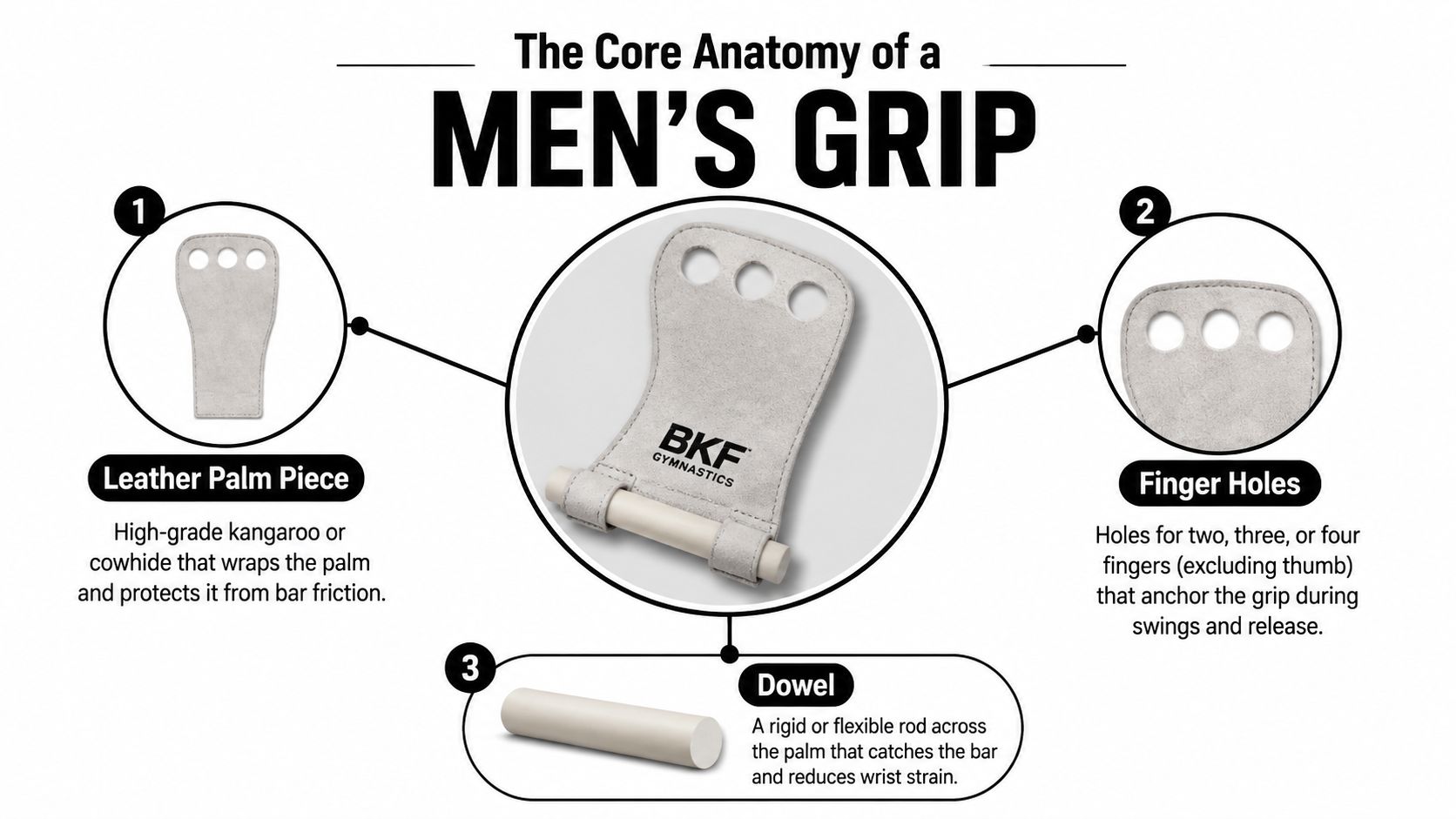
The leather palm piece
The palm piece covers the area exposed to repeated contact and friction. Its thickness also changes the information your hand receives. Thin leather usually keeps you closer to the bar or rings, while thicker leather adds structure and protection under heavier loading.
Leather construction affects how the pair changes with use. Split-grain and laminate leather are commonly chosen because they break in predictably while retaining their shape. Product information for a men's high-bar grip compares engineered leather that stretches less than 1% with natural leather at about 4%. That comparison is described by US Glove. A material that changes less can keep the hand position more consistent across training sessions.
For a first purchase, match thickness to the event and your workload. A palm piece that feels protective during a few swings may still feel too bulky if it delays the hand adjustment needed before a release.
Finger holes
Men's grips can have two, three, or four finger holes, with the thumb excluded. Hole placement anchors the leather to the hand, so the count must agree with the apparatus and the grip's intended construction. High-bar grips generally use three finger holes, whereas still-rings grips generally use two. NBC's gymnastics equipment guide outlines these event-specific layouts.
Check the fit with your wrist in the position you will use. The holes should sit securely without pinching, twisting, or pulling the fingers into an unnatural angle. Leather that bunches when you close the wrist points to a sizing or shape problem, even if the palm piece appears to cover enough skin.
The dowel and closure
The dowel is a rigid or semi-rigid rod sewn near the working edge of the palm piece. As the leather folds around the apparatus, the dowel catches against it and helps maintain contact during swings and releases. Slimmer profiles can preserve bar feedback, while larger profiles change pressure distribution and settle differently against rings.
The wrist closure anchors the grip to your hand. Hook-and-loop closures adjust quickly. Buckle and double-buckle systems hold a more fixed position, and a double buckle allows finer pressure adjustment when fastened carefully.
Judge the parts as a system. Leather thickness, stitching, dowel profile, and closure all influence break-in time and hand control. Ask which event shaped the design and how each part will behave when your wrist closes, rotates, and loads.
High Bar Grips Compared to Ring Grips
A gymnast moving from a giant on high bar to a ring support changes how the hand is loaded. High bar requires repeated rotation, fast swings, and controlled releases. Still rings add static strength and support positions, while the rings can rotate and roll against the palm. The grip should match that movement rather than serve as generic hand protection.
| Feature | High Bar Grips | Ring Grips |
|---|---|---|
| Finger-hole layout | Generally three finger holes | Generally two finger holes |
| Palm profile | Often slimmer and more sensitive | Often thicker and more protective |
| Dowel | Usually smaller or thinner | Usually larger and more substantial |
| Primary demand | Swing speed, release control, and retention | Stable anchoring during support, strength, and swing work |
| Closure preference | Buckle or double buckle for secure positioning | Buckle or double buckle for wrist stability |
High-bar grips commonly use a curved palm piece, a sewn-on dowel, and three finger holes. Their slimmer shape helps the athlete feel the bar during a giant, adjust wrist position, and prepare the hand for a release. The dowel and the rest of the construction work together to keep the grip controlled around the bar, as described in US Glove's high-bar grip description.
Ring grips generally use thicker leather and a broader palm piece. That added material supports repeated loading in strength and support work, while the hand still needs to move with the rings through swings. Ring-specific construction differs from high-bar construction because the apparatus loads the palm and wrist in a different pattern, as outlined in US Glove's ring-grip product information.
The hole count reflects that difference. Three holes distribute a high-bar grip across the fingers during rapid bar movement. Two holes shape a ring grip around the way the hand anchors, rotates, and bears weight on the rings. A high-bar pair can feel restrictive on rings, while a ring pair can feel thick and less responsive on high bar.
If both events are regular parts of training, use apparatus-specific pairs. One pair may work temporarily, but it should not automatically become the long-term choice for both events.
Athletes arriving from wrestling may also recognize how hand orientation changes control. An underhooks and overhooks guide provides a useful comparison, though wrestling grips cannot replace gymnastics equipment. For further explanation of grip construction and use, consult this guide to gymnastics grips.
How to Measure and Fit Men's Gymnastics Grips
You are standing at the gym with a new pair of grips, and the size chart seems simple until the fingers, palm, dowel, and wrist strap need to work together. Fit follows a repeatable measurement process. Use a flexible tape and a ruler, then ask your coach or an experienced equipment staff member to check your first pair.
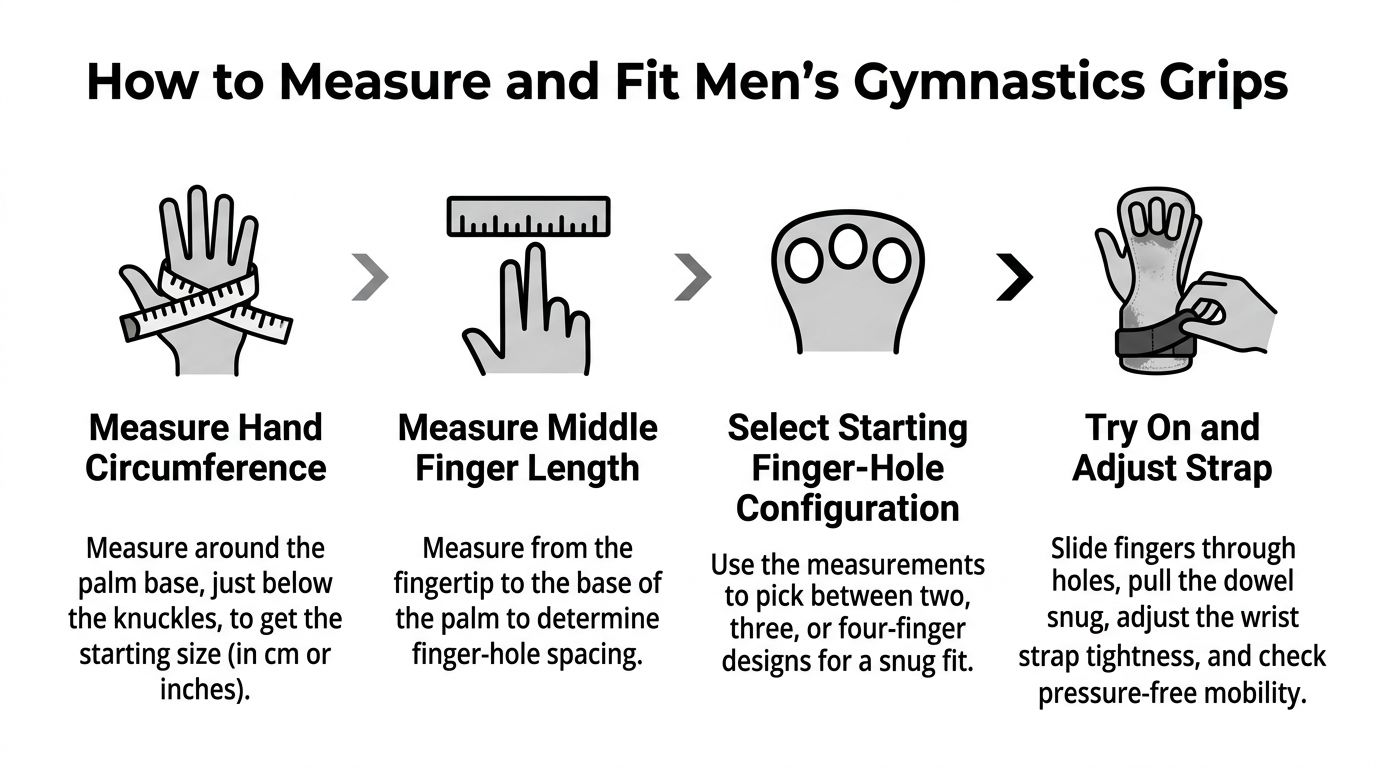
Start with hand measurements
Measure around the base of the palm, just below the knuckles. Keep the tape level and snug without compressing the hand. Then measure the middle finger from its tip to the base of the palm. These measurements give the manufacturer's size chart a useful starting point and help you judge where the finger holes will sit.
Hand circumference alone cannot determine the right finger-hole count. Palm width, finger length, event, and the grip pattern all affect the fit. A smaller hand may need a narrower pattern for clearer bar feedback, while a broader palm may need more coverage and a different leather shape. The measurement starts the choice. Your apparatus and hand position finish it.
Check the dowel position
Slide your fingers into the holes and place the grip over the apparatus with the wrist in a neutral working position. The dowel should catch the bar or ring without pressing into the finger joints or reaching too far down the palm. On high bar, poor placement can change how the hand closes during a swing. On rings, it can interfere with the hand's rotation and support position.
Use a mechanical check while your hand wraps around the apparatus. If any part of the dowel touches the lower portion of the grip, the grip is too long. A grip that slips off the fingertip or allows the dowel to slide sideways is also too long. This gymnastics grip guide explains those fit checks and recommends gradual break-in.
Adjust the closure and test movement
Fasten the wrist strap firmly enough to anchor the grip. Your hand should not tingle, change color, or lose normal movement. Open and close the wrist, set the hand for a swing, and perform a slow under-swing. The leather should follow the hand rather than fold into a sharp pressure point.
Use a simple pinch test. Pull the palm piece slightly away from your skin. It needs room to move with the hand, while excess slack can let the dowel rotate unpredictably. Recheck the fit after the first training swings because leather may relax as it begins to shape itself.
Use this decision rule as a starting point, then test the grip on the correct apparatus:
- Narrow palm: Start with the manufacturer's narrower pattern and the finger-hole configuration recommended for your event.
- Average palm: Use the standard event-specific configuration, then verify finger placement and dowel position.
- Broad palm: Look for wider palm coverage. Increase the finger-hole count only when the fingers and event design support it.
Breaking In and Maintaining Grips Season After Season
A new pair should not go straight from its packaging to a full high-bar routine. Start with controlled loading so the leather can soften and take the shape of your hand, while you learn how the dowel behaves through the swing.
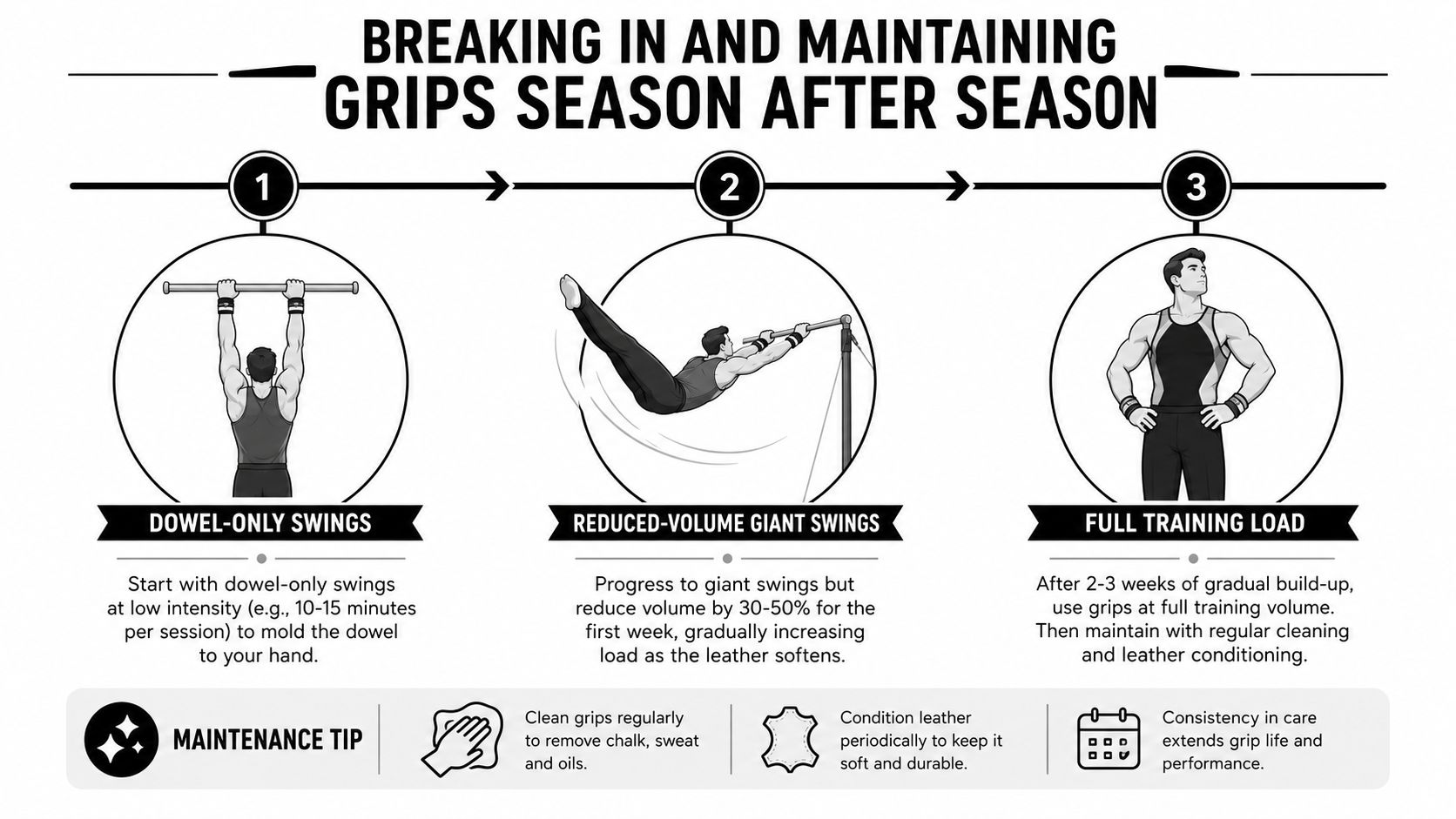
Begin with slow under-swings and low-intensity work. Use these sessions to feel the dowel engage, check that the finger holes remain smooth, and identify hot spots before adding speed. Gradual loading also lets you notice whether the high-bar grip stays seated during movement.
Build load in stages
A practical progression looks like this:
- Dowel-only swings: Use easy swings to mold the leather and confirm that the dowel catches without shifting.
- Reduced-volume giants: Add giant swings only after the grip remains stable during earlier work. Keep the volume conservative while the leather softens.
- Full training: Return to normal routines once the pair feels predictable with your regular technique.
Shape the leather gradually. Sharp folding and soaking can create weak spots or change the fit. If the manufacturer recommends a grip-specific balm, apply only that product and use a small amount. Household oils may soften leather unevenly, affect stitching, and make the dowel response less predictable.
Maintenance continues after the initial break-in. Rotate two pairs during heavy training, air-dry them between sessions, store them flat, and inspect the dowel stitching and buckle hardware regularly.
Maintenance check: Retire a grip when the leather has thinned around the finger holes, the dowel shifts inside the strap, or a wrist strap begins to fray. Repair is not a sensible trade when the grip can no longer hold its shape.
Sweat and chalk change the leather's contact surface. Apply a controlled amount of chalk instead of allowing a thick layer to build up, and dry the grips fully between sessions. For bar-specific chalk handling, see this guide to chalk for gymnastics bars. Proper chalk management preserves leather integrity season after season.
Safety, Grip Lock, and the Rules Athletes Need to Know
A grip can feel secure during a warm-up and still become dangerous during a fast release. Grip lock occurs when a grip around a dowel-equipped apparatus fails to release or shifts far enough to trap the fingers. Fit, leather condition, wrist closure, and inspection therefore affect safety, not just comfort.
An epidemiologic survey of male high-school and college gymnasts recorded 17 grip-lock injuries reported by high-school coaches and 21 reported by college coaches over a 10-year period. Thirty-six percent of responding coaches said at least one such injury had occurred in their program. Among 23 injured gymnasts who returned detailed questionnaires, 20 suffered fractures and 9 required surgery. The injury findings are summarized in the cited gymnastics discussion.
A later systematic review found that 82.6% of gymnasts with grip-lock injuries had used dowel grips. Dowel grips carry risk when their length, position, or construction does not suit the athlete, apparatus, or skill level. High-bar and ring grips deserve the same careful inspection, even though their swing demands differ.
| Variable | Low-Risk Setup | High-Risk Setup |
|---|---|---|
| Grip length | Dowel stays correctly positioned against the apparatus | Dowel reaches the lower grip area or slides sideways |
| Break-in | Gradual under-swings and controlled loading | Full-speed releases on stiff, untested leather |
| Wrist closure | Secure, even, and free of circulation pressure | Loose enough to rotate or tight enough to distort the hand |
| Inspection | Stitching, dowel, leather, and hardware checked | Frayed strap, thinning holes, or shifting dowel ignored |
| Chalk use | Enough to manage moisture without changing the leather surface | Heavy buildup or poor cleaning that masks fit problems |
Competition rules add a separate concern. Under FIG Code of Points language, a false grip on still rings used for strength holds receives a 0.1 deduction. Ring athletes must establish secure support while keeping the hand position within the permitted grip distinction. The FIG Code of Points describes the distinction between false and good grip positions.
NCAA rules classify a torn hand grip as equipment failure and allow a second trial when the tear occurs during a routine. The gymnast performs at the end of the rotation. If he is the last competitor, he receives a minimum of two minutes for recovery and re-gripping. A lost dowel or grip slippage alone does not qualify as hand-grip failure. The NCAA rules modification document explains this distinction.
Shared apparatus also requires sensible hygiene. Coaches and gym owners can consult these gym disinfectant recommendations, while keeping cleaning products away from leather unless the manufacturer approves them.
Common Grip Problems and How to Fix Them
A slipping grip doesn't always mean you bought the wrong pair. Many problems blamed on equipment begin with wrist position, moisture, poor sizing, or neglected leather.
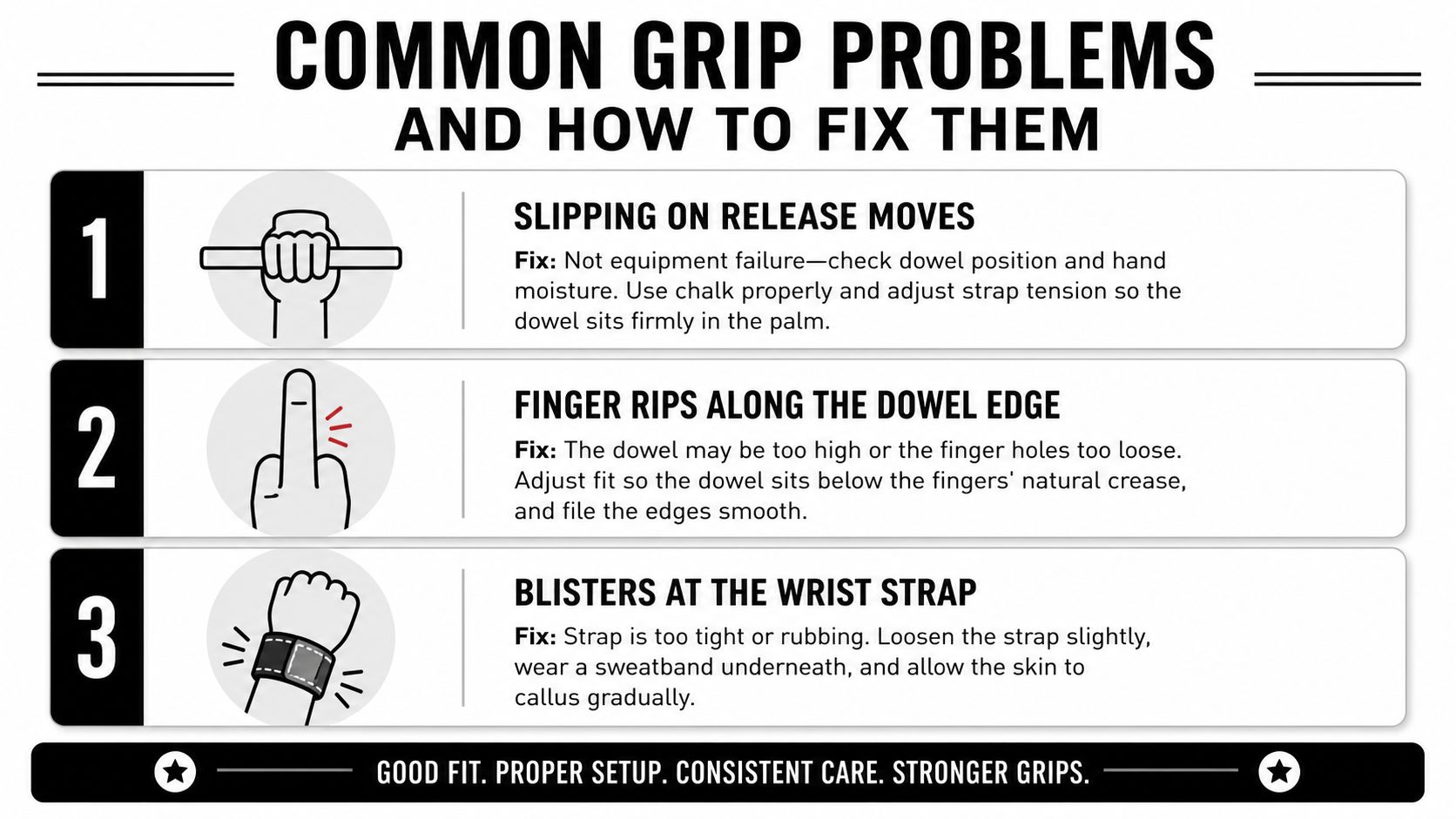
Slipping during release moves
If the grip moves during a release, first check whether you're over-gripping with a soft wrist. Practice controlled wrist-set drills on low swings, then inspect whether the dowel is sitting squarely across the apparatus. Manage hand moisture with a light, even application of chalk and adjust the wrist closure so it anchors without crushing the wrist.
Leather that has become excessively soft can also lose its predictable shape. If conditioning has made the palm piece floppy or the dowel no longer catches consistently, replacement may be safer than continued reshaping.
Rips along the dowel edge
Finger rips can develop when the dowel sits at the wrong angle, the holes are too loose, or the edge has dried and curled. Check that the dowel sits below the natural finger crease, smooth rough leather edges with an appropriate grip tool, and verify that the holes don't allow the grip to twist.
A dowel rod and mallet can help reshape a leather grip when the material is structurally sound. Use controlled pressure, not aggressive hammering, and stop if stitching, leather, or the dowel begins to shift.
For skin management and training modifications, use this guide to gymnastics hand rips alongside advice from your coach.
Blisters at the wrist strap
A wrist blister often points to a buckle positioned over the pisiform or a strap tightened beyond what the hand needs. Reposition the buckle, loosen the strap slightly, and try a sweatband underneath if that doesn't interfere with the closure.
Replace the grip when the strap is frayed, the leather has thinned through the working area, or the dowel no longer remains aligned. Those are structural failures, not break-in problems.
Choosing the Right Grip for Your Training Goals
The right pair is the one that matches your next training block. An athlete learning consistent release mechanics needs a forgiving setup that doesn't overwhelm the hand, while a senior optional gymnast preparing giant-to-release sequences may need a more structured palm piece and firmer dowel engagement.
Start by separating the decision into the variables that change performance.
- Event: Choose a high-bar construction for high bar and a ring construction for still rings.
- Dowel profile: Select a smaller, more sensitive profile when bar feel matters, and a larger, more supportive profile when ring loading demands greater palm structure.
- Finger holes: Follow the event-specific pattern, then verify that the holes sit naturally on your fingers without bunching.
- Leather feel: Look for predictable break-in and enough structure for your current swing volume.
- Closure: Use a closure you can fasten consistently and that keeps the wrist anchored without restricting movement.
A pro-shop purchase should include a physical check, not just a size-chart decision. Bring your hand measurements, compare the dowel length with your palm, try the grip with any wristband you normally wear, and perform slow swings on the relevant apparatus before committing.
Match the grip to the training phase
Pre-season often rewards a durable, forgiving setup while technique and volume develop. Competition preparation calls for equipment that has already been shaped to your hand and tested under the exact skills you'll perform. During a taper, avoid introducing an unfamiliar pair because the leather looks newer or the closure feels more secure.
Your grip choice should support the next training cycle, not only the next meet. If you're unsure, ask your coach to watch the dowel during a slow swing, a giant, and a release preparation. That outside view can reveal twisting, excess length, or a wrist position you won't notice from inside the grip.
Evermost LLC offers EVMT Liquid Chalk, a fast-drying, sweat-resistant grip aid that can be used with gymnastics grips to help manage moisture on bars and other grip-intensive apparatus. Apply it as a supplemental tool, not as a substitute for correct sizing, apparatus-specific leather, or a sound pre-routine inspection.
Evermost LLC provides EVMT Liquid Chalk for gymnasts who want a clean way to manage sweaty hands while using properly fitted men's gymnastics grips. Visit Evermost LLC to choose a formula and bottle size that fit your training environment, then test it in practice before relying on it for demanding work.