


Liquid Grip Liquid Chalk: The Athlete's Guide
You're halfway through a heavy deadlift, working the final pull while your back and legs still have capacity. The bar starts rotating in your hands. On a climbing wall, the same problem appears when a sweaty palm turns a reliable crimp into a question mark. During ring work or a high-repetition workout, grip may fail before the target muscles have reached their limit.
Liquid grip liquid chalk addresses that specific failure point. It's a paste applied to the hands, rubbed across the contact areas, and left to dry before the attempt. Unlike loose powder, it's designed to leave a controlled magnesium carbonate layer with far less airborne mess. EVMT Liquid Chalk is one practical option for athletes who want a clean, gym-approved grip aid for lifting, climbing, gymnastics, dance, and other grip-intensive training.
The Reality of Grip Failure in High-Stakes Training
A failed grip rarely feels dramatic at first. The bar shifts slightly during a pull. Your fingers open a fraction on a sloping hold. You spend the next repetition thinking about your hands instead of your movement. In competition or a demanding training session, that small loss of certainty can end a set before your legs, back, or pulling muscles have done their work.
A powerlifter may notice it during a final deadlift attempt, particularly when sweat creates a slick contact layer between the palm and knurling. A boulderer encounters it on a humid day, when the skin feels damp and a precision hold demands exact pressure. A functional fitness athlete has a different problem, repeated transitions between bars, rings, and other implements can make inconsistent hand moisture costly.
Why liquid formats emerged
Climbing chalk itself dates back to the 1950s, when John Gill introduced it to climbing, and the format later developed into powder, block, and liquid versions. Liquid chalk emerged as indoor climbing facilities confronted airborne dust and the cleaning demands of shared spaces. Its practical use is simple. Apply the paste, spread it across the skin, and allow the carrier to dry.
The usual active ingredient is magnesium carbonate, suspended in alcohol and combined with a thickener. At least one product reference describes an alcohol content of more than 70%, alongside magnesium carbonate and thickener, as documented in this overview of liquid chalk. The formulation changes how the chalk reaches the hand. Instead of dropping loose particles into the air or onto equipment, it deposits a more even layer directly on the skin.
Practical rule: Grip aid should make contact more predictable, not create another variable you have to manage.
EVMT's product range is engineered in Los Angeles and described by the brand as trusted by over 250,000 athletes, according to its publisher information. That positioning matters less than the application principle. For a serious athlete, liquid chalk isn't a luxury accessory when sweat consistently causes early grip failure. It's a method for controlling the hand surface before the attempt, whether the task is a heavy pull, a long route, or a high-rep set.
The Science Behind the Liquid Grip Barrier
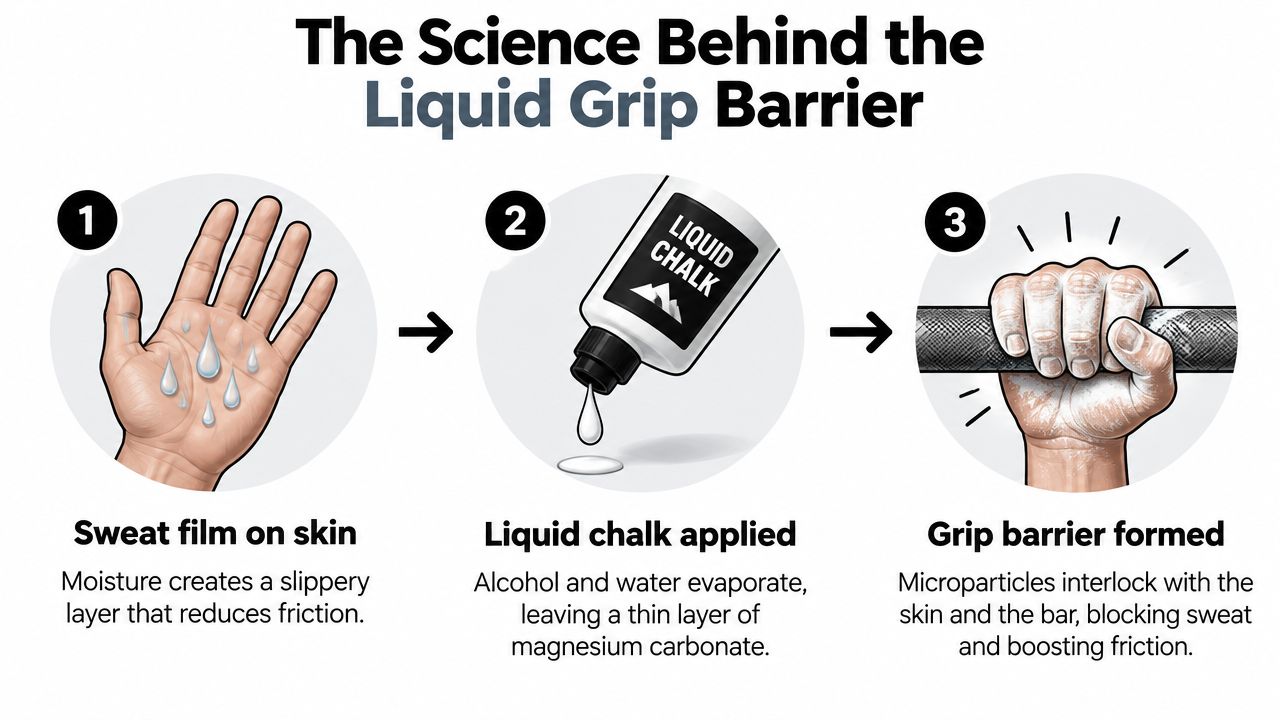
Sweat reduces grip because moisture can act as a lubricating layer between skin and surface. Liquid chalk works through two connected actions. The alcohol carrier evaporates quickly, and magnesium carbonate remains behind as a dry film that helps manage moisture at the contact point.
Technical descriptions place the drying window at roughly 10 to 30 seconds, depending on the formulation and conditions, as explained in this technical guide to liquid chalk. Once the carrier has evaporated, the remaining chalk creates a thin, more uniform interface between the skin and the bar, hold, or apparatus. The useful effect isn't having more white material on your hands. It's reducing the lubricating influence of sweat while keeping the contact layer relatively controlled.
What the deposited film changes
Powder chalk can work well, but loose application often produces uneven coverage. One part of the palm may be heavily coated while the fingers remain relatively bare. A liquid formulation begins as a spreadable paste, so the athlete can work it across the palms, fingers, and other contact areas before it dries.
That creates three practical advantages:
- More even coverage: The athlete controls where the chalk goes instead of relying on loose particles to distribute themselves.
- Lower airborne mess: Liquid chalk doesn't create the same dust cloud associated with loose powder.
- Moisture management: The dried magnesium carbonate film helps limit the effect of sweat during demanding efforts.
The formulation doesn't make skin permanently dry, and it doesn't remove the need to clean a bar or hold. It gives you a prepared surface. If you apply too much, fail to let it dry, or layer product repeatedly without assessing the contact, the result can become irregular rather than more secure.
For athletes who need a formula that dries quickly and behaves predictably, EVMT also discusses its drying formula. The important habit remains the same: spread the product evenly, wait until the carrier has evaporated, then test the grip with the actual surface you'll use.
Choosing the Right EVMT Formula and Size
Liquid chalk isn't a single experience across every discipline. A weightlifter wants reliable contact across the palm while pulling against a knurled bar. A boulderer may want controlled coverage on fingertips without turning small holds into a heavily coated surface. A pole dancer or gymnast may need clean, repeatable grip without loose residue transferring onto shared equipment.
EVMT offers three formulas with different use cases. Classic is the broad-coverage choice for general training. Weightlifting is aimed at maximum bar contact and heavy pulls. Rock Climbing is intended for precision holds and small crimps, where excess product can interfere with tactile feedback.
Size matters more than athletes expect
The 50 ml bottle suits athletes who move between training locations, competitions, or climbing areas. Some portable options include a carabiner ring, which makes carrying the bottle on a harness or training bag straightforward. The 250 ml format makes more sense for a home gym, coach, team, or facility where the bottle stays in one place and multiple sessions draw from the same supply.
| Athlete Profile | Recommended Formula | Ideal Size | Primary Benefit |
|---|---|---|---|
| Powerlifters and Olympic lifters | Weightlifting | 250 ml for a home gym, 50 ml for meets or travel | Maximum bar contact during heavy pulls |
| Boulderers and sport climbers | Rock Climbing | 50 ml, especially for portable use | Controlled coverage for precision holds |
| CrossFit and functional fitness athletes | Classic or Weightlifting | 50 ml for classes, 250 ml for a home setup | Adaptable grip support across varied implements |
| Pole dancers and grip-focused performers | Classic | 50 ml | Portable, clean application for shared training spaces |
The formula should match the surface and movement demands, while the size should match your routine. A competitive climber who carries chalk between crags has different needs from a home-gym owner who trains beside the same bar every day. EVMT presents these options on its liquid chalk product page, but the decision should still begin with your actual failure point. Are you losing contact on a bar, over small holds, or during repeated transitions?
Application Protocol for Maximum Friction
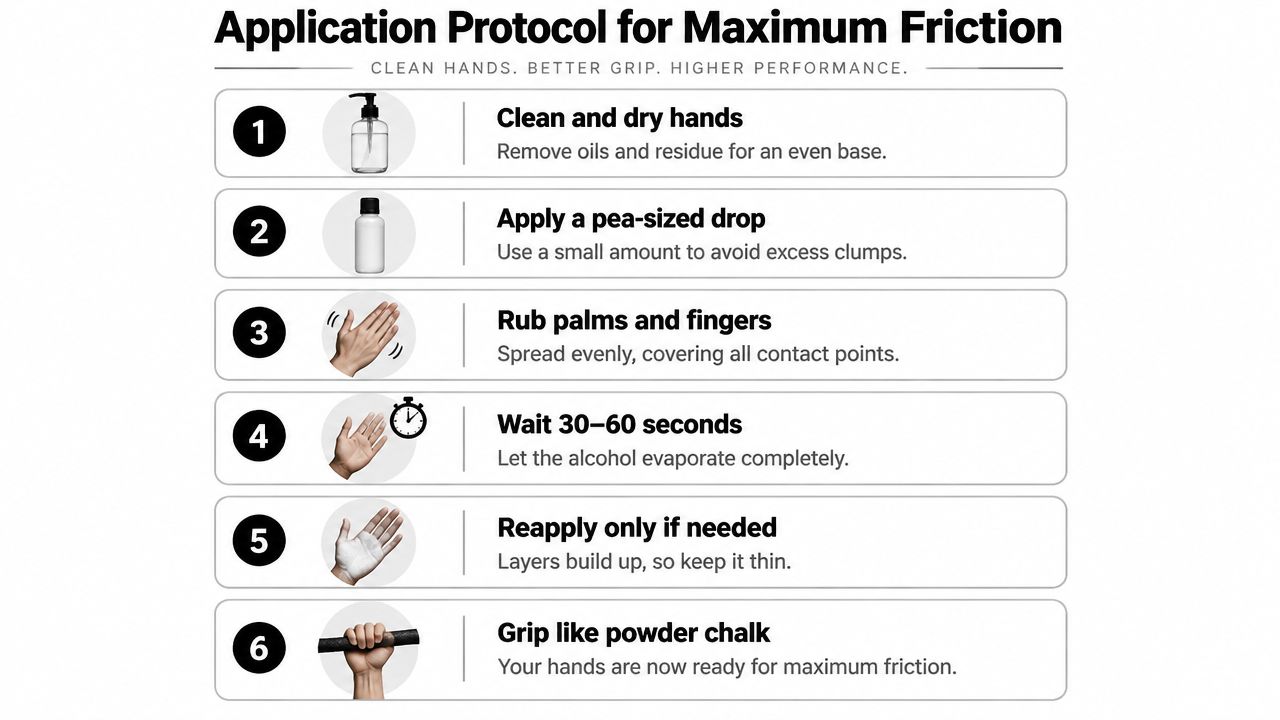
The most common error is treating liquid chalk like powder. Athletes squeeze on too much, start the lift immediately, then wonder why the bar or hold feels coated instead of controlled. Liquid chalk needs a short preparation routine because the carrier must evaporate before the chalk film can do its job.
A repeatable pre-attempt routine
- Clean and dry your hands. Remove sweat, oil, lotion, and old residue. A clean surface gives the product a more consistent base.
- Use a small amount. Apply enough to cover the required contact areas without creating thick pools around the fingers or in the center of the palm.
- Rub it in thoroughly. Work the paste across the palms, finger pads, and any area that will contact the implement. Uneven application creates uneven friction.
- Wait for the film to dry. Allow roughly 20 to 30 seconds before climbing or lifting, as outlined in this climbing chalk application guide. If you begin too soon, the wet product can transfer to the bar or hold.
- Check the surface. If the hand feels wet, tacky, or clumped, keep waiting. If the grip feels dry and even, start with the planned attempt.
- Reapply selectively. Add a thin touch-up only when sweat or repeated work has removed the useful layer. More product isn't automatically more grip.
Using liquid chalk as a primer
Outdoor climbers sometimes use liquid chalk as a base layer beneath a light dusting of loose chalk. The liquid layer prepares the skin, while the small amount of powder provides additional coverage during a longer route or extended session. Keep the top layer light. Caking the hand or hold can reduce useful tactile feedback and leave unnecessary residue.
For back-to-back efforts, don't apply liquid chalk in the instant before you grab the implement. Build the drying pause into your warm-up or attempt sequence. This is particularly important for climbing, where a transfer onto a hold can change the feel for everyone using it afterward.
Gym Air Quality and the Shift to Liquid Formats
The case for liquid chalk extends beyond the athlete's palm. Loose chalk becomes airborne during application, hand claps, brushing, and repeated contact with bars or holds. In a commercial facility, that dust can settle on equipment, clothing, floors, and ventilation components, creating more work for staff and a less pleasant environment for members.
A Climbing Wall Association summary describes evidence in which ethanol-based liquid chalk produced airborne chalk concentrations similar to banning chalk entirely, while pressed, powdered, and chalk-ball formats generated airborne particles that increased with traffic, as reported in the cited climbing-wall air-quality paper. That finding doesn't mean every liquid product or every facility will behave identically. It does show why gyms evaluate chalk format as an operational issue rather than only a performance preference.
Why facilities care
A powder-only policy can create several problems at once:
- Air management: Fine particles circulate through shared indoor spaces and complicate particulate control.
- Equipment upkeep: Loose chalk leaves more visible residue on bars, rigs, mats, and climbing surfaces.
- Cleaning workload: Staff must remove deposits from areas far beyond the chalk bucket.
- Member experience: Athletes with respiratory sensitivities may object to persistent airborne dust, even when they value chalk's grip benefits.
Some facilities now restrict athletes to liquid chalk. One gym's house rules explicitly state “liquid chalk only” and prohibit powdered chalk because of staff health, air-conditioning function, and cleanliness concerns, as shown in the facility's published policy. Carrying a personal bottle can therefore be a practical access requirement, not merely a way to keep your own hands prepared.
Liquid chalk still contains a volatile carrier, so ventilation and responsible use matter. For broader indoor-air guidance, Covenant Aire Solutions' indoor air quality tips provide useful context on managing indoor pollutants and ventilation. Athletes can also review EVMT's discussion of whether chalk is non-toxic before choosing a product for a home or commercial setting.
Contextual Performance and Grip Limitations
Liquid chalk can improve grip in the right conditions, but it isn't a universal friction upgrade. Independent testing has found that liquid chalk can perform differently from dry hands and powder chalk depending on the task. In one climbing-specific study, liquid chalk produced lower friction than dry hands or powder chalk under the tested conditions, and the dried layer could crack under stress, reducing grip quality, as summarized in this review of climbing chalk research.
That result doesn't make liquid chalk useless. It tells you to stop treating “chalked” as a complete description of the grip system. The surface, moisture level, skin condition, pressure pattern, and movement all matter.
Where the variables show up
A 2024 study found that chalk effectiveness depended on moisture level and the shape of rock asperities, according to the open-access research review. In plain language, chalk may behave differently on a rough hold than on a smoother one, and a hand with mild moisture may respond differently from a heavily sweaty hand.
Broader sports-science research still supports magnesium carbonate as a grip aid because it can help manage hand sweat and alter friction. Reported outcomes vary by hold type, skin condition, and loading pattern. Another controlled study reported no friction change even though participants hung longer with chalk, which shows that perceived endurance and measured friction aren't always identical.
The honest test: Judge the product by the surface and task you actually train on, not by a universal promise of “maximum grip.”
A dried liquid layer can also crack when the hand experiences high shear stress. That matters during repeated dynamic movement, aggressive crimping, or transitions where the skin and surface move against each other rather than pressing together. If your grip feels brittle, pasty, or less tactile, remove excess and reassess instead of automatically adding another layer.
Practical Answers for the Training Floor
Can athletes with sensitive or sweaty hands use liquid chalk? EVMT describes its product as dermatologist-tested and skin-friendly, but individual tolerance still varies. Athletes prone to irritation, blisters, or unusually sweaty hands should apply a thin layer, monitor how the skin responds, and stop if discomfort develops. Liquid chalk can help manage moisture, but it isn't a substitute for addressing damaged skin or changing a technique that repeatedly creates hotspots.
Should you reapply during a session? Yes, when the original layer has worn away or sweat has returned. Wipe away excess residue first, then apply a small amount to clean, dry contact areas. During a long climbing day, liquid chalk works well as a prepared base, with a light powder touch-up when the route or conditions demand it. During a high-repetition gym session, avoid interrupting a set to add wet product. Apply it before the next block and let it dry fully.
Cleaning and equipment habits
Wash the product from your hands after training with ordinary soap and water. Clean the bar, rings, or other shared equipment according to the facility's rules, especially if you can see buildup. A clean surface helps you evaluate whether the problem is your hand moisture, the grip aid, or the implement itself.
Does liquid chalk eliminate the need for powder? Not always. Some climbers prefer it alone for indoor sessions, while others use it as a primer beneath a small amount of loose chalk outdoors. The useful choice depends on the route, humidity, surface texture, and facility policy.
What purchasing policies are available? EVMT's publisher information lists flexible subscriptions with 20% savings, free U.S. shipping on orders over $20, and 30-day hassle-free returns. Those terms can reduce the commitment involved in testing a formula and size, but the performance decision should still come from your training environment.
Which size should you start with? Choose the portable bottle if you train across gyms, climbing areas, or competitions. Choose the high-volume bottle if the product will stay in a home gym, team space, or coaching facility. Match the formula to the contact problem, then keep the application thin and give it time to set.
Evermost LLC offers EVMT Liquid Chalk in Classic, Weightlifting, and Rock Climbing formulas, with portable and high-volume bottle options for different training settings. Visit Evermost LLC to choose a liquid grip solution that fits your sport, surface, and application routine.