


Liquid Bandage Blisters
Liquid bandage is often sold as the easy answer for blisters. That advice is too broad. A liquid seal can help a small, shallow blister that has already opened, stopped draining, and sits in a low-friction area. It's a poor choice for a deep heel blister, a large fluid-filled bubble, a blood blister, or any wound showing infection.
That distinction matters for athletes. Weightlifters, climbers, gymnasts, pole athletes, and anyone with sweaty hands may search for “liquid bandage blisters” when the underlying problem is repeated friction, moisture, or grip. The best solution may be a dressing, a friction barrier, or a cleaner grip aid such as EVMT Liquid Chalk, not a seal placed over damaged skin.
Table of Contents
- Why Liquid Bandage Is Not a Universal Blister Fix
- How Liquid Bandage Actually Protects a Blister
- Applying Liquid Bandage to a Small Blister Safely
- Liquid Bandage vs Hydrocolloid and Other Blister Dressings
- Aftercare, Reapplication, and How Long the Seal Lasts
- Red Flags That Mean Stop and See a Clinician
- Matching the Right Blister to the Right Call
Why Liquid Bandage Is Not a Universal Blister Fix
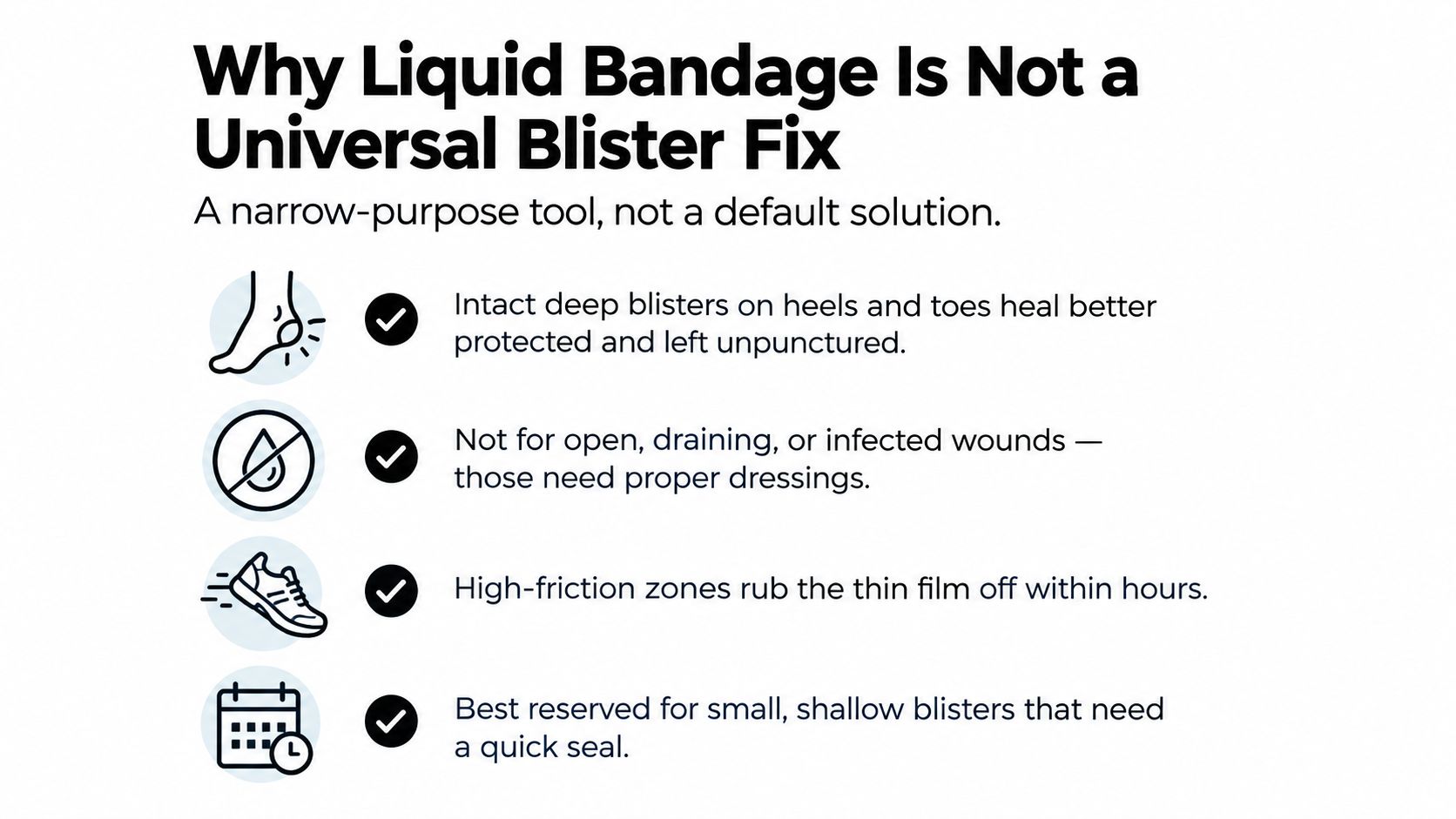
The popular assumption is simple: blister appears, liquid bandage goes on. That skips the most important question, what kind of blister is it?
An intact blister roof is natural protection for the skin underneath. Sealing over it can trap sweat and soften the surrounding tissue, especially when the blister sits inside a sock, shoe, glove, or other high-contact area. Liquid bandage also doesn't cushion pressure, absorb fluid, or stop the shear caused by running, climbing, lifting, or pole work.
The narrow-use case is much clearer. Liquid bandage suits a small blister that has popped naturally, has shallow exposed skin, has stopped bleeding, and is surrounded by clean, dry skin that won't move heavily. A fingertip, knuckle, or toe may fit. A heel rubbing inside a shoe usually doesn't.
The practical boundary
A 2008 clinical study followed 98 volunteers across 101 application sites during a march in tropical conditions. 27 participants developed 46 blisters, but none formed at the bandage application sites, and 99 of 101 bandages stayed adhered. That supports the value of a properly applied liquid-style friction barrier, but it doesn't turn every blister into a candidate for sealing. The clinical study examined prevention under specific conditions, not a universal treatment rule.
For prevention, athletes should address the trigger early. Dry skin, hot-spot taping, and appropriate blister coverings are usually more useful than waiting until a wound needs sealing. The guidance on preventing blisters belongs before the skin breaks, not after repeated rubbing has already created an open lesion.
Practical rule: Match the dressing to the blister. Don't force the blister to fit the product.
How Liquid Bandage Actually Protects a Blister
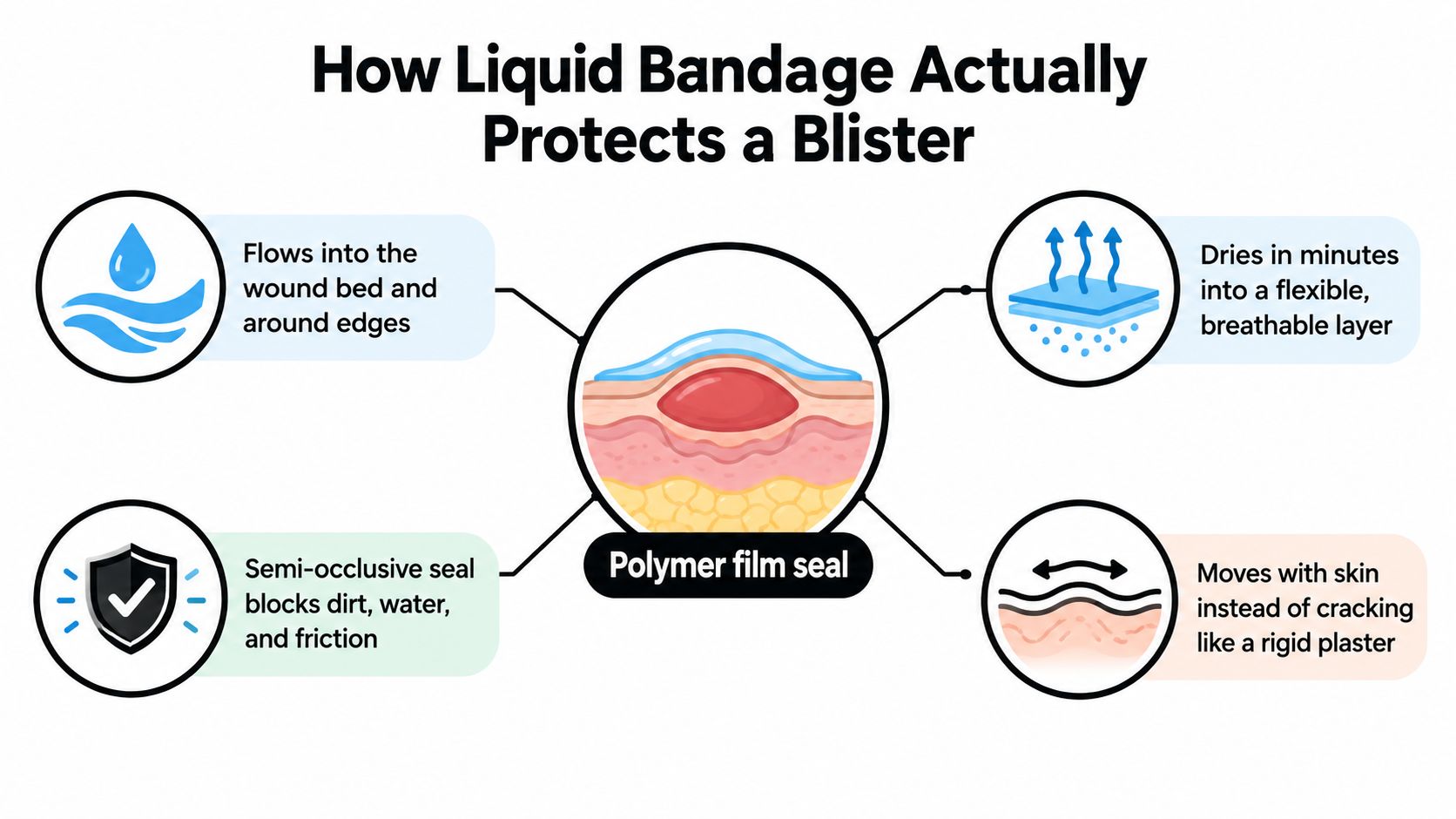
Liquid bandage is a surface seal, not a universal blister fix. It works by spreading over a shallow skin opening, allowing its carrier to evaporate, and leaving a thin, flexible film behind.
That film limits contact with dirt, water, and light rubbing. It does not cushion a heel or the ball of the foot, where pressure and shear can lift the seal quickly. On larger, deeper, or heavily rubbed blisters, it may also trap moisture and make changes in the wound harder to see.
Where the film makes sense
A small, popped fingertip blister is a good use case. Once drainage has stopped, a thin film can cover the exposed surface without the bulk of a dressing interfering with a bar, hold, or pole. A shallow knuckle blister may also suit liquid bandage when the surrounding skin is clean and the joint is not repeatedly flexing under force.
Use the same judgment for the wound itself. Liquid bandage fits a superficial opening with controlled drainage. It is a poor choice for an intact, tense blister, active bleeding, a deep split, or a site that keeps rubbing against footwear or equipment.
A randomized wound-healing trial published in 2002 found no significant difference in complete healing by day 12 between liquid adhesive bandages and conventional bandages, with P=.493. The liquid adhesive bandage did provide significant hemostasis, with P=.0001, and pain relief, with P=.002. These findings support liquid bandage as a reasonable option for small skin injuries, not as proof that it heals every blister faster. The randomized trial provides the relevant comparison.
Why grip products solve a different problem
Liquid chalk manages moisture and improves grip through a dry surface layer. It is commonly described as magnesium carbonate combined with alcohol. As the alcohol evaporates, it leaves a thin layer that can be topped with powder during longer routes.
EVMT Liquid Chalk provides grip for weightlifting, gymnastics, rock climbing, and sports. It is a grip product, not a wound dressing, so keep it away from broken skin.
Applying Liquid Bandage to a Small Blister Safely
The application needs to be cleaner than many quick gym fixes. Liquid bandage only adheres well when the surrounding skin is free of sweat, lotion, oil, and loose debris.
Start by washing the hands. Clean the blister area gently with mild soap and water, then pat it completely dry. Rubbing can irritate the exposed surface, while peeling the remaining skin can enlarge the wound. The blister roof shouldn't be pulled away, and liquid bandage shouldn't go over active bleeding or an intact, tense blister.
Use thin coats, not a thick patch
Brush on a thin first coat over the shallow opening and only a small margin of nearby skin. Keep the hand or foot still while the film sets, and avoid spreading the product onto unaffected skin. A heavy pool at the edges is more likely to catch, peel, and tug at the wound.
Let the first coat dry for 30 to 60 seconds before adding a second thin layer. The finished film should feel smooth and flexible, not wet, gummy, or sharply raised around the perimeter. If the area continues to bleed, drain heavily, or sting increasingly, the application should stop rather than being reinforced with more product.
For hand injuries, athletes should also consider whether movement is the main problem. A properly placed tape barrier may protect a finger more effectively during gripping than a film alone. The technique discussed in this guide to taping a finger can help when the site needs mechanical protection instead of only surface coverage.
A sealed blister shouldn't be used as permission to resume the activity that caused it. If the film is being rubbed against a bar, shoe, climbing hold, or pole immediately after application, it may fail before the skin has had time to settle.
Liquid Bandage vs Hydrocolloid and Other Blister Dressings
Liquid bandage wins when sealing is the priority. It's thin, flexible, and useful on a small popped blister where cushioning isn't needed. Hydrocolloid, moleskin, felt padding, and protecting an intact blister serve different problems.
A hydrocolloid dressing is the stronger choice for an intact heel, palm, or ball-of-foot blister. It can provide a more substantial protective layer and pressure relief than a liquid film. Evidence summaries note that research on second-skin bandages is limited, and trials of hydrocolloid plasters are also limited, so the comparison shouldn't be framed as a proven healing race. Keeping the blister roof intact may reduce bacterial colonization compared with draining or deroofing, according to first-aid blister guidance.
| Dressing Option | Best Blister Type | Friction Level | When to Choose It |
|---|---|---|---|
| Liquid bandage | Small, popped, shallow blister on a finger, toe, or knuckle | Low | Choose when a flexible seal matters more than padding |
| Hydrocolloid dressing | Intact blister on a heel, palm, or weight-bearing area | Moderate to high | Choose when cushioning, coverage, and pressure relief matter |
| Moleskin or felt donut | Early hot spot before the skin breaks | Rising friction | Choose to offload pressure before a blister forms |
| Leave intact with loose coverage | Large, deep, or blood-filled blister | Variable | Choose when the blister roof still protects the underlying skin |
Liquid bandage is the wrong tool for a high-friction sports blister that needs pressure removed. A runner's heel, a climber's palm, or a lifter's thumb repeatedly contacting equipment may need a physical barrier or activity adjustment instead. Athletes dealing with torn callused skin should review rock-climbing hand care rather than treating every hand injury as a simple liquid-bandage problem.
Aftercare, Reapplication, and How Long the Seal Lasts
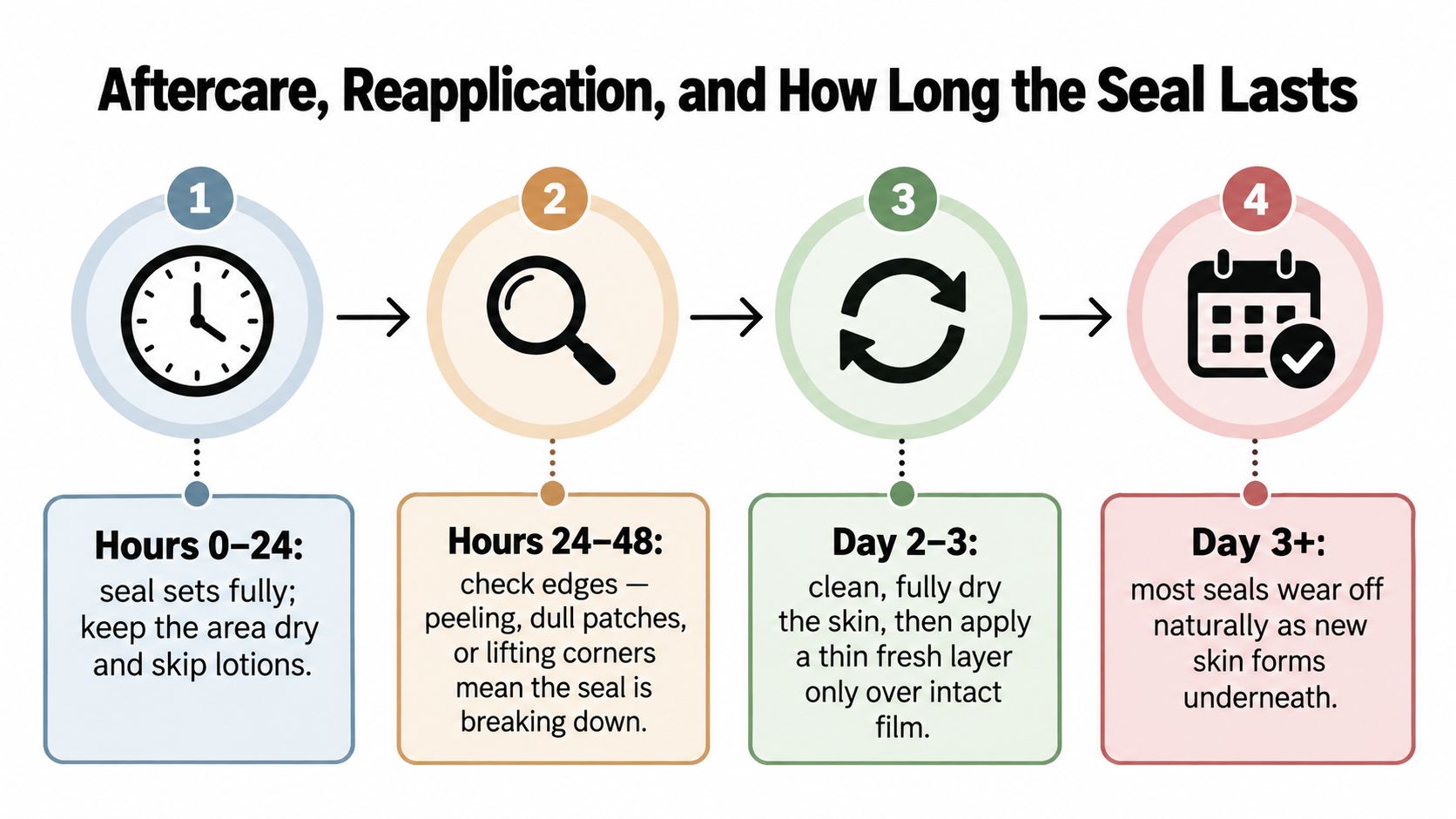
A liquid seal needs monitoring, not blind trust. During the first 24 to 72 hours, the area should stay as dry as practical and remain free of lotions that soften the film. The seal is working only while it stays continuous and the wound beneath remains calm.
Wear time depends heavily on friction and moisture. On a low-friction site, many formulas can hold for 1 to 3 days, while heavy sock or shoe contact may wear the film down in less than a day. Those durations are practical expectations, not guarantees, and sweaty sports can shorten them further.
Signs the coating has failed
Watch for:
- Lifting edges: Corners that catch on clothing or equipment can pull the film away from the wound.
- Whitening or dull patches: A change in appearance often signals moisture exposure or breakdown.
- Reopening: If the wound surface becomes exposed again, the existing layer no longer provides reliable protection.
- Softened film: Sweat or water can make the coating flexible in the wrong way, allowing contamination and rubbing underneath.
Reapplication starts with removing loose old film gently. Clean the area, let it dry fully, and apply a fresh thin coat only to a clean, shallow opening. The product shouldn't be layered over a wet, dirty, increasingly painful, or infected wound.
For sweat-heavy lifting, climbing, gymnastics, or pole sessions, reapplication every few hours may be necessary, but frequent failure is a decision signal. If the seal repeatedly peels off, switch to a dressing that better handles movement and friction instead of repeatedly painting over the same site.
Red Flags That Mean Stop and See a Clinician
A sealed wound can look tidy while an infection worsens underneath. Liquid bandage should come off and the blister should be assessed when symptoms progress rather than settle.
Urgent warning signs include redness extending more than a few millimeters beyond the wound edge, increasing warmth, cloudy fluid or pus instead of clear drainage, red streaking toward a joint or ankle, and throbbing pain that keeps intensifying. Fever or chills also change the situation from routine blister care to medical evaluation.
Blisters that shouldn't receive liquid bandage
Liquid bandage should not be used as a cover-up for:
- Large blisters over 1 cm, especially when painful or tense.
- Blood blisters, which may involve deeper tissue injury.
- Burn or allergic-reaction blisters, where the cause needs assessment.
- Blisters on a diabetic or circulation-impaired foot, where even a small wound can become serious.
Increasing swelling, numbness, a wound splitting open, or worsening pain also requires evaluation. MedlinePlus blister guidance specifically flags redness, increasing pain, pus, fever, numbness, and wound separation as reasons to seek medical care. For a broader explanation of when to seek medical attention for wounds, a wound-care resource can help athletes judge symptoms that shouldn't be managed under a sealed film.
A clean-looking surface isn't evidence that the tissue underneath is healthy.
The safest response to a red flag isn't another coat. Remove loose seal material without scraping the skin, keep the area clean, and arrange appropriate clinical care.
Matching the Right Blister to the Right Call
The decision becomes straightforward when the blister's condition, location, and friction level are considered together.
| Blister Scenario | Recommended Call | Liquid Bandage Appropriate |
|---|---|---|
| Small, intact heel blister during low-impact activity | Leave it intact or use soft cushioning | No |
| Small, popped finger or toe blister with drainage stopped | Clean, dry, and apply a thin seal | Yes |
| Large, fluid-filled blister under a shoe | Use a protective hydrocolloid dressing and reduce pressure | No |
| Friction-prone blister during a sports event | Use tape or moleskin to create a physical barrier | Usually no |
| Blister with warmth, streaking, pus, or increasing pain | Remove the seal and contact a clinician | No |
The small popped finger or toe blister is the clearest liquid-bandage use case. A large blister under a shoe needs space and cushioning, while a mid-event hot spot needs friction control before the skin deteriorates further. A diabetic or circulation-impaired foot deserves particular caution, and Carevo Home Health Care foot care offers useful context for why those feet require a different level of attention.
Athletes should also separate wound care from grip care. Liquid bandage protects a superficial opening, while liquid chalk manages sweat and grip on intact skin. For climbers, liquid chalk works best as a base layer under powder chalk. Apply it to dry hands, let it dry fully, then add powder as normal. The added layer can last through more moves before re-chalking, with the method especially useful on long sport routes, multi-pitch climbing, and humid gyms rather than short boulder problems.
Evermost LLC offers EVMT Liquid Chalk in single bottles and multi-packs for weightlifting, powerlifting, CrossFit, climbing, gymnastics, cheer, pole fitness, and other sweaty-hand activities. Visit Evermost LLC to choose a clean, fast-drying grip aid for training spaces where powder chalk creates dust or isn't allowed.