


Climbing Board Training: Protocols, Workouts, and Safety
More board volume isn't automatically better climbing. Piling on extra hangs, ladder drills, and fatigue sets can leave your fingers exhausted without improving the specific quality that limits your movement. Climbing board training works when the tool, load, rest, and weekly placement match the adaptation you're trying to create.
A hangboard and a campus board aren't interchangeable finger-strength devices. The hangboard gives you controlled isometric loading, while the campus board challenges dynamic force production, timing, coordination, and the ability to transfer force between successive holds. Treating them as the same tool is one of the fastest ways to build a noisy program that creates fatigue faster than performance.
The practical approach is simpler. Identify whether you need more recruitable finger force, better power, or the capacity to repeat hard moves. Then use the smallest effective dose that trains that quality while leaving enough recovery for actual climbing.
Why Most Climbing Board Training Plans Miss the Point
The popular assumption is that more contact time produces more strength. It sounds logical, but the training effect depends on how much force you produce, how long you produce it, and how completely you recover between efforts. Ten tired hangs aren't automatically superior to a few high-quality hangs performed with a clear progression.
Hangboard work and campus-board work also create different problems for the body. A hangboard lets you isolate grip positions under relatively stable conditions. A campus board adds acceleration, catching, body tension, shoulder control, and repeated force transfer. If you use campus ladders as a substitute for max-strength hangs, or turn every hangboard session into a forearm endurance circuit, you may train neither quality well.
A 2021 randomized trial provides a useful correction to volume-heavy programming. In advanced climbers, an 8-week hangboard protocol using progressively increasing weight produced significantly greater grip-strength gains than regular climbing alone, with a reported p-value of 0.032 and an effect size of 0.36. The trial randomized 30 participants and analyzed 27 completers, and the maximizing-weight protocol improved strength across multiple grip positions, including three of seven pinch configurations. The minimizing-edges protocol didn't outperform the control group. Read the full randomized trial.
Practical rule: Choose the board for the limiting quality, not for the exercise that leaves you most exhausted.
A strong plan usually has less clutter. Hangboard sessions can target maximum finger force with long rests. Campus sessions can target dynamic power or power endurance. Climbing itself supplies movement practice, footwork, route reading, and exposure to varied holds. Board work should fill a gap, not compete with every other training quality in the same week.
Warming Up Before You Touch the Board
A useful warm-up should raise temperature and progressively load the tissues without creating forearm fatigue. Use a focused 10-minute sequence before hangboard or campus work, and extend it if your fingers feel cold, stiff, or unusually restricted.
Build heat before loading fingers
Start with 3 to 4 minutes of easy movement. Light jogging, brisk walking, easy traversing, arm circles, and relaxed shoulder movements all work. Keep the intensity low enough that you can breathe comfortably and finish feeling more prepared, not tired.
Spend the next 2 minutes on joint movement and shoulder activation. Perform wrist circles in both directions, gentle shoulder circles, and controlled scapular movements. Band pull-aparts or shoulder dislocates can fit here if you already use them safely. The objective is to prepare the shoulder girdle for hanging, not to create a separate strength set.
Move from range of motion to load
Use approximately 2 minutes for wrist and finger preparation. Open and close the hands, move through gentle finger tendon glides, and avoid forcing any painful range. Climbers who need more general wrist mobility can also review these wrist exercises for arthritis relief, adapting any movement that causes discomfort.
Finish with progressive loading. Begin with light open-hand hangs on a large edge, using two controlled repetitions of 5 seconds with about 30 seconds of rest. Move to a slightly smaller edge or modestly greater load for another two repetitions of 5 seconds, again resting 30 seconds. Finish with two or three controlled pull-ups, leaving several repetitions in reserve. This sequence prepares the shoulder girdle without turning the warm-up into a test.
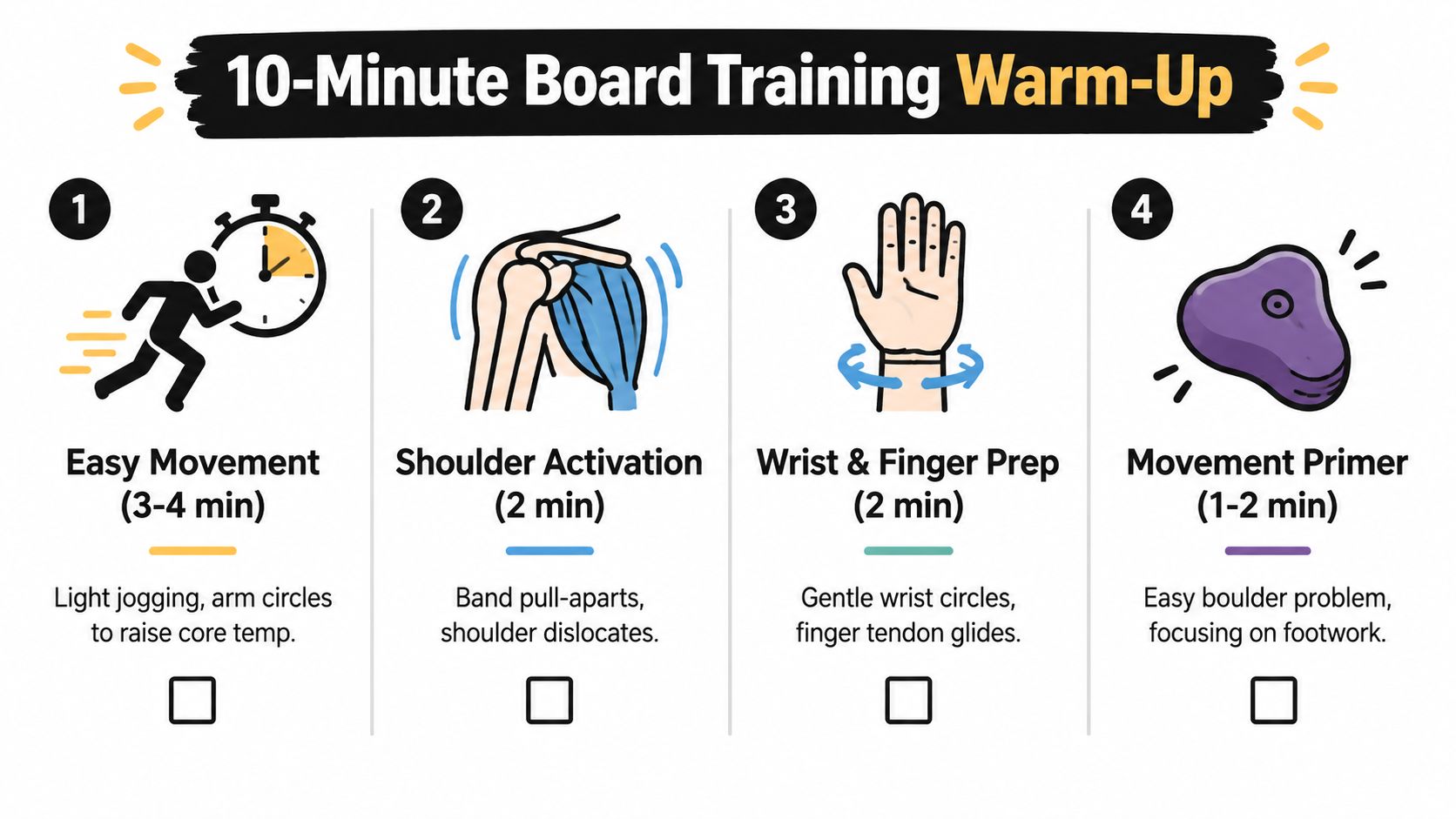
Don't jump straight from cold hands into full crimping. Don't skip the extensors, either. Gentle opening and closing of the fingers, tendon glides, and varied grip exposure help you avoid making the first hard hang a sudden, unfamiliar load.
Hangboard vs Campus Board and What Each Actually Trains
A hangboard is primarily an isometric finger-strength tool. You select an edge, grip position, and load, then produce force without moving through space. That controlled setup makes it useful for measuring progression and applying progressive overload to a specific grip.
A campus board is a dynamic power tool. The climber catches rungs, accelerates upward or laterally, stabilizes the shoulder, and transfers force through the trunk. Even when the fingers are the point of contact, the training stimulus includes rate of force development, coordination, timing, and upper-body power.
The distinction matters because the same session can feel hard for different reasons. A heavy hang may fail because your fingers can't produce enough force. A campus move may fail because you can't generate force quickly enough, your feet and hips lose position, or your shoulder arrives late to the catch.
Match the board to the adaptation
The 2021 hangboard research supports a high-intensity, progressive-loading approach for maximum grip strength. The practical interpretation is short, demanding hangs with long rests, not endless fatigue sets. A separate 2021 campus-board study found that a 5-week training block improved climbing-specific attributes in advanced-to-elite climbers. Its broader review reported that four weekly sessions improved maximal force and rate of force development, while two weekly sessions improved bouldering performance and maximal moves to failure. The study's central lesson is that frequency changes the adaptation, and more sessions aren't automatically better. Review the campus-board study.
| Variable | Hangboard | Campus Board |
|---|---|---|
| Primary stimulus | Isometric finger force | Dynamic force and power |
| Main limiter | Finger strength and grip position | Rate of force development, timing, and coordination |
| Typical loading | Body weight, added weight, or reduced edge depth | Rung spacing, movement distance, and catch quality |
| Rest demand | Long rests preserve force output | Full rests for power, shorter rests for power endurance |
| Best use | Build the force available on a hold | Transfer force rapidly between holds |
| Common mistake | Turning max hangs into fatigue work | Using poor catches and excessive volume |
Hangboards build the engine. Campus boards help transmit that force through fast movement. Most serious climbers can benefit from both, but they shouldn't give both tools equal volume by default.
Hangboard Protocols You Can Run This Week
Start by choosing an edge and grip you can load without pain or uncontrolled shoulder movement. The commonly used 20 mm edge works well for structured testing when it suits your hand size and experience, but a larger edge is the correct choice if the smaller one forces compensation. Your first goal is repeatable force, not a dramatic number on the loading pin.
Rotate through open-hand crimp, half-crimp, full crimp, and three-finger drag positions. Add a pinch block when pinch strength limits your climbing. Full crimp deserves conservative use because the joint position increases stress and can hide poor load tolerance when fatigue arrives.
Use long rests for maximum force
A maximum-strength session can use 10-second hangs with added load. The research and practical protocols commonly use hang durations around 7 to 10 seconds, with 3 to 5 minutes of rest between hard efforts. Begin with a load that lets you complete every repetition without changing wrist position or losing shoulder engagement.
For a beginner-to-intermediate climber, a simple progression looks like this:
- Warm-up sets: Two easy hangs on a large edge, then two moderate hangs on the training edge.
- Main work: Three to five 10-second max hangs, adding approximately 5 to 15% load only when the final repetition remains technically clean.
- Grip rotation: Use one or two grip positions per session rather than trying to train every grip at maximum intensity.
- Recovery: Rest 3 to 5 minutes between hard hangs and stop if the force drops sharply.
For repeaters, use 6-second hangs at body weight with short rests. Keep the edge large enough that you can maintain the intended grip. Density work can use the same edge and grip with gradually reduced rest, but it should remain submaximal. If your fingers fail because of accumulated fatigue, you're no longer training maximum force.
Quality beats contact time. If your wrist collapses, elbow bends, or shoulder rises toward your ear, reduce the load or choose a larger edge.
| Goal | Edge & Grip | Hang Time | Load | Rest | Sets x Reps |
|---|---|---|---|---|---|
| Maximum strength | Stable edge, half-crimp or open hand | 10 sec | Add 5 to 15% when controlled | 3 to 5 min | 3 x 2 to 3 |
| Repeaters | Comfortable edge, rotating grips | 6 sec | Body weight | Short, consistent intervals | 3 x 4 to 6 |
| Density endurance | Larger edge, open hand | 5 to 7 sec | Body weight or reduced load | Gradually reduced | 2 to 3 rounds |
| Pinch strength | Pinch block | 7 to 10 sec | Manageable external load | 2 to 3 min | 3 x 2 to 4 |
Run a 4-week cycle by establishing a controlled baseline, adding a small load increase or a modestly smaller edge during the middle weeks, then reducing load or depth demand during the final week. Deload by making the edge larger, reducing external weight, or cutting repetitions. Skipping a session isn't the only form of recovery.
Your technique determines what gets trained. Keep the shoulders slightly engaged and away from the ears, align the wrist with the forearm instead of letting it fold, and keep the elbows softly extended unless the exercise specifically calls for a pull. Place the feet on the floor or a low support so you can maintain a stable body position without kicking, swinging, or unconsciously unloading the fingers. For more grip-specific programming ideas, use this guide to improve grip strength for climbing.
Campus Board Protocols Built Around Power and Endurance
Campus boards use the same rungs for different outcomes. Power work prioritizes distance, acceleration, and catch quality. Power endurance keeps the movement pattern but manipulates rest and total work so you can repeat hard efforts without letting technique disintegrate.
A power-endurance ladder can use matched rungs, a 1-5-9 ladder, or a 1-5-9-13 pyramid. Use foot-only placements at the base when the goal is to remove the easy upper-body cheating route. The body should stay organized through the hips and shoulders rather than swinging wildly between rungs.
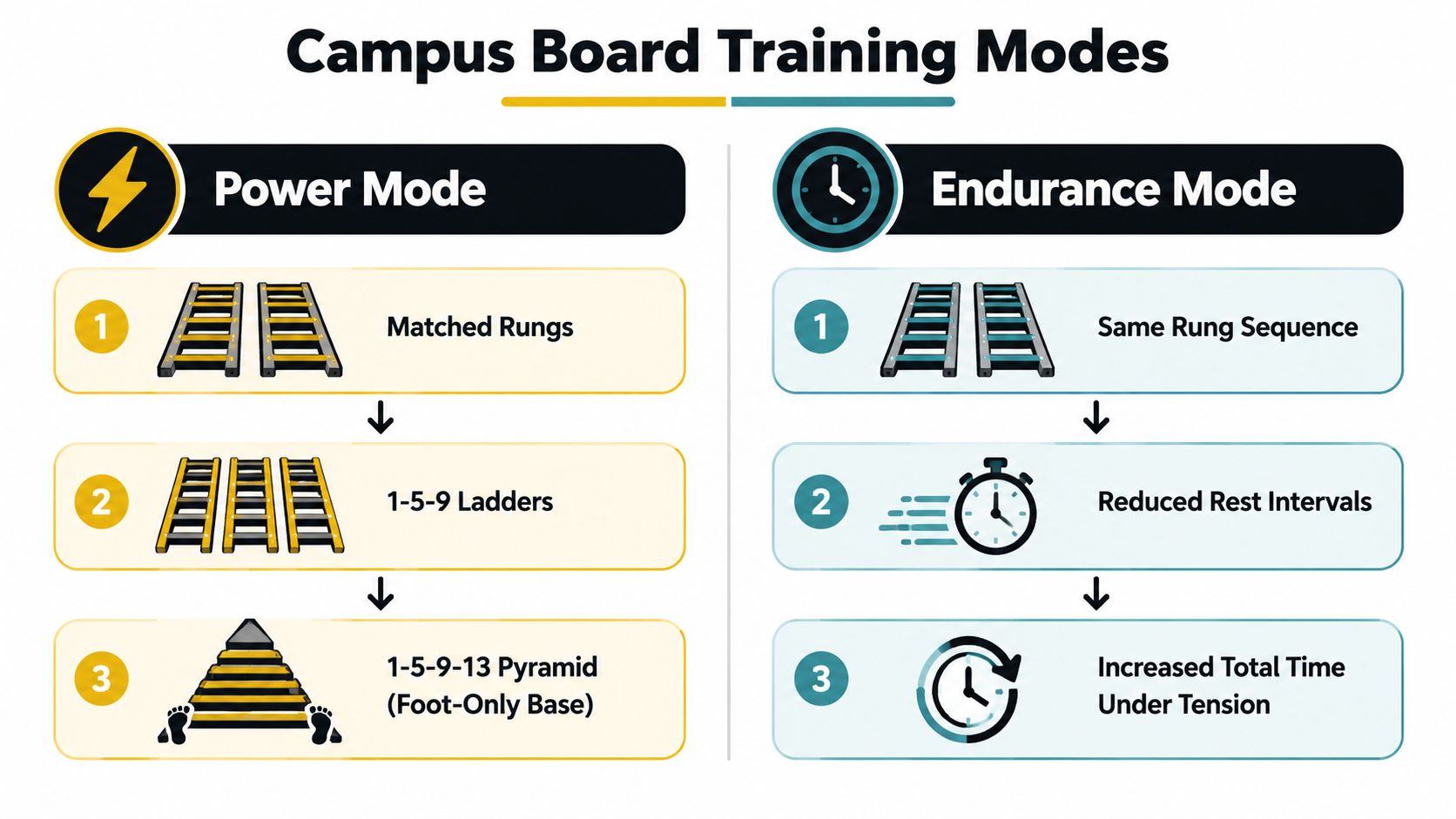
Separate pure power from repeated efforts
For pure power, use max-distance deadpoints from the bottom rung. Take 2 to 3 minutes of full rest between attempts and cap the session at 8 to 12 quality efforts. Stop when you can't stick the intended distance or the catch becomes uncontrolled. Power training ends when speed and precision disappear, even if your forearms still feel capable.
The campus-board evidence supports a short block rather than permanent high frequency. A 5-week study found meaningful improvements in advanced-to-elite climbers, while the associated evidence showed different outcomes at different weekly frequencies. Use a dedicated climbing endurance framework when your goal is repeated effort rather than a single explosive move.
Campus work isn't a beginner exercise. A conservative prerequisite is a 5.12 onsight, full-crimp endurance at body weight, and three months of structured hangboard work. Climbers who don't meet that standard can build power through limit bouldering with feet, controlled lock-offs, system-board traverses, and explosive pulling on large holds.
Rung design changes the exercise. Round rungs demand more precise contact and can punish a poor catch. Sloper rungs shift the demand toward open-hand tension and shoulder positioning. Undercling rungs change the stimulus entirely by adding a different direction of force and a stronger contribution from the shoulder and trunk.
Use a clear landing area, a competent spotter, and a safe falling position. Keep the shoulder organized during latches and lateral moves, avoid catching with a locked, internally rotated arm, and don't allow the bar position to force your shoulder into an awkward overhead angle. Athletes who are training around campus facilities may also benefit from practical fueling resources such as Gym Snack in universities, particularly when sessions combine high intensity with substantial climbing volume.
Fitting Board Work Into a Real Weekly Training Plan
Board sessions should sit beside climbing, not on top of it. Avoid heavy board work the day before or after a project session, keep at least 48 hours between hangboard sessions for the same finger-tendon complex, and place campus work on the same day as limit bouldering or anaerobic-capacity work when you want high-intensity fatigue grouped together.
A workable four-day week
For an intermediate climber with two gym sessions and two outdoor or project days, the week might look like this:
| Day | 4-Day Week | 3-Day Week | Deload Week |
|---|---|---|---|
| Monday | Hard gym session, limit bouldering plus campus power | Hard climbing, no board | Moderate climbing, technique focus |
| Tuesday | Easy movement, mobility, or rest | Rest or easy movement | Rest |
| Wednesday | Moderate hangboard strength plus technique climbing | Hangboard strength after easy climbing | Reduced-load hangboard |
| Thursday | Rest or low-intensity aerobic work | Rest | Rest |
| Friday | Hard outdoor or project session | Hard project session | Moderate climbing, no campus |
| Saturday | Easy technique session or rest | Easy movement | Easy technique |
| Sunday | Outdoor climbing, moderate intensity | Rest | Rest |
This arrangement keeps the hardest finger and movement demands away from consecutive days. If Friday's project session becomes unexpectedly intense, remove Sunday's board work rather than trying to preserve the calendar.
A three-day week can combine one hard climbing day with campus power, one moderate climbing day with hangboard strength, and one outdoor or project day. Don't add a separate board session merely because the week has fewer climbing days. Your total finger-tendon load still determines recovery.
When traveling, a pull-up bar can maintain lock-off and scapular strength, while a pinch block can preserve pinch loading without requiring a board. Neither perfectly replaces a hangboard or campus board, so reduce the ambition of the session and return gradually when the normal equipment is available.
Board work fills the gaps climbing doesn't cover. It shouldn't consume the recovery that makes hard climbing possible.
Injury Risk, Youth Climbers, and When to Step Back
Board training isn't automatically dangerous, and it isn't automatically protective. The risk depends on the climber's history, level, tissue tolerance, grip choice, and loading strategy.
A 2023 web-based study of 434 climbers found that regular fingerboard training wasn't associated with a higher overall rate of self-perceived finger injury. Among climbers with 6 or more years in the sport, regular fingerboard training was negatively associated with finger pain or injury, with χ²[1, n=200]=4.57 and p=0.03. The same study found a different pattern among male climbers with less than 6 years of experience who had reached French 7a or harder. In that group, self-reported finger injury was common and fingerboard training was positively associated with injury, with χ²[1, n=75]=4.61 and p=0.03. Review the climber injury survey.
Use symptoms to adjust the dose
Campus boards place repeated dynamic stress on tendons and the shoulder complex. Hangboards can create acute pulley or A2 strain when a climber uses an aggressive grip, excessive load, or poor progression. Step back when you notice:
- Sharp pain: Stop the set rather than testing whether pain disappears after another attempt.
- Stiffness lasting beyond 24 hours: Reduce edge demand, load, or total repetitions at the next session.
- Declining crimp performance: Treat a sudden drop in force or control as a load-management signal.
- Changing mechanics: If you can only finish by bending the elbows, twisting the wrist, or shrugging the shoulders, the target load is too high.
Youth climbers require extra caution. A 2021 review of U.S. coaches noted limited evidence that campus-board training may contribute to finger epiphyseal stress fractures, and youth-awareness research found that only 6% of adolescent climbers knew the correct safe age to start double-dyno campus-board training. Read the youth climbing injury-prevention review. Before skeletal maturity, prioritize system-board traversing, varied grip positions, controlled lock-offs, footwork, and movement skill over high-tension dynamic board work.
Use a simple decision path. Pain during a hang means stop and modify. Symptoms that remain sub-acute mean deload and monitor rather than escalating. Persistent pain, worsening function, or uncertainty about an injury warrants assessment from a qualified climbing-aware physiotherapist. A broader roadmap for injured athletes can help organize the return-to-training process, while this guide to prevent hand injuries covers practical hand-care considerations.
Correctly dosed board work can help you tolerate climbing demands more consistently. The protective side comes from progressive exposure and recovery, not from forcing through pain or chasing a particular weekly volume.
Evermost LLC offers liquid chalk for climbing and other grip-intensive training, with fast-drying, sweat-resistant formulas that leave minimal residue once dry. If cleaner, more consistent hand contact would improve your board sessions, visit Evermost LLC to compare the available climbing and training options.