


Big Clear Water Bottles: The 2026 Material Guide
You're standing at the gym with a large clear bottle that still looks spotless, yet the lid smells faintly stale. It has spent the day in a car, office, or training bag, been refilled repeatedly, and probably received little more than a quick rinse. Capacity and transparency make a bottle convenient, but neither proves that it's clean.
For athletes, the better buying question isn't just how much water a bottle holds. It's whether the body, cap, gasket, threads, and handle can survive daily use while remaining easy to wash and inspect. That matters just as much as grip does during a heavy pull, a climbing session, or any workout where sweaty hands and chalk already complicate the environment.
Table of Contents
- Introduction to High-Capacity Hydration
- Material Comparison - Tritan, Glass, and Steel
- The Hygiene Reality of Transparent Containers
- Essential Cleaning Protocols for Large Bottles
- Selecting the Right Bottle for Your Activity
- Final Recommendations and Buying Checklist
Introduction to High-Capacity Hydration
Large reusable bottles, generally those exceeding 800 milliliters, have become an established segment of the hydration-product market. One commercial market estimate places bottles above 800 ml at 28.7% of reusable-water-bottle sales, with bottles above 1,000 ml accounting for another 13.0%. The same estimate reports that 52% of large-bottle purchasers use them for athletic or outdoor recreation, while large-capacity bottles represent 48% of fitness-related water-bottle purchases in North America. These figures are directional industry estimates rather than an official global census, but they show why the category has moved beyond novelty drinkware. Market analysis of reusable water bottles
A big clear water bottle can reduce refill stops during lifting, commuting, travel, office work, and extended outdoor sessions. That's useful when a training session is busy or a refill station is inconvenient. It also lets the user see the remaining volume, sediment, and obvious residue without opening the lid.
The trade-off is mass. Each additional liter of water adds approximately one kilogram, before the bottle itself is counted. A large container that feels manageable empty can become awkward when carried across a gym, lifted into a vehicle, or held during a long walk. A strong handle, textured grip, and secure cap aren't decorative extras at this size.
| Feature | What works in practice | What can go wrong |
|---|---|---|
| Capacity | Fewer refills during training and travel | The full bottle becomes heavy and cumbersome |
| Clear body | Easier monitoring of volume and visible residue | Transparency cannot reveal microscopic contamination |
| Wide mouth | Faster filling, easier brushing, simpler drying | More exposed drinking area if the cap stays open |
| Complex lid | Convenient sipping and transport | Straws, channels, and seals trap moisture |
| Large handle | Better control when the bottle is full | Weak attachment points can fail under load |
Capacity should therefore be treated as a daily-use decision, not a status symbol. A bottle that reaches a one- or two-gallon target but is difficult to clean may create more inconvenience than it removes. The right model supports hydration without becoming another neglected piece of gym equipment.
Material Comparison - Tritan, Glass, and Steel
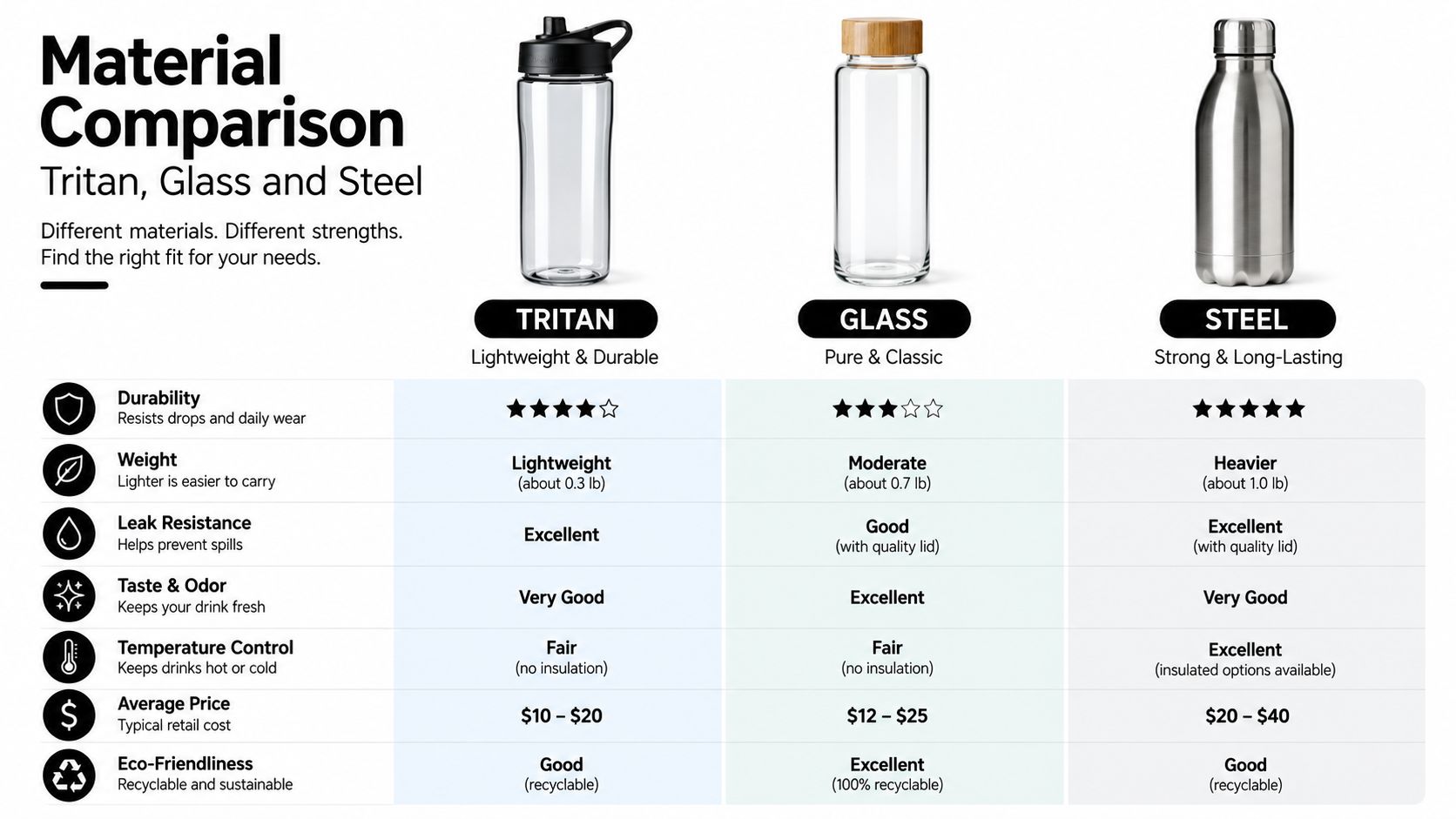
The clearest choice isn't automatically the safest or most practical. Material affects impact resistance, weight, thermal limits, insulation, cleaning, and how much confidence a user can place in the product's specifications.
Clear Tritan for active use
Clear BPA-free Tritan copolyester is often chosen for gym and outdoor bottles because it combines visibility with relatively low weight and shatter resistance. That makes it more practical than glass for a bottle that gets dropped beside a platform, pushed into a travel bag, or carried through a climbing area.
The limitation is heat. A transparent body doesn't mean the bottle is designed for hot liquids. Generic Tritan guidance warns that boiling or near-boiling liquids can cause deformation, clouding, or longer-term performance concerns. A buyer should look for an explicit maximum temperature, not infer heat suitability from the material name or a clear finish.
The specification checklist should include:
- Food-contact certification: The product should clearly identify its relevant food-contact compliance.
- Temperature limit: The maximum permitted temperature should be stated plainly.
- Dishwasher guidance: Instructions should identify which parts can be washed and under what conditions.
- Closure testing: The lid should be designed around leak resistance, not only visual appeal.
- Wash durability: The body should remain readable and intact after repeated cleaning.
For a more general look at how material decisions affect everyday product performance, the discussion of ceramic vs silicone in brewers offers useful context. The same principle applies here: a material should be judged against the job, not described as universally superior.
Glass for purity and visibility
Glass offers excellent clarity and doesn't depend on a plastic body for its visual transparency. It's also less vulnerable to the kind of heat limitation associated with many lightweight clear plastics. The problem is practical: a large glass bottle is heavier before filling and more vulnerable to impact, even when a protective sleeve is included.
That makes glass a better fit for controlled office use than for a crowded weight room or outdoor route. A full bottle can become tiring to carry, while a fall near hard flooring is a more serious event than a scuff on copolyester.
Steel for insulation
Stainless steel is the sensible choice when temperature retention matters more than visibility. It offers a durable, opaque body, but it fails the central requirement of a clear bottle. Users can't visually monitor the remaining water or inspect the interior without opening it.
That trade-off may be worthwhile for travel or hot-weather use, but it should be acknowledged rather than hidden behind broad claims about durability. Before buying any material, readers should also examine durability testing information for the specific closure, handle, and body design. A strong material can still be paired with a weak lid.
The Hygiene Reality of Transparent Containers
A clear bottle can look clean while carrying contamination that the eye can't detect. Transparency helps identify cloudiness, residue, or visible growth, but it says nothing about microscopic contamination, chemical migration, or particles released through repeated cap wear.
A peer-reviewed survey of in-use reusable bottles reported interior heterotrophic plate counts from below 1 to 8.03 × 10^6 CFU/mL, with a median of 1,115 CFU/mL. Exterior ATP readings ranged from 32 to 2,510 relative light units, with a median of 300. The study also found that cleaning behavior significantly affected heterotrophic and coliform counts. Peer-reviewed reusable-bottle hygiene survey
Those findings don't mean every large clear bottle is dangerous. They show that cleaning design matters. A large body holds more water, and a complicated lid can create more places for moisture and residue to remain after the main chamber appears fresh.
What transparency can and can't show
A transparent body is useful for spotting:
- Cloudiness: A change in appearance can signal residue, wear, or cleaning problems.
- Visible growth: Mold or buildup is easier to notice than it would be inside an opaque bottle.
- Sediment: Particles in the water can be seen before drinking.
- Drying status: Users can inspect whether water remains in the lower body.
It can't establish that the bottle is hygienic. Microbial contamination may be present in the gasket, mouthpiece, cap channel, or threads while the main chamber looks perfectly clear. A bottle's appearance is an inspection aid, not a safety certificate.
Recent reporting on research published in NPJ Science of Food described micro- and nanoplastics released into beverages through ordinary opening and closing of food containers. Another study found microplastics in all 10 tested bottled-water brands, averaging 35 particles per liter. Those findings don't prove that every reusable bottle is unsafe, or that clear plastic is worse than opaque plastic. They do support a measured approach: buyers should consider heat, scratches, sunlight, cap wear, and product age instead of relying on appearance alone. Research discussion of microplastics in food and beverage containers
Practical rule: If a large clear bottle needs a specialized brush, a permanently trapped gasket, or a lid that can't be opened for drying, its capacity isn't the main problem. Its maintenance design is.
A useful replacement cue is persistent odor, deep scratches, crazing, damaged seals, or any internal part that can't be cleaned properly. The aim isn't alarmism. It's to stop a clear surface from creating false confidence.
Essential Cleaning Protocols for Large Bottles
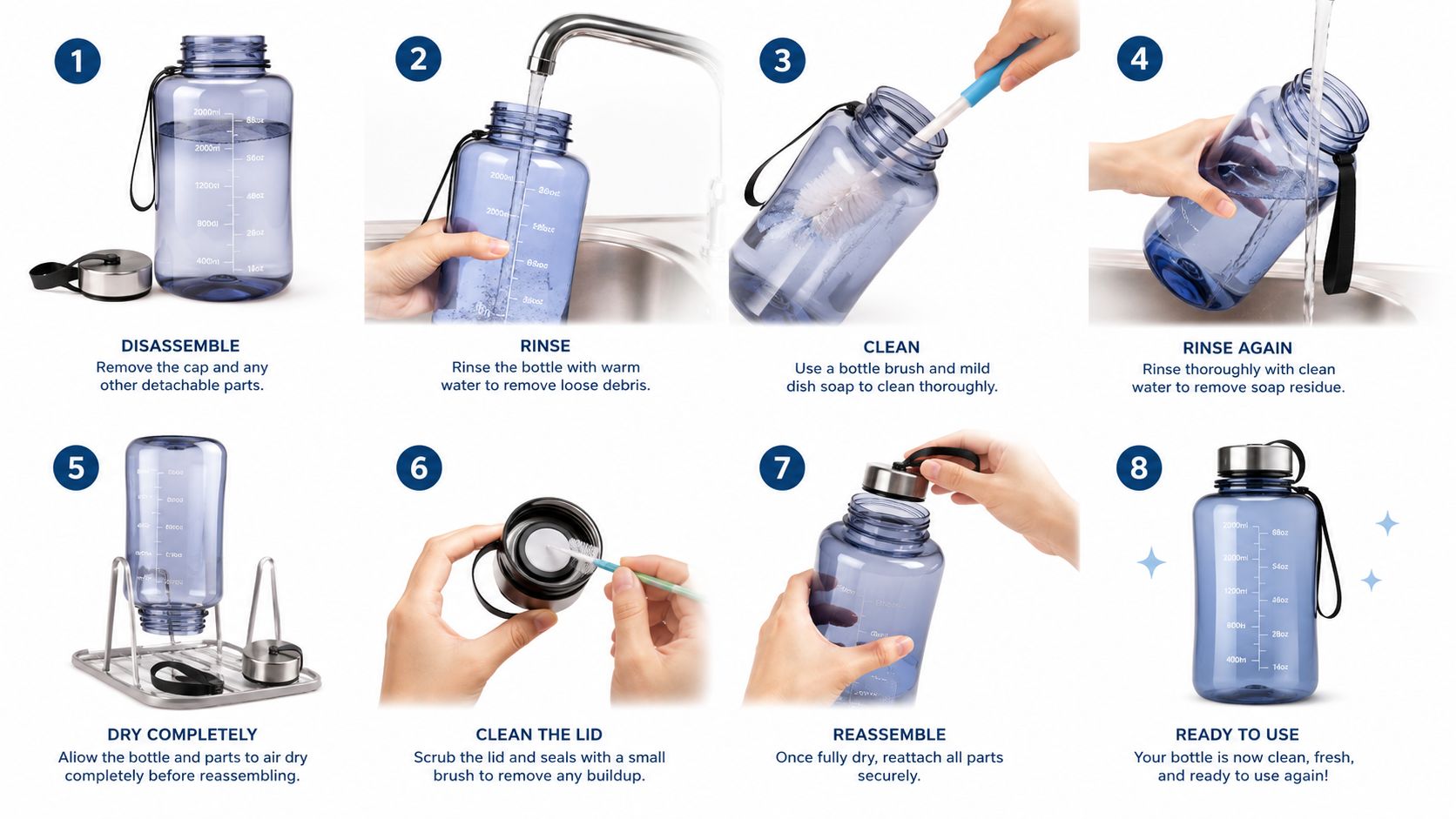
A quick rinse removes some leftover water, but it doesn't replace washing. Large bottles need a repeatable routine that reaches the cap, gasket, threads, and narrow channels.
The daily process
- Empty the bottle completely. Don't leave old water sitting in the bottom overnight.
- Separate every removable part. Remove the gasket, mouthpiece, straw, cap insert, and any tether that the manufacturer allows users to detach.
- Wash with warm soapy water. Use a bottle brush for the body and a smaller brush for narrow channels.
- Scrub the threads and seal. These areas contact hands and retain moisture even when the body looks clean.
- Rinse thoroughly. Soap left behind can affect taste and irritate sensitive mouths.
- Air-dry fully. Leave the body and parts separated rather than sealing a damp lid onto a damp chamber.
Dishwasher compatibility is useful, but it must be confirmed for each component. Some bodies tolerate the dishwasher while seals, printed markings, or lids require different care. The product instructions should determine the method, not a generic assumption that “dishwasher safe” applies to the whole assembly.
The same principle applies to gym accessories and surfaces. A practical gym equipment cleaning guide can help establish a broader habit of cleaning items that collect sweat and hand contact.
Adjusting the routine to the setting
At the office, a bottle used only for water still needs washing and complete drying. At the gym, the cap and mouthpiece encounter more hand contact and shared surfaces, so the lid deserves as much attention as the chamber. During travel, the safest habit is to empty the bottle before storing it and avoid closing it while damp.
Sweetened drinks, flavored mixes, dairy, and protein-containing beverages demand more careful cleaning because residues provide a better environment for growth. If the bottle is shared, or if the user has reduced immunity, cleaning should be treated as a higher priority.
A bottle that dries completely is easier to keep clean than one that stays sealed and damp between sessions.
Selecting the Right Bottle for Your Activity
Different activities expose the weaknesses of large clear bottles in different ways. The best choice for a weight room may be frustrating on a climbing wall, while a bottle that travels well may be too difficult to fill and clean during high-volume training.
Weightlifting and CrossFit
Weightlifters and CrossFit athletes generally benefit from a wide mouth. It accepts ice, fills quickly, and gives a brush direct access to the interior. A strong handle matters when the bottle is full, especially if it gets moved repeatedly between stations.
A fast-drinking lid can be convenient, but every extra valve, straw, and channel adds another cleaning obligation. For sweaty training environments, a simple removable closure often works better than a feature-heavy lid that looks complex but cannot be disassembled.
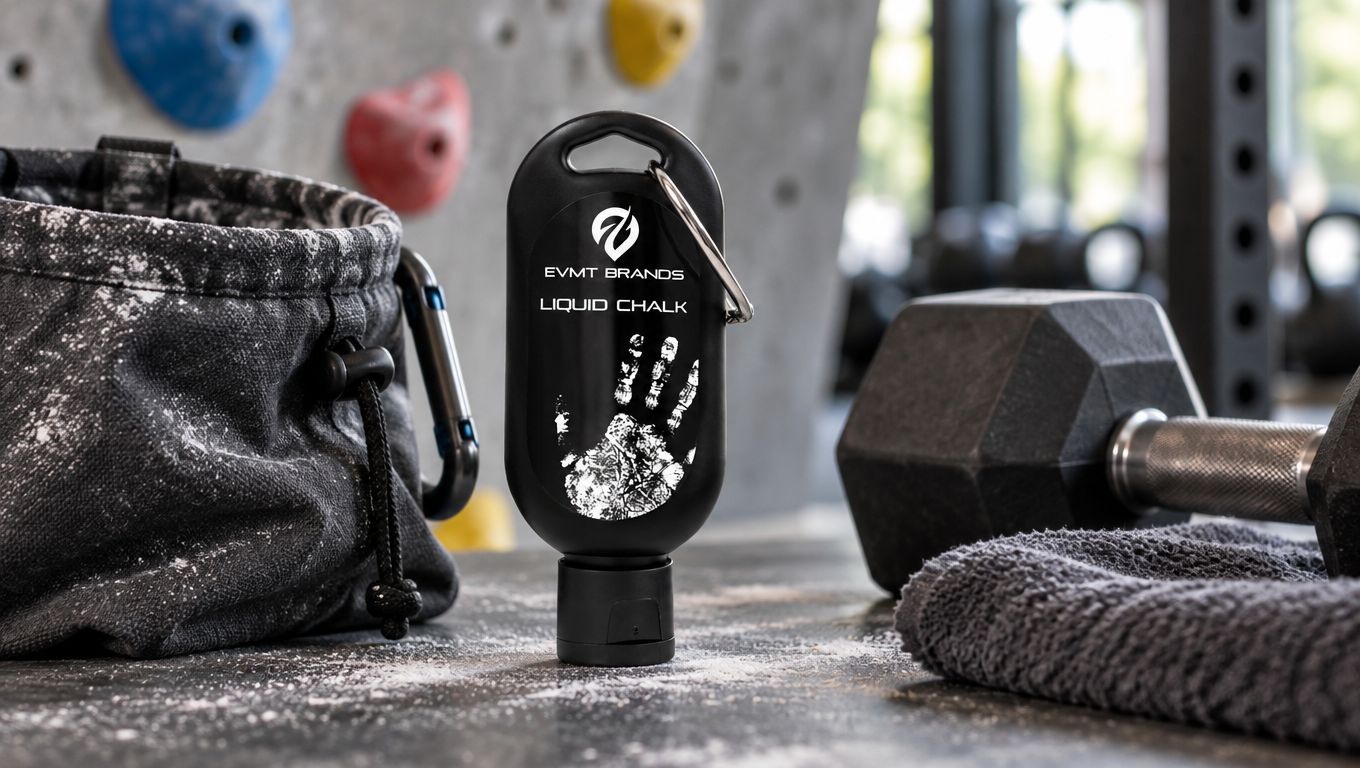
Grip problems deserve separate attention. EVMT Liquid Chalk is a magnesium-carbonate option for weightlifting, gymnastics, rock climbing, and sports, and EVMT LIQUID CHALK can be used by athletes who need hand-applied grip support without turning a home gym into a dust-covered room.
Climbing and bouldering
Climbers rarely need a big clear bottle to replace their existing chalk system. The practical use of liquid chalk is as a base layer, not a reason to abandon loose chalk.
Apply EVMT Liquid Chalk to dry hands before the session and let it dry fully. Powder chalk can then be applied on top as normal. The liquid coat creates another layer of grip, so it can last through more moves before re-chalking, with fewer trips to the chalk bag. That approach is more useful on long sport routes, multi-pitch climbing, and humid gyms than on short boulder problems.
The bottle itself should have a leak-resistant closure and a surface that remains controllable when hands are wet or dusty. More detail on travel fitness equipment is useful for athletes moving between training spaces, but the same cleaning standard still applies after the bottle returns from the crag or gym.
Office, commuting, and outdoor use
For commuting, a clear body can act as a visual reminder of remaining hydration, but the bottle shouldn't be so large that it becomes a burden. Handle strength and cap security matter more than decorative time markings.
An opaque insulated bottle may be the better choice when temperature retention is the priority. Readers comparing lightweight metal options can also review this titanium bottle ultimate guide, then decide whether visibility is needed for their route.
Final Recommendations and Buying Checklist
The strongest big clear water bottle isn't the one with the largest printed capacity. It's the one that can be filled, carried, opened, cleaned, dried, and inspected without creating a daily nuisance.
A sensible buying checklist includes:
- Food-contact certification: The product should state the relevant certification clearly.
- Explicit temperature limit: Never assume clear plastic can handle hot or near-boiling liquid.
- Removable seals: Gaskets and inserts should come out for washing and drying.
- Simple internal geometry: Fewer narrow channels usually mean fewer hidden maintenance problems.
- Wide-mouth access: A brush should reach the base and corners without improvisation.
- Leak-resistant closure: The cap should protect the bottle during transport and gym use.
- Durable handle and grip: Full capacity creates real load on attachment points.
- Clear inspection value: Use transparency to monitor residue, not to declare the bottle sterile.
- Replacement cues: Persistent odor, deep scratches, crazing, damaged seals, or inaccessible parts justify replacing the bottle.
Water quality is another separate decision. A large bottle can only carry the water placed inside it, so readers comparing household or travel hydration options may find this overview of low-sodium drinking water UAE useful for context.
The verdict is straightforward. Choose Tritan when low weight, impact resistance, and visibility matter. Choose glass when clarity and material simplicity outweigh portability. Choose steel when insulation matters more than seeing the contents. In every case, cleanability should outrank capacity and appearance.
Evermost LLC offers EVMT Liquid Chalk in single bottles and multi-packs for athletes who need clean, hand-applied grip during lifting, climbing, gymnastics, cheer, or pole training. Visit Evermost LLC to choose a liquid chalk option that fits the athlete's venue, sweat level, and cleaning requirements.