


Barbell 35 Lb Guide: Specs, Uses, and Who It Really Helps
You're at the rack, deciding whether to start your training block with a 35 lb barbell or the familiar 45 lb bar. The lighter bar feels more manageable, but you're not sure whether it's a serious Olympic lifting tool, a beginner's accessory, or a pound-based label for something else. That confusion is common because “35 lb” can describe a competition-style women's bar, a lightweight training bar, or a seller's rounded description.
The right choice depends on more than the number stamped on the end. Hand size, shaft diameter, sleeve length, rack spacing, plate inventory, and the lifts you train all determine whether a 35 lb bar solves a real problem or creates equipment friction. This guide treats the bar as a training decision, not just a specification.
What a 35 lb Barbell Is
You reach for a 35 lb bar because the 45 lb bar makes a technical session feel heavier than intended. The label usually points to a 15 kg women's Olympic barbell, not a reduced version of the men's bar. Under IWF-based equipment conventions, women's bars weigh 15 kg and men's bars weigh 20 kg. Since 15 kg converts to about 33.1 lb, “35 lb” is a rounded imperial label rather than the bar's exact metric weight (Toronto Weightlifting's plate calculator).
That difference turns the bar into a training choice. A 35 lb bar can give smaller hands a better grip and reduce starting load during technique work, while a 45 lb bar may offer the fit and stiffness you want for heavier training. A 33 lb bar can be closer to the metric specification, and bars below 25 lb may suit rehabilitation or very early practice. The right option depends on the movement, your hand size, and the plates and rack you already use.
The core design
A competition-style 35 lb bar follows the Olympic format. It has rotating sleeves for Olympic plates and a shaft long enough for a rack and lifting platform. One market specification lists a 25 mm shaft, 70.86 in, or 180 cm, overall length, dual grip marks, no center knurling, and eight needle bearings for sleeve rotation (Rogue Fitness).
The 25 mm shaft is often the first feature you feel. It gives smaller hands more contact around the bar, which can make the turnover in a snatch or clean feel more secure. The same design also helps experienced lifters during drills, repeated complexes, and accessory work when a 20 kg bar would create unnecessary fatigue.
Coaching rule: Choose the bar that lets you repeat the intended movement with consistent positions. A lighter starting weight helps only when it improves practice quality.
Don't confuse Olympic and standard bars
A 35 lb Olympic bar uses sleeves made for Olympic plates, commonly the 50 mm plate-hole system. A standard home-gym bar may have smaller sleeves and a different construction, even when its seller also calls it a 35 lb bar. Compare the shaft, sleeve, plate-hole size, and rack fit before buying. This 1 inch barbell differences guide explains the distinction between those bar types.
In practical terms, a true 35 lb women's Olympic bar is a 15 kg-class bar with a thinner shaft and Olympic sleeves. The label suggests its loading range. Its construction determines whether it fits your hands, plates, rack, and training purpose.
Standard Specs and Dimensions Worth Knowing
Specifications matter because two bars carrying the same “35 lb” label can feel very different. Before ordering, check the manufacturer's actual dimensions instead of relying on the product title.
A common women's Olympic specification uses a total length of 2,200 mm, or about 86.6 inches, with a loadable sleeve length of 1,310 mm and a 25 mm shaft diameter. These figures come from the standard equipment details supplied in the brief. The longer Olympic format gives the bar enough width for a rack and platform, while the slimmer shaft is easier for smaller hands to close around during pulling and receiving positions.
The main measurements
| Spec | Standard 35 lb Bar |
|---|---|
| Competition class | 15 kg women's Olympic bar |
| Shaft diameter | 25 mm |
| Overall length | About 2,200 mm, or 86.6 inches |
| Loadable sleeve length | About 1,310 mm |
| Sleeve diameter | 50 mm Olympic plate compatibility |
| Center knurl | Commonly absent |
| Grip markings | Dual IWF rings at 910 mm |
| Rotation | Bushings or needle bearings, depending on model |
| Finishes | Black oxide, Cerakote, hard chrome, and other options |
The 50 mm sleeve diameter is the compatibility checkpoint. Olympic plates and bumper plates are built around that sleeve size, but plate thickness still determines how much load fits. A 35 lb bar can have a shorter loadable sleeve than a 45 lb men's bar, so compare sleeve length when your training uses thick bumpers.
Knurling, rotation, and steel
Dual IWF grip rings help you place your hands consistently for Olympic lifts. Many women's weightlifting bars omit center knurling, which reduces contact against the neck during cleans and front rack positions. Knurl depth varies by manufacturer, so inspect photographs or product specifications rather than assuming every 25 mm shaft feels alike.
Bearings and bushings create different training sensations. Needle bearings generally produce faster, freer sleeve rotation, which suits snatches and cleans. Bushings are often quieter and less expensive, and a well-made bushing bar can still serve general Olympic lifting effectively.
Manufacturers may publish tensile-strength ratings in the 165,000 to 190,000 PSI range, but that figure should be read alongside warranty terms, shaft straightness, sleeve construction, and actual use case. Steel strength alone won't tell you whether the knurl, spin, and rack fit suit your training.
Why the 35 lb Label Exists in the First Place
The 35 lb name came from a practical clash between two equipment languages. International weightlifting standardized around kilogram-based bars and plates, while American manufacturers, gyms, and lifters continued to think in pound increments. The result was a parallel system in which the metric competition bar needed a familiar imperial description.
By 1928, Olympic weightlifting had effectively standardized around three lifts, according to fitness historian Conor Heffernan's historical account. European manufacturers were already marking plates in both systems, including combinations such as 15 kg and 33 lb. American companies adapted those increments for customers who loaded plates in pounds, helping establish 35 lb as a more convenient commercial reference (Men's Health).
York Barbell played a role in cementing that pound-based thinking. The historical account notes that York produced a 35 lb plate as early as the 1930s, giving the category a place in American strength equipment beyond simple arithmetic. Once gyms stocked familiar pound denominations, the 35 lb label became easier to understand than an exact conversion that landed closer to 33 lb.
Translation, not a separate competition class
The key point is that 35 lb isn't a separate international barbell standard. It's an imperial shorthand associated with the 15 kg women's Olympic bar. Competition rules continue to calculate equipment and attempts in kilograms, even when athletes training outside competition use pound-labeled plates.
That history also explains why the category remains useful. The 35 lb bar sits between the 45 lb men's bar and much lighter technique bars, giving gyms a bridge between international lifting practice and American pound-based equipment inventories. Its name reflects commercialization and convenience as much as mathematics.
How the 35 lb Bar Compares to Other Common Bars
The comparison starts with the actual bar in your hands. A 35 lb women's Olympic bar has a thinner shaft and a lighter unloaded weight than the common 45 lb men's Olympic bar. A true 15 kg training bar can share the same nominal weight but use different steel, knurling, sleeve construction, or intended durability. A technique bar may be much lighter and may not tolerate the same loading or rack use.
The 10 lb difference between 35 and 45 lb affects warm-ups, high-repetition sets, and early technique practice more than it affects a maximal single. It changes the starting load before you add plates, which can determine whether a beginner can rehearse a movement with an empty bar or must start with external load.
| Feature | 35 lb Bar, 15 kg Women's | 45 lb Bar, 20 kg Men's | 15 kg Training Bar | Technique Bar, 15–25 lb |
|---|---|---|---|---|
| Main purpose | Olympic lifting, technique, volume | Olympic lifting and heavier loading | Skill practice and general training | Learning positions and movement patterns |
| Shaft feel | Slimmer, commonly 25 mm | Thicker, commonly around the men's standard | Varies by model | Often lightweight and forgiving |
| Plate system | Usually Olympic, 50 mm sleeves | Usually Olympic, 50 mm sleeves | Usually Olympic, but verify | Varies, verify before purchase |
| Starting load | Lower than a 45 lb bar | Heavier unloaded starting point | Around the 15 kg class | Lower than Olympic bars |
| Best fit | Smaller hands, mixed gyms, technique blocks | Larger hands, heavier training, established programming | Practice with a dedicated training tool | Beginners and unloaded pattern work |
| Main concern | Sleeve length and rack fit | Heavier starting load and thicker grip | Construction quality varies | Loading limits and durability |
A 35 lb bar isn't automatically better than a 45 lb bar. The right choice depends on whether your hands benefit from a 25 mm shaft, whether your rack accepts the bar comfortably, and whether your plates use Olympic holes. If you're comparing bar types more broadly, this guide to different types of barbells helps separate Olympic, powerlifting, standard, and specialty designs.
One warning deserves emphasis. A true 15 kg bar and a “33 lb” bar may be mathematically close, but they aren't necessarily identical products. Check the maker's stated weight, sleeve diameter, shaft diameter, load rating, and intended use before treating them as interchangeable.
Who Gets the Most Out of a 35 lb Bar
The best candidate isn't defined by gender. The useful question is whether the bar's weight, shaft diameter, and sleeve behavior match the lifter's body and training demands.
A beginner learning the clean or snatch may need enough resistance to feel the bar path, but not so much that fatigue changes the receiving position. Starting with a 35 lb bar can make the first technical exposures more manageable while preserving the dimensions and rotating sleeves of an Olympic-style tool.
Smaller hands and proportional loading
Athletes with smaller hands often prefer a 25 mm shaft because it supports a more secure closed grip. That can matter during a hook grip, turnover, front rack transition, or overhead hold. The bar doesn't remove the need to build grip strength, but it can reduce the equipment mismatch created by a thicker shaft.
Women entering strength training may also prefer a 35 lb bar because it offers a lower unloaded starting point without forcing them onto a non-Olympic implement. The same logic applies to any lifter who wants proportional loading for technique, volume, or a return to structured training after time away.
Mixed-gender home gyms benefit from the shared setup. One person can use the 35 lb bar for Olympic lifts and high-repetition work, while another uses a 45 lb bar for heavier sessions. That arrangement works best when both bars fit the rack and share the same Olympic plate inventory.
Practical rule: Buy the 35 lb bar for a specific training need, such as hand comfort, technique volume, or a shared home-gym setup. Don't buy it simply because the label sounds specialized.
Coaches can also use it during technique blocks. Repeated clean pulls, snatch balances, presses, and pauses become easier to organize when the empty bar doesn't impose the same starting load as a heavier men's bar. Lifters returning from an injury may find that familiar movement patterns with a lighter unloaded bar help them re-establish confidence, but load progression should still follow their coach's or clinician's guidance.
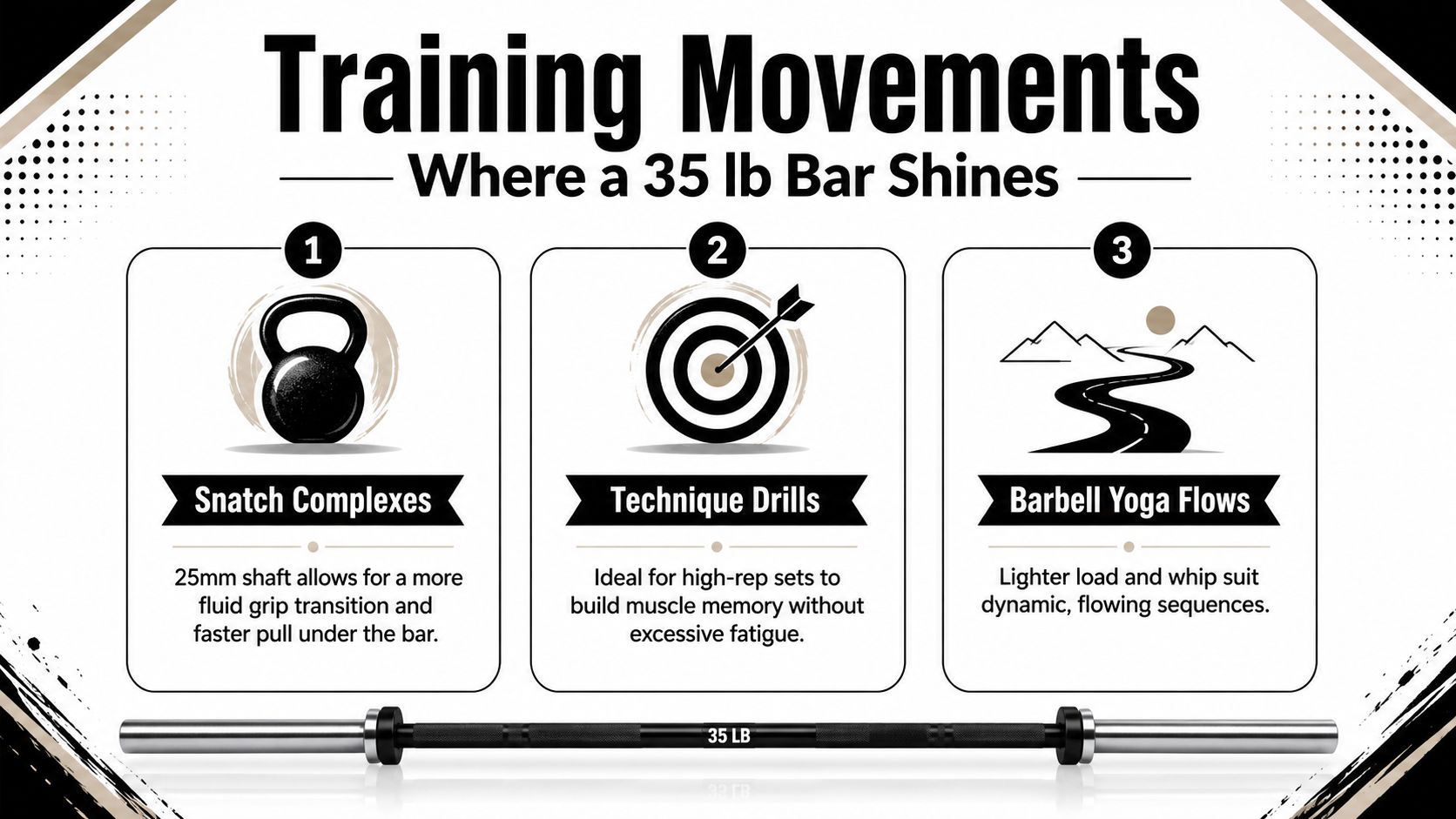
Training Movements Where a 35 lb Bar Shines
The 35 lb bar earns its place when the unloaded weight and slimmer shaft improve repetition quality. Start with Olympic lift technique. In a snatch complex, the 25 mm shaft can make the transition from the pull into the turnover feel less crowded in smaller hands. In clean work, the lighter starting load lets you focus on keeping the bar close, finishing the pull, and receiving with control.
Where it earns repeated use
- Snatch and clean complexes: Combine positions and pulls without making every repetition a test of strength.
- Overhead press and push press: The lower starting load helps you practice a stable rack, a vertical bar path, and a controlled lockout.
- Rows and Romanian deadlifts: The slimmer shaft changes hand contact and can make grip-focused accessory work more deliberate.
- Tempo squats and pauses: Slower reps expose position errors, while a lighter bar leaves more room to preserve technique.
- Landmine presses and light accessory work: The bar provides a manageable implement for angled pressing and posterior-chain training.
The bar also suits dynamic sequences and flowing drills when you want the implement to move easily between positions. Coaches planning varied sessions can use a drag-and-drop workout builder for coaches to organize complexes, technique work, and accessory blocks without losing track of the bar assigned to each movement.
The limitation appears when your technique requires very wide grip spacing or substantial bumper loading. A shorter loadable sleeve may restrict the number of thick plates you can fit before the plates crowd the collars. Check the specific bar's sleeve length before programming heavy pulls or high-volume work with wide plates.
Limitations and Compatibility Issues to Plan Around
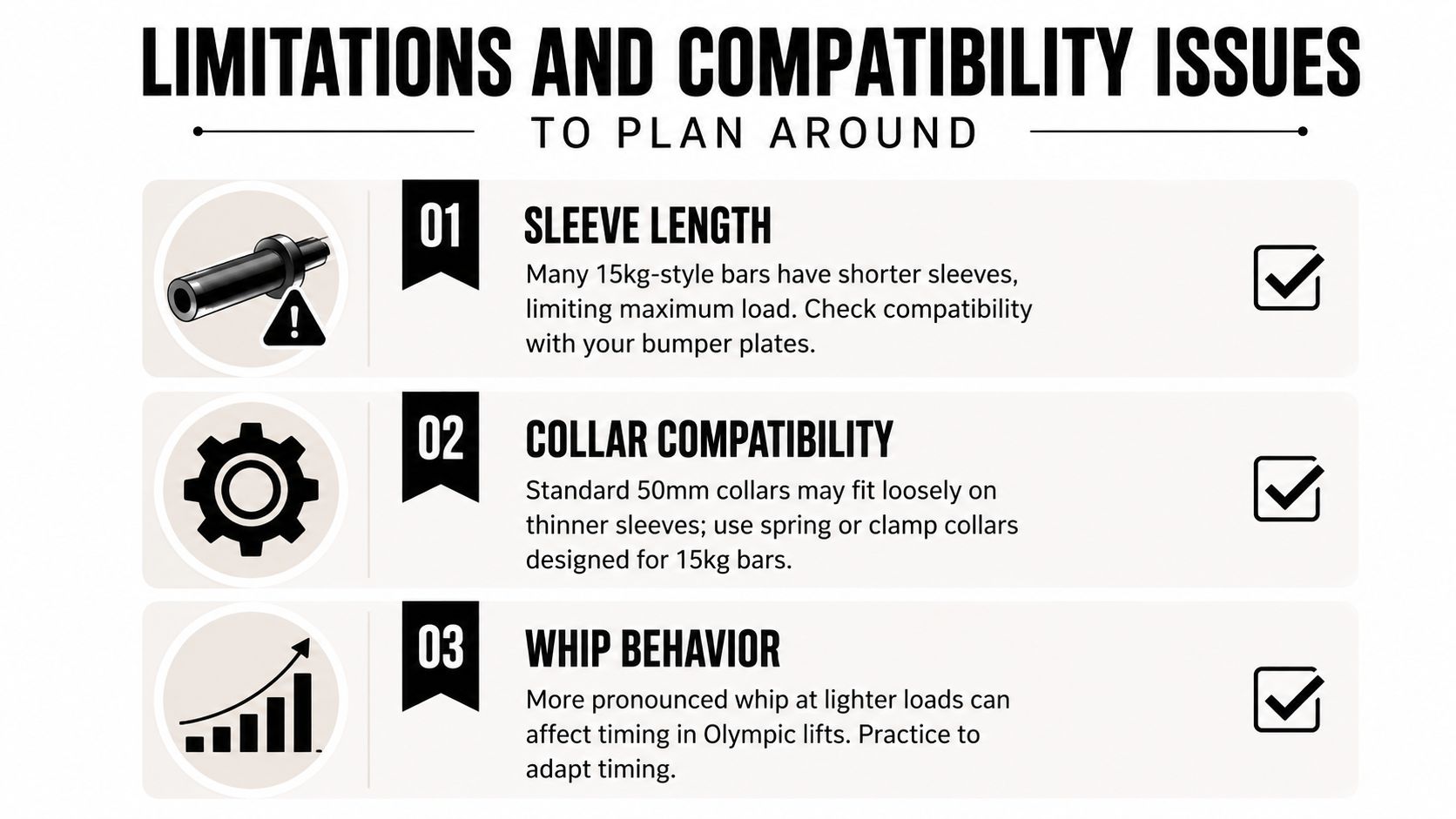
A 35 lb bar can solve a training problem while creating an equipment mismatch. Before choosing it, compare the bar with your plates, rack, collars, storage, and load-tracking habits. It is a decision, not a specialized label to collect.
The first check is sleeve capacity. Many 15 kg-style bars have shorter sleeves than 20 kg men's bars, so thick bumper plates can fill the available space quickly. This matters during deadlifts, pulls, or squats. The shaft may handle the session, yet the sleeves may not hold enough of the plates already in your gym. A 45 lb bar often gives you more loading room, while a 33 lb bar may offer a closer middle ground. Smaller, sub-25 lb bars can reduce starting load further, but they may create different rack and plate-compatibility questions.
Check the entire setup
Test rack fit in person when possible. Older or budget racks may be arranged around seven-foot men's bars. A shorter bar can change the clearance around the J-cups, which affects unracking, re-racking, and hand placement. In a tight home gym, that difference can matter more than the bar's label.
Your plate inventory can create another source of friction. Kilogram bumpers and pound plates can work together, but switching between them makes load calculations harder. If several lifters use the bar, record whether the empty bar is logged as 15 kg or as a rounded 35 lb.
- Sleeves: Compare loadable sleeve length with your bumper plate thickness.
- Rack: Place the bar in the J-cups and check clearance before heavy squats or presses.
- Collars: Confirm that your collars clamp securely on the sleeve diameter.
- Storage: Measure the wall-mounted or vertical position, especially if this bar is shorter than your men's bar.
- Programming: Record the actual bar used so a change mid-block does not distort load tracking.
Collar diameter and sleeve shape also affect how plates sit and how the loaded bar feels on a bench or squat pad. Keep the finish and moving parts clean with this barbell cleaning guide, especially after sweat or residue builds up.
Buying, Setting Up, and Training with Your Bar
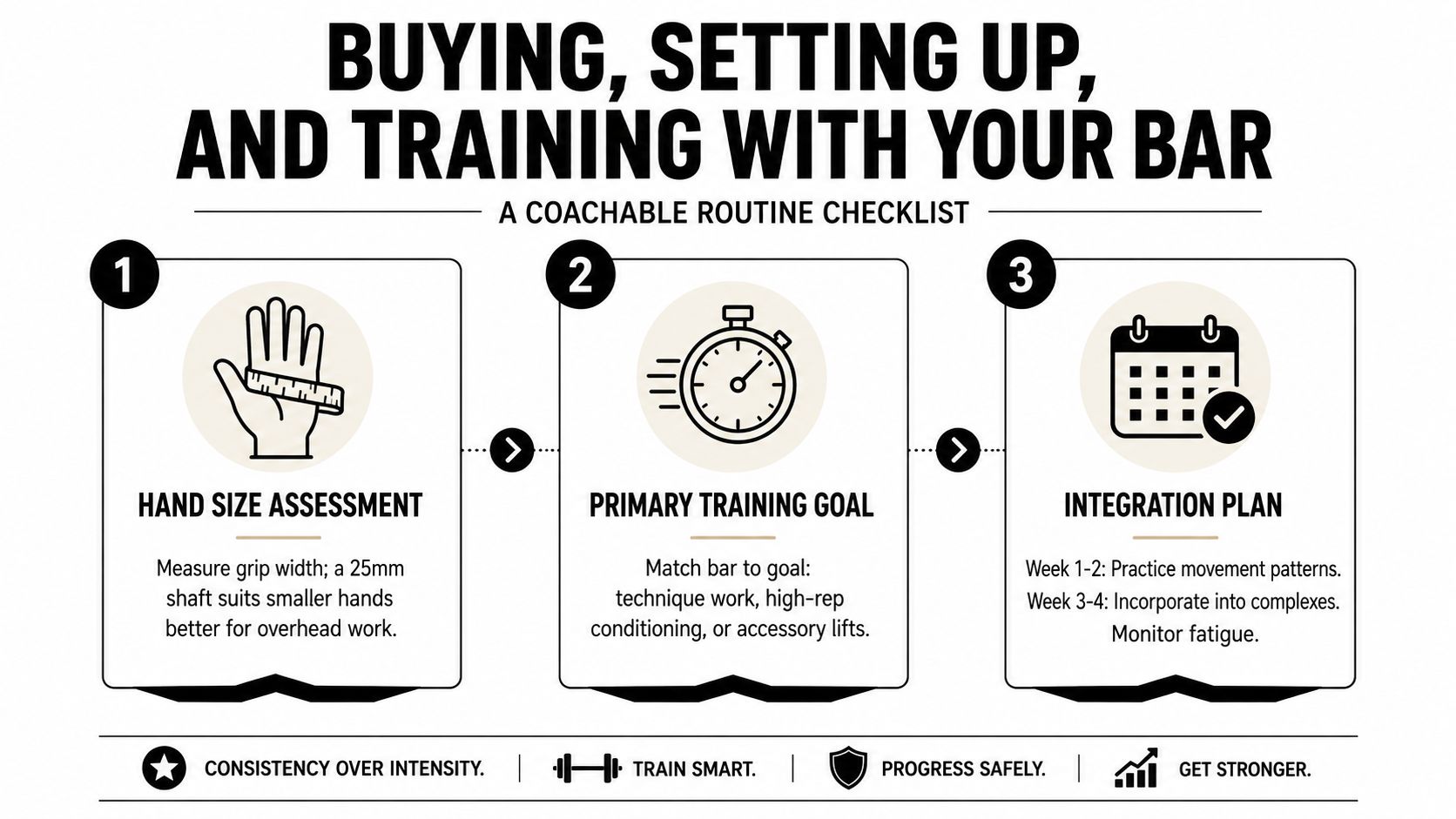
Start with four questions: Do your hands benefit from a 25 mm shaft? What lifts will dominate your training? Which plates do you already own? Where will the bar live? Those answers narrow the field faster than browsing finish colors.
Inspect the bar before you buy or immediately after unboxing it. Spin each sleeve and listen for roughness. Run your fingers across the knurl to check whether it offers enough grip without feeling unnecessarily aggressive. Confirm whether there's center knurling, verify the stated tensile strength, and check that the shaft is straight. For Olympic lifts, sleeve rotation and consistent markings deserve more attention than appearance.
A simple setup routine
Use a small chalk block or a liquid chalk option if sweat interferes with your grip. Official weightlifting rules permit chalk and explicitly identify magnesium carbonate as the allowed chalk material (British Weight Lifting technical rules). Some strength-sport rules are even more restrictive, allowing chalk as the only gripping aid (Southern Squeeze rules).
Add a reliable pair of spring or lockjaw collars, then keep a microfibre towel nearby for sweat. EVMT Liquid Chalk is one clean, gym-approved grip option. It dries quickly and forms a sweat-resistant layer for barbell, climbing, gymnastics, and other grip-intensive training, without the loose dust associated with traditional powder chalk.
Use the first training block to learn the bar's timing rather than chase heavy numbers. A practical two-week on-ramp can include technique drills, snatch or clean complexes, tempo squats, presses, rows, and light accessory work. Keep notes on hand comfort, sleeve rotation, rack clearance, and whether your plates fit as expected.
Wipe the shaft and knurl after sessions, inspect the sleeves periodically, and follow the manufacturer's maintenance guidance. Bronze bushings may need occasional oiling, while bearing systems require their own care instructions. If you're building a complete setup around pressing and bench work, compare the bar with your bench dimensions using this guide to a barbell for a weight bench.
The decision is straightforward once you stop treating “35 lb” as the whole product. Choose it when the 25 mm shaft, lower starting load, Olympic sleeve system, and technique-friendly feel match your body and your training. Before ordering, verify the exact weight, sleeve length, rack fit, plate compatibility, and maintenance requirements.
Evermost LLC offers Olympic-focused training equipment guidance alongside EVMT Liquid Chalk, a clean grip option for lifters who need dependable contact during technique work, high-repetition sets, and competition-style training. Visit Evermost LLC to choose a grip solution that fits your barbell setup and training environment.